


Fort Worth Home Health Care Provider Malpractice Lawyer
Written by: Hastings Law Firm | Reviewed by: Gabe Sassin | Updated: July 27, 2026
Home health care is meant to keep vulnerable patients safe, but negligence in the home can lead to serious injuries and life threatening consequences. Common problems involve medication mistakes, poor infection control, unsafe transfers, and neglect that allows preventable wounds to worsen. These cases are often hard to evaluate because care happens out of public view and documentation can be incomplete. Understanding how agencies and caregivers may share responsibility can help families make informed decisions after a preventable injury. If you or a loved one were harmed or worse due to home health care provider malpractice in Fort Worth, Texas, contact Hastings Law Firm for a free, confidential case review.
Trusted Fort Worth Medical Attorneys for Patients Injured by Home Healthcare
What You Should Know About In-Home Caregiver Negligence Claims in Fort Worth:
- Harm can worsen before it is discovered because home health care occurs behind closed doors with limited real time oversight.
- Severe pressure ulcers can signal preventable neglect when repositioning and skin assessment routines are not followed.
- Serious medication harm can result from incorrect dosing, missed administrations, or incompatible drugs in the home setting.
- Life threatening infection complications can follow when aseptic technique and wound care basics are not followed and early warning signs are missed.
- Financial responsibility may fall on the home health agency when the caregiver was acting as an employee within the scope of the job.
- Options can expand when agency level failures are involved, such as negligent hiring or inadequate supervision.
- Liability can be harder to sort out when a caregiver is labeled an independent contractor even if the agency controlled the work.
- The ability to pursue a claim can be lost if Texas medical liability procedural requirements are not met.
- Recovery can be limited for non economic harms in Texas even when the injury impact is substantial.
- Case proof can depend on non hospital documentation such as daily care logs, agency communications, and photographs.

A Healthcare Focused Law Firm
When someone you love is harmed by the very person sent to care for them at home, the sense of betrayal can be overwhelming. You trusted a home health care provider to follow proper protocols, including basics like aseptic technique, the clean and sterile practices required to prevent infection during wound care and other procedures. When that trust is broken and your family member suffers preventable harm, you deserve answers.
Hastings Law Firm represents patients and families across Fort Worth who have been injured by home health care negligence. As a Fort Worth home health care provider malpractice lawyer team that focuses exclusively on medical malpractice, we understand both the medical details and the emotional toll of these cases. If you suspect a caregiver’s error caused harm, contact us for a free, confidential case evaluation. We can review what happened and explain your options.
Common Types of Home Health Care Negligence in Fort Worth
Home health negligence occurs when a caregiver fails to meet the accepted standard of care, resulting in injuries such as pressure ulcers, medication overdoses, untreated infections, or falls due to lack of supervision. A standard of care represents the level of caution and expertise a professional must provide. Contact an attorney for home health negligence to investigate.
Because home health care happens behind closed doors, these injuries often go unnoticed until they become severe. A Fort Worth home health care provider malpractice lawyer investigates these patterns to determine whether the harm was preventable.
Medication Errors
Medication mistakes are among the most common forms of nursing negligence in home health settings. These can include giving an incorrect dosage, mixing incompatible drugs, or failing to administer time-sensitive medications for heart conditions or seizure disorders. Providers must track these in the Medication Administration Record (MAR), which we review for errors. A home health care attorney can evaluate these mistakes.
Physical Neglect and Bedsores
Immobile patients depend entirely on their caregivers to reposition them on a regular schedule. They must follow a repositioning or turning protocol, the scheduled routine designed to prevent prolonged pressure on any one area of the body. When a caregiver ignores this protocol, the patient can develop pressure ulcers, commonly called bedsores.
These wounds are classified by severity: a Stage III pressure ulcer extends into the fat tissue beneath the skin, while a Stage IV ulcer can expose muscle or bone. This is a clear caregiver error. According to MedlinePlus, pressure sores require careful ongoing treatment, and advanced stages can become life-threatening. The presence of a Stage III or IV wound in a patient receiving regular home care is a strong indicator of failure to treat.
Falls and Transfer Injuries
Falls frequently happen during transfers, such as moving a patient from bed to a wheelchair. Some transfers require two aides for safety. When a single caregiver attempts a two-person job, the risk of dropping or injuring the patient increases significantly. A Fort Worth home health lawyer will review staffing logs and care plans to determine whether the agency sent adequate help.
Infection Control Failures
Post-surgical patients receiving wound care at home are especially vulnerable to infection. Failure to change dressings on schedule, use sterile supplies, or recognize early warning signs of sepsis can turn a manageable recovery into a medical crisis. If a caregiver neglected basic infection control and the patient developed a serious complication, that negligence by a provider may form the basis of a malpractice claim.
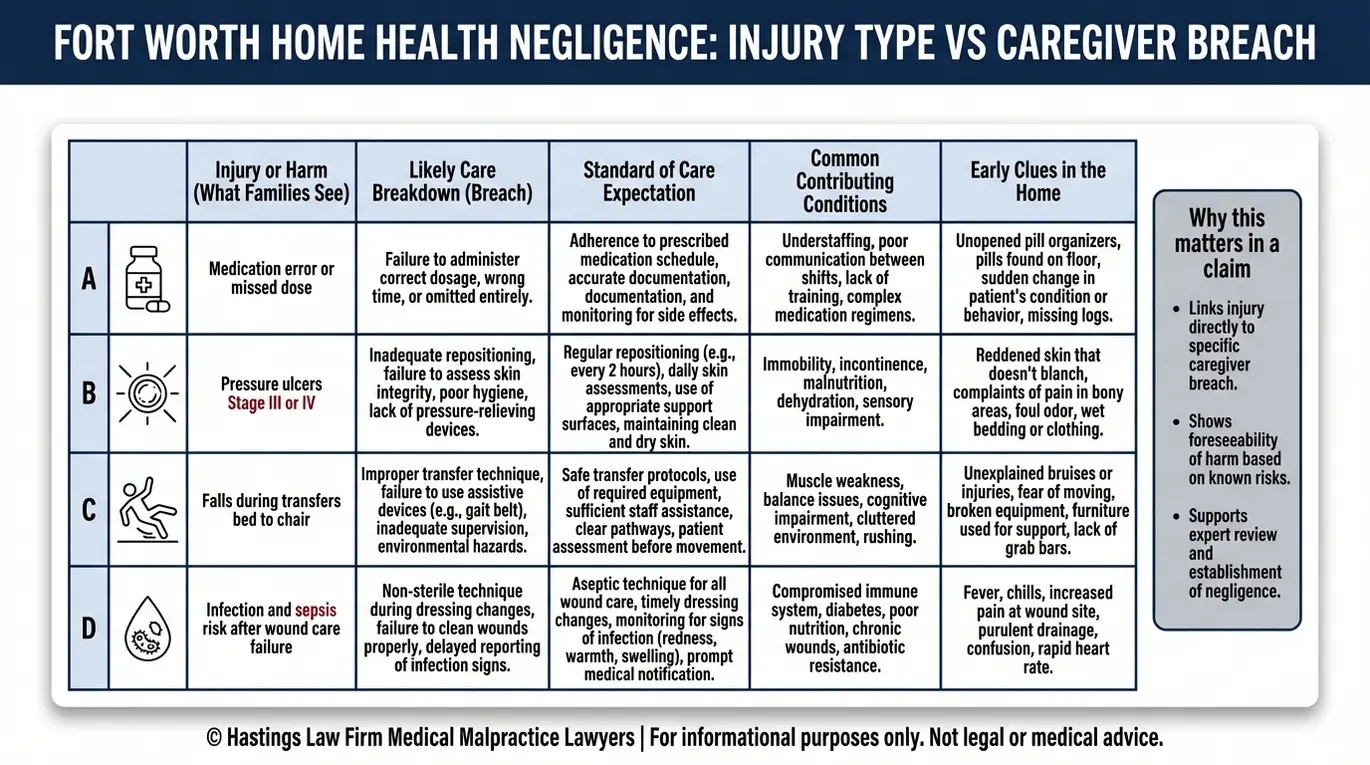
The following table outlines common injury types and the caregiver errors a medical malpractice lawyer typically investigates:
| Injury Type | Associated Caregiver Negligence |
|---|---|
| Stage III/IV Pressure Ulcers | Failure to follow repositioning schedule; lack of skin assessments |
| Medication Overdose or Missed Dose | Incorrect dosage, skipped administrations, drug interactions ignored |
| Falls During Transfers | Single aide performing a two-person transfer; no fall risk assessment |
| Post-Surgical Infection / Sepsis | Failure to change dressings, recognize infection signs, or use aseptic technique |
| Malnutrition or Dehydration | Failure to monitor intake, prepare meals, or report changes in appetite |
Identifying Liability: Suing the Agency vs. Independent Caregivers
While individual caregivers can be sued, the home health agency is often liable for the actions of its employees under the doctrine of *respondeat superior*, or for its own negligence in hiring, training, or supervising staff. This legal doctrine means an employer is responsible for the actions an employee takes within the scope of their job. Liability determines which party is legally responsible for paying damages to the patient. For many families working with a Fort Worth home health lawyer, this means the agency, not just the individual aide, bears financial responsibility. Experienced medical malpractice counsel can guide you.
Agency Liability and Negligent Hiring
A healthcare agency has a duty to conduct thorough background checks, verify professional credentials, and screen applicants for any history of abuse or disciplinary action. When an agency fails to meet hiring standards and places an unqualified or dangerous caregiver in your loved one’s home, the agency itself is directly liable for the harm that results. This is known as negligent hiring, and it is a separate claim from the caregiver’s own negligence. An agency liability lawyer can help identify this breach.
Failure to Supervise
Texas regulations require that home health agencies arrange for registered nurse (RN) supervisory visits, periodic check-ins by a licensed RN to evaluate the patient’s condition and oversee the aide’s performance. When an agency fails to schedule these visits, problems with care can go undetected for weeks. A home health negligence attorney will examine whether the agency followed its own home health plan of care (POC), the individualized care plan that outlines the specific services, schedules, and goals for each patient.
Independent Contractor vs. Employee
Suing a provider becomes more complex when the caregiver is classified as an independent contractor rather than a direct employee. Agencies sometimes use this classification to shield themselves from suing a provider. If the agency controlled the caregiver’s schedule, training, and methods of care, a court may still treat the relationship as employment for liability purposes.
Here are the key questions a provider malpractice attorney evaluates when determining agency liability:
- Did the agency verify the caregiver’s license and credentials before placement?
- Were background checks and abuse registry screenings completed?
- Did the agency provide adequate training for the patient’s specific needs?
- Were required RN supervisory visits conducted on schedule?
- Did the agency respond appropriately to complaints or reported changes in the patient’s condition?
- Is the caregiver classified as an employee or independent contractor, and does the actual work arrangement match that classification?
The Hastings Law Firm Difference
Results matter, but what truly sets us apart is how we achieve them. Every verdict, every settlement, and every Fort Worth courtroom victory comes from one guiding promise: To treat each client’s fight for justice as if it were our own.
This balance of skill, experience, and empathy reflects our core philosophy that justice should not only compensate the injured, but also make healthcare safer nationwide.

Proving Negligence Without Hospital Records
Proving negligence in a home setting requires assembling a puzzle from daily care logs, agency communication records, witness statements, and expert testimony to establish that the care fell below the standard expected of a prudent provider. Because home care lacks the constant monitoring of a hospital, medical documentation is the primary way to track the quality of care. There are no electronic monitoring systems, no nursing station logs updated in real time, and often no witnesses beyond the patient and caregiver. This documentation gap is one of the biggest challenges families face, and it is why working with a malpractice lawyer in Fort Worth who understands home health cases matters. A Fort Worth medical liability lawyer knows how to bridge this gap.
Despite these obstacles, strong evidence does exist. It just takes experience to know where to look when proving provider negligence.
The Evidence We Gather
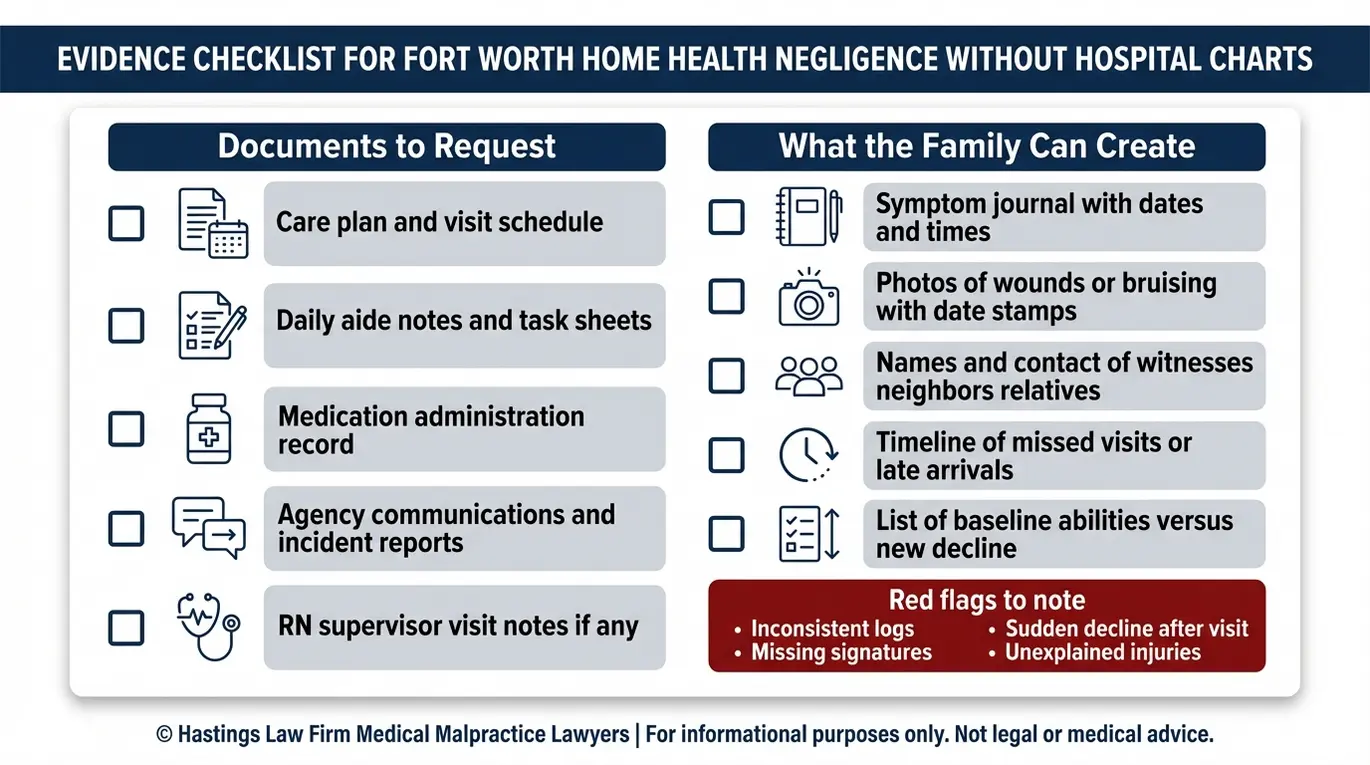
When building a case, a home health negligence lawyer collects and analyzes the following types of documentation:
- Daily care logs and visit notes completed by the aide or nurse after each session
- Medication administration records (MARs), the written logs showing what medications were given, at what time, and at what dose
- Medication reconciliation documents, the records tracking whether the patient’s prescribed medications were accurately maintained across providers and visits
- Agency communication records, including emails, call logs, and internal reports between staff and supervisors
- Photographs of the patient’s condition, especially wounds, bruising, or living environment
- Witness statements from family members, neighbors, or other caregivers who observed changes in the patient
- Hospital or urgent care records from any emergency treatment that followed the home care failure. This assists in suing for home health errors.
Why Family Journals Matter
If your loved one is currently receiving home health care and you suspect something is wrong, start keeping a detailed symptom journal. Write down dates, times, observations about your family member’s condition, and any concerns you raised with the caregiver or agency. This record can become critical evidence that a Fort Worth home health care provider malpractice lawyer uses to build a timeline of decline. An attorney for home care abuse uses these logs to substantiate claims.
Expert Reconstruction
Medical experts play an essential role in connecting the evidence to the standard of care. For example, a wound care specialist can examine photographs and medical records to determine whether a pressure ulcer progressed in a way that could only result from a breach of duty in the caregiver’s practice. Our team works with qualified experts who assist your lawyer for caregiver negligence in reconstructing the injury timeline based on physical evidence, filling in the gaps that missing records leave behind.
Texas Chapter 74: Expert Reports and Procedural Requirements
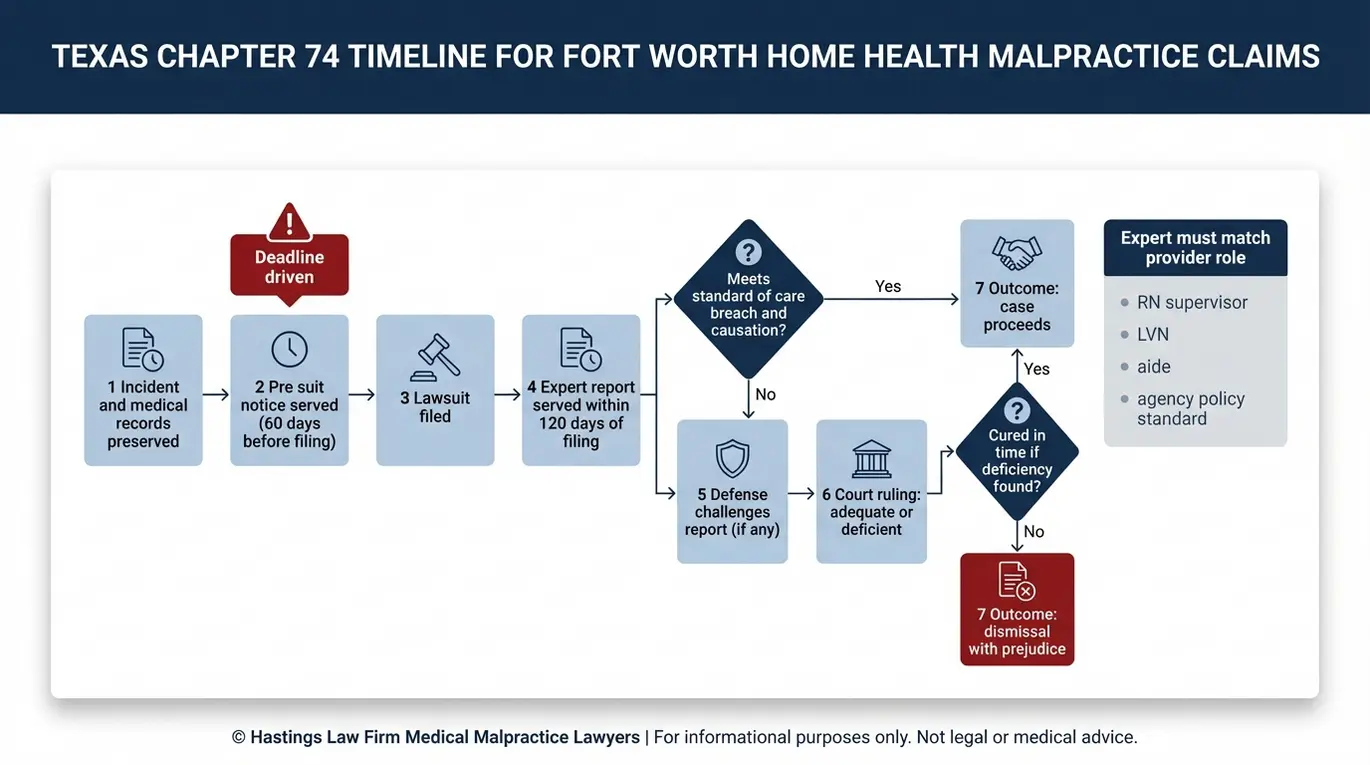
Texas law (Chapter 74) mandates that a valid medical expert report detailing the standard of care, the breach, and causation must be served within 120 days after the date each defendant’s original answer is filed, or the case will be dismissed with prejudice. This statute governs all medical liability claims in the state. Meeting this requirement is essential to keeping your case active. A home health litigation attorney ensures these deadlines are met.
The 120-Day Expert Report Deadline
According to Texas Civil Practice and Remedies Code § 74.351, the expert report must identify the applicable standard of care, explain how the provider breached that standard, and establish how the breach caused the patient’s injury. This is not a formality. Courts regularly dismiss cases where the report is late, incomplete, or authored by an unqualified expert. For a medical malpractice attorney handling a Fort Worth home health case, meeting this deadline is a top priority from the first day a case is accepted. For a home health litigation attorney, this is critical.
Pre-Suit Notice Requirements
Before a lawsuit can even be filed, Texas Civil Practice and Remedies Code § 74.051 requires that a written notice of claim be sent to each defendant at least 60 days before the suit is initiated. This notice triggers a statutory pause that can affect the overall timeline, making early legal consultation critical. Understanding Fort Worth legal requirements is essential.
Matching Expert Credentials
Texas courts also require that the expert who authors the report hold credentials relevant to the type of care at issue. A general physician may not be qualified to testify about the specific duties of a home health nurse or aide. A Fort Worth home health care provider malpractice lawyer must identify and retain an expert whose background matches the provider being challenged. Texas malpractice counsel ensures this match.
Exceptions to the Statute of Limitations for Minors and Incapacitated Patients
Texas generally imposes a two-year statute of limitations on medical malpractice claims. Exceptions exist for patients who are minors or who are legally incapacitated at the time the negligence occurs. The discovery rule may apply if the injury was not immediately apparent, meaning the time limit begins when the injury is found rather than when the error occurred.
Because many home health patients are elderly or cognitively impaired, these minor exceptions and provisions for incapacity can be significant. A tolling provision is a legal rule that pauses the time limit for filing a claim. An experienced Fort Worth medical malpractice lawyer can evaluate whether a tolling provision applies to your family’s situation.
Recoverable Damages in Home Health Malpractice Cases
Victims of home health negligence in Texas can recover economic damages for medical bills and lost care costs, as well as non-economic damages for pain, suffering, and physical impairment, subject to state caps. Understanding what compensation may be available helps families plan for the long road ahead. A home health damages attorney can help calculate these costs.
Economic Damages
Economic damages cover the measurable financial losses caused by the malpractice. These include:
- Past and future medical bills related to treating the injury
- Cost of corrective or replacement home care
- Lost wages or lost earning capacity, if the patient was employed
- Out-of-pocket expenses for medical equipment, transportation, or household help
There is no statutory cap on economic damages in Texas medical malpractice cases, which allows for full recovery for caregiver negligence regarding bills. In severe cases involving long-term injury, we may work with life care planners to project the cost of medical needs for the remainder of the patient’s life, adjusting for medical inflation to ensure the settlement lasts.
Non-Economic Damages
Non-economic damages account for harm that cannot be assigned a simple dollar figure. These include pain and suffering, physical impairment, disfigurement, and loss of enjoyment of life. Under Texas law, non-economic damages are capped at $250,000 per claimant against individual physicians or health care providers, with separate caps applying to health care institutions. A Fort Worth home care injury lawyer will structure the case to identify all responsible parties so the full range of compensation for malpractice is pursued. We specifically document how the injury reduced the patient’s quality of life, focusing on their inability to interact with family or participate in daily activities.
Wrongful Death Claims
If a loved one passed away as a result of home health negligence, surviving family members may bring a wrongful death claim. These cases can recover damages for loss of companionship, mental anguish, lost financial support, and funeral expenses. Statutory beneficiaries such as spouses, children, and parents are typically the eligible parties. A Fort Worth home health care provider malpractice lawyer can help your family understand which claims apply and who is eligible to file. A Fort Worth injury attorney can help you understand inheritance rules for these complex claims.
Why Choose Hastings Law Firm for Your Case
We operate on a contingency fee basis, meaning you pay nothing unless we win, and our board-certified leadership ensures you have elite representation against aggressive home health insurance carriers. There is no financial risk to your family for hiring a malpractice lawyer to investigate what happened. This no win no fee structure ensures access to justice.
Hastings Law Firm is not a general personal injury practice. We handle medical malpractice cases exclusively. As a dedicated Fort Worth medical negligence firm, our team includes former defense attorneys who previously worked for the systems they now challenge, giving us insight into their tactics. This medical-legal approach allows us to review your loved one’s medical records with clinical precision and prepare your case for trial from the very beginning.
We understand the betrayal families feel when a home health care provider causes harm instead of healing. We provide home health advocacy for the vulnerable. Many of our clients come to us not just seeking a settlement, but wanting to know the truth about what happened and wanting to prevent it from happening to someone else.
That mission drives every case we take. Under the leadership of Tommy Hastings, who is board-certified in Personal Injury Trial Law by the Texas Board of Legal Specialization, our firm works hard to be the best Fort Worth attorney choice for your needs. We are proud of our history of securing substantial recoveries that help families move forward with dignity and financial security.
Contact the Fort Worth Healthcare Malpractice Attorneys at Hastings Law Firm Today for Help
If your loved one suffered injury or worsening health under the care of a home health provider, you do not have to accept vague explanations or unanswered questions. The medical-legal team at Hastings Law Firm is ready to review your family member’s records, identify what went wrong, and hold the responsible parties accountable.
Time matters in Texas malpractice cases. Strict filing deadlines and expert report requirements mean that early investigation can make the difference between a strong case and a missed opportunity. We are committed to helping your family find the truth and secure the financial stability your loved one needs going forward.
Contact Hastings Law Firm today for a free, confidential case evaluation. You pay nothing unless we win.
Frequently Asked Questions About Home Health Care Provider Malpractice in Fort Worth


This content was researched and written by the Hastings Law Firm editorial team, which includes attorneys, medical professionals, and experienced researchers. Our writing is informed by internal knowledge and practical experience, and we cross-check critical details against authoritative sources cited throughout. Every piece undergoes human-led fact-checking and legal review. Because legal and medical information can change, if you spot an error, please contact us. Learn more about our content standards and review process on our editorial policy page.

Gabe Sassin has focused exclusively on medical malpractice law since 2007. After spending more than a decade as a malpractice defense attorney, he knows exactly how the other side works. He has seen firsthand how healthcare providers, insurers, corporate defendants, and their legal teams think, prepare, and build their defense against claims. That knowledge works for the people who need it most today, injured patients and their families. His unique experience shapes everything he writes, giving readers a look at how these cases actually work from someone who has handled them from both sides.
