


Houston Fetal Monitoring Error Lawyer
A fetal monitoring error during labor can leave a family facing lifelong medical needs and deep uncertainty about what went wrong. Electronic fetal monitoring is meant to detect signs of oxygen deprivation early so the care team can respond quickly and prevent permanent harm. When staff misread strips, fail to escalate concerns, or delay an emergency delivery, the consequences can be severe for a child and overwhelming for parents. If your child suffered harm or worse due to fetal monitoring errors in Houston, Texas, contact Hastings Law Firm for a free, confidential case review.
Last Updated: July 27, 2026
Trusted Medical Attorneys for Birth Negligence Claims in Houston
When your child suffers a preventable birth injury, the weight of that experience can feel impossible to carry. You trusted your medical team to protect your baby during labor and delivery, and now you are left with questions, worry, and the sense that something went wrong. You deserve clear answers about what happened and whether medical negligence played a role.
At Hastings Law Firm, founded in 2005, we focus exclusively on medical malpractice. Our team of attorneys, nurse consultants, and Board Certified Patient Advocates understands the medical details behind fetal monitoring failures and the lasting impact they have on families. As a dedicated Houston fetal monitoring error lawyer team, we are prepared to investigate your case, identify where the standard of care was broken, and pursue the accountability your family deserves.
If you believe a monitoring error harmed your child, contact us for a free, confidential case evaluation. We can review what happened and explain your options.

The Critical Role of Electronic Fetal Monitoring During Labor
Electronic fetal monitoring (EFM), the standard medical procedure used during labor to continuously track a baby’s heart rate alongside the mother’s contractions, exists to provide early warning signs of oxygen deprivation or distress. This electronic fetal monitoring technology allows the medical team to observe the baby’s health in real-time.
There are two primary methods. External monitoring uses sensors placed on the mother’s abdomen to detect the fetal heart rate and uterine activity from outside the body. Internal fetal monitoring, which involves a fetal scalp electrode attached directly to the baby’s head and sometimes an intrauterine pressure catheter, provides more precise data and is often used when external readings are unclear or when closer surveillance is needed.
The value of EFM lies in its ability to signal problems early. Early detection allows for timely interventions that can prevent lifelong injury. According to research indexed through the National Library of Medicine (PubMed), continuous heart rate monitoring is widely used during labor to assess fetal well-being. This technology helps detect patterns that may indicate the baby is not tolerating labor well.
When those patterns are recognized and acted on promptly, the medical team can move to emergency delivery, often a cesarean section, to prevent brain injury. When a fetal monitoring error lawyer in Houston reviews a birth injury case, the question is almost always whether those warning signs were caught and whether the response came fast enough. This response time is part of the standard of care, which is the level of care a competent medical professional should provide.
Recognizing Signs of Fetal Distress on Medical Strips
Common signs of fetal distress visible on monitoring strips include tachycardia (an abnormally fast heart rate), bradycardia (an abnormally slow heart rate), and late decelerations, gradual drops in the baby’s heart rate that begin at or after the peak of a contraction and suggest uteroplacental insufficiency. Trained staff should recognize these signals and respond without delay.
These warning patterns appear in clinical guidelines, such as those from the American College of Obstetricians and Gynecologists’ Intrapartum Fetal Heart Rate Monitoring guidelines published through Washington University School of Medicine. Key indicators of concern include:
- Tachycardia: A sustained fetal heart rate above 160 beats per minute, which can signal infection or developing oxygen deprivation.
- Bradycardia: A heart rate below 110 beats per minute, potentially indicating cord compression, other acute problems, or even the risk of stillbirth.
- Variable or late decelerations: Sudden or delayed drops in heart rate relative to contractions, both of which may point to worsening hypoxia.
- Loss of baseline variability: The heart rate line becomes flat, with little fluctuation. Baseline variability, the normal small fluctuations in fetal heart rate, reflects a healthy nervous system. When it disappears, it can indicate the baby’s brain is under significant stress.
A Houston fetal monitoring error attorney examines these fetal heart rate strips closely, working alongside medical experts to determine whether the clinical team should have recognized fetal distress and acted sooner.

The Hastings Law Firm Difference
Results matter, but what truly sets us apart is how we achieve them. Every verdict, every settlement, and every Houston courtroom victory comes from one guiding promise: To treat each client’s fight for justice as if it were our own.
This balance of skill, experience, and empathy reflects our core philosophy that justice should not only compensate the injured, but also make health care safer nationwide.

Common Types of Fetal Monitoring Negligence
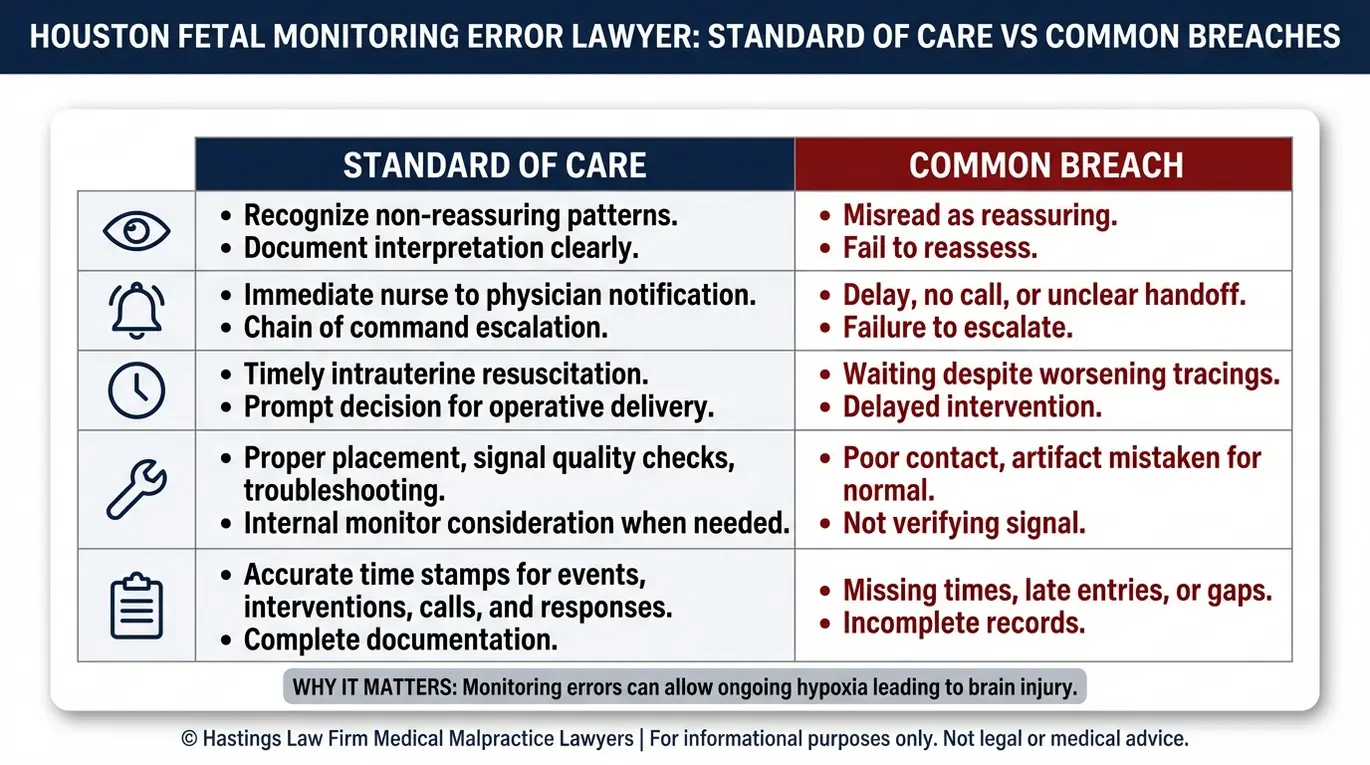
Medical negligence occurs when medical staff fail to properly attach monitors, misinterpret the data on the strips, or delay a necessary emergency cesarean section despite clear evidence of fetal distress. These errors can take several forms, and each one represents a breakdown in the standard of care.
A non-reassuring fetal heart rate tracing, a strip pattern that suggests the baby may not be tolerating labor well, requires immediate attention and a defined clinical response. Once a non-reassuring pattern is identified, the standard of care dictates specific interventions, such as intrauterine resuscitation or expediting delivery. Failure to execute these steps allows healthcare providers to avoid accountability while the fetus suffers.
| Type of Failure | What Should Happen | What May Go Wrong |
|---|---|---|
| Failure to interpret | Staff should classify strip patterns accurately (reassuring vs. non-reassuring) | The strip is misread as normal when warning signs are present |
| Failure to escalate | Nurses who identify distress should immediately notify the attending obstetrician | Distress is noted in charting but the physician is not alerted in time |
| Delayed cesarean section | Once distress is confirmed, delivery should follow within the expected decision-to-incision time, the interval between the decision to operate and the start of surgery | The doctor waits too long to order or begin the procedure |
| Equipment misuse | Monitors should be correctly placed and regularly checked for accurate readings | Sensors are improperly positioned or equipment malfunctions go unnoticed |
Fetal monitoring malpractice lawyers investigate each of these failure points by reconstructing the timeline from medical records, nursing notes, and the monitoring strips themselves. We scrutinize the actions of healthcare providers to see if protocols were followed. The goal is to determine exactly where the breakdown occurred and whether it directly contributed to the injury.
Devastating Injuries Caused by Oxygen Deprivation
Prolonged oxygen deprivation caused by monitoring failures can lead to permanent disabilities, including cerebral palsy, hypoxic ischemic encephalopathy (HIE), seizure disorders, and cognitive impairments. These are not minor setbacks. They can reshape a child’s entire life and place extraordinary demands on a family.
The mechanism is direct. When fetal distress goes unrecognized or unaddressed, the baby’s brain may be deprived of adequate oxygen, a condition called hypoxia. A hypoxic-ischemic brain injury occurs when this oxygen deprivation is severe enough to cause permanent damage. According to the Centers for Disease Control and Prevention’s data on cerebral palsy, cerebral palsy is one of the most common motor disabilities in childhood, and some cases are directly linked to a preventable birth injury.
The long-term reality for affected families often includes future medical care, lifelong nursing care, ongoing physical and occupational therapy, specialized education, and adaptive equipment. The financial burden alone can reach into the millions over a child’s lifetime. As a Houston fetal monitoring error lawyer, we also understand that no dollar amount captures the emotional toll: the lost milestones, the constant caregiving, and the grief of knowing it may have been preventable. That is why our investigation focuses not just on what happened, but on securing the resources your child will need for the road ahead.
Establishing Liability and the Standard of Care
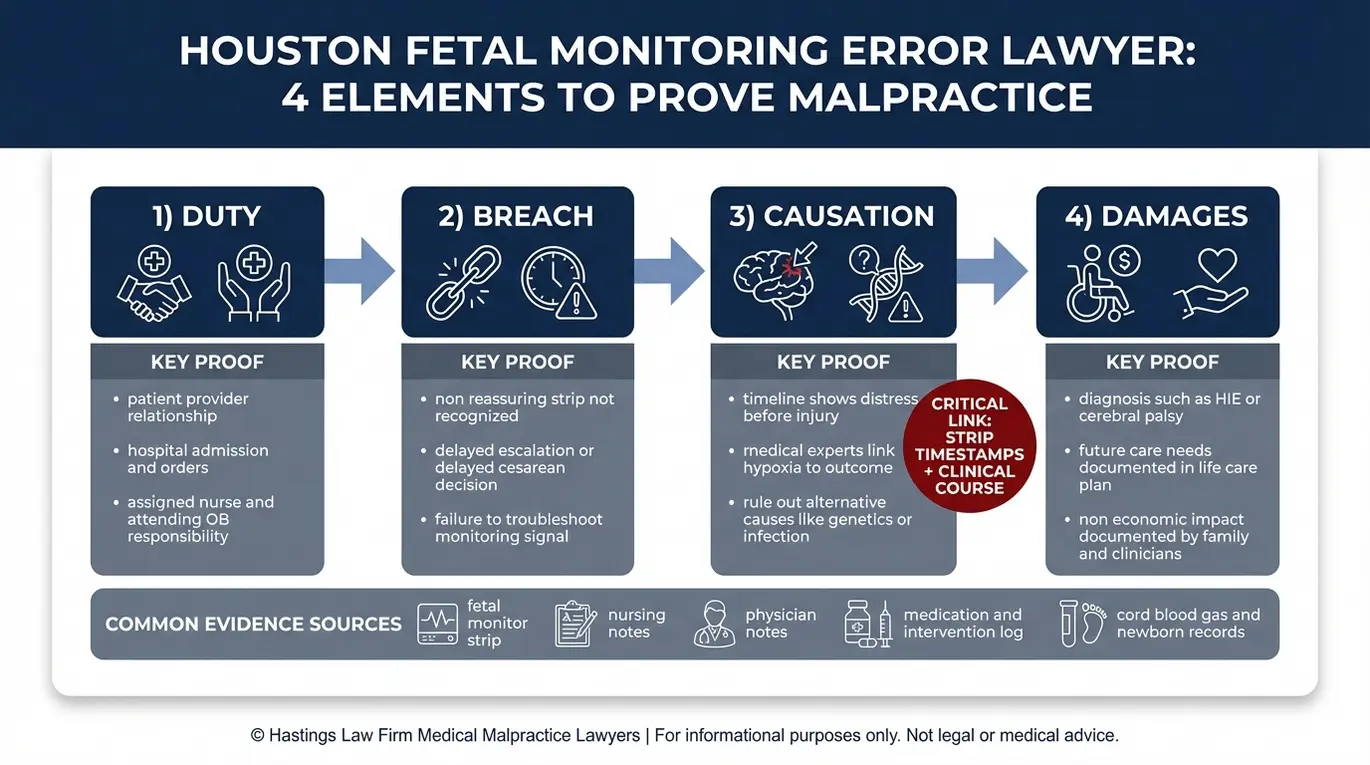
To prove malpractice, a plaintiff must demonstrate that a competent medical professional in the same situation would have recognized the distress signals and intervened sooner to prevent the injury. This requires establishing four connected legal elements, each supported by specific evidence.
According to clinical literature available through the NCBI Bookshelf on fetal monitoring, accepted medical standards exist for how healthcare teams should monitor, interpret, and respond to fetal heart rate data. A Houston fetal monitoring error lawyer uses these standards as the benchmark for evaluating whether the care your child received fell short.
The evidence we examine typically includes:
- Duty: Confirming the medical team owed a duty of care via a doctor-patient or nurse-patient relationship during labor and delivery
- Breach: Identifying the specific failure, whether it was misreading the strip, delaying notification, or postponing delivery in violation of accepted protocols
- Causation: Linking the delay or error directly to the brain injury through expert analysis, while ruling out alternative causes such as genetic conditions
- Damages: Documenting the full extent of harm, including medical diagnoses, developmental assessments, and projected care needs
Our team reconstructs a minute-by-minute timeline using the electronic fetal monitoring strips, labor and delivery nursing logs, physician orders, and cord blood gas results to establish whether the standard of care was met.
Addressing Arguments Against Monitor Reliability
Fetal monitors track the baby’s heart rate to detect distress during labor. Defense attorneys frequently argue that fetal monitors have a high false-positive rate, meaning the strips may show concerning patterns even when the baby is not truly in danger. They also point to interobserver variability, the reality that different clinicians can interpret the same strip differently, to suggest that misreading a strip is reasonable rather than negligent.
We are familiar with these defense tactics. We use expert testimony from qualified medical professionals to establish what a competent provider should have seen in the medical records and on the strip. Their testimony is important to refute claims that the monitoring data was too ambiguous to warrant action. Medical experts explain how standard protocols apply even in complex situations. While no monitoring tool is perfect, the standard of care still requires clinicians to act on non-reassuring patterns, not dismiss them.
Calculating Damages for Lifelong Birth Injuries
Compensation in birth injury cases covers past and future medical expenses, loss of earning capacity for the child, pain and suffering, and the cost of lifelong care assistance. Because these injuries often affect a child for decades, the financial scope of a claim or settlement can be significant.
Damages generally fall into two categories:
- Economic damages: These include the cost of life care plans, future surgeries, adaptive equipment such as wheelchairs and communication devices, physical and occupational therapy, in-home nursing, and special education services. They also account for the child’s lost future earning capacity, often calculated as projected lost wages.
- Non-economic damages: These cover the child’s physical pain and suffering, mental anguish, and loss of enjoyment of life. Parents may also recover for their own emotional distress related to their child’s condition.
The goal for a lawyer for fetal monitoring errors is to build a damages case that accounts for the child’s needs across an entire lifetime, ensuring long-term financial security for the family.
Navigating the Cap on Damages in Texas
Texas law imposes specific limits on medical malpractice compensation. The Texas medical malpractice cap imposes a limit on non-economic damages in medical malpractice cases, limiting pain and suffering awards regardless of severity. However, economic damages, the actual costs of medical care, equipment, therapy, and lost earnings, are not capped.
Despite these limits, a skilled attorney focuses on documenting and maximizing uncapped economic damages through life care plans and financial projections. This ensures the compensation reflects the true cost of your child’s future needs and provides financial security. These plans detail the specific costs of a child’s needs over their lifetime.
Why Partner with Hastings Law Firm for Your Case
Hastings Law Firm offers a unique combination of board-certified legal expertise and in-house medical experience, ensuring that complex medical records are accurately analyzed to hold negligent hospitals accountable. Our team includes experienced attorneys, former defense counsel who understand hospital litigation tactics, and nurse consultants who previously worked for the healthcare systems we challenge.
Our founder, Tommy Hastings, is Board Certified in Personal Injury Trial Law, a distinction held by less than 2% of Texas attorneys. As a Houston fetal monitoring error lawyer team that is medical malpractice exclusive, we bring focused experience to every case we accept. We prepare from day one as though your case will go to trial, which strengthens our position whether the case resolves through settlement or before a jury.
We also understand that your family is going through something deeply difficult. Our mission is to restore trust and treat you as a partner, keeping you informed at every step. There is no financial risk to get started. We work on a contingency fee basis, operating on a no win no fee basis, meaning you pay no attorney fees or costs unless we secure a recovery for your family.
Contact the Houston Birth Injury Attorneys at Hastings Law Firm Today for Help
Fetal monitoring strips and other delivery room records are time-sensitive evidence. The sooner your case is evaluated, the better positioned we are to preserve the documentation that may prove what happened to your child.
If you suspect a monitoring failure contributed to your baby’s birth injury, we encourage you to reach out for a free case evaluation. Our team will review your medical records, explain whether you have a viable claim, and outline the path forward. You will speak with a specialized Houston fetal monitoring error lawyer who understands both the medicine and the law, and who will give you honest answers.
Call Hastings Law Firm or complete our online form to schedule your confidential case evaluation. You owe nothing unless we win, and your family deserves to know the truth.
Frequently Asked Questions About Fetal Monitoring Error in Houston


This content was researched and written by the Hastings Law Firm editorial team, which includes attorneys, medical professionals, and experienced researchers. Our writing is informed by internal knowledge and practical experience, and we cross-check critical details against authoritative sources cited throughout. Every piece undergoes human-led fact-checking and legal review. Because legal and medical information can change, if you spot an error, please contact us. Learn more about our content standards and review process on our editorial policy page.

Tommy Hastings, founder of Hastings Law Firm, is a board-certified personal injury trial lawyer dedicated exclusively to healthcare injury cases. Since 2001, he has represented injured patients and families in litigation against major hospital systems, pharmaceutical companies, and negligent healthcare providers nationwide. He has handled numerous high-profile cases that have drawn national media attention and resulted in multi-million dollar recoveries. He draws on that experience in his writing, helping readers understand how these cases work and what options may be available to them.
