


Houston Nursing Home Fall Lawyer
A nursing home fall can leave a family facing sudden injury, confusion, and a facility that offers few clear answers. Many falls are preventable when staff identify fall risks, follow an individualized care plan, maintain safe conditions, and provide timely supervision and assistance. When those safeguards break down, the consequences can be severe and sometimes life threatening. Clear documentation and reliable timelines often matter when determining what happened and why. If your loved one was harmed or worse due to nursing home fall negligence in Houston, Texas, contact Hastings Law Firm for a free, confidential case review.
Last Updated: July 27, 2026
Trusted Houston Injury Attorneys for Nursing Home Negligence Claims
When someone you love is injured in a fall at a nursing home, it can feel like the system meant to protect them failed at its most basic job. You may be dealing with a serious injury, unanswered questions, and a facility that provides limited information about what happened. That combination of fear and frustration is something we understand deeply.
At Hastings Law Firm, our team of attorneys, nurse consultants, and in-house medical professionals focuses exclusively on medical negligence cases, including falls caused by substandard care in Houston-area nursing facilities. As a Houston nursing home fall lawyer team, we know how to uncover the truth behind a preventable fall and hold the responsible parties accountable.
If your loved one was hurt in a nursing home fall, we can review what happened and explain your legal options at no cost and no obligation.

Why Falls Happen in Care Facilities and Determining Liability
A nursing home can be held liable for a resident’s fall when the facility fails to meet the standard of care required under Texas law, such as ignoring a known fall risk or neglecting to follow an individualized care plan. But not every fall in a care facility automatically means someone was negligent. The legal question centers on whether the facility knew, or should have known, about the risk and failed to act.
Upon admission, staff should perform a fall risk assessment, an evaluation conducted to identify residents at an elevated risk of falling due to mobility issues, medications, or cognitive decline. When a facility identifies that risk but does nothing to address it, the fall shifts from an unfortunate accident to potential negligence.
The Line Between Accident and Negligence
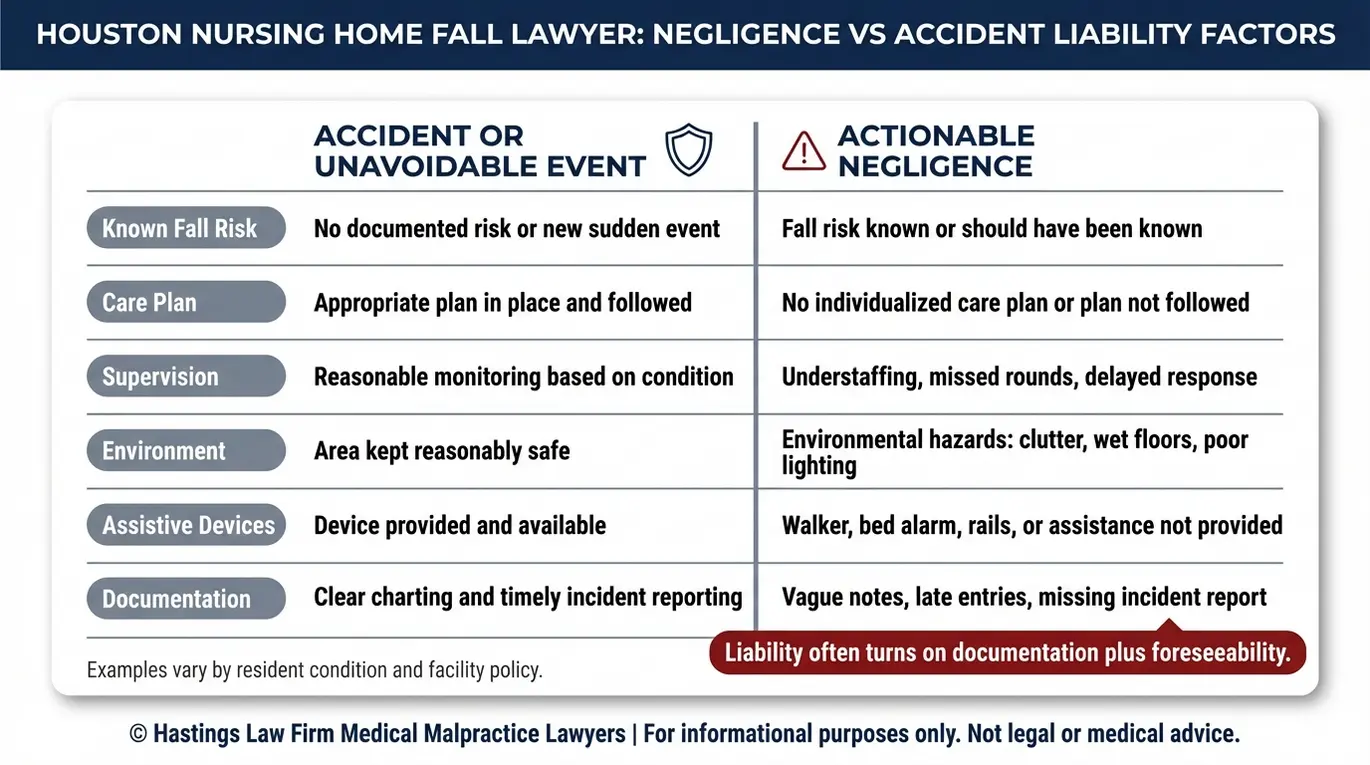
Understanding the difference between an unavoidable accident and actionable negligence is one of the first things a nursing home fall attorney evaluates. Here is a general comparison:
| Factor | Unavoidable Accident | Actionable Negligence |
|---|---|---|
| Fall risk identified | Risk was unknown despite proper screening | Risk was documented but no precautions taken |
| Staffing levels | Adequate staff present and responsive | Understaffing left resident unattended |
| Care plan | Individualized care plan followed | Care plan ignored or never created |
| Environment | Hazard appeared suddenly (e.g., unexpected spill) | Known environmental hazards left unaddressed (wet floors, poor lighting, broken equipment) |
| Response | Staff responded promptly after the fall | Fall went unnoticed for an extended period |
Environmental hazards, meaning physical conditions in the facility like loose handrails, cluttered hallways, or inadequate lighting, are among the most preventable causes of falls. When a facility allows these conditions to persist, it reflects a pattern of neglect rather than an isolated incident.
Understaffing as a Root Cause
Understaffing is one of the most common contributors to nursing home falls in Houston and across Texas. When a facility operates with low staffing levels relative to the number of residents, response times slow down, scheduled check-ins get missed, and high-risk residents may be left without assistance for transfers or walks. According to Older Adult Falls Data from the CDC, falls are the leading cause of injury among older adults, and adequate supervision is a key factor in prevention.
An individualized care plan is a personalized protocol designed around each resident’s medical conditions, mobility limitations, and daily needs. Lawyers for elderly falls examine whether the facility created and followed this plan, because its absence or neglect is often the clearest evidence that the duty of care was not met.
Common Injuries and the Role of Medical Evidence
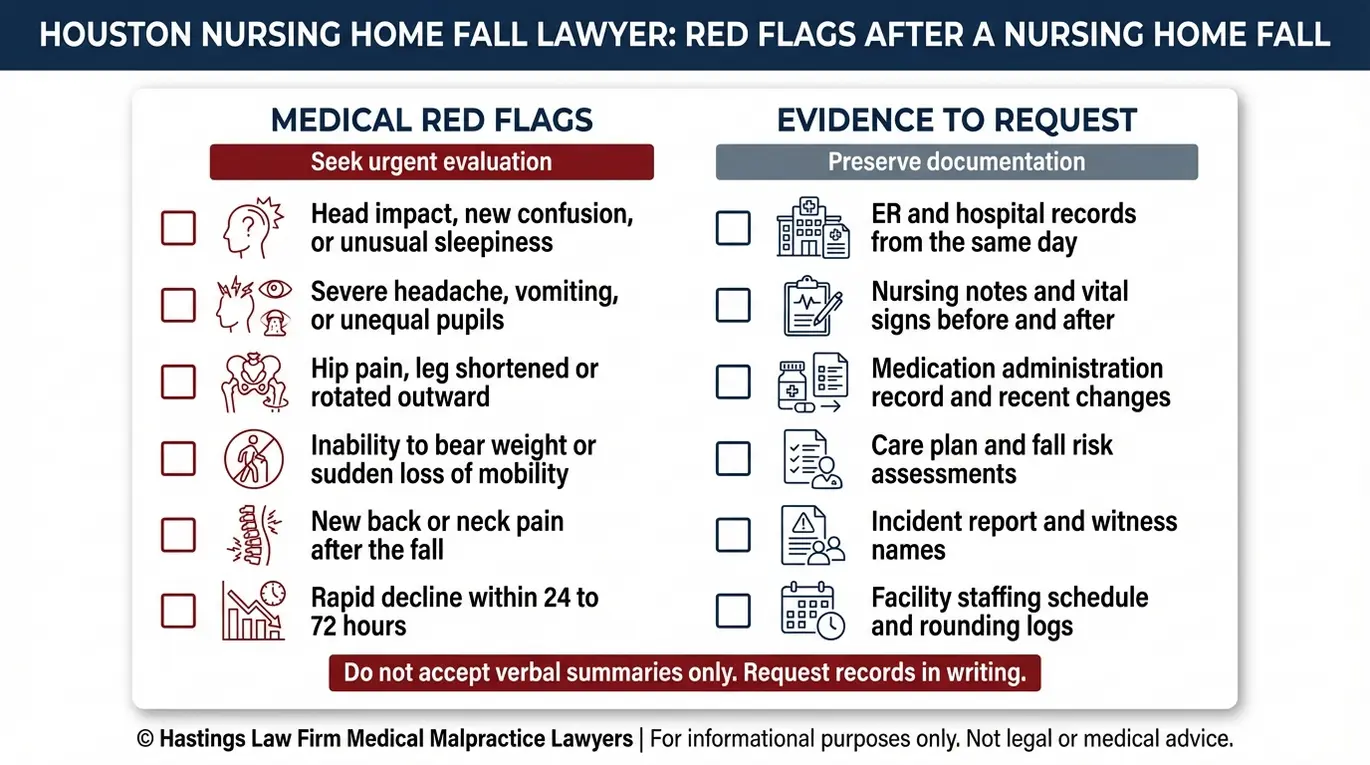
Falls in nursing homes often result in catastrophic injuries like hip fractures and subdural hematomas, which require specific medical documentation to connect the injury directly to the facility’s negligence.
Elderly residents are especially vulnerable to severe outcomes because of age-related bone density loss, slower healing, and pre-existing conditions. A fall that might cause only bruising in a younger person can be life-threatening for a resident in their 70s or 80s. For this reason, medical evidence collected immediately after the fall is critical to building a case.
Injuries We Commonly See
The most frequent injuries from nursing home falls involve physical trauma that requires immediate specialized care. These incidents serve as primary evidence of the physical impact on the resident.
- Hip fractures: Hip fractures, a break in the upper portion of the femur, often require surgery and extended rehabilitation. For elderly patients, a hip fracture can permanently reduce mobility and independence.
- Subdural hematomas: A chronic subdural hematoma, described by MedlinePlus as a collection of blood between the surface of the brain and its outermost covering, may develop slowly after a fall, making early detection essential.
- Traumatic brain injuries: Even a seemingly minor blow to the head can cause lasting cognitive damage in an elderly resident.
- Spinal fractures and trauma: Compression fractures or damage to the spinal cord can lead to chronic pain or paralysis.
- Soft tissue injuries and infections: Deep bruising, skin tears, and wounds that become infected due to delayed treatment.
Proving Causation Through Medical Records
A fall injury attorney in Houston must do more than show that an injury occurred. The legal standard requires proving causation, meaning the facility’s failure to supervise or assist the resident is what led to the specific injury. For these reasons, medical records become essential.
Immediate documentation of the resident’s condition after the fall, including imaging results, physician notes, and nursing assessments, creates a timeline. When we compare that timeline against the facility’s staffing logs and care plan records, gaps in care often become visible. If a resident identified as a fall risk was left unattended for hours before a fracture occurred, that gap is powerful evidence of negligence.
The Hastings Law Firm Difference
Results matter, but what truly sets us apart is how we achieve them. Every verdict, every settlement, and every Houston courtroom victory comes from one guiding promise: To treat each client’s fight for justice as if it were our own.
This balance of skill, experience, and empathy reflects our core philosophy that justice should not only compensate the injured, but also make health care safer nationwide.

Hidden Causes of Falls and Chemical Restraints
Beyond physical hazards, many falls are caused by chemical restraints or unnecessary medications that leave residents dizzy or disoriented without proper supervision.
Facilities may use chemical restraints, medications such as sedatives or antipsychotics administered not for a legitimate medical purpose but to keep residents calm, to compensate for inadequate staffing. This misuse of medication constitutes nursing home neglect, causing residents to become drowsy, lose their balance, and fall. Federal nursing home regulations prohibit the use of chemical restraints imposed for purposes of discipline or convenience under 42 CFR § 483.12, and separately prohibit unnecessary drugs under 42 CFR § 483.45 (Pharmacy Services).
Polypharmacy, the practice of prescribing multiple medications simultaneously, also increases the risk of drug interactions that cause dizziness or confusion. When a resident starts a new combination of medications without updated fall precautions, the facility creates a foreseeable risk.
Failure to provide assistive devices leaves residents vulnerable. A resident assessed as needing a walker or bed rails must have consistent access to them; if these tools are unavailable or out of reach, the facility fails its duty.
Analyzing Keycard Data and Non-Traditional Evidence
One of the most revealing types of evidence in nursing home negligence cases is electronic access logs, the digital records created when staff members swipe their keycards or badges to enter a resident’s room or floor. These logs show exactly when, or whether, a staff member checked on a resident before a fall occurred.
If the data reveals that no staff member entered a high-risk resident’s area for several hours before the fall, that evidence can directly contradict a facility’s claim that the resident was being properly monitored. We also examine incident reports, internal communications, and witness statements from roommates or other residents to build a complete picture of what happened.
Legal Grounds for Suing a Nursing Home in Texas
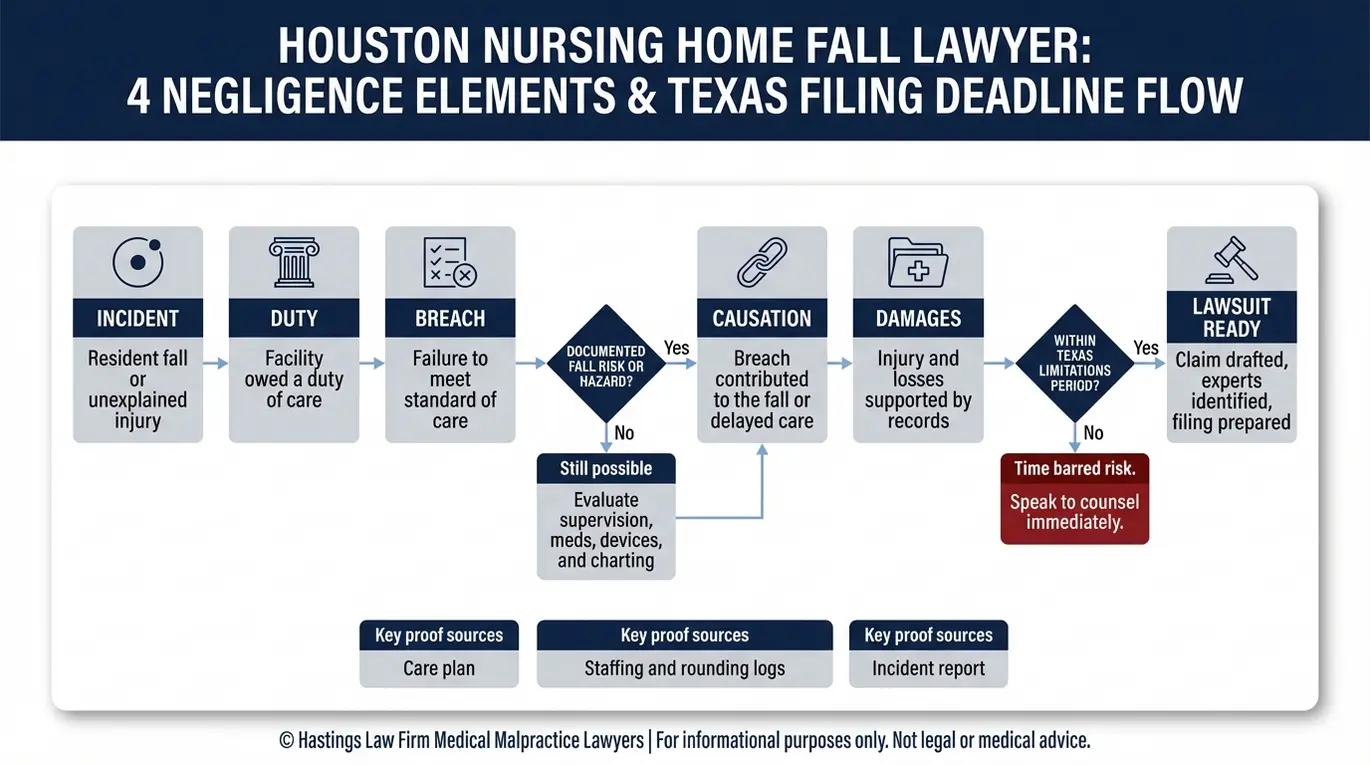
To sue a nursing home for a fall in Texas, a plaintiff must demonstrate that the facility owed a duty of care, breached that duty through action or inaction, and that this breach directly caused the resident’s injury.
Establishing the four elements of a negligence claim forms the foundation of every nursing home fall case. A Houston nursing home fall lawyer must establish each one to move a personal injury lawsuit forward.
The Four Elements of a Negligence Claim
Proving these legal requirements helps determine if a facility is liable for a resident’s injuries. Here is what each element requires:
- Duty of care: The nursing home had a legal obligation to provide a safe environment and appropriate supervision. Texas nursing home regulations, outlined in the Texas Administrative Code Title 26, Chapter 554, set specific standards for resident safety and care.
- Breach of duty: The facility failed to meet that obligation. This could involve ignoring a care plan, failing to address a known hazard, or operating with insufficient staff.
- Causation: The breach is what caused the resident’s fall and resulting injury, not a separate, unrelated event.
- Damages: The resident suffered actual harm, whether physical injuries, emotional distress, medical expenses, or a combination.
Texas Standard of Care for Nursing Homes
The standard of care for Texas nursing facilities is defined by both state regulations and federal requirements under the Centers for Medicare & Medicaid Services. It refers to the level of care and caution that a reasonably competent facility would provide under similar circumstances. Facilities must conduct regular risk assessments, maintain adequate staffing, follow individualized care plans, and respond promptly to changes in a resident’s condition.
These standards are mandatory requirements enforced to protect vulnerable adults. Compliance involves maintaining precise staff-to-resident ratios, ensuring environments are free of tripping hazards, and conducting hourly rounds for high-risk patients. When a facility falls below these standards, it creates the basis for a liability claim.
Statute of Limitations
Texas law sets a deadline for filing a nursing home negligence or elder abuse claim. Under the Texas Civil Practice and Remedies Code, Section 74.251, the statute of limitations generally allows two years from the occurrence of the breach or tort to file a lawsuit. This is the legal timeframe during which a person must file a case or lose their right to do so. Missing this window can result in losing the right to pursue legal representation for falls entirely.
While two years seems like a long time, building a case takes months. Investigating the claim, obtaining records, and verifying the breach of duty must happen well before filing. Exceptions to this rule are rare, making strict adherence to the calendar crucial. Because evidence can be lost or altered over time, consulting with an attorney as early as possible protects both your timeline and the strength of your case.
How Hastings Law Firm Investigates Fall Accidents
Our firm uses a specialized investigation team, including nurse consultants and independent investigators, to secure video footage, staffing logs, and internal incident reports before they can be altered or destroyed. Our specialized team works under the direction of founder Tommy Hastings, a board-certified trial lawyer who has focused on medical negligence for over twenty years. This combination of medical and legal expertise allows us to prioritize evidence preservation from the moment we are hired.
Early action is essential. Nursing facilities are not always forthcoming with internal records, and surveillance footage is frequently recorded over within days or weeks. Our team moves quickly to preserve this evidence through formal legal demands and, when necessary, court orders.
Our Investigation Timeline
When a family contacts us about a nursing home fall, our investigation process follows a deliberate sequence of evidence collection and expert analysis:
- Immediate evidence preservation: We send preservation letters to the facility to prevent the destruction of video recordings, electronic access logs, staffing schedules, and the resident’s complete medical file. We send formal spoliation letters immediately. These legal documents put the facility on notice that deleting data is a sanctionable offense, stopping the automated cycle that often overwrites surveillance footage every 30 days.
- Securing the incident report: Facilities are required to document falls through internal incident reports, but these records are sometimes incomplete or difficult to obtain. We know where to look and what to request. Under the Texas Health and Human Services Nursing Facility Residents’ Rights guidelines, residents and their families have the right to access their own records.
- Interviewing witnesses: Our team gathers witness statements from staff members, roommates, and visitors who may have observed conditions leading up to the fall or the facility’s response afterward.
- In-house medical review: Our nurse consultants and Board Certified Patient Advocates review the resident’s medical records and individualized care plan, a documented strategy outlining specific safety interventions, to identify where the standard of care broke down. These records often reveal understaffing, which compromises supervision.
- Expert validation: We work with our national network of medical experts, including geriatric physicians and nursing directors, to confirm whether the facility’s conduct fell below accepted standards. Their independent analysis strengthens the case and provides the necessary expert testimony for trial.
As a nursing home negligence lawyer team with former defense attorneys on staff, we understand the strategies facilities use to minimize their exposure. That insight helps us anticipate their approach from day one, and our Houston injury attorney team prepares every case as if it will go before a jury.
Recoverable Damages in Nursing Home Fall Cases
Compensation in fall cases may cover medical bills, future rehabilitation costs, physical pain and suffering, and in cases of gross negligence, punitive damages designed to hold the facility accountable. A Houston nursing home fall lawyer evaluates every category of loss to ensure the full impact of the injury is reflected in the claim. Seeking recovery for medical bills is often the first step in addressing the financial burden placed on families.
Types of Damages
| Damage Category | What It Covers |
|---|---|
| Economic Damages | Past and future medical expenses, hospitalization, surgery, rehabilitation, prescription costs, specialized equipment, and in-home care needs |
| Non-Economic Damages | Physical pain and suffering, emotional distress, loss of quality of life, loss of independence, and mental anguish |
| Wrongful Death Damages | Funeral and burial costs, loss of companionship, loss of financial support, and mental anguish of surviving family members |
| Punitive Damages | Awarded in cases of gross negligence or willful misconduct to punish the facility and deter similar conduct |
Economic damages are calculated using medical bills, care projections, and expert testimony about the resident’s future needs. These compensation categories account for the cost of long-term care facilities if the resident can no longer live independently. These projections often run into the hundreds of thousands of dollars.
Non-economic damages, such as pain and suffering, are assessed based on the severity of the injury, the resident’s quality of life before and after the fall, and the ongoing impact on their daily functioning. This includes the profound loss of companionship for a spouse or the emotional anguish of children watching a parent suffer unnecessarily.
If a fall resulted in a loved one’s death, Texas law allows surviving family members to pursue a wrongful death claim. The Texas Department of State Health Services Death Records division maintains official records that may be relevant to establishing the timeline and cause of death.
Compensation for nursing home falls varies based on the facts of each case. Our goal is to ensure that every recoverable loss is identified and documented, maximizing the potential for a fair settlement or verdict.
Defense Tactics Used by Care Facilities
Nursing homes often attempt to blame the resident’s age or pre-existing conditions for the fall, claiming the injury was inevitable rather than a result of their failure to supervise.
Understanding these defense tactics helps families prepare for what lies ahead and reinforces why thorough investigation matters from the start.
The “Inevitable Accident” Defense
One of the most common tactics is arguing that the fall would have happened regardless of what the facility did. The defense may point to the resident’s age, frailty, or history of falls to suggest that no amount of care could have prevented the incident. Our response is to examine the facility’s own fall risk assessment. If they identified the resident as high-risk but failed to implement fall prevention measures, the “inevitable” argument collapses.
Facilities assume the responsibility for a resident’s safety upon admission, regardless of their frailty. Arguing that a resident was “too sick” to be protected effectively admits that the facility accepted a patient they were not equipped to care for.
Blaming the Resident
Facilities sometimes claim the resident contributed to the fall by not calling for help, attempting to walk unassisted, or refusing assistance. What this argument overlooks is the facility’s obligation to anticipate these behaviors. A resident with cognitive decline or a history of attempting unassisted transfers should have safeguards in place, including bed alarms, scheduled check-ins, and proper use of assistive devices.
Incomplete or Altered Charting
In some cases, medical records may be incomplete, vague, or inconsistent with what actually occurred. These charting gaps can obscure the timeline, making it harder to establish when the fall happened and how long the resident went without assistance. Nurses may attempt to backdate entries to make it appear that rounds were completed on time.
Our team looks for digital timestamps and handwriting discrepancies that reveal these alterations. Our in-house medical team is trained to identify these inconsistencies. By cross-referencing nursing notes with electronic access logs, medication administration records, and staffing schedules, we can reconstruct what the official record may not show.
Contact the Houston Nursing Home Attorneys at Hastings Law Firm Today for Help
If your loved one suffered a serious fall in a Houston nursing home, the evidence needed to hold the facility accountable may already be at risk. Surveillance footage gets overwritten, staffing records are archived, and memories fade. Acting quickly gives your family the best chance of preserving the truth.
Hastings Law Firm handles nursing home fall cases on a contingency fee basis, meaning you pay no attorney fees or costs unless we secure a recovery for your family. A Houston nursing home fall lawyer from our team can review your situation, explain your options, and help you take the first step toward answers.
Our goal is not only to pursue fair compensation but to prevent the same failures from harming another family. Contact us today for a free, confidential case evaluation.
Frequently Asked Questions About Nursing Home Fall in Houston


This content was researched and written by the Hastings Law Firm editorial team, which includes attorneys, medical professionals, and experienced researchers. Our writing is informed by internal knowledge and practical experience, and we cross-check critical details against authoritative sources cited throughout. Every piece undergoes human-led fact-checking and legal review. Because legal and medical information can change, if you spot an error, please contact us. Learn more about our content standards and review process on our editorial policy page.

Tommy Hastings, founder of Hastings Law Firm, is a board-certified personal injury trial lawyer dedicated exclusively to healthcare injury cases. Since 2001, he has represented injured patients and families in litigation against major hospital systems, pharmaceutical companies, and negligent healthcare providers nationwide. He has handled numerous high-profile cases that have drawn national media attention and resulted in multi-million dollar recoveries. He draws on that experience in his writing, helping readers understand how these cases work and what options may be available to them.
