


Houston Delayed or Prolonged Surgery Lawyer
Delayed or prolonged surgery can turn a treatable problem into a serious injury when an operation is postponed beyond a clinically appropriate timeframe or extends far longer than expected due to errors. The resulting harm can involve infection, organ damage, cognitive impairment, nerve injury, or life threatening consequences, especially when extended anesthesia exposure or operating room mistakes occur. Understanding how standard of care and causation apply can clarify when a delay is considered preventable and negligent. If you or a loved one were harmed or worse due to delayed or prolonged surgery in Houston, Texas, contact Hastings Law Firm for a free, confidential case review.

Last Updated: July 27, 2026
Trusted Legal Representation for Surgical Delays in Houston
When a surgery is delayed beyond what is medically reasonable, or when an operation takes far longer than expected, patients can suffer serious and preventable harm. Patients of delayed surgery face severe consequences. These delays occur when a procedure fails to happen within the clinically appropriate timeframe. Prolonged surgery, also known as prolonged operative time, involves an operation extending well beyond its anticipated duration due to errors.
Founded in 2005, Hastings Law Firm is a dedicated medical negligence practice focused exclusively on representing patients and families in Houston. If you or a loved one experienced a worsened medical outcome because of a surgical delay, our surgical negligence law firm is here to help. As Houston delayed or prolonged surgery lawyers, we can review what happened and explain your options in a free, confidential consultation. Our medical malpractice attorneys are ready to fight for you.

When Does a Delayed or Prolonged Surgery Constitute Malpractice
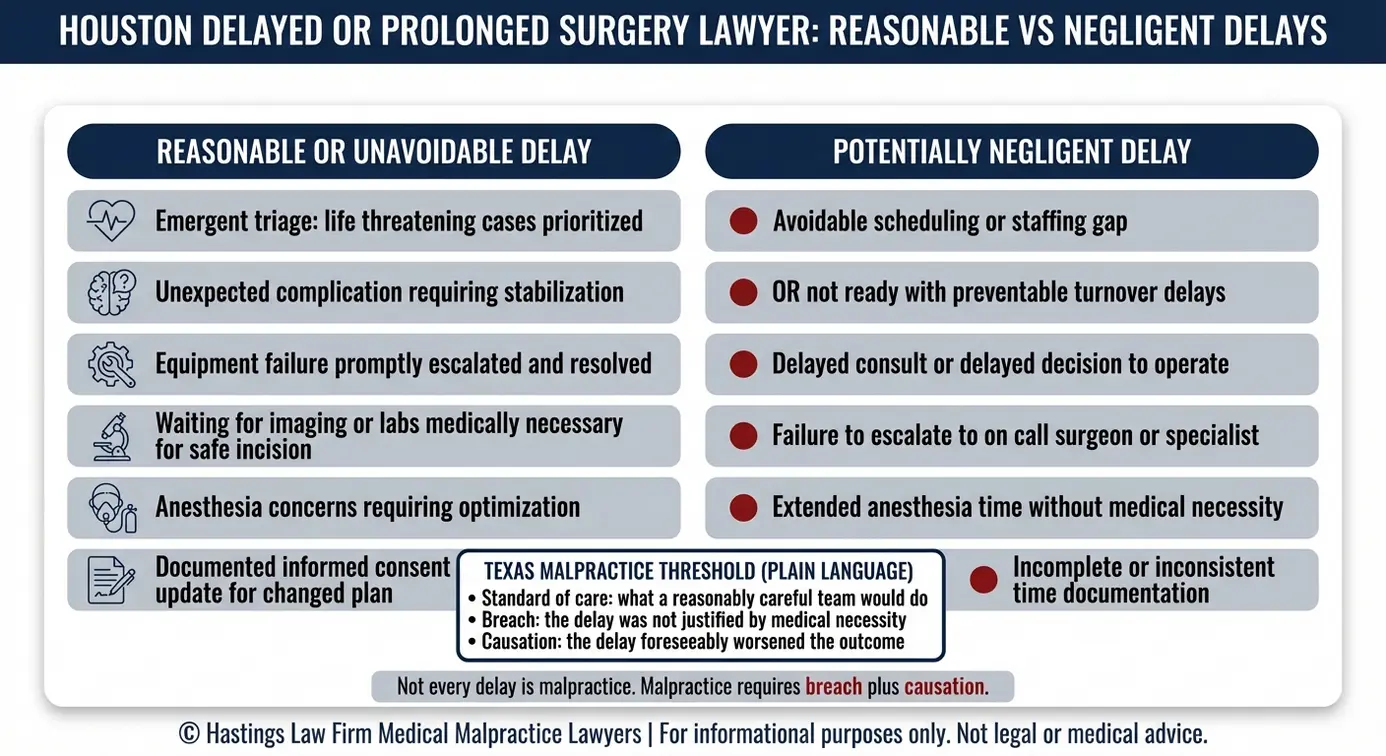
A surgical delay constitutes malpractice when it deviates from the accepted standard of care and directly causes foreseeable harm to the patient. Not every delay or prolonged surgery negligence instance is actionable, but when the timeline falls below what a competent surgeon or hospital should have provided, a delayed surgery lawyer can investigate.
The standard of care refers to the level of treatment a reasonably skilled professional would provide, establishing a duty of care to the patient. A breach of duty occurs when this standard is unmet. For example, prolonged anesthesia exposure, the state of keeping a patient sedated longer than necessary due to poor planning, increases the risk of cognitive impairment. Similarly, tissue ischemia and necrosis, the death of tissue caused by inadequate blood supply, can result when surgeon negligence leads to wasted time.
The distinction between an unavoidable complication and an operating room error is central to any medical malpractice claim. Under Civil Practice and Remedies Code Chapter 74, Texas law sets requirements for proving medical negligence.
Reasonable Delays vs. Negligent Delays:
In a surgical setting, we evaluate the following to determine if a delay was reasonable or negligent:
- Reasonable: Unexpected anatomical findings during surgery that require careful adjustment; emergency triage requiring the surgical team to stabilize a higher-acuity patient first; brief equipment changes needed for patient safety.
- Negligent: Scheduling conflicts that push a time-sensitive procedure back by hours; failure to prepare the operating room or assemble the surgical team on time; surgeon inattention or distraction leading to unnecessarily prolonged operative time; leaving a patient under anesthesia while addressing avoidable logistical issues.
A surgical malpractice lawyer evaluates these distinctions by reconstructing the timeline of events. Our Houston surgical injury attorney team knows how to identify the preventable surgical error gaps in documentation. An experienced delayed operation lawyer or hospital negligence counsel can reveal why a delay occurred, holding providers accountable for surgical delay negligence.
Common Injuries Caused by Surgical Delays and Operating Room Errors
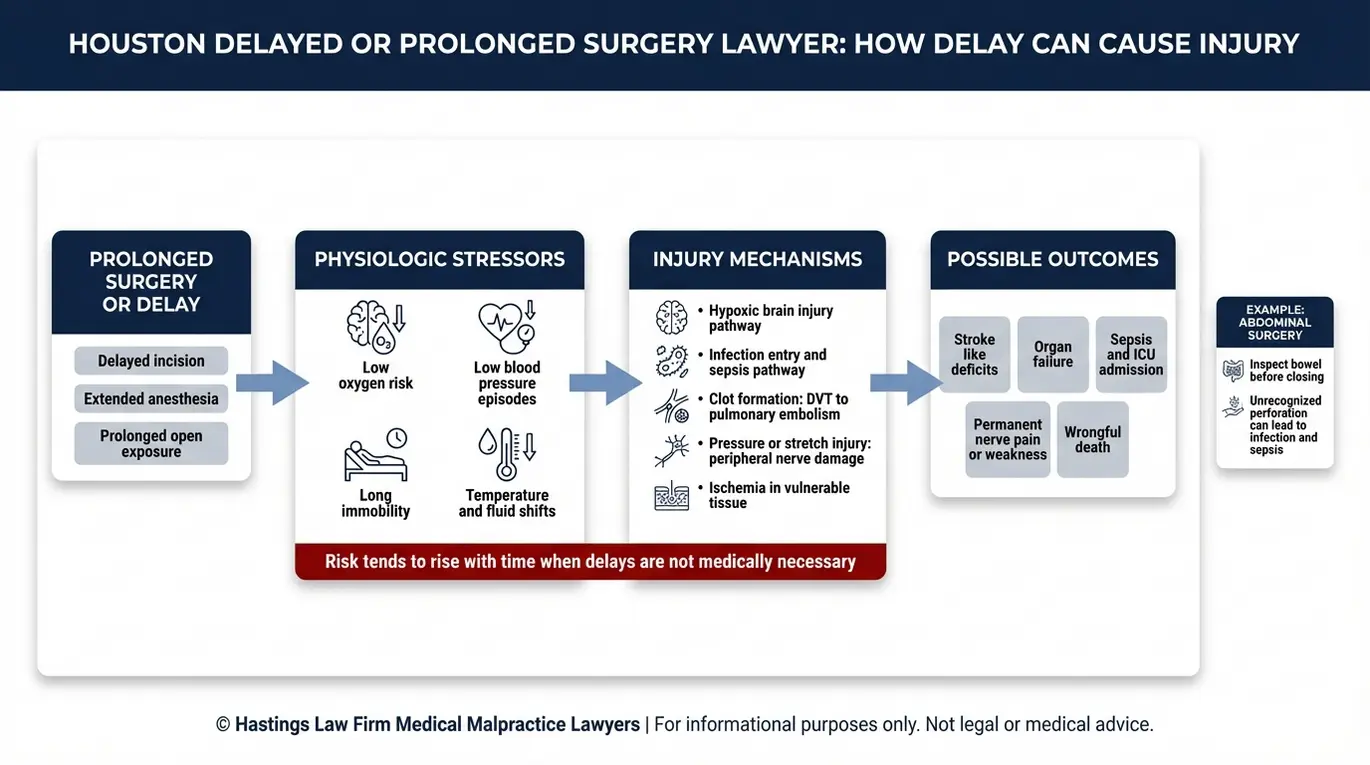
Prolonged surgeries increase the risk of severe complications such as infection, nerve damage, deep vein thrombosis, and organ failure due to extended anesthesia exposure. Every additional minute a patient spends on the operating table compounds physiological stress, leading to complications in the surgical setting. When these minutes result from a preventable medical error, a lawyer for prolonged surgery complications can help families seek justice.
Extended time under anesthesia can lead to intraoperative hypoxia, a condition marked by insufficient oxygen flow to the brain and organs. Even brief periods of deprivation can cause surgical complications like cognitive deficits. Research published in *Wiley Online Library* on the incidence of high-severity anesthesia-related adverse events highlights the elevated risk profile associated with these events. A Houston surgical error attorney frequently sees how these incidents alter lives.
When a surgical site remains open longer than necessary, the risk of bacterial contamination rises significantly. This can lead to sepsis, a life-threatening systemic infection. Hospital negligence often plays a role, particularly when providers fail to follow protocols for postoperative care or sterile field maintenance. Our legal team includes in-house nurse consultants who previously worked for the hospital systems they now challenge and analyze records for signs of preventable complications.
Surgical positioning injuries, or perioperative nerve compression, damage caused by prolonged pressure on nerves and blood vessels, are another consequence. When a patient remains fixed for hours, an anesthesia error attorney or operating room negligence lawyer may find that staff failed to rotate or pad the patient properly. Tragically, these errors can sometimes lead to wrongful death.
Scheduling conflicts where hospitals delay necessary procedures for administrative reasons also cause harm. An OR error lawyer or surgical malpractice counsel can investigate if administrative decisions led to inadequate staffing or unsafe protocols.
| Type of Delay or Error | Potential Health Consequence |
|---|---|
| Extended anesthesia exposure | Brain injury, cognitive impairment, respiratory failure |
| Prolonged open surgical site | Infection, sepsis, organ failure |
| Delayed emergency intervention | Tissue death, need for additional surgeries |
| Extended patient positioning | Nerve compression, chronic pain, paralysis |
| Scheduling-related surgical delay | Patient decompensation, worsened underlying condition |
If you need a lawyer for a prolonged surgery, contact our surgical delay law firm. We act as your medical negligence attorney and delayed procedure advocate regarding preventable surgical delays.
Specific Risks of Abdominal Surgery and Bowel Perforation
Abdominal procedures carry risks when the surgical intervention is prolonged beyond expected timeframes. A surgical intervention in the abdomen requires precise timing to avoid injury to internal organs. Bowel perforations, or holes and tears in the intestinal wall, can occur if instruments nick tissue. Left undetected, this can cause peritonitis.
This is why the standard of care requires a surgeon to “run the bowel,” a systematic bowel inspection to check for cuts before closing. When a surgeon fails to perform this, nerve injuries or sepsis may follow. Medical records are critical evidence in determining if this step was missed.
The Hastings Law Firm Difference
Results matter, but what truly sets us apart is how we achieve them. Every verdict, every settlement, and every Houston courtroom victory comes from one guiding promise: To treat each client’s fight for justice as if it were our own.
This balance of skill, experience, and empathy reflects our core philosophy that justice should not only compensate the injured, but also make health care safer nationwide.

How Our Houston Delayed Surgery Lawyers Prove Negligence
We prove negligence by securing expert testimony to establish the standard of care and using medical records to demonstrate a direct link between the delay and the patient’s injury. Tommy Hastings, a board-certified trial lawyer with over two decades of experience, leads our team in building every case as if it will go to trial.
The Investigation
We analyze the anesthesia record, a minute-by-minute account of drugs and vital signs. By comparing “wheels in” and “wheels out” times, we pinpoint unexplained gaps. Our Houston malpractice counsel also looks for evidence of a break in sterile technique, or sterile field contamination, which can explain infections.
Under Texas law, patients have rights reinforced by the Texas Medical Board’s guidelines on patient information and medical records. We also examine informed consent documents to ensure risks were disclosed.
Expert Testimony
Our surgical injury claim lawyer team works with a national expert network. An expert witness, such as a board-certified surgeon or anesthesiologist, reviews the case to offer opinions. This validation is vital for proving negligence. Our experienced medical error attorneys ensure this testimony is prepared early to withstand defense challenges.
Establishing Causation
Proving liability requires connecting the time lapse to the injury. Our legal team performs a detailed causation analysis. A surgical timeline expert may assist in demonstrating how the outcome would have differed had the procedure occurred on time.
Key evidence we gather includes:
- Operating room entry and exit logs
- Complete anesthesia records and vital sign data
- Surgeon and staff scheduling records
- Pre-operative assessments and imaging
- Postoperative notes and complication reports
- Hospital staffing records and internal protocols
- Communications between care team members
As a surgical negligence law firm, we build a thorough case based on evidence. Contact a delayed surgery advocate or Houston surgical malpractice lawyer to discuss your potential medical negligence case.

Compensation for Victims of Prolonged Surgical Procedures
Victims may recover economic damages for medical bills and lost wages, as well as non-economic damages for pain, suffering, and physical impairment. Seeking compensation for surgical errors helps restore financial stability for families devastated by medical errors.
Economic damages cover the financial losses directly tied to the injury:
- Past and future medical expenses, including corrective or revision surgeries
- Rehabilitation and long-term care costs
- Lost wages and diminished earning capacity
- Home care assistance and medical equipment
Non-economic damages address the human toll of a preventable surgical error:
- Physical pain and suffering
- Mental anguish and emotional distress
- Loss of enjoyment of life
- Physical impairment or disfigurement
A settlement for prolonged surgery must account for these factors. However, the Texas malpractice cap limits non-economic damages, generally to $250,000 for claims against individual healthcare providers. Our surgical injury compensation team works to maximize recovery despite this, focusing on patient safety failures that juries understand.
In cases involving wrongful death, surviving family members may pursue a claim for surgical fatality. This includes compensation for funeral expenses and loss of companionship. A malpractice damages lawyer can explain recovery for surgical negligence options. We fight for financial restitution for surgical delays and justice for operating room errors. Securing damages for delayed treatment is our priority.
Texas Statute of Limitations for Filing a Surgical Injury Claim
In Texas, you generally have two years from the date of the surgical error to file a medical malpractice lawsuit, though exceptions exist for discovery of the injury and for minors. This makes filing a claim time-sensitive. A statute of limitations lawyer can help identify the correct deadline.
Texas also imposes a statute of repose. Under the discovery rule, exceptions may apply, but the ten-year repose deadline has only narrow exceptions. Missing the deadline to file a surgical suit bars recovery.
Because evidence disappears, contacting a Houston delayed surgery attorney or Texas malpractice time limit expert is crucial. Our surgical error claim timeline specialists ensure your medical malpractice rights are protected.
Contact the Houston Surgical Error Attorneys at Hastings Law Firm Today for Help
Surgical delays are often preventable errors. At Hastings Law Firm, our mission is to restore trust. If you believe a delayed surgery caused harm, our Houston medical malpractice attorneys are ready to listen.
Contact a Houston delayed surgery lawyer at Hastings Law Firm to get the answers you need. Call our firm for a free evaluation. Our surgical negligence team handles cases on a contingency fee basis. Schedule a consultation today to let us hold negligent providers accountable.
Frequently Asked Questions About Delayed or Prolonged Surgery in Houston


This content was researched and written by the Hastings Law Firm editorial team, which includes attorneys, medical professionals, and experienced researchers. Our writing is informed by internal knowledge and practical experience, and we cross-check critical details against authoritative sources cited throughout. Every piece undergoes human-led fact-checking and legal review. Because legal and medical information can change, if you spot an error, please contact us. Learn more about our content standards and review process on our editorial policy page.

Tommy Hastings, founder of Hastings Law Firm, is a board-certified personal injury trial lawyer dedicated exclusively to healthcare injury cases. Since 2001, he has represented injured patients and families in litigation against major hospital systems, pharmaceutical companies, and negligent healthcare providers nationwide. He has handled numerous high-profile cases that have drawn national media attention and resulted in multi-million dollar recoveries. He draws on that experience in his writing, helping readers understand how these cases work and what options may be available to them.
