


Houston Nursing Home Malnutrition Lawyer
Nursing home malnutrition and dehydration can cause rapid decline in an older adult, especially when a facility fails to provide adequate nutrition, hydration, and feeding assistance. Warning signs such as unexplained weight loss, confusion, and weakness can be mistaken for normal aging, which can delay needed intervention. These problems are often tied to systemic issues like understaffing, poor training, and inconsistent monitoring, and they can lead to serious medical complications or worse. If a loved one was harmed or worse due to nursing home malnutrition in Houston, Texas, contact Hastings Law Firm for a free, confidential case review.

Last Updated: July 27, 2026
Trusted Legal Representation for Elderly Care Negligence in Houston
When a loved one in a nursing home begins losing weight, growing weaker, or showing signs of confusion, it can be difficult to know whether what you’re seeing is a natural part of aging or something far more preventable. Malnutrition, specifically protein-energy malnutrition, involves a dangerous deficit of proteins and calories. Dehydration occurs when the body loses more fluid than it takes in, and in severe cases can lead to hypovolemia, a dangerous drop in blood volume. In many cases, these conditions result from a facility’s failure to provide adequate nutrition and hydration.
If you suspect that a nursing home or assisted living facility allowed your family member’s health to decline through neglect, you deserve clear answers. As a Houston nursing home malnutrition lawyer, we focus exclusively on medical negligence cases and can review your loved one’s situation, explain what the evidence shows, and help you understand your legal options. Contact us for a free, confidential case evaluation.

How We Prove Liability in Nursing Home Malnutrition Claims
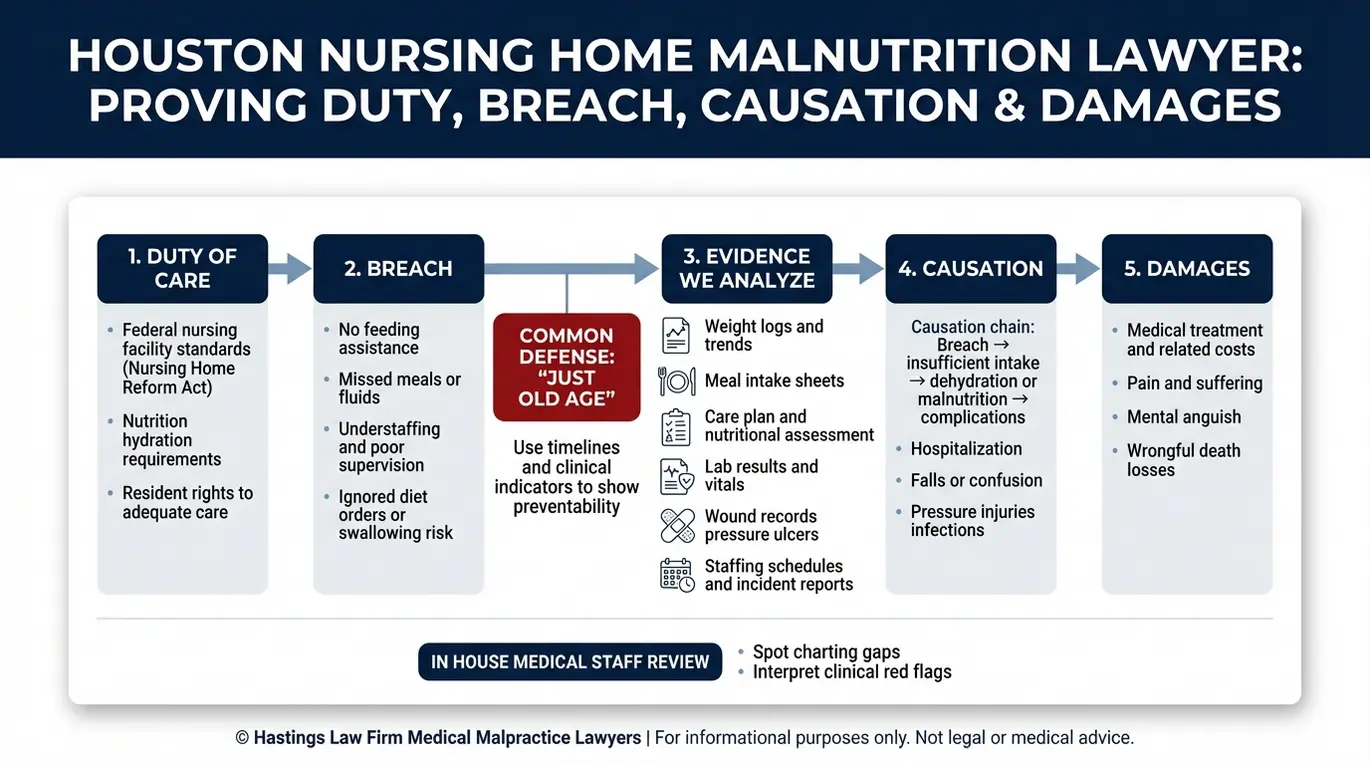
Our attorneys establish liability by analyzing clinical records for unexplained weight loss and proving the facility violated federal standards of care regarding nutrition and hydration. Liability is the legal responsibility a facility holds when its care fails to meet professional standards.
Every nursing home that accepts Medicare or Medicaid funding must comply with the 42 U.S.C. § 1396r, commonly known as the Nursing Home Reform Act. This federal law establishes a duty of care that requires facilities to maintain each resident’s nutritional health. This requires a nutritional assessment, which is a clinical evaluation of dietary needs and health conditions. The facility must then develop an individualized care plan, or nutrition care plan, to outline exactly how they will meet those specific requirements.
A breach of duty occurs when the facility fails to follow through on these obligations, which may constitute medical malpractice. We look for specific proof points that reveal where the breakdown happened:
- Missing or incomplete weight charts showing the facility was not tracking the resident’s condition
- Ignored dietary restrictions or physician orders for modified diets
- Gaps in feeding assistance logs, suggesting staff were not helping residents who could not eat on their own
- Failure to update the care plan after documented weight loss or a change in medical status
- No referral to a dietitian or physician when nutritional decline was evident
Once we identify the breach, we work to prove causation, the direct link between the facility’s negligence and your loved one’s injury. Our in-house medical staff and national network of experts analyze the clinical evidence to establish this connection. They review the clinical timeline, compare the resident’s condition at admission against their decline, and provide testimony establishing that proper care would have prevented the harm. If malnutrition contributed to a loved one’s death, we also pursue wrongful death claims on behalf of the family.
Identifying Signs of Severe Malnutrition and Dehydration
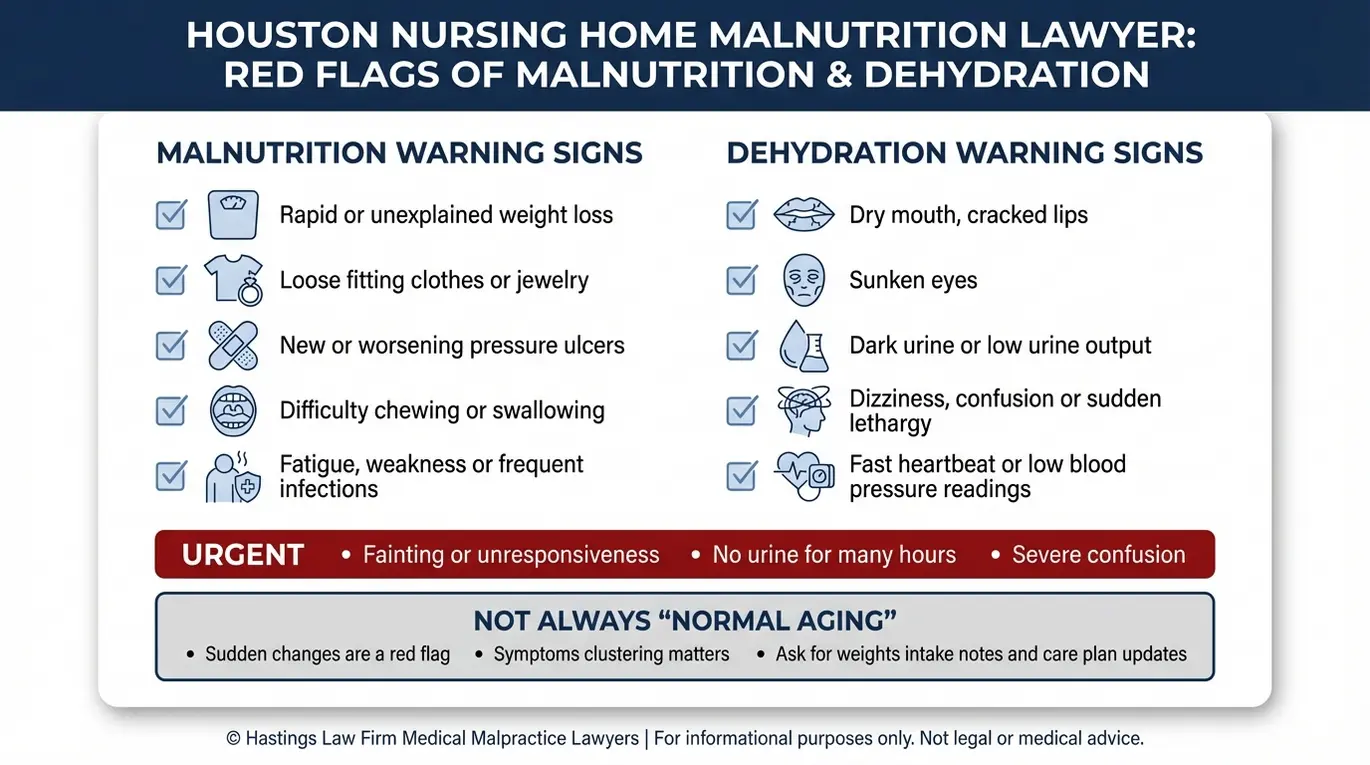
Common signs of malnutrition include sudden weight loss, brittle hair, confusion, and pressure ulcers, while dehydration often presents as sunken eyes, dark urine, and lethargy. Recognizing clinical markers for nutritional decline is essential for protecting a resident’s well-being.
Distinguishing between gradual, age-related changes and neglect-driven decline is crucial. While older adults may naturally lose some appetite or muscle mass, rapid or unexplained decline often points to a failure of care rather than the normal aging process. The link between chronic diseases and malnutrition is significant; conditions such as diabetes require strict management, and failure to do so accelerates decline.
The GLIM criteria, a framework developed by the Global Leadership Initiative on Malnutrition to standardize how malnutrition is diagnosed, identifies specific clinical markers that distinguish true malnutrition from expected changes. We work with medical experts who apply these criteria when evaluating whether a facility allowed a resident’s condition to deteriorate.
Physical warning signs of elder malnutrition include:
- Clinically significant, unintentional weight loss over a short period
- Dental deterioration or mouth sores making eating painful
- Pressure ulcers, also called decubitus ulcers or bedsores, which develop when the body lacks the nutrition needed for skin integrity
- Muscle wasting and visible bone prominence
- Chronic fatigue and slow wound healing
Behavioral and cognitive symptoms can include:
- New or worsening confusion, sometimes misdiagnosed as dementia progression
- Increased irritability or withdrawal from social interaction
- Lethargy and reduced responsiveness
Signs of dehydration in elderly residents often overlap with malnutrition and may include:
- Sunken eyes and dry, cracked lips
- Dark or concentrated urine
- Dizziness, fainting, or rapid heart rate
- Low blood pressure and reduced skin elasticity
According to Healthline’s guide on dehydration in older adults, seniors are at higher risk because their sense of thirst diminishes with age, making them dependent on caregivers to ensure adequate fluid intake.
The following table can help families distinguish between what may be age-related and what may indicate neglect:
| Symptom | Possible Age-Related Cause | Possible Neglect Indicator |
|---|---|---|
| Gradual weight loss (1–2 lbs/year) | Reduced metabolism, decreased appetite | Not a concern on its own if monitored |
| Rapid weight loss (5%+ in 30 days) | Rarely normal | Missed meals, no feeding assistance, ignored care plan |
| Mild confusion | Early cognitive decline | Sudden onset tied to dehydration or nutritional deficiency |
| Pressure ulcers | Uncommon with proper care | Prolonged immobility without repositioning; poor nutrition |
| Dark urine, dry mouth | Occasional mild dehydration | Persistent symptoms suggesting chronic fluid deprivation |
The Hastings Law Firm Difference
Results matter, but what truly sets us apart is how we achieve them. Every verdict, every settlement, and every Houston courtroom victory comes from one guiding promise: To treat each client’s fight for justice as if it were our own.
This balance of skill, experience, and empathy reflects our core philosophy that justice should not only compensate the injured, but also make health care safer nationwide.

Common Causes of Nutritional Neglect in Texas Facilities
The leading causes of malnutrition in nursing homes and any assisted living facility are systemic understaffing, lack of staff training on feeding assistance, and high turnover rates that prevent consistent resident monitoring. Root causes of nutritional neglect often involve systemic failures in facility management.
Understaffing is the most common driver. Many residents require 30 to 45 minutes of hands-on help per meal. When a facility does not schedule enough aides, staff simply cannot sit with every resident who requires feeding assistance, the direct support a caregiver provides to help a resident eat and drink safely. As a result, meals go unfinished and undocumented.
Lack of training compounds the problem. Aides may not be taught to recognize dysphagia, a condition that makes swallowing difficult or dangerous, which puts residents at risk of choking. Without proper training, staff may not manage feeding tubes, adjust food textures, or escalate concerns. Federal regulations under 42 CFR §483.60 require facilities to provide meals that meet each resident’s nutritional and dietary needs, but compliance fails if staff are not equipped.
High employee turnover creates another gap. When caregivers rotate frequently, no single staff member develops familiarity with a resident’s needs. Families looking for a Houston nursing home malnutrition lawyer often report seeing different faces at every visit, confirming the facility is stretched too thin.
The CMS Five-Star Quality Rating System allows families to check staffing levels and inspection results for any Medicare-certified facility in Texas. These ratings can provide early warning signs and serve as evidence if legal help for nursing home neglect becomes necessary.
Recovering Damages for Malnutrition in Houston Facilities
Families affected by malnutrition may be entitled to financial compensation, including economic damages for medical bills and non-economic damages for pain, suffering, and mental anguish caused by the facility’s negligence. Financial compensation helps families manage the costs and emotional impact of facility neglect.
We evaluate economic damages such as medical expenses and ongoing care costs. Our team also looks at non-economic losses including pain and suffering or mental anguish.
Recoverable damages in malnutrition injury compensation cases typically include:
- Medical expenses: Hospital stays, IV fluid therapy, nutritional rehabilitation, wound care for pressure ulcers, and any emergency treatment required to stabilize the resident’s condition.
- Ongoing care costs: Future medical needs resulting from the malnutrition, including physical therapy, specialized dietary support, or transfer to a higher level of care.
- Pain and suffering: Physical pain from starvation, dehydration, and related complications like bedsores or infections.
- Mental anguish: The emotional toll on both the resident and their family, including anxiety, depression, and the distress of watching a loved one deteriorate.
- Punitive damages: In cases involving especially reckless or egregious conduct, a court may award punitive damages to deter the facility from repeating the same failures.
- Wrongful death damages: When malnutrition or dehydration contributes to a resident’s death, surviving family members may pursue a wrongful death claim for loss of companionship, funeral and burial expenses, and other related losses.
Every case is different, and we do not promise specific outcomes. What we can tell you is that our team evaluates every category of harm so that nothing is overlooked. Our in-house nurse consultants and medical experts help quantify the full scope of injury and settlement value, connecting the facility’s failures to the financial and human cost your family has endured.
Steps to Take if You Suspect Nursing Home Neglect
If you suspect neglect, immediately document the resident’s condition with photos, file a report with the Texas Department of Health and Human Services, and consult a specialized attorney to preserve evidence. Quickly securing evidence is a critical step in holding a facility accountable.
Here is what we recommend:
- Document the resident’s condition right now. Take clear photos and videos of your loved one’s physical state, including visible weight loss, bedsores, dry skin, or any untouched food trays. Note the date and time. If the resident can communicate, write down what they tell you about meals, water access, and staff responsiveness.
- Request a copy of the medical records. Ask the facility for your loved one’s complete chart, including weight logs, nutritional assessments, and the individualized care plan. Look for evidence of clinically significant unintentional weight loss, defined as a loss of 5% or more of body weight in 30 days or 10% in 180 days. Also ask about any orders for enteral feeding, nutrition delivered through a feeding tube, if the resident’s oral intake was declining.
- File a formal complaint with state agencies. Contact the Texas Health and Human Services Commission (HHSC) to report suspected neglect. You can also reach out to Adult Protective Services (APS) for immediate intervention and notify the Long-Term Care Ombudsman, an independent advocate who investigates complaints on behalf of nursing home residents.
- Contact a Houston nursing home malnutrition lawyer before evidence disappears. Surveillance footage is often recorded over within days or weeks. Shift logs, meal intake records, and staffing schedules can be altered or lost. An attorney experienced in nursing home cases can send a legal preservation notice to the facility, requiring them to retain all relevant records and footage.
The sooner you take these steps, the stronger your ability to prove what happened and protect your loved one from further harm.

Contact the Houston Nursing Home Attorneys at Hastings Law Firm Today for Help
No elderly resident should suffer from hunger or thirst while living in a facility that is paid to provide their care. When a nursing home fails to meet the most basic nutritional needs of the people in its charge, families have the right to demand answers and accountability.
Hastings Law Firm is led by Tommy Hastings, a board-certified trial attorney and one of fewer than 2% of Texas lawyers to earn that distinction. Our team includes former defense attorneys and hospital nurses who understand the internal operations of care facilities. Our group of attorneys, nurse consultants, and patient advocates focuses exclusively on medical negligence, and we prepare every case as if it will go to trial.
If you believe your loved one has suffered from malnutrition or dehydration in a Houston-area nursing home or assisted living facility, we are here to help. As your Houston nursing home malnutrition lawyer, we will review the records, explain what we find, and walk you through your options.
Call Hastings Law Firm for a free, confidential case evaluation. You pay no fees unless we recover compensation for your family.
Frequently Asked Questions About Nursing Home Malnutrition in Houston


This content was researched and written by the Hastings Law Firm editorial team, which includes attorneys, medical professionals, and experienced researchers. Our writing is informed by internal knowledge and practical experience, and we cross-check critical details against authoritative sources cited throughout. Every piece undergoes human-led fact-checking and legal review. Because legal and medical information can change, if you spot an error, please contact us. Learn more about our content standards and review process on our editorial policy page.

Tommy Hastings, founder of Hastings Law Firm, is a board-certified personal injury trial lawyer dedicated exclusively to healthcare injury cases. Since 2001, he has represented injured patients and families in litigation against major hospital systems, pharmaceutical companies, and negligent healthcare providers nationwide. He has handled numerous high-profile cases that have drawn national media attention and resulted in multi-million dollar recoveries. He draws on that experience in his writing, helping readers understand how these cases work and what options may be available to them.
