


Fort Worth Defective Joint Replacement Lawyer
Written by: Hastings Law Firm | Reviewed by: Gabe Sassin | Updated: July 27, 2026
Living with chronic pain or instability after a hip or knee replacement can signal an implant failure rather than a routine recovery. The underlying cause may involve a defective design, a manufacturing problem, a failure to warn about known risks, or a surgical error during implantation. Implant failure can lead to revision surgery, longer recovery, permanent functional loss, and serious complications such as tissue damage from metal debris. If you or a loved one were harmed or worse due to a defective joint replacement in Fort Worth, Texas, contact Hastings Law Firm for a free, confidential case review.
Trusted Legal Representation for Failed Medical Implants in Fort Worth
What You Should Know About Orthopedic Device Failure Claims in Fort Worth:
- Long term harm can follow a failed hip or knee implant because premature failure can require revision surgery with longer recovery and lasting functional limitations.
- Options can depend on whether the failure is tied to a device defect or a surgical error because liability may fall on a manufacturer, a surgeon, or both.
- Serious complications can occur when metal debris enters tissue and the bloodstream because metallosis is described as a form of metal poisoning linked to metal on metal implants.
- Recovery can be limited if key deadlines are missed because Texas law imposes strict time limits for defective device and medical negligence claims.
- Clarity about the device involved can shape next steps because surgical records can identify the implant model and related recall history.
- Outcomes can worsen if a removed implant is not preserved because the explanted device is described as critical physical evidence for testing and analysis.
- Disputes can arise over the cause of symptoms because implant failure signs may be mistaken for normal aging or expected post surgical discomfort.
- Compensation categories can be affected by the extent of harm because the text describes economic damages and non economic damages tied to medical costs, lost wages, and pain related impacts.

A Healthcare Focused Law Firm
If you are living with chronic pain, instability, or complications after a hip or knee replacement, you may be dealing with more than a slow recovery. When a joint implant fails prematurely, it can leave you facing additional surgeries, mounting medical bills, and the frustrating feeling that something went wrong and no one is giving you a straight answer.
You deserve clarity about what happened and whether a defective device or a surgical error is to blame. As a Fort Worth Defective Joint Replacement Lawyer, Hastings Law Firm focuses exclusively on medical negligence and defective medical device cases. Our legal team, which includes in-house medical staff and former defense attorneys, can review your records, identify what failed, and explain your options.
If you or a loved one is suffering after a joint replacement, contact us for a free, confidential consultation.
Types of Joint Implant Defects We Handle
We handle cases involving defective design, manufacturing errors, and marketing defects (failure to warn) across all major joint replacement systems, including hips, knees, and shoulders. Each of these defect categories represents a distinct legal theory, and understanding which one applies to your situation is the first step toward holding the responsible party accountable. A qualified joint replacement attorney in Fort Worth can evaluate your specific circumstances to determine the best legal path forward.
Design Defects involve devices that are inherently dangerous regardless of how carefully they were manufactured. A common example is the metal-on-metal hip implant, a device where both the ball and the acetabular cup (the socket component anchored into the pelvis) are made entirely of metal alloys. As the joint moves, metal grinds against metal, releasing microscopic debris into the surrounding tissue and bloodstream. Several of these designs were cleared for market based on limited clinical data and later caused widespread harm, eventually leading to a massive hip replacement recall.
Manufacturing Defects occur when specific batches or individual units of an otherwise sound design are contaminated, improperly machined, or assembled incorrectly at the factory. This defective manufacturing means a knee implant that passes quality control on paper but contains microscopic surface flaws can fail years ahead of its intended lifespan. These errors are often isolated to specific lot numbers, which requires detailed investigation to uncover.
Marketing Defects arise when a medical device manufacturer fails to warn doctors and patients about known risks. If a company possessed internal data showing elevated failure rates but withheld that information, patients and surgeons were denied the opportunity to make an informed decision. A defective joint replacement lawyer can expose when corporations conceal these critical warning signs regarding device safety.
Our Fort Worth defective joint replacement lawyers investigate all three theories because the right legal strategy depends on identifying what exactly went wrong.
| Defect Type | What It Means | What Patients May Notice |
|---|---|---|
| Design Defect | The device is inherently flawed in its engineering | Premature wear, metal debris, chronic pain |
| Manufacturing Defect | A specific unit or batch was improperly made | Early loosening, device fracture, contamination |
| Marketing Defect (Failure to Warn) | The manufacturer concealed or minimized known risks | Unexpected complications not disclosed before surgery |
Specific Defective Hip and Knee Manufacturers
Several major manufacturers have faced recalls and ongoing litigation over defective hip and knee implant systems. Specific defective hip implant manufacturers like DePuy Orthopaedics (a Johnson & Johnson subsidiary) recalled its ASR hip system after data revealed significantly higher failure rates than originally reported. Stryker’s Rejuvenate and ABG II hip stem systems were recalled due to corrosion and fretting at the junction between components. Zimmer Biomet has faced litigation involving its NexGen knee implant and Durom acetabular cup.
If you received a hip or knee replacement and are now experiencing complications, a defective joint replacement lawyer can identify the specific device model from your surgical records and determine whether it has been linked to knee replacement surgery failures or recalls.

Recognizing the Signs of Implant Failure
Common signs of a defective joint replacement include chronic pain, swelling, instability, audible clicking or popping sounds, and elevated levels of metal ions in the blood (metallosis). This condition, known as metallosis, occurs when metal debris builds up in the soft tissues of the body. These symptoms can emerge months or even years after the initial hip or knee replacement surgery, and they are often mistakenly attributed to normal aging or expected post-surgical discomfort. A lawyer for defective joint replacement can help you determine if your symptoms point to a deeper issue.
Physical Symptoms
For defective hip replacements, persistent groin or thigh pain that worsens over time is one of the most reported warning signs. In failed knee implants, patients may feel the joint “giving way” or experience a grinding sensation during movement. Swelling, warmth around the joint, and dislocation are also red flags. Signs of infection around the joint, such as redness or discharge, can indicate that the device materials are causing a biological reaction or that the implant site has been compromised.
Systemic Issues: Metallosis
One of the more serious complications is metallosis, a form of metal poisoning that occurs when toxic metal shavings from a failing implant enter surrounding tissue and the bloodstream. Cobalt and chromium ions released from metal-on-metal hip implants can cause tissue damage, neurological symptoms such as cognitive changes and hearing loss, and even cardiac complications. Research published by the UPMC Department of Pathology documents how bilateral metal-on-metal hip prostheses can produce dangerously elevated blood cobalt levels.
Under the Texas Civil Practice and Remedies Code Chapter 82, manufacturers can be held liable for defective products that cause these types of injuries.
Radiographic Signs
X-rays and other imaging may reveal osteolysis, or bone loss around the implant, as well as visible loosening of the device from the bone bed. These Radiographic Signs provide clear visual evidence of how the device is interacting with your bone. These findings often confirm what a patient already feels: the device is failing. A knowledgeable Fort Worth joint replacement attorney knows how to use these medical findings to substantiate your claim.
Symptom Checklist
- Chronic or worsening pain in the hip, groin, thigh, or knee
- Joint instability or the sensation of “giving way”
- Swelling, warmth, or inflammation around the implant site
- Audible clicking, popping, or grinding sounds
- Difficulty walking or decreased range of motion
- Skin discoloration or rash near the implant
- Neurological symptoms such as headaches, memory issues, or hearing changes
- Blood tests showing elevated cobalt or chromium levels
If you recognize several of these symptoms, do not assume they are a normal part of recovery. A Fort Worth defective joint replacement lawyer can help you determine whether your device is the cause and connect you with independent medical experts for evaluation.
The Medical Mechanism of Metal-on-Metal Failure
In a metal-on-metal hip implant, the repeated motion of the metal ball rotating inside the metal socket produces friction that generates microscopic metallic debris. Over time, these toxic metal shavings can trigger a destructive inflammatory response in the surrounding tissue. This often leads to pseudotumors, which are non-cancerous masses that can destroy muscle, bone, and soft tissue around the joint.
If left unaddressed, this process can lead to tissue necrosis, the death of healthy tissue around the implant. Tissue necrosis is the death of living tissue, and it can significantly complicate future surgeries. The damage from tissue necrosis often makes any future revision surgery significantly more difficult and less likely to restore full function.
The Hastings Law Firm Difference
Results matter, but what truly sets us apart is how we achieve them. Every verdict, every settlement, and every Fort Worth courtroom victory comes from one guiding promise: To treat each client’s fight for justice as if it were our own.
This balance of skill, experience, and empathy reflects our core philosophy that justice should not only compensate the injured, but also make healthcare safer nationwide.

The Health Risks: Why Revision Is Often Required
Defective implants often necessitate revision surgery, a complex and risky procedure to remove the failed device and replace it with a new one, often resulting in longer recovery times and permanent functional loss. Revision surgery is not simply a “redo” of the original operation; it carries substantially higher risks and typically results in longer, more painful recovery periods. As experienced defective joint replacement counsel, we understand that the physical toll of a second surgery is a major component of your damages.
Why revision is more dangerous than the initial procedure:
Revision arthroplasty is the medical term for a surgery to replace or repair a failed implant. It is more complex because surgeons must work around scar tissue, weakened or missing bone, and damaged soft tissue left behind by the failed device. Research published by the Archives of Medical Science confirms that revision hip procedures carry meaningfully lower long-term survival rates compared to primary replacements. Surgeons must adhere to a rigorous standard of care to mitigate these elevated risks, but even excellent medical technique cannot fully offset the damage caused by the original defective device.
Primary Surgery vs. Revision Surgery
- Post-operative infection: Revision surgery carries a higher risk of infection due to the longer operating time and compromised tissue.
- Bone fracture: The weakened bone bed increases the chance of fracture during the procedure itself.
- Leg length discrepancy: This is a condition where one leg becomes shorter than the other, often requiring lifelong accommodation.
- Recovery time: Initial replacements may involve weeks of rehabilitation; revisions often require months.
- Functional outcome: Many patients never fully regain the range of motion or stability they had before the original device failed.
For a patient who went into their first hip or knee replacement surgery expecting improved mobility, the reality of revision surgery and permanent functional limitations can be devastating. A Fort Worth defective joint replacement lawyer can help you pursue compensation that accounts for these ongoing medical needs, lost wages, and diminished quality of life.
Liability: Manufacturer Defect vs. Surgical Malpractice
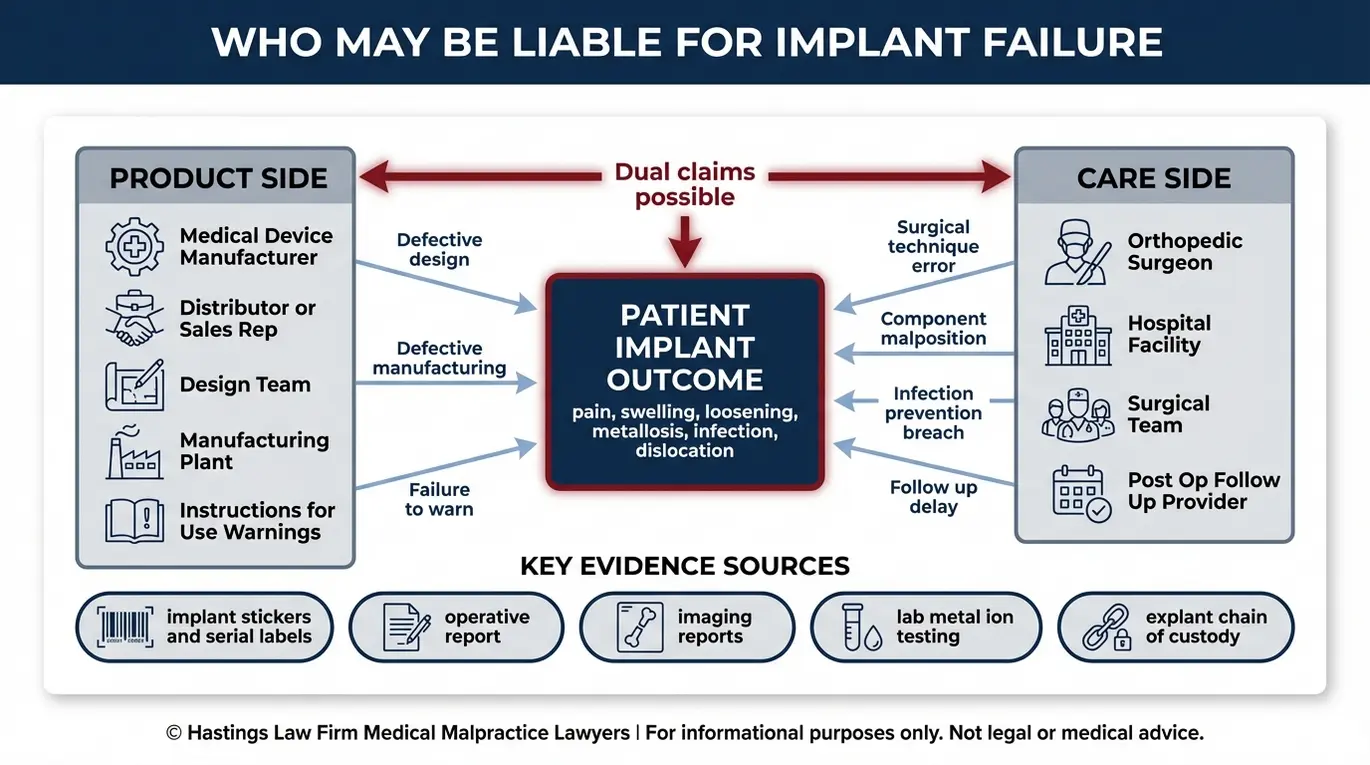
A failed joint replacement may be caused by a defective product (Product Liability) or an error made by the surgeon during implantation (Medical Malpractice); we investigate both avenues to maximize recovery. Determining the root cause is essential because it dictates who must pay for your injuries. A skilled lawyer for joint replacement errors can parse the evidence to see if the failure stems from the boardroom or the operating room.
Product Liability Claims
When a hip or knee implant is defective due to its design or manufacturing, the medical device manufacturer may be held strictly liable. This means you do not need to prove the company was careless; you need to prove the product was unreasonably dangerous. This applies to companies like DePuy, Stryker, and Zimmer Biomet when their devices fail at rates that exceed acceptable standards. An attorney for defective implants focuses on securing internal company documents that prove knowledge of these defects.
Medical Malpractice Claims
In some cases, the implant itself functions as intended, but the surgeon made an error during the procedure. Misaligning the acetabular cup, selecting the wrong implant size, or damaging nerves during installation are examples of surgical errors that can lead to premature failure. These claims require proving that the orthopedic surgeon violated the standard of care, the level of treatment that a reasonably competent specialist would have provided in the same situation.
Dual Liability
Sometimes both the manufacturer and the surgeon share shared responsibility. A defective device may have been implanted improperly, compounding the harm. Our Fort Worth defective joint replacement lawyers examine both the device itself and the surgical technique to determine where liability falls.
| Liable Party | Basis for Claim | What We Investigate |
|---|---|---|
| Device Manufacturer | Product liability (strict liability) | Design data, recall history, FDA reports, failure rates |
| Orthopedic Surgeon | Medical malpractice (negligence) | Operative notes, implant positioning, imaging, surgical technique |
| Both | Combined product defect and surgical error | Full medical record review, device testing, expert analysis |
Understanding Multidistrict Litigation (MDL)
When a defective joint implant injures thousands of patients across the country, individual lawsuits against the manufacturer are often consolidated into multidistrict litigation. MDL is a federal legal procedure designed to manage many similar cases efficiently. It is different from a class action because each case retains its individual value while sharing common discovery and bellwether trials.
Our firm works within these MDL structures and maintains relationships with national experts who can analyze your specific device. Whether your case is part of a mass tort or involves an individual attorney for defective implants, we pursue the strategy that protects your interests.
Your Path to Recovery: Steps After Implant Failure
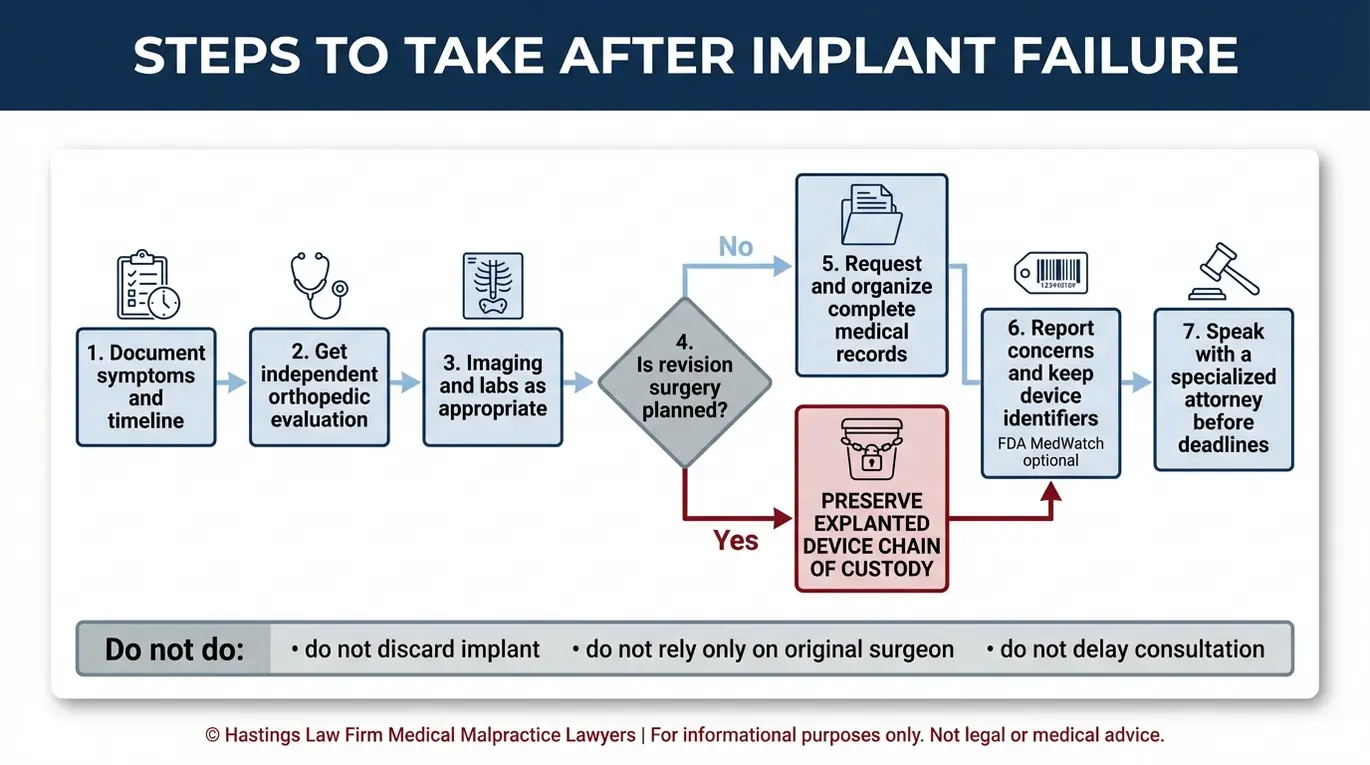
If you suspect your implant is defective, you must immediately seek a second medical opinion, preserve the explanted device if revision surgery occurs, and consult a specialized attorney before the statute of limitations expires. Our founder, Tommy Hastings, is board-certified in Personal Injury Trial Law and leads our thorough investigation of these medical records. A lawyer for defective hip replacement can guide you through this critical timeline.
- Get an independent medical evaluation. Do not rely solely on the surgeon who performed the original procedure. Seek a second opinion from an orthopedic specialist who has no financial relationship with the original provider. An independent review can confirm whether your symptoms are caused by device failure.
- Request your complete medical records. Ask for your operative report, implant identification records (including the device’s serial number, lot number, and manufacturer), and all post-surgical imaging. These documents are the evidence needed to identify the exact device and link it to known defects.
- Preserve the explanted device. If revision surgery is recommended, the removed implant, known as the explanted device, is the single most important piece of physical evidence in your case. Hospitals sometimes dispose of removed devices as medical waste. The United States District Court Explant Preservation Agreement provides a framework for ensuring the device is saved for testing and analysis. Your attorney should coordinate this before any revision procedure.
- Report the device to the FDA. You or your doctor can file an adverse event report through FDA MedWatch, the FDA’s safety information and adverse event reporting program. This provides official guidance on reporting failures and creates a record that contributes to broader device surveillance.
- Consult a specialized attorney before the deadline passes. Texas law imposes strict time limits for filing defective device and medical negligence claims. A Fort Worth defective joint replacement lawyer can evaluate your case, identify the right legal theory, and ensure critical deadlines are not missed.
The earlier you take action, the better your chances of preserving evidence and building a strong case.
Contact the Fort Worth Medical Device Attorneys at Hastings Law Firm Today for Help
A defective hip or knee implant can take away the mobility and independence you were promised. At Hastings Law Firm, our entire team, including in-house medical professionals, former defense attorneys, and a national network of experts, is dedicated to investigating what went wrong and pursuing the compensation you need to move forward. With over 20 years of experience, we understand the long-term impact of failed implants and the care required for recovery.
Whether your case involves a recalled device or a surgical error, our Fort Worth Defective Joint Replacement Lawyer team is prepared to take your case to trial if that is what it takes to secure a fair result.
Contact us today for a free, confidential case evaluation. There is no fee unless we recover for you.
Frequently Asked Questions About Defective Joint Replacement in Fort Worth


This content was researched and written by the Hastings Law Firm editorial team, which includes attorneys, medical professionals, and experienced researchers. Our writing is informed by internal knowledge and practical experience, and we cross-check critical details against authoritative sources cited throughout. Every piece undergoes human-led fact-checking and legal review. Because legal and medical information can change, if you spot an error, please contact us. Learn more about our content standards and review process on our editorial policy page.

Gabe Sassin has focused exclusively on medical malpractice law since 2007. After spending more than a decade as a malpractice defense attorney, he knows exactly how the other side works. He has seen firsthand how healthcare providers, insurers, corporate defendants, and their legal teams think, prepare, and build their defense against claims. That knowledge works for the people who need it most today, injured patients and their families. His unique experience shapes everything he writes, giving readers a look at how these cases actually work from someone who has handled them from both sides.
