


Texas Chiropractic Stroke Lawyer
Written by: Hastings Law Firm | Reviewed by: Gabe Sassin | Updated: July 27, 2026
A stroke after a neck adjustment can be shocking and life changing, especially when the visit was meant to relieve pain. Cervical spine manipulation can injure the vertebral artery and trigger a clot that cuts off blood flow to the brain, and symptoms may appear right away or later. These cases often involve disputes about screening, technique, informed consent, and delayed diagnosis, with long term rehabilitation and loss of independence. If you or a loved one were harmed or worse due to chiropractic stroke in Texas, contact Hastings Law Firm for a free, confidential case review.

Trusted Texas Medical Attorneys for Chiropractic Stroke Claims
What You Should Know About Vertebral Artery Dissection Malpractice Claims in Texas:
- Long term recovery and independence can be affected when a neck manipulation leads to vertebral artery dissection and an ischemic stroke.
- Options for accountability can turn on whether the injury was caused directly by the force of manipulation or by a failure to identify risk factors before treatment.
- A viable claim can exist even when technique was otherwise proper if a chiropractor failed to disclose stroke as an inherent risk before cervical manipulation.
- Outcomes can worsen when stroke symptoms after an adjustment are missed or misdiagnosed, especially when the recent chiropractic visit is not considered.
- Liability can depend on whether the standard of care was breached through excessive force, inadequate screening, lack of informed consent, or failure to respond to adverse symptoms.
- The ability to pursue compensation can be lost if the filing deadline under Texas malpractice law is missed.
- Recovery can be limited for non economic damages in Texas due to statutory caps, even when the injury is catastrophic.
- Financial recovery can include both measurable losses and personal harm, such as medical bills, lost wages, pain and suffering, and physical impairment.
- The ability to move forward with a Texas malpractice claim can depend on qualified expert support to address standard of care and causation.
- Proof disputes can hinge on what the clinical documentation shows about screening, consent, symptoms, and follow up after the adjustment.

A Healthcare Focused Law Firm
A chiropractic visit is supposed to relieve pain, not cause a life-threatening injury. If you or a loved one suffered a stroke after a cervical spine manipulation, you may be struggling with questions that no one seems willing to answer. The connection between a routine adjustment and a catastrophic neurological event can feel impossible to believe, and that disbelief is something healthcare providers and insurers count on.
At Hastings Law Firm, we focus exclusively on medical malpractice. Our team includes in-house nurse consultants and former defense attorneys who understand how these cases are built and how the other side tries to dismantle them. As a Texas chiropractic stroke lawyer, our founder, Tommy Hastings, is board-certified in Personal Injury Trial Law and prepares every case as if it is going to trial. This level of preparation is what it takes to uncover the truth and hold negligent providers accountable.
If you believe a chiropractic adjustment caused a stroke, we can review what happened and explain your options in a free, confidential consultation.
Vertebral Artery Dissection and the Link to Neck Adjustments
A vertebral artery dissection (VAD), a type of cervical artery dissection, occurs when force applied to the neck damages the arterial wall, allowing blood to pool between the vessel’s layers and form a clot that can travel to the brain and cause a stroke.
To understand why this happens, it helps to know where the vertebral arteries sit. These two arteries thread upward through small bony openings in the cervical spine, the section of vertebrae in your neck, before entering the skull to supply blood to the brain’s posterior region. Because the arteries pass through and around these vertebrae, they are uniquely vulnerable to rotational and extension forces applied to the neck.
The technique most commonly associated with this injury is known as a high-velocity, low-amplitude (HVLA) thrust, a quick, forceful motion applied to the cervical spine during a chiropractic adjustment. The HVLA thrust is designed to move a joint just beyond its normal physiological range of motion in a fraction of a second.
The injury mechanism typically unfolds in this sequence:
- Intimal tear: The rapid rotation or extension of the neck stretches the vertebral artery beyond its tolerance, creating a small tear in the intima, the artery’s innermost lining.
- Blood enters the arterial wall: Once the lining is breached, blood seeps between the layers of the vessel wall, forming a bulge called a hematoma that narrows the artery.
- Clot formation: The damaged area triggers the body’s clotting response, producing a thrombus (blood clot) at the injury site.
- Clot migration and stroke: If the clot breaks free or the artery becomes fully blocked, blood flow to the brain is cut off. The result is a thromboembolic stroke, an ischemic stroke caused by a clot that originated at the site of arterial damage.
Research published in Medical Research Archives has documented cases of cervical spine manipulation producing immediate thromboembolic stroke. This research details how the injury occurs through this exact sequence.
Many patients and even some emergency room physicians struggle to connect a chiropractic visit to a stroke, particularly when the patient is young and otherwise healthy. This doubt can delay diagnosis and legal action. But the medical literature is clear: vertebral artery dissection is a recognized complication of neck manipulation. Understanding this link is essential when pursuing a legal claim for a chiropractic injury. If you suspect negligence, a Texas chiropractic stroke lawyer can help evaluate your claim.
Distinct Mechanisms of Chiropractic Stroke
Not every chiropractic stroke case involves the same mechanism. In some situations, the HVLA thrust directly causes the intimal tear, meaning the artery was healthy before the adjustment and the force of the manipulation created the dissection. This is the most direct form of causation. Identifying these mechanisms help legal teams determine if the injury was preventable.
In other cases, a patient may have had a pre-existing condition or dissection that the chiropractor failed to identify through proper screening. The adjustment then worsens an already compromised artery. Both scenarios can support a claim, but the legal analysis differs.
In the first, the issue is whether the force itself was excessive or contraindicated. In the second, the focus shifts to whether the chiropractor met the standard of care by screening for risk factors before performing the adjustment. Establishing proximate cause, the direct legal link between the chiropractor’s actions and the stroke, is essential in either scenario.

Texas Informed Consent Laws Regarding Chiropractic Risks
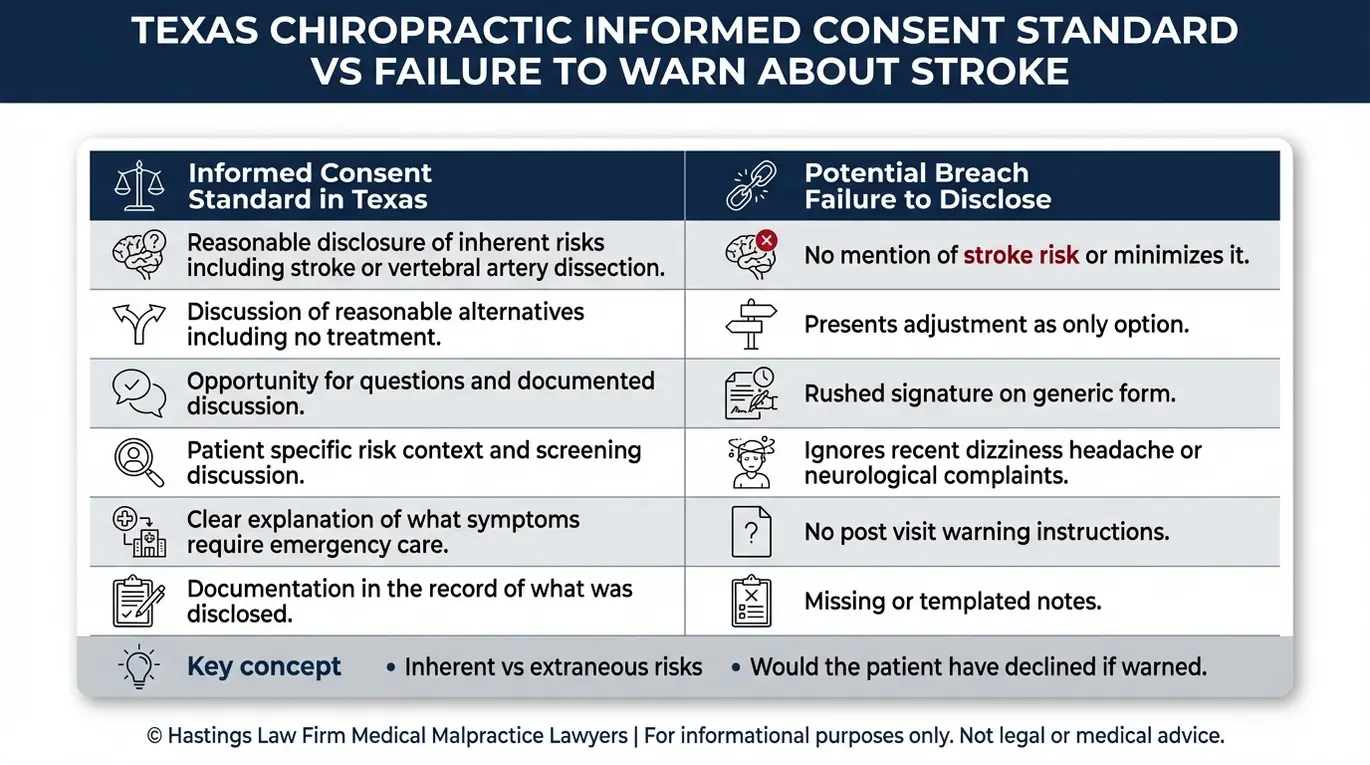
Under Texas law and the precedent set by the Texas Supreme Court in *Felton v. Lovett*, chiropractors are classified as healthcare providers who must comply with informed consent requirements, including a duty to disclose inherent risks like stroke before performing cervical manipulation. The Centers for Disease Control and Prevention (CDC) outlines stroke signs that providers should be aware of as inherent risks. Informed consent is the legal requirement for doctors and chiropractors to explain treatment risks so a patient can make an educated choice.
This ruling was significant because it settled a long-standing question: do the same informed consent rules that apply to physicians also apply to chiropractors? The court said yes. Under Texas informed consent law, a healthcare provider must make a reasonable disclosure of the risks and hazards that could influence a patient’s decision to undergo or refuse a proposed treatment.
The distinction between inherent and extraneous risks matters here. An inherent risk is one that exists within the procedure itself, regardless of how carefully it is performed. Vertebral artery dissection and stroke fall into this category for cervical spine manipulation.
When a chiropractor fails to warn a patient about this known inherent risk, that failure can constitute a breach of the duty of care and form the basis of a medical malpractice claim. This remains true even if the manipulation itself was performed with proper technique.
A stroke lawyer for chiropractic negligence must also address a critical question: would the patient have declined treatment if they had been warned? This is evaluated from the perspective of a reasonable person in the patient’s position. If a reasonable person, knowing that a neck adjustment carried a risk of stroke, would have chosen not to proceed, the chiropractor’s failure to disclose that risk is legally actionable. Our team works with medical experts and reviews the clinical documentation to establish exactly what was and was not disclosed before treatment began.
The Hastings Law Firm Difference
Results matter, but what truly sets us apart is how we achieve them. Every verdict, every settlement, and every Texas courtroom victory comes from one guiding promise: To treat each client’s fight for justice as if it were our own.
This balance of skill, experience, and empathy reflects our core philosophy that justice should not only compensate the injured, but also make healthcare safer nationwide.

Recognizing Stroke Symptoms After a Spinal Manipulation
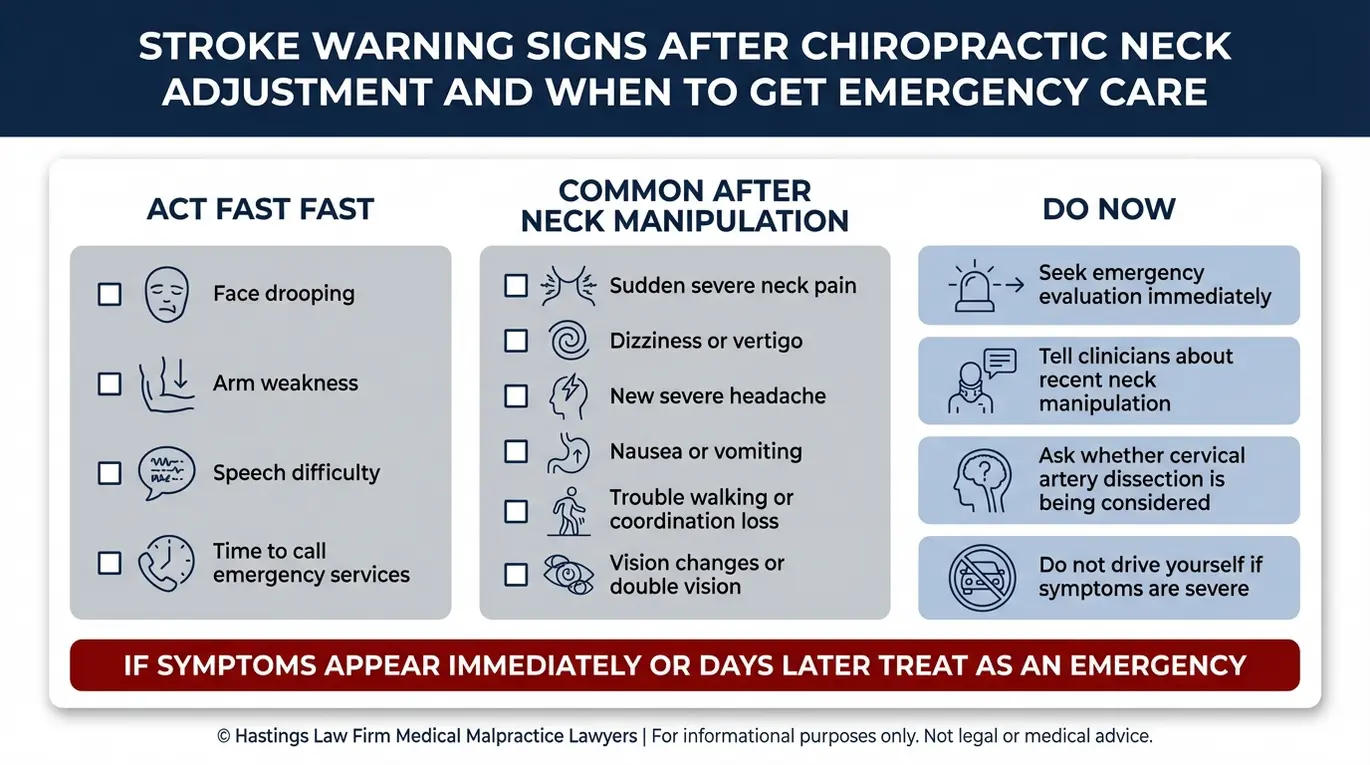
Warning signs of a stroke following chiropractic care include sudden severe neck pain, dizziness, vertigo, slurred speech, and loss of coordination, and they require immediate emergency medical attention. Early detection of these symptoms is critical for medical intervention and for building a legal case.
Symptoms do not always appear on the treatment table. While some patients experience an immediate reaction during or just after the adjustment, others may not notice anything unusual for hours or even days. This delayed onset is part of what makes chiropractic strokes so dangerous. A clot can form gradually at the dissection site and migrate to the brain well after the patient has left the office.
A posterior circulation stroke affects the back of the brain and often requires specialized screening. The BE-FAST screening test, an expanded version of the FAST test, covers the most common warning signs:
- B (Balance): Sudden loss of balance or coordination
- E (Eyes): Blurred or double vision, or sudden loss of vision in one or both eyes
- F (Face): Facial drooping on one side
- A (Arms): Weakness or numbness in one arm
- S (Speech): Slurred or confused speech
- T (Time): Time to call 911 immediately
Other symptoms to watch for after a cervical adjustment include a sudden, severe “thunderclap” headache, persistent nausea, ringing in the ears, and difficulty swallowing.
One serious concern in these cases is misdiagnosis. When a young, otherwise healthy patient arrives at an emergency room with dizziness and neck pain, physicians may not consider a vertebral artery dissection. This is especially true if the patient does not volunteer that they recently had a chiropractic adjustment.
This failure to diagnose can delay critical treatment and worsen the long-term outcome. If you or a loved one experienced neurological symptoms after a neck manipulation, seek emergency care and make sure the treating physician knows about the recent chiropractic visit. A Texas chiropractic stroke lawyer can then assist with the legal aspects of your case.
Establishing Liability and Standard of Care in Texas
To prove liability, the patient must demonstrate that the chiropractor breached the standard of care, the level of treatment a reasonably competent chiropractor would have provided under similar circumstances, by applying excessive force, failing to screen for stroke risk factors, or failing to obtain informed consent. The standard of care is the benchmark used to measure whether a professional’s actions were appropriate. Identifying a breach in this standard is the foundation of a medical malpractice case.
A chiropractic malpractice lawyer builds the case by identifying specific failures in the chiropractor’s conduct. Common breaches we evaluate include:
- Failure to perform pre-screening: The chiropractor did not take an adequate history to identify red flags for cervical artery dissection (CeAD), such as prior headaches, dizziness, neck pain, or a history of connective tissue disorders.
- Use of contraindicated techniques: Performing HVLA cervical manipulation on a patient who presented with symptoms or conditions that made the technique inappropriate. Contraindications to cervical spine manipulation are clinical factors that indicate the procedure should not be performed.
- Failure to obtain informed consent: Not disclosing the known risk of vertebral artery dissection and stroke before the adjustment.
- Failure to respond to adverse symptoms: Ignoring or downplaying a patient’s complaints of neck pain, dizziness, or headache during or after treatment.
Under Texas Civil Practice and Remedies Code, Chapter 74, medical malpractice claims require expert testimony to define what the standard of care was and how the chiropractor’s actions fell below it. The patient must retain a qualified expert witness, typically a chiropractor or physician with relevant clinical experience.
This expert can review the records and explain to a jury both the breach and causation. Without this expert analysis, the Chapter 74 case cannot proceed. Our team includes in-house medical staff who assist in reviewing treatment records, identifying charting inconsistencies, and coordinating with our national network of experts to build a clear picture of what happened and why.
Compensation for Catastrophic Chiropractic Injuries
Patients who suffer a stroke caused by chiropractic negligence may recover economic damages for medical bills and lost wages, as well as non-economic damages for pain, suffering, and physical impairment, subject to Texas statutory caps. Economic damages refer to measurable financial losses like hospital bills and lost wages.
A stroke is a catastrophic injury. Many survivors require months or years of rehabilitation, and some never regain full independence. The financial cost of this reality is enormous, and the law allows injured patients to seek compensation that reflects both the tangible expenses and the profound personal losses they have endured. A life care plan is often used to accurately project these lifelong needs.
| Damage Category | What It Covers |
|---|---|
| Past Medical Expenses | Emergency care, hospitalization, surgery, imaging, and medications already incurred |
| Future Medical Expenses | Ongoing rehabilitation, physical therapy, speech therapy, 24/7 nursing care, and assistive devices |
| Lost Wages | Income lost during recovery and treatment |
| Loss of Future Earning Capacity | Reduction in the patient’s ability to earn a living going forward |
| Pain and Suffering | Physical pain and emotional distress caused by the injury |
| Physical Impairment | Loss of bodily function, mobility, or independence |
| Wrongful Death | Claims brought by surviving family members when the stroke is fatal, including loss of companionship and financial support |
A Texas chiropractic stroke lawyer will often work with life care planners and economists to document future costs. Loss of future earnings is calculated not just on current salary, but on the trajectory of a career cut short. The World Stroke Academy’s post-stroke discharge checklist for ischemic stroke illustrates the scope of ongoing care a survivor may require.
This kind of detailed evidence is what separates a case that captures the full extent of the harm from one that falls short. Non-economic damages provide recovery for the impact on your quality of life.
Statute of Limitations for Texas Malpractice Lawsuits
In Texas, the general statute of limitations for medical malpractice is two years from the occurrence of the breach or the completion of the treatment that is the subject of the claim, though exceptions like the discovery rule may apply in specific circumstances. A statute of limitations is the strict legal timeframe allowed for a patient to file a lawsuit.
This deadline is strict. If you do not file a claim within two years, the court will almost certainly bar the claim regardless of how strong the evidence is. Exceptions are governed by strict interpretations of the Texas Civil Practice and Remedies Code. For a chiropractic stroke attorney, one of the first priorities is confirming exactly when the clock started running and whether any tolling provisions apply.
Acting quickly also protects the evidence. Medical records, appointment scheduling logs, and consent forms are all critical to proving what happened. Waiting gives the other side time to prepare its defense, and waiting for a chiropractor’s insurance company to voluntarily offer fair compensation is rarely a productive strategy. If you believe negligence occurred, the most protective step you can take is to have an attorney evaluate the timeline and preserve the record before anything is lost.
Contact the Texas Healthcare Malpractice Attorneys at Hastings Law Firm Today for Help
A stroke caused by a chiropractic adjustment can change everything in an instant: your health, your independence, your ability to work and care for your family. These injuries demand answers, and getting those answers requires a legal team with the medical knowledge and trial preparation to hold negligent providers accountable.
Hastings Law Firm is built for exactly this kind of case. Our in-house medical staff, former defense attorneys, and national expert network allow us to investigate chiropractic malpractice claims with the depth and precision they require. Every case is prepared as if it is going to trial, because that is what it takes to pursue fair compensation.
We work on a contingency fee basis, which means you pay no attorney fees unless we recover compensation for you. Contact a Texas chiropractic stroke lawyer at Hastings Law Firm for a free, confidential case evaluation. Let us help you find the answers you deserve.
Frequently Asked Questions About Chiropractic Stroke in Texas


This content was researched and written by the Hastings Law Firm editorial team, which includes attorneys, medical professionals, and experienced researchers. Our writing is informed by internal knowledge and practical experience, and we cross-check critical details against authoritative sources cited throughout. Every piece undergoes human-led fact-checking and legal review. Because legal and medical information can change, if you spot an error, please contact us. Learn more about our content standards and review process on our editorial policy page.

Gabe Sassin has focused exclusively on medical malpractice law since 2007. After spending more than a decade as a malpractice defense attorney, he knows exactly how the other side works. He has seen firsthand how healthcare providers, insurers, corporate defendants, and their legal teams think, prepare, and build their defense against claims. That knowledge works for the people who need it most today, injured patients and their families. His unique experience shapes everything he writes, giving readers a look at how these cases actually work from someone who has handled them from both sides.
