


Texas Angioplasty Malpractice Lawyer
Written by: Hastings Law Firm | Reviewed by: Brady D. Williams | Updated: July 27, 2026
Angioplasty and stent procedures are often performed to restore blood flow, but preventable errors can leave patients facing serious complications, prolonged recovery, and lasting loss of trust in medical care. Distinguishing an accepted risk from malpractice often turns on whether the cardiologist followed the standard of care, obtained informed consent, and responded appropriately to warning signs during and after the procedure. Medical records and expert review can clarify whether an injury was avoidable and whether negligence played a role. If you or a loved one were harmed or worse due to angioplasty malpractice in Texas, contact Hastings Law Firm for a free, confidential case review.

Trusted Texas Medical Attorneys for Angioplasty Negligence Claims
What You Should Know About Angioplasty Complications Negligence Claims in Texas:
- Liability can depend on whether a cardiologist deviated from the accepted standard of care during a percutaneous coronary intervention and caused injury or death.
- A malpractice claim can fail if the harm is treated as a known complication rather than a preventable error tied to decisions made during the procedure.
- Recovery can turn on whether informed consent covered the material risks and whether the injury aligns with what was actually disclosed.
- Severe outcomes can be linked to procedural mistakes such as artery perforation or failure to respond to sustained cardiac distress.
- Long term harm can follow mechanical stent problems such as underexpansion or fracture that restrict blood flow and raise clot risk.
- Ongoing medical burdens can result from unnecessary stent implantation, including prolonged antiplatelet therapy and continued risks of clots and restenosis.
- Compensation in Texas can include economic losses such as medical bills and lost wages, and non economic losses such as pain, suffering, and impairment.
- Recovery for non economic damages can be limited in Texas, while economic damages are not capped.
- Options can be lost if filing deadlines or other Texas malpractice requirements are missed.
- Case outcomes can depend on what catheterization lab reports, angiographic images, nursing notes, and monitoring logs show about decisions made before, during, and after the procedure.

A Healthcare Focused Law Firm
When a procedure meant to restore blood flow to your heart causes unexpected harm, the experience can feel deeply unsettling. You trusted a medical team with your life, and now you may be dealing with injuries, unanswered questions, or a painful recovery that was never supposed to happen. These feelings of confusion or loss of trust are valid, and you deserve clear answers about what went wrong.
At Hastings Law Firm, we focus exclusively on medical malpractice, and our team includes in-house medical professionals who understand both the clinical and legal sides of cardiac procedure cases. If you or a loved one suffered a serious injury during or after an angioplasty, a Texas angioplasty malpractice lawyer at our firm can review what happened and explain your options in a free, confidential consultation.
Establishing Liability for Failed Percutaneous Coronary Intervention
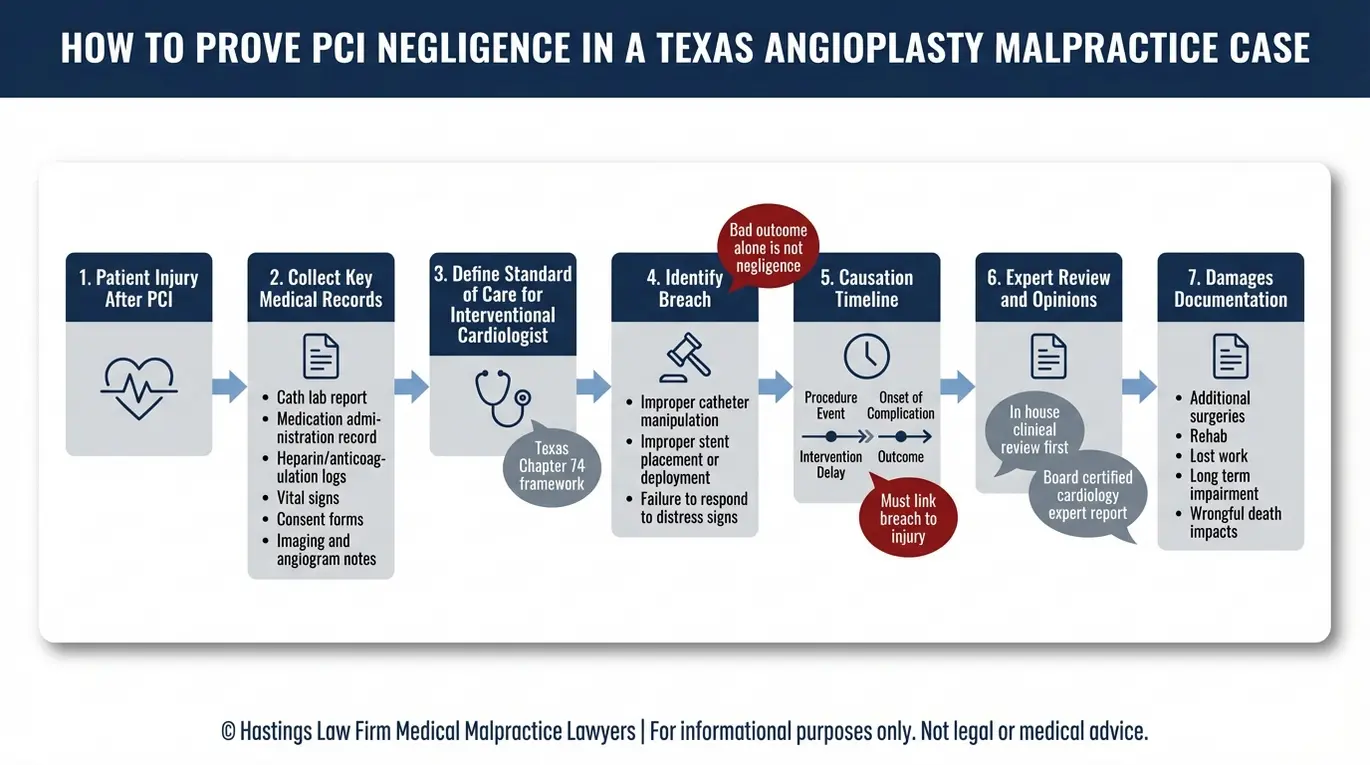
Medical liability in angioplasty cases is established by proving the cardiologist deviated from the standard of care during the percutaneous coronary intervention (PCI), a catheter-based procedure used to open narrowed or blocked coronary arteries, and that this deviation directly caused injury or death.
The standard of care refers to the level of treatment a reasonably competent interventional cardiologist would have provided under similar circumstances. In Texas, this standard is not aspirational or theoretical. It reflects what a qualified peer in the same specialty, with access to the same information, would have done at the time of the procedure. Cardiac catheterization, the process of threading a catheter through blood vessels to reach the heart, carries inherent risks. But when those risks materialize because of a specific error or omission, the case shifts from an unfortunate outcome to potential medical negligence.
This distinction matters. A bad result alone does not establish medical malpractice. The question is whether the cardiologist’s decisions and actions fell below what the medical community would consider acceptable. To answer that, we rely heavily on medical records and qualified expert testimony.
Medical records capture nearly every decision made before, during, and after the procedure. These include catheterization lab reports, angiographic images, nursing notes, and post-procedure monitoring logs. Our team reviews these records in detail to identify where a breach may have occurred.
Under the Texas Civil Practice and Remedies Code Chapter 74, a qualified medical expert must then confirm that the care provided fell below the accepted standard and that the breach caused the patient’s injury. If you believe your cardiac procedure went wrong because of a preventable error, an angioplasty attorney in Texas can help determine whether the evidence supports a claim.
Distinguishing Malpractice from Known Angioplasty Complications
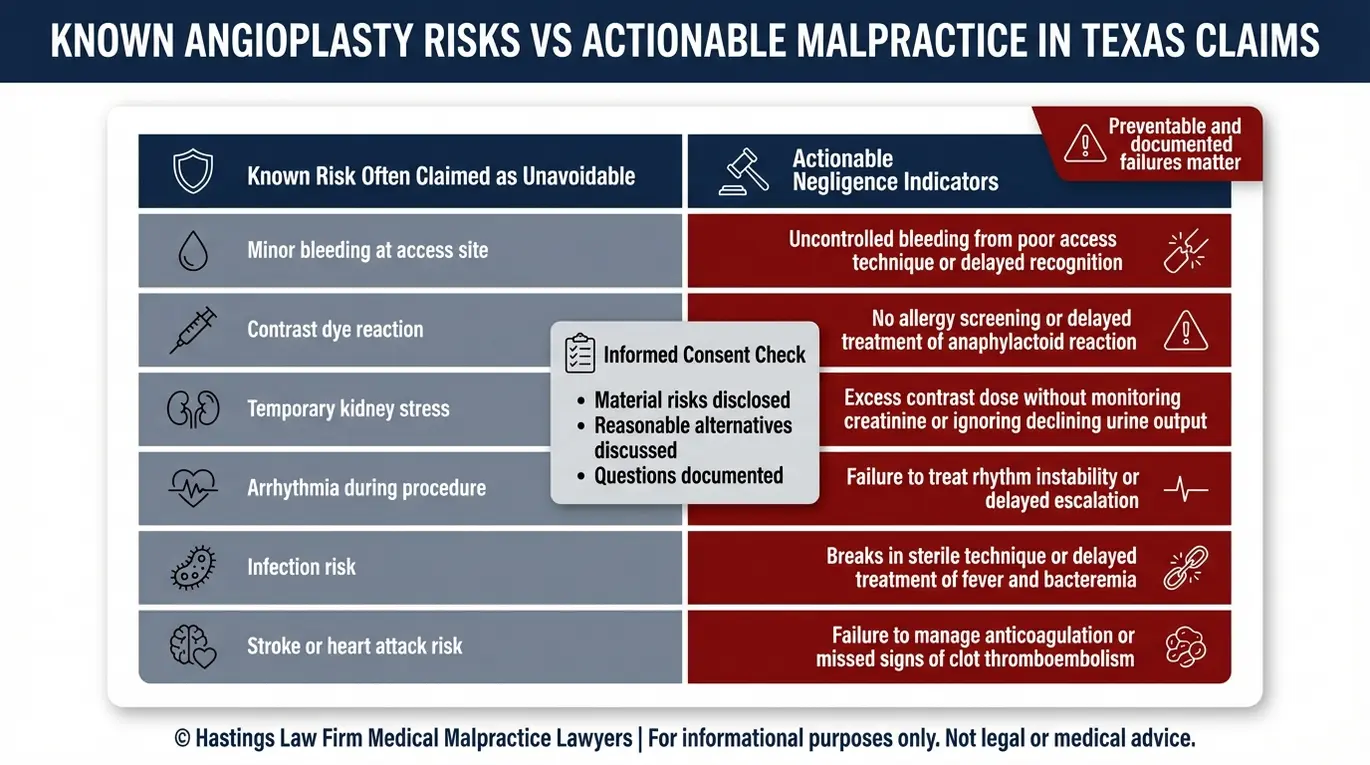
While risks like minor bleeding or temporary discomfort are common and expected, malpractice involves preventable errors, such as piercing an artery wall or ignoring signs of distress, that a competent cardiologist would have recognized and addressed.
Every patient undergoing angioplasty should receive informed consent. This means the cardiologist explained the material risks of the procedure and the patient agreed to move forward. Known complications can include bruising at the catheter insertion site, brief episodes of arrhythmia, or mild reactions to iodinated contrast media. This iodine-based dye is injected during imaging to visualize the arteries. Defense attorneys frequently point to these disclosed risks to argue that the injury was simply an accepted complication.
There is a clear line between a known risk and a preventable mistake. For example, contrast-induced acute kidney injury (CI-AKI), a form of kidney damage caused by contrast dye, can sometimes occur even with proper precautions. However, if a cardiologist administers excessive contrast dye without monitoring kidney function, that may cross into negligence. Similarly, a stroke or heart attack during the procedure could reflect an unavoidable event, or it could indicate a failure to monitor or manage blood thinners properly.
An experienced angioplasty malpractice lawyer examines whether the medical team followed established protocols or whether their actions fell short. The table below illustrates how we distinguish between these two categories:
| Known Risk (Defense Argument) | Actionable Negligence (Malpractice) |
|---|---|
| Minor bleeding or bruising at the catheter site | Uncontrolled bleeding from a perforated artery that was not promptly identified |
| Mild allergic reaction to contrast dye | Administering contrast dye despite a documented allergy history without premedication |
| Transient arrhythmia during catheter movement | Failing to respond to sustained arrhythmia or cardiac distress on monitoring |
| Slight soreness or discomfort post-procedure | Infection caused by a breach in sterile technique |
| Minor kidney stress from contrast dye | Kidney failure from excessive contrast dye use without hydration protocols in a high-risk patient |
The Hastings Law Firm Difference
Results matter, but what truly sets us apart is how we achieve them. Every verdict, every settlement, and every Texas courtroom victory comes from one guiding promise: To treat each client’s fight for justice as if it were our own.
This balance of skill, experience, and empathy reflects our core philosophy that justice should not only compensate the injured, but also make healthcare safer nationwide.

Common Surgical Errors During Angioplasty and Stent Placement
Common errors during these procedures include perforating the coronary artery with the guidewire, deploying a stent in the wrong location, or failing to recognize arterial dissection as it occurs.
In balloon angioplasty and stent placement, a surgeon guides a catheter through a blood vessel, typically from the wrist or groin, to the site of the blockage. These methods help improve blood flow in blocked arteries by physically opening the narrowed section. The surgeon then inflates a balloon catheter to compress the plaque, and deploys a coronary stent, a small mesh tube, to hold the artery open. Each step carries specific mechanical risks that become actionable when they result from carelessness or poor technique.
A five-year report from the Polish National Registry on percutaneous coronary interventions documented complication rates in complex coronary procedures. While some events are statistically expected, many are tied to procedural technique and decision-making. Errors that we may investigate include:
- Coronary artery perforation, where the guidewire or catheter punctures the artery wall, potentially causing life-threatening bleeding into the pericardial sac
- Over-inflation of the balloon catheter, which can rupture the artery or cause coronary artery dissection, a tear in the artery’s inner lining that disrupts blood flow
- Deploying a stent in the wrong segment of the artery, leaving the actual blockage untreated
- Failure to administer or properly manage anticoagulation medication, leading to blood clots or thromboembolism during or after the procedure
- Inadequate post-procedure monitoring, missing early signs of complications like clot formation or restenosis, the re-narrowing of the treated artery
Mechanical Failures in Stent Deployment
Beyond procedural technique, the physical deployment of the stent itself can go wrong. Stent deployment occurs when the surgeon places the mesh tube into the artery to keep it open. Stent underexpansion, where the stent fails to fully open against the artery wall, can leave the patient with restricted blood flow and a higher risk of clot formation. Stent fracture, a structural break in the metal framework, may occur due to improper sizing or placement in a segment of the artery subject to excessive movement.
These mechanical issues can trigger thromboembolism or progressive artery blockage, sometimes weeks or months after the initial procedure. When a drug-eluting stent (DES) is involved, incomplete expansion can also affect the delivery of the anti-restenosis medication the stent is designed to release. Our medical team evaluates post-procedure imaging and follow-up records to determine whether these failures were caused by device selection errors, deployment mistakes, or inadequate follow-up care.

Legal Recourse for Unnecessary Stent Implantation
Patients may have grounds to pursue legal action if a cardiologist implants a stent in an artery that did not require intervention, particularly when the procedure is driven by financial incentives rather than medical need.
Not every blocked artery needs a stent. The ACC/AATS/AHA/ASE/ASNC/SCAI/SCCT/STS 2017 Appropriate Use Criteria for Coronary Revascularization provide evidence-based guidelines that help determine when intervention is warranted. Under these Appropriate Use Criteria (AUC), stenting is generally considered appropriate when a patient has significant coronary stenosis, typically defined as 70% or greater blockage in a major coronary artery along with symptoms or objective evidence of reduced blood flow.
When a stent is placed in an artery with a blockage well below this threshold, the medical justification becomes questionable. This often happens when doctors bypass adequate diagnostic testing like stress tests or fractional flow reserve measurements. Unnecessary stent implantation is not a harmless act. A patient who receives an unneeded stent must take antiplatelet medications for a long time and faces ongoing risks of blood clots and restenosis. A medical malpractice attorney for angioplasty cases can work with independent cardiologists to review the original angiograms and diagnostic workup.
Recoverable Damages in Texas Cardiac Injury Cases
Patients harmed by cardiac negligence in Texas can recover economic damages for medical bills and lost wages, as well as non-economic damages for pain, suffering, and physical impairment.
The financial impact of a botched angioplasty or stent procedure often extends far beyond the initial hospitalization. Economic damages may include:
- Emergency treatment and corrective surgeries
- Ongoing cardiology care to manage risks of blood clots and restenosis
- Lost wages and diminished future earning capacity
- Home health services and adaptive medical equipment
These economic damages have no cap under Texas law. This means recovery reflects the full extent of documented financial losses. If a patient is unable to return to their previous profession due to physical limitations, the claim can account for the difference in lifetime earnings.
Non-economic damages compensate for the physical pain, emotional distress, and lasting impairment that follow a serious cardiac injury. Texas does cap non-economic damages in medical malpractice cases at $250,000 against all physicians or healthcare providers and $250,000 per healthcare institution. If a family loses a loved one because of medical negligence, they may pursue a wrongful death claim to help provide financial stability after a devastating loss.
Contact the Texas Healthcare Malpractice Attorneys at Hastings Law Firm Today for Help
Hospitals and their insurers have experienced legal teams working to protect their interests from the moment something goes wrong. You deserve a firm with the same level of preparation and medical knowledge working for you.
Hastings Law Firm brings together Board Certified trial attorneys, former defense lawyers, and in-house medical staff who focus solely on cases involving medical errors. Our founder, Tommy Hastings, is Board Certified in Personal Injury Trial Law, a credential held by less than 2% of Texas attorneys. Our team includes former defense lawyers who understand how hospitals and insurance companies build their cases.
If you or a loved one was seriously injured during an angioplasty or stent procedure, a Texas angioplasty malpractice lawyer at our firm is ready to listen. The consultation is free, confidential, and there is no fee unless we recover compensation for you. Contact us today to start getting the answers you deserve.
Frequently Asked Questions About Angioplasty Malpractice in Texas


This content was researched and written by the Hastings Law Firm editorial team, which includes attorneys, medical professionals, and experienced researchers. Our writing is informed by internal knowledge and practical experience, and we cross-check critical details against authoritative sources cited throughout. Every piece undergoes human-led fact-checking and legal review. Because legal and medical information can change, if you spot an error, please contact us. Learn more about our content standards and review process on our editorial policy page.

Brady D. Williams is a nationally recognized medical malpractice attorney who has spent his career handling high-stakes litigation for injured patients and families across the country. Licensed in both Texas and California, Brady draws on experience from hundreds of resolved medical cases to break down complex legal and medical topics for the people who need that information most. His writing reflects the same attention to detail and commitment to clarity that he brings to every case he handles.
