


Arizona Wrongful Birth Lawyer
Written by: Hastings Law Firm | Reviewed by: Tommy Hastings | Updated: July 27, 2026
Wrongful birth claims arise when prenatal screening or test results are missed, misread, or not communicated, leaving parents without the information needed to make informed decisions about a pregnancy. In Arizona, these cases often focus on whether a provider failed to detect or disclose a fetal abnormality and whether that failure caused a loss of parental choice and extraordinary financial burdens. Arizona law also places significant limits on many wrongful birth claims, with a narrow exception for gross negligence or intentional misconduct. If you or a loved one were harmed or worse due to wrongful birth in Arizona, contact Hastings Law Firm for a free, confidential case review.

Top Rated Arizona Attorneys for Failure to Detect Birth Defects
What You Should Know About Birth Defect Misdiagnosis Claims in Arizona:
- Legal options can be sharply limited in Arizona because many wrongful birth claims are restricted unless the conduct is grossly negligent or intentional.
- Accountability can extend beyond the treating physician because radiologists, genetic counselors, and diagnostic laboratories may share responsibility for missed or undisclosed prenatal abnormalities.
- Recovery can focus on extraordinary expenses and emotional harm because the claimed injury is the loss of informed parental choice rather than the child condition itself.
- Disputes often turn on whether accurate disclosure would have changed parental decisions because causation depends on showing a different reproductive choice was more likely.
- Severe financial impact can follow a missed prenatal diagnosis because damages may address lifetime medical care and other specialized needs beyond typical child rearing costs.
- Confusion about the claim type can affect outcomes because wrongful birth differs from birth injury and from a birth defect that was properly disclosed.
- Missed findings can stem from breakdowns in prenatal screening because imaging interpretation, test ordering, and result communication are recurring problem areas.
- Liability can arise from laboratory mistakes because specimen mix ups and reporting errors can produce false negative results.
- Options can narrow quickly when timing rules apply because medical malpractice limitations and discovery issues can affect whether a claim can proceed.
- Documentation can be central because prenatal records, lab reports, imaging studies, and communications may show whether accepted protocols were followed.

A Healthcare Focused Law Firm
Learning that your child has a serious genetic condition or congenital abnormality is life-changing. When that diagnosis comes at birth, after months of prenatal care that should have detected the condition, the emotional weight can feel even heavier. You trusted your medical team to provide accurate information about your pregnancy. If that trust was broken by a failure to screen, test, or communicate results, you may have a legal right to seek accountability.
An experienced Arizona wrongful birth lawyer can review your medical records, identify where the standard of care may have been violated, and explain what options are available to you and your family. At Hastings Law Firm, our team of attorneys, in-house nurses, and medical consultants focuses exclusively on medical malpractice. If you believe critical information about your pregnancy was missed or withheld, we welcome you to contact us for a free, confidential case evaluation.
What Qualifies as a Wrongful Birth Claim in Arizona
A wrongful birth claim is a medical malpractice lawsuit filed by parents who allege that a healthcare provider’s failure to warn them of a fetus’s genetic or congenital abnormalities deprived them of the opportunity to make an informed decision about the pregnancy. Wrongful birth is a legal concept where parents seek accountability for the loss of their right to make informed decisions about a pregnancy. The claim is not centered on the child’s condition itself. It is centered on the loss of choice.
Important Note About Arizona Law: Arizona Revised Statutes § 12-719 significantly restricts wrongful birth claims in Arizona. Under this statute, a person is not liable for damages in a wrongful birth action “based on a claim that, but for an act or omission of the defendant, a child or children would not or should not have been born,” regardless of whether the child is born with a birth defect or other adverse medical condition. However, the statute contains an important exception: it does not apply to civil actions for damages arising from an intentional or grossly negligent act or omission, including acts that violate criminal law. This means that while standard negligence-based wrongful birth claims face significant legal barriers in Arizona, claims involving gross negligence or intentional misconduct may still be viable. An Arizona wrongful birth attorney can evaluate whether your specific circumstances may fall within this exception.
Parents have a legal right to receive accurate, timely information about fetal health. This right is grounded in the principle of informed consent, which in the prenatal context means that your doctor had a duty to provide you with the medical information necessary to make meaningful decisions about continuing or terminating the pregnancy. When a provider withholds, overlooks, or fails to communicate that information, they may have violated the duty of care, the level of treatment a reasonably competent provider would deliver under similar circumstances. A lawyer for wrongful birth claims helps families assert this right by establishing that this duty was breached.
An Arizona wrongful birth lawyer examines whether the provider met that duty. These claims can involve physicians, radiologists, genetic counselors, and diagnostic laboratories. Any professional in the chain of prenatal care who fails to identify or disclose a known risk may bear responsibility.
The legal process is complex because it requires differentiating between an unavoidable outcome and one caused by negligence. Providers are not expected to be perfect, but they are expected to be prudent. When a deviation from standard practice occurs, it strips parents of their autonomy.
Our legal team includes former defense attorneys who understand the strategies medical institutions use to avoid accountability. This background provides a strategic advantage when investigating hospital protocols and identifying inconsistencies in medical records.
What makes wrongful birth distinct from other medical negligence claims is its focus on the parents’ right to know. The question is not whether the provider caused the condition. Rather, it is whether the failure to disclose the condition robbed the parents of the ability to prepare or consider options like termination of pregnancy. Wrongful birth attorneys in Arizona evaluate the full scope of prenatal care to determine where that breakdown occurred. By investigating the timeline of care, legal counsel can determine if the parents were given the full picture required to make the deeply personal decisions regarding their family’s future.
Common Medical Failures in Detecting Genetic Defects
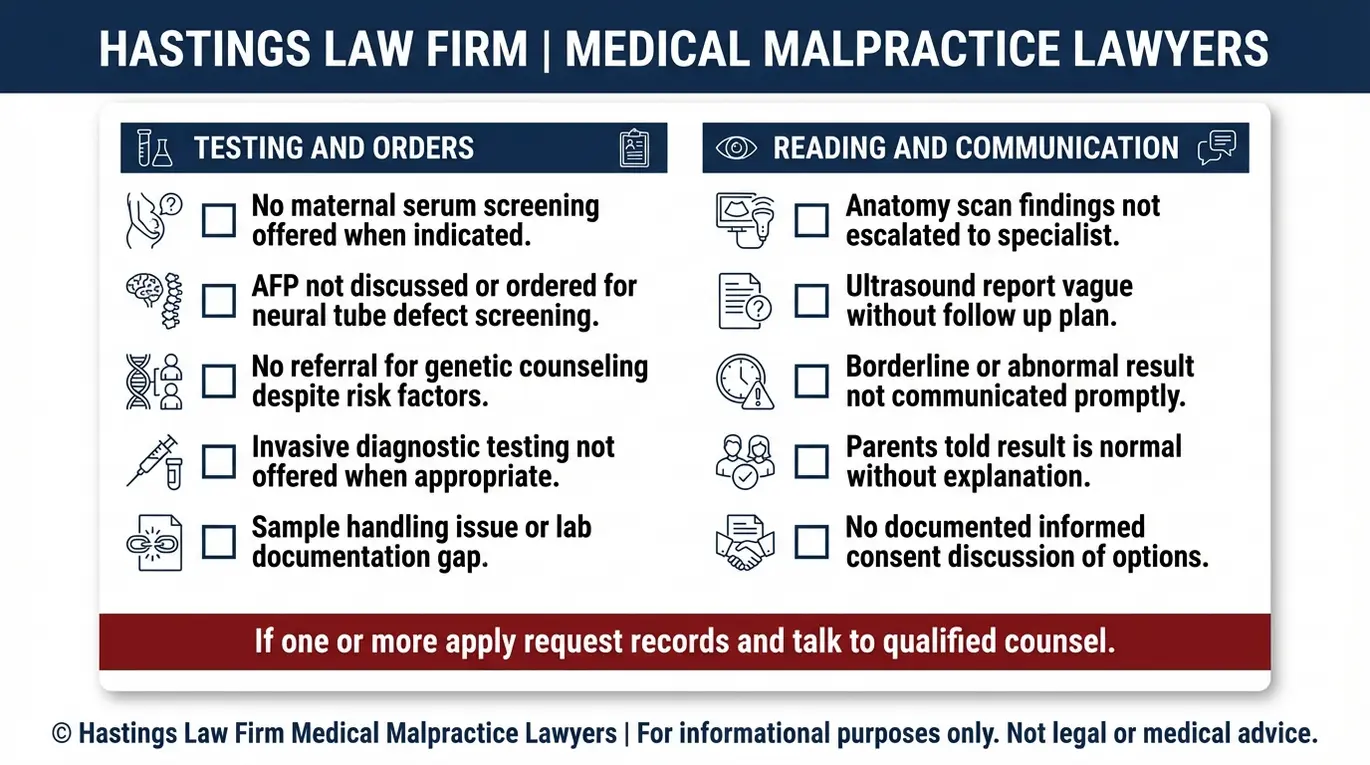
Medical malpractice in wrongful birth cases often stems from the failure to offer standard prenatal screening, the misinterpretation of ultrasound images, errors in genetic lab testing, or the failure to communicate abnormal test results to the parents in a timely manner. Prenatal screening consists of routine tests and scans used to detect potential health issues in a developing fetus. These failures can occur at multiple points throughout a pregnancy, and a wrongful birth lawyer in Arizona will trace the care timeline to identify exactly where the process broke down. Experienced wrongful birth counsel will review communication logs to ensure every critical finding was conveyed and that all standard protocols were followed during the gestation period.
The most common categories of medical failure include:
- Diagnostic oversights on imaging: The 20-week anatomy scan, a second-trimester ultrasound used to evaluate fetal structure, is one of the most important screening tools in prenatal care. According to the National Center for Biotechnology Information’s review of second-trimester sonography assessment protocols, this scan is designed to identify structural abnormalities in the brain, spine, heart, and limbs. When a radiologist or sonographer misreads these images or fails to flag an abnormal finding, conditions like spina bifida or congenital heart defects can go undetected.
- Failure to order appropriate testing: Maternal serum screening, a blood test that measures markers like alpha-fetoprotein (AFP), helps identify pregnancies at higher risk for chromosomal abnormalities and neural tube defects. For mothers with elevated risk factors based on age, family history, or prior results, the standard of care may require additional testing such as amniocentesis or chorionic villus sampling. When these tests are not offered or ordered, the window for diagnosis can close entirely.
- Communication breakdowns: In some cases, a screening does flag an abnormality, but the result is not communicated to the patient. A borderline finding may be minimized, a follow-up referral may not be made, or an abnormal lab value may sit in a chart without ever being discussed with the parents.
It is not uncommon for a busy practice to overlook a report. However, system failures are not a valid defense. If a critical result sits unread in an electronic medical record, or if a receptionist files a report without physician review, the standard of care has been breached.
- Missed conditions: The types of conditions most commonly at issue in these cases include Down syndrome, cystic fibrosis, thalassemia, and neural tube defects such as spina bifida and anencephaly. Viral infections like Rubella can also cause severe complications if infection occurs during pregnancy, particularly in the first trimester. The Centers for Disease Control and Prevention’s overview of neural tube defects describes these as serious conditions affecting the brain and spine that develop very early in pregnancy, making early screening essential.
Arizona wrongful birth lawyers review every prenatal record, lab order, and imaging report to determine whether the care team followed accepted protocols or fell short.
The Hastings Law Firm Difference
Results matter, but what truly sets us apart is how we achieve them. Every verdict, every settlement, and every Arizona courtroom victory comes from one guiding promise: To treat each client’s fight for justice as if it were our own.
This balance of skill, experience, and empathy reflects our core philosophy that justice should not only compensate the injured, but also make healthcare safer nationwide.

Distinguishing Wrongful Birth from Birth Injury and Birth Defects
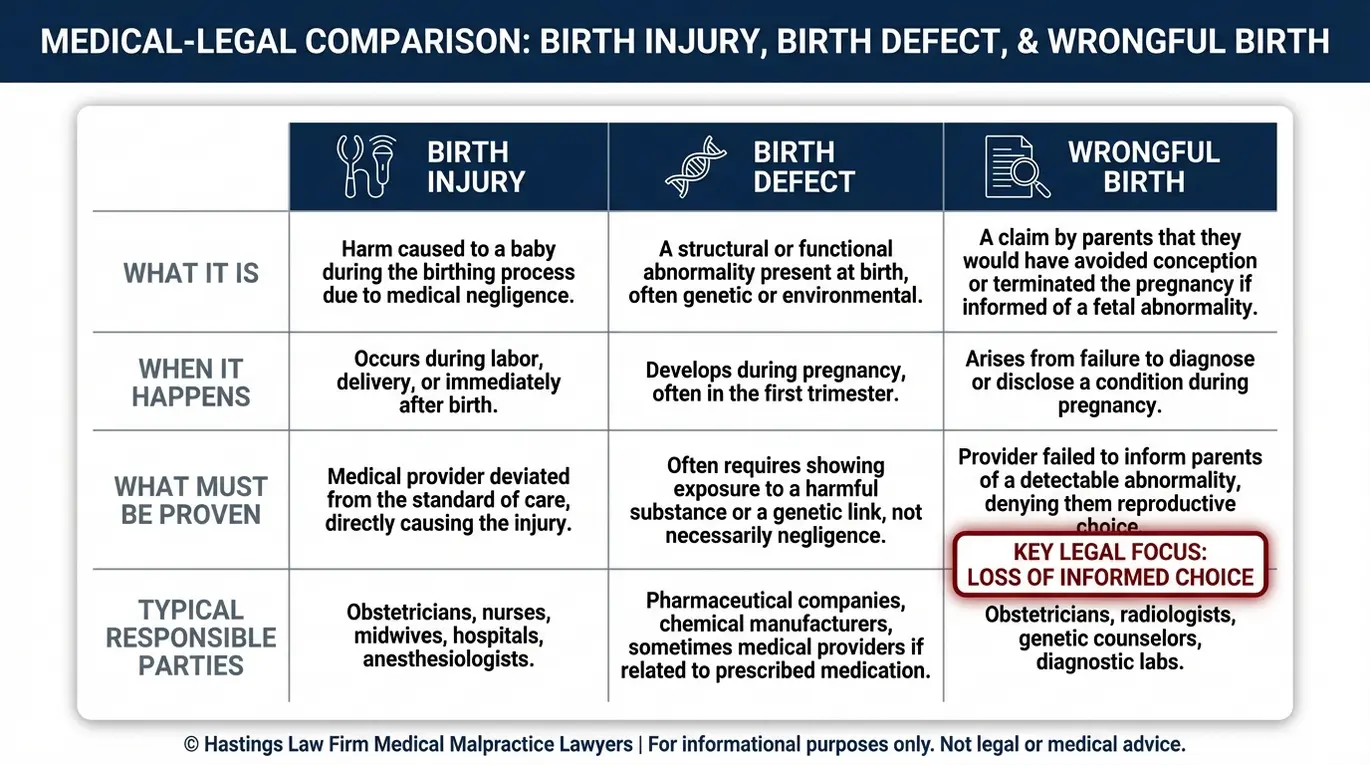
While a birth injury is physical harm caused by medical error during delivery, and a birth defect is an inherent condition of the fetus, a wrongful birth claim specifically addresses the provider’s negligent failure to detect or disclose that defect during the pregnancy. These claims focus on a missed diagnosis rather than an injury caused during the delivery process itself. These three concepts are frequently confused, but they involve very different legal theories.
A birth injury happens when something goes wrong during labor or delivery. Oxygen deprivation from a delayed C-section or nerve damage from improper use of forceps are examples. The provider’s actions directly caused the harm. A birth defect, on the other hand, is a congenital condition, a structural or chromosomal abnormality, often referred to as congenital birth defects, that existed before birth. The provider did not cause the defect.
A wrongful birth claim bridges the gap. It holds the provider accountable not for causing the condition, but for failing to identify prenatal abnormalities through available screening tools. The legal remedy is for the missed diagnosis.
| Category | Cause | Provider’s Role | Legal Claim |
|---|---|---|---|
| Birth Injury | Medical error during labor or delivery | Provider directly caused the harm | Medical malpractice for delivery negligence |
| Birth Defect | Genetic or structural abnormality (congenital) | Provider did not cause the condition | No claim if properly disclosed |
| Wrongful Birth | Provider failed to detect or disclose a known defect | Provider missed or withheld the diagnosis | Malpractice claim for lost parental choice |
Understanding this distinction matters because it determines how the case is investigated, what evidence is needed, and what types of damages may be recoverable. A wrongful birth lawyer will focus on the prenatal care record rather than the delivery itself. An Arizona wrongful birth attorney can help you determine which type of claim applies to your family’s situation.
Proving Negligence and The Four Part Legal Test
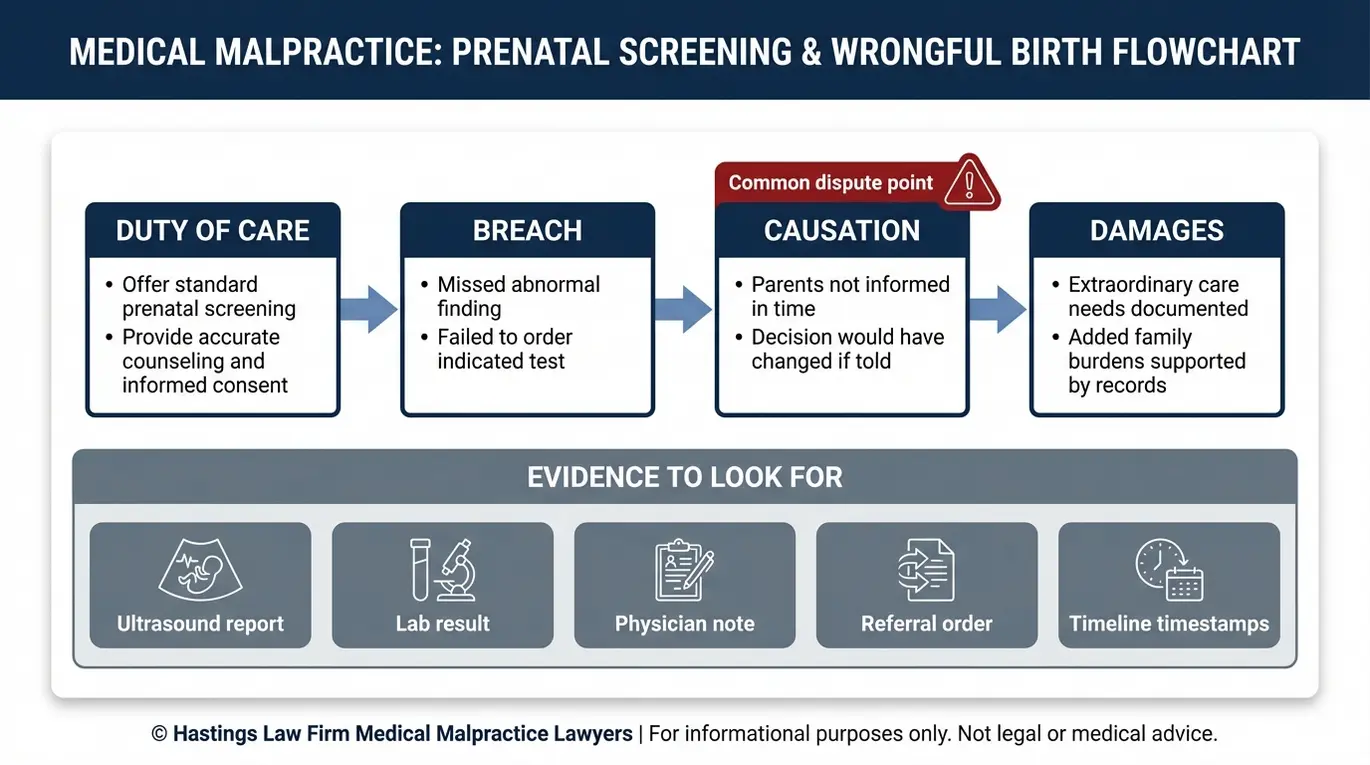
To prevail in a wrongful birth case, parents must prove that the provider owed a duty of care, breached that duty by failing to diagnose or disclose the condition, caused the parents to lose the opportunity to make an informed reproductive decision, and that this failure resulted in extraordinary financial damages. In Arizona, medical malpractice requires proving that a healthcare professional failed to meet the accepted medical standard. This is the same four-element negligence framework that applies to all medical malpractice claims, but the way each element is proven in wrongful birth cases has unique characteristics.
Here is what each element requires:
- Duty: The healthcare provider had an obligation to offer standard prenatal screening and communicate results. This duty extends to OB/GYNs, maternal-fetal medicine specialists, genetic counselors, and diagnostic labs.
- Breach: The provider deviated from accepted medical practice. This could mean failing to order amniocentesis, a procedure in which a small amount of amniotic fluid is tested for chromosomal abnormalities like aneuploidy, or not recommending chorionic villus sampling (CVS), an early-pregnancy test that analyzes placental tissue for genetic conditions. It could also mean misreading imaging or ignoring abnormal blood work.
- Causation: The parents must establish that had they received accurate information, they would have made a different decision regarding the pregnancy, whether that meant terminating the pregnancy or preparing differently for a child with special needs. In some jurisdictions, this involves demonstrating a greater than 50% disclosure probability, meaning it is more likely than not that the parents would have chosen differently had they been informed. The recently decided *CV-24-0259-PR* before the Supreme Court of the State of Arizona addresses how Arizona courts evaluate the relationship between provider disclosure and parental decision-making in these claims.
- Damages: The parents must quantify the financial burden resulting from the lost choice, typically measured by the extraordinary costs of raising a child with the undetected condition.
An Arizona wrongful birth lawyer works with qualified medical experts to reconstruct the prenatal timeline, compare the care provided against accepted standards, and establish where the breakdown occurred. Our wrongful birth legal team examines medical records, lab reports, imaging studies, and provider communications to build a clear picture of what should have happened versus what did.
Lab Errors and Misinterpretation of Results
Liability in wrongful birth cases does not always rest with the treating physician. Diagnostic laboratories are responsible for analyzing genetic samples with high precision to ensure parents receive accurate results. Laboratories that process genetic testing, blood work, or tissue samples can also bear responsibility when errors occur at the diagnostic level. Common lab mistakes include a specimen mix-up or sample mislabeling, where one patient’s genetic material is confused with another’s, producing a false negative prenatal test result, a report that incorrectly shows no abnormality when one exists.
These errors may involve mishandling of samples during processing, incorrect calibration of testing equipment, or interpretation errors of data by lab personnel. When an attorney for missed birth defects investigates a wrongful birth case, the lab’s chain of custody, quality control records, and reporting protocols are all part of the review. If a lab error deprived parents of an accurate diagnosis, that lab may be held independently liable alongside the referring provider.
Compensation for the Extraordinary Costs of Special Needs Care
Damages in wrongful birth cases are designed to cover the extraordinary expenses associated with the child’s condition, including lifetime medical care, specialized therapy, home modifications, and special education costs that exceed the cost of raising a healthy child. Damages are financial awards intended to cover costs like medical bills and specialized therapy. The legal term “extraordinary expenses” refers to this difference: the financial gap between what it costs to raise a child without the condition and the actual cost of the specialized care the child requires. Compensation typically includes both economic damages for tangible costs and non-economic damages for the mental anguish associated with the deprivation of choice.
Parents may also seek compensation for emotional distress and mental anguish resulting from the lost opportunity to prepare or make informed choices. Because these costs often extend across a child’s entire lifetime, an Arizona wrongful birth lawyer will typically work with medical and financial experts to develop a life care plan, a detailed projection of the child’s future care needs and associated costs. This plan becomes a central piece of evidence in establishing the full scope of damages.
Contact the Arizona Birth Injury Attorneys at Hastings Law Firm Today for Help
No amount of compensation can change your child’s diagnosis. Led by Tommy Hastings, a board-certified trial lawyer with over 20 years of experience, we prepare every case to be trial-ready from day one.
At Hastings Law Firm, our legal and medical team reviews prenatal records, lab results, and imaging studies to determine whether your providers met the standard of care. Our in-house nursing staff and network of national medical experts allow us to evaluate these cases with the clinical precision they require. We work on a contingency fee basis, meaning you pay no attorney fees or costs unless we recover compensation for your family.
If you believe your medical team failed to detect or disclose a prenatal abnormality, an Arizona wrongful birth lawyer at our firm is ready to listen. Contact us for a free, confidential case evaluation and let us help you find the answers you deserve.
Frequently Asked Questions About Wrongful Birth in Arizona


This content was researched and written by the Hastings Law Firm editorial team, which includes attorneys, medical professionals, and experienced researchers. Our writing is informed by internal knowledge and practical experience, and we cross-check critical details against authoritative sources cited throughout. Every piece undergoes human-led fact-checking and legal review. Because legal and medical information can change, if you spot an error, please contact us. Learn more about our content standards and review process on our editorial policy page.

Tommy Hastings, founder of Hastings Law Firm, is a board-certified personal injury trial lawyer dedicated exclusively to healthcare injury cases. Since 2001, he has represented injured patients and families in litigation against major hospital systems, pharmaceutical companies, and negligent healthcare providers nationwide. He has handled numerous high-profile cases that have drawn national media attention and resulted in multi-million dollar recoveries. He draws on that experience in his writing, helping readers understand how these cases work and what options may be available to them.
