


Texas Velamentous Cord Insertion Lawyer
Written by: Hastings Law Firm | Reviewed by: Tommy Hastings | Updated: July 27, 2026
Velamentous cord insertion is a high risk pregnancy complication where the umbilical cord attaches in a way that leaves fetal blood vessels less protected. When it is missed during prenatal screening, labor and delivery can turn dangerous quickly, with rapid blood loss and oxygen deprivation that can cause permanent injury or worse. Clear documentation, appropriate imaging, and timely delivery planning are central to preventing avoidable harm. If you or a loved one were harmed or worse due to velamentous cord insertion errors in Texas, contact Hastings Law Firm for a free, confidential case review.

Top Rated Representation for Preventable Umbilical Cord Birth Injuries
What You Should Know About Placental Cord Insertion Misdiagnosis Claims in Texas:
- Permanent injury or worse can result when velamentous cord insertion or vasa previa is not identified before labor and delivery.
- Options for preventing catastrophic outcomes can be lost when the placental cord insertion site is not visualized and documented during routine prenatal imaging.
- A planned cesarean delivery can be central to avoiding rapid fetal blood loss when vasa previa is diagnosed before labor.
- Disputes often focus on whether ultrasound imaging and follow up were appropriate when risk factors or warning signs were present.
- Severe brain injury can follow rapid oxygen deprivation after membrane rupture when unprotected fetal vessels tear.
- Recovery can be limited for non economic harms in Texas medical malpractice cases due to statutory caps.
- Compensation for long term care needs can be driven by economic damages such as future medical costs and lost earning capacity that are not capped under Texas law.
- Case outcomes can depend heavily on what prenatal records, ultrasound reports, fetal monitoring strips, and delivery notes show about clinical decision making.

A Healthcare Focused Law Firm
When a pregnancy complication like velamentous cord insertion goes undiagnosed, the consequences for a baby can be serious and permanent. If your family is living with the aftermath of a birth injury that proper prenatal screening should have prevented, you deserve honest answers about what happened and why.
At Hastings Law Firm, our medical malpractice team includes in-house nurse consultants and former defense attorneys who understand how hospitals respond to these claims. As a board-certified Texas velamentous cord insertion error lawyer, a distinction achieved by less than 2% of Texas attorneys, founder Tommy Hastings uses his experience to advocate for injured families. A 2025 inductee into ABOTA, Tommy Hastings and his team focus exclusively on medical negligence cases, and we prepare every case as if it is going to trial.
If you believe your child’s injury was preventable, we can review what happened and explain your options during a free, confidential consultation. You pay nothing unless we recover compensation for your family.
Understanding Velamentous Cord Insertion and Its Risks
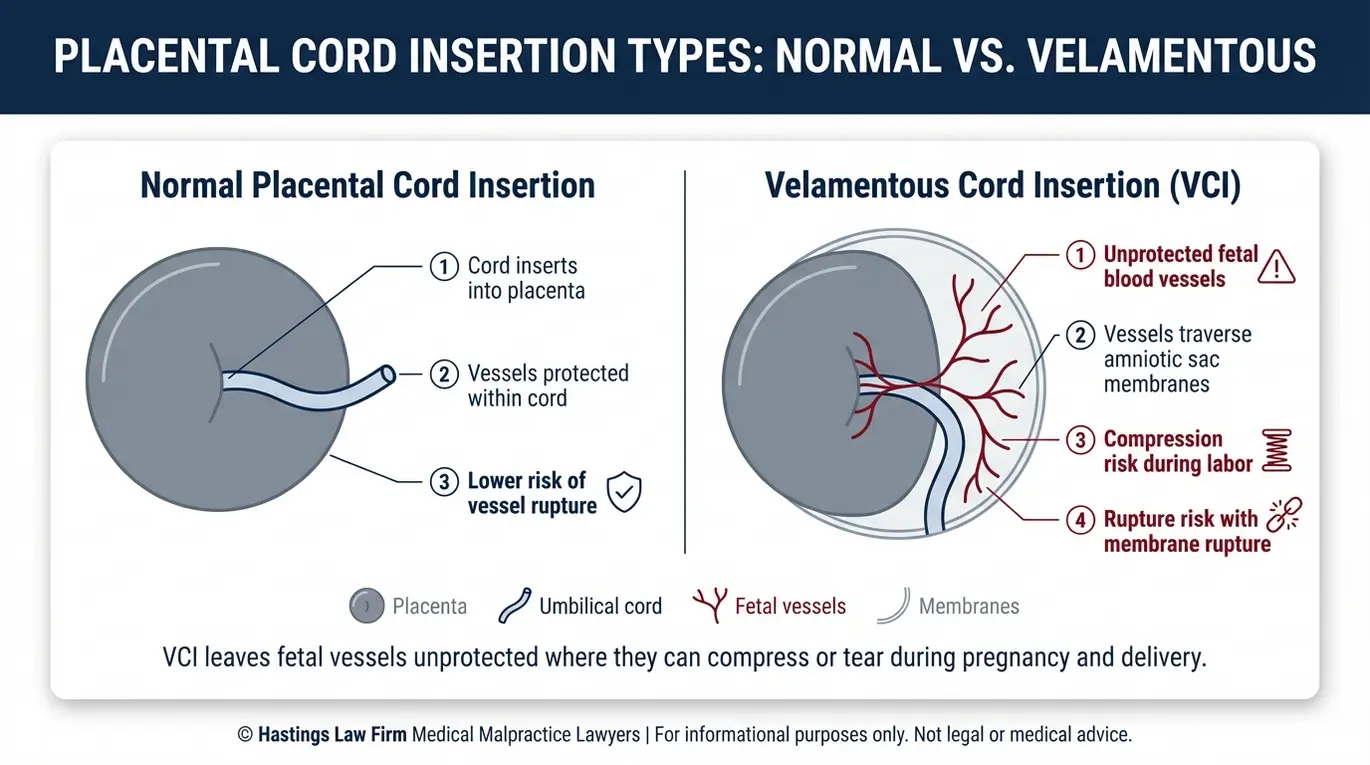
Velamentous cord insertion (VCI) is a high-risk pregnancy complication where the umbilical cord inserts into the fetal membranes rather than the center of the placenta, leaving fetal blood vessels unprotected and vulnerable to rupture. Recognizing this condition early is essential to preventing serious harm during pregnancy and delivery.
In a normal pregnancy, the umbilical cord attaches directly to the placental disc. This central connection surrounds and protects the fetal blood vessels within a layer of insulating tissue called Wharton’s jelly. With velamentous cord insertion, the cord instead attaches to the chorioamniotic membranes, the thin tissue lining the amniotic sac. The blood vessels must then travel across these fragile, unsupported membranes before reaching the placenta.
The placental cord insertion site, meaning the precise location where the cord meets the placenta, determines how well-protected those vessels are. Texas velamentous cord insertion attorneys note that when the insertion is abnormal, as with VCI, the exposed vessels lack the structural protection they need and can be compressed or torn during labor.
| Feature | Normal Cord Insertion | Velamentous Cord Insertion |
|---|---|---|
| Insertion Site | Directly into the placental disc | Into the fetal membranes, away from the placenta |
| Vessel Protection | Surrounded by Wharton’s jelly | Unprotected; vessels traverse thin membranes |
| Risk of Rupture | Very low | Significantly elevated, especially during labor |
| Associated Conditions | Typically none | Vasa previa, fetal growth restriction |
Several known risk factors should prompt closer monitoring by an OB-GYN. Pregnancies conceived through in vitro fertilization (IVF) carry a higher rate of abnormal cord insertion. Research published by PubMed Central on the association of assisted reproductive technology with placental and umbilical abnormalities has confirmed this correlation. Multiple gestations (twins or higher-order pregnancies), placenta previa, and advanced maternal age also increase risk.
A related condition, marginal cord insertion, occurs when the cord attaches near the edge of the placenta rather than the membranes. While generally less dangerous than VCI, marginal insertion still warrants careful observation. A velamentous cord insertion error attorney evaluates whether the treating physician identified these risk factors and responded appropriately during prenatal care.
During labor, contractions and membrane rupture can compress or tear the exposed vessels. Because a baby’s total blood volume is remarkably small, even a brief period of hemorrhage can become life-threatening within minutes.
The Vital Importance of Diagnosing Vasa Previa and VCI
Physicians must diagnose VCI and vasa previa using transvaginal ultrasound and Color Doppler imaging during the second trimester so they can schedule a C-section and prevent fatal hemorrhage during labor. When these conditions go undetected, a delivery that should have been carefully planned can become an emergency with serious outcomes.
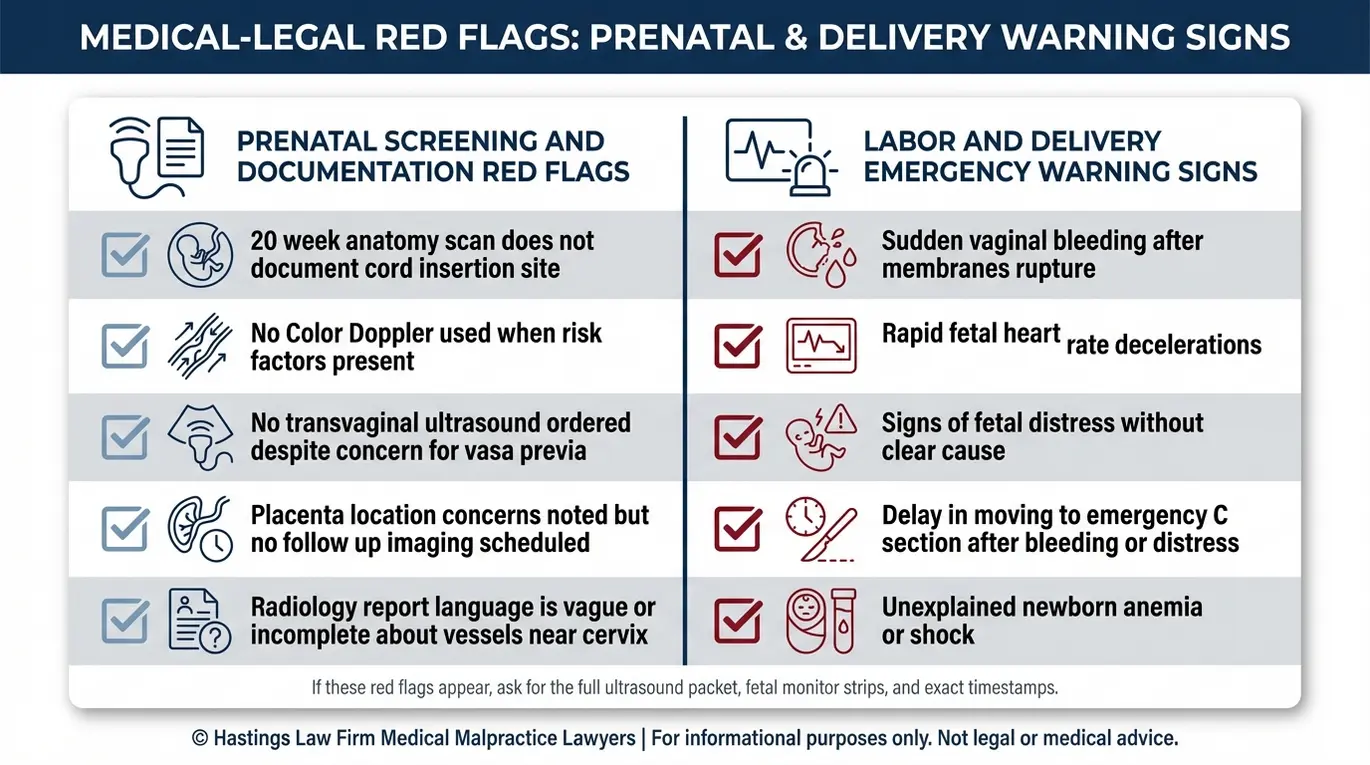
The standard of care in prenatal care requires that the cord insertion site be visualized during the routine anatomy scan, typically performed around 20 weeks of gestation. This scan is the primary opportunity for an OB-GYN or radiologist to identify whether the umbilical cord attaches normally to the placenta or inserts into the membranes.
When VCI is present, there is a serious risk of a related condition called vasa previa, which occurs when unprotected fetal blood vessels cross over or run near the internal opening of the cervix. If these vessels are in the path of delivery, they can rupture when the membranes break, causing rapid and potentially fatal blood loss for the baby.
A transvaginal ultrasound, an imaging technique where the ultrasound probe is placed inside the vaginal canal for a closer view of the cervix and lower uterine structures, is a reliable tool for detecting vasa previa. When combined with Color Doppler imaging, which maps blood flow through the vessels in real time, physicians can identify at-risk vessels with a high degree of accuracy.
A recent systematic review and meta-analysis published in PubMed on ultrasound screening for vasa previa supports the effectiveness of prenatal ultrasound screening in detecting this condition before labor begins.
Diagnostic steps that should occur during prenatal care include:
- Identification of the cord insertion site during the 20-week anatomy ultrasound
- Transvaginal ultrasound with Color Doppler if VCI or a low-lying placenta is suspected
- Serial monitoring of fetal heart rate patterns throughout the third trimester
- Assessment for placenta previa or other placental abnormalities that increase risk
- Documentation of findings and communication of the diagnosis to the patient
When vasa previa is diagnosed in advance, the standard management approach is a planned C-section, typically scheduled between 34 and 37 weeks of gestation. This allows delivery before labor begins naturally and before the membranes have a chance to rupture on their own. A Texas velamentous cord insertion error lawyer examines whether these diagnostic and management steps were followed, and if not, why they were missed.
Allowing a patient with undiagnosed vasa previa to proceed with vaginal delivery exposes the baby to risks that a timely diagnosis would have eliminated entirely.
The Hastings Law Firm Difference
Results matter, but what truly sets us apart is how we achieve them. Every verdict, every settlement, and every Texas courtroom victory comes from one guiding promise: To treat each client’s fight for justice as if it were our own.
This balance of skill, experience, and empathy reflects our core philosophy that justice should not only compensate the injured, but also make healthcare safer nationwide.

Catastrophic Complications of Abnormal Cord Insertion
Failure to manage VCI can lead to vessel rupture upon membrane rupture, resulting in rapid fetal exsanguination, oxygen deprivation, and permanent brain injuries. The speed at which these complications develop is what makes an undiagnosed velamentous cord insertion so dangerous.
When the amniotic membranes break during labor, a process known as rupture of membranes (ROM), any unprotected fetal blood vessels in the path can tear open. Because these vessels carry the baby’s blood supply between the placenta and the umbilical cord, a tear can cause fetal exsanguination, the rapid loss of the baby’s blood volume. A full-term newborn has roughly 80 milliliters of blood per kilogram of body weight. Losing even a small fraction of that volume can trigger cardiovascular collapse in minutes.
According to a systematic review published through Beaumont Scholarly Works on the incidence and causes of perinatal death in prenatally diagnosed vasa previa, the mortality risk associated with undiagnosed vasa previa during delivery remains high compared to cases detected before labor.
Even when hemorrhage does not prove immediately fatal, the resulting oxygen deprivation can cause severe and lasting damage. The injuries most commonly associated with velamentous cord insertion errors, which are frequently litigated by Texas velamentous cord insertion attorneys, include:
- Hypoxic-ischemic encephalopathy (HIE): A form of brain damage caused when the brain is deprived of adequate oxygen and blood flow. HIE can range from mild, with short-term effects, to severe, causing permanent neurological impairment.
- Cerebral palsy: A group of disorders affecting movement, muscle tone, and coordination. Cerebral palsy frequently results from oxygen deprivation during or shortly before delivery and may require lifelong therapy, adaptive equipment, and full-time care.
- Fetal distress and organ damage: Prolonged oxygen deprivation can harm not only the brain but also the heart, kidneys, and other organs, compounding the child’s medical needs.
- Stillbirth or neonatal death: In the most tragic outcomes, the baby does not survive the hemorrhage or the resulting lack of oxygen. These wrongful death cases represent a complete failure of the care that was owed to both parent and child.
The necessary timing in these cases is essential. When VCI and vasa previa are diagnosed before labor, a scheduled C-section eliminates the risk of membrane rupture during delivery. The birth injury occurs not because the condition itself is untreatable, but because the opportunity to treat it was missed.
A Texas VCI birth injury attorney investigates whether the medical team had the information, or should have had the information, to prevent the severe outcome.
Proving Medical Malpractice in Texas VCI Cases
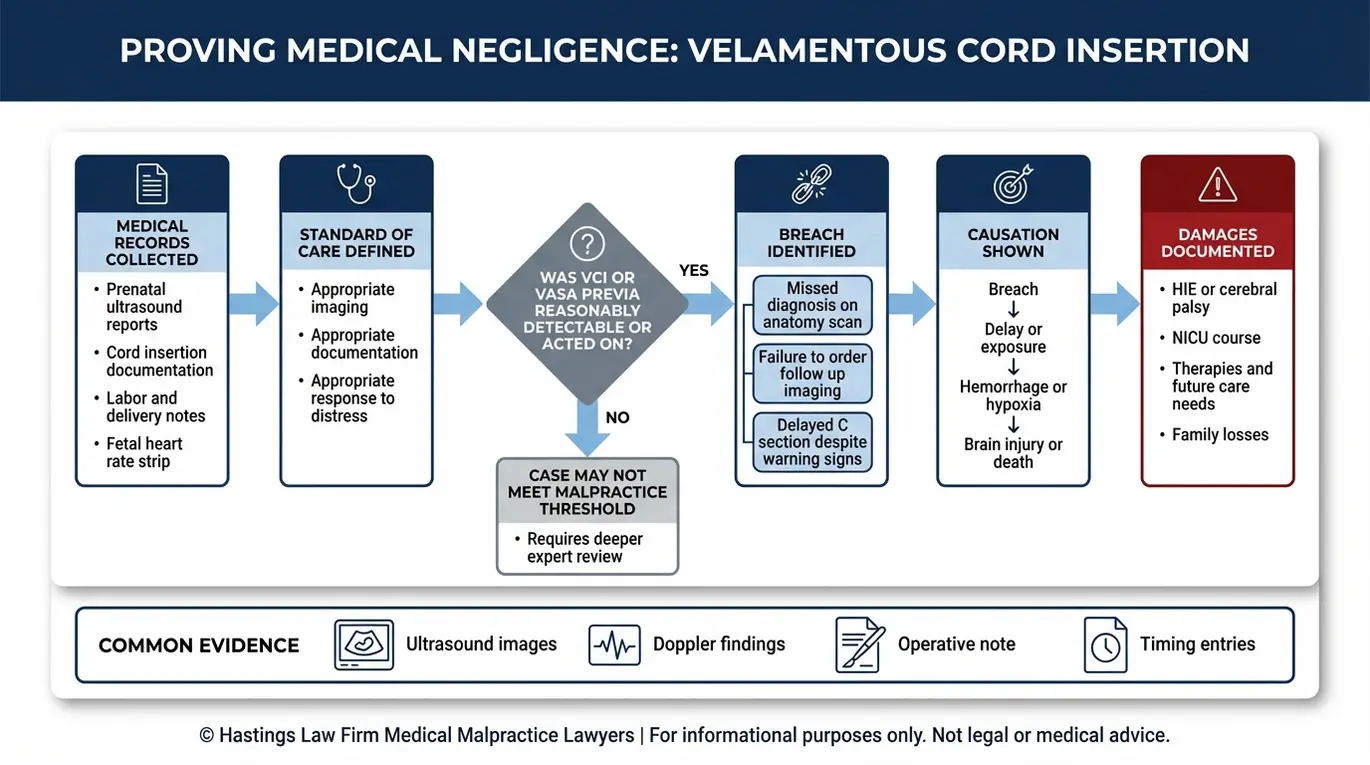
To prove malpractice in a VCI case, a lawyer must demonstrate that the OB-GYN or radiologist violated the standard of care by failing to detect the condition on ultrasound or failing to order a timely C-section despite distress signals. This requires a detailed reconstruction of the prenatal and delivery timeline, supported by qualified expert testimony.
Medical malpractice lawsuits in Texas require proof of four elements. In a velamentous cord insertion case, each element connects directly to specific clinical decisions or omissions:
- Duty: The physician or healthcare provider owed a duty of care to the patient. In obstetric care, this duty includes performing appropriate prenatal screening and responding to abnormal findings.
- Breach: The provider failed to meet the accepted standard of care. This could mean failing to identify the cord insertion site during the anatomy scan, not ordering a transvaginal ultrasound when risk factors were present, or not scheduling a C-section after a vasa previa diagnosis.
- Causation: The breach directly caused or contributed to the injury. The legal team must show that if the provider had acted appropriately, the outcome would have been different.
- Damages: The child, the parents, or both suffered measurable harm as a result, whether physical, financial, or emotional.
Each of these elements requires support from medical expert testimony. Our team works with board-certified maternal-fetal medicine specialists and radiologists who can review the imaging studies, medical records, and fetal monitoring strips to determine whether the standard of care was met.
Common examples of OB-GYN negligence handled by a Texas velamentous cord insertion lawyer include:
Missed diagnosis. The 20-week anatomy scan is the standard opportunity to visualize the placental cord insertion site. If the sonographer or interpreting physician failed to document the insertion location, or if images were of poor quality and no follow-up was ordered, that gap can form the basis of a breach of the standard of care.
Failure to react to warning signs. Fetal heart rate decelerations, which are drops in the baby’s heart rate that can indicate cord compression or reduced blood flow, should trigger immediate evaluation. Color Doppler ultrasound, an imaging method that uses sound waves to visualize blood movement through vessels, can confirm whether fetal vessels are at risk. If these tools were available and not used, that omission matters.
Delayed C-section. When vaginal bleeding occurs during labor in a patient with known or suspected vasa previa, an emergency C-section may be the only way to prevent severe blood loss. A delay of even minutes can mean the difference between a healthy delivery and a permanent brain injury. A Texas VCI malpractice lawyer focuses on building a minute-by-minute timeline to identify where intervention should have occurred.
At Hastings Law Firm, our in-house medical staff, including nurse practitioners and patient advocates, assist in the initial review of records to identify these critical decision points before the case even enters litigation.
The Legal Process for Texas Birth Injury Lawsuits
The legal process begins with a thorough investigation and filing the lawsuit, followed by submission of an expert report within 120 days after the defendant responds, and then discovery and aggressive litigation designed to dismantle the defense’s claims that the injury was unavoidable. Understanding how this process works can reduce some of the uncertainty families feel when considering a lawsuit.
Step 1: Free Case Evaluation and Medical Record Review
The process starts with a confidential consultation. At Hastings Law Firm, a patient advocate leads this initial screening to understand what happened and determine whether the case warrants further investigation. If the case is accepted, our in-house medical team conducts a detailed review of all prenatal records, ultrasound reports, fetal monitoring strips, delivery notes, and postnatal documentation.
Step 2: Filing the Lawsuit
Your Texas velamentous cord insertion error lawyer files the lawsuit in the appropriate Texas court. The statute of limitations for medical malpractice in Texas is generally two years from the date of the negligent act. For minor children, the timeline is different. Children who are injured by medical malpractice before they turn 12 years old must have their lawsuit filed before their 14th birthday, regardless of when the injury occurred or was discovered. For children who are 12 or older at the time of injury, the standard two-year statute of limitations applies. These deadlines are strict, and missing them can permanently bar recovery.
Step 3: Expert Report Requirement
Texas law requires that after the defendant files their answer to the lawsuit, the patient must serve a detailed expert report on each defendant within 120 days. This report must be prepared by a qualified medical expert and must confirm that the claim has merit, identify the specific standard of care violations, explain how the defendant breached that standard, and establish causation. Our firm works with a national network of maternal-fetal medicine specialists, radiologists, and neonatologists who provide objective, credible opinions. Meeting this 120-day deadline is critical, as failure to do so can result in dismissal of the case.
Step 4: Discovery and Depositions
During discovery, both sides exchange evidence. This includes interrogatories, document requests, and depositions of the treating physicians, nurses, sonographers, and the recording of expert testimony. The deposition phase is often where the strength of a VCI malpractice case becomes clear, as the defense’s experts and the patient’s experts present competing interpretations of the medical evidence. Our trial-ready preparation means we build the evidentiary foundation from day one so we are prepared for these critical moments.
Step 5: Settlement Negotiation or Trial
Many birth injury cases resolve through settlement once the evidence has been fully developed. Because we prepare every case as though it will go to a jury, defense counsel and insurance carriers understand we will not accept an offer that undervalues the harm done. If a fair resolution cannot be reached, we are prepared to present the case at trial.
Understanding the Two Plaintiffs Concept
In Texas birth injury cases involving velamentous cord insertion errors, experienced Texas velamentous cord insertion attorneys often manage two separate legal claims. This legal strategy addresses the unique ways a birth injury impacts both the child and their caregivers. The child has their own claim for pain, suffering, loss of future earning capacity, and the cost of future medical care.
Because the child is a minor, the court will typically appoint a guardian ad litem, an independent representative who protects the child’s interests in any settlement or verdict. This ensures that compensation designated for the child’s lifetime care is properly managed and preserved. Both claims must be evaluated independently, and the damages for each are calculated based on distinct legal criteria.
Calculated Damages for VCI Birth Injuries
Damages in VCI cases are calculated to cover the lifetime cost of care for the child, including medical treatment, therapy, and lost earning capacity, as well as non-economic damages for pain and suffering. Because many children injured by velamentous cord insertion errors require decades of specialized support, the financial scope of these cases can be substantial.
Economic damages represent the measurable financial losses the family has incurred and will continue to incur. A life care plan, developed by medical and economic experts, projects the total cost of the child’s needs over their full life expectancy. A life care plan is not merely a list of expenses; it is a complete medical and economic roadmap. It accounts for inflation, potential medical complications, and the increasing cost of healthcare over decades. This level of detail is necessary to secure a settlement that will not run out as the child ages.
Non-economic damages compensate for losses that do not carry a specific price tag but are no less real. These include physical pain, mental anguish, loss of enjoyment of life, diminished quality of life, and disfigurement.
| Category | What It Covers | Cap in Texas |
|---|---|---|
| Past Medical Expenses | Hospital stays, surgeries, NICU care, medications incurred to date | No cap |
| Future Medical Costs | Ongoing therapies, surgeries, 24/7 nursing care, adaptive equipment | No cap |
| Lost Earning Capacity | Projected lifetime income the child will be unable to earn | No cap |
| Past and Future Pain & Suffering | Physical pain endured by the child | Capped* |
| Mental Anguish (Parents) | Emotional distress experienced by the parents | Capped* |
| Loss of Companionship | Impaired parent-child relationship | Capped* |
*Under the Texas Civil Practice and Remedies Code Chapter 74, non-economic damages in medical malpractice cases are subject to caps. The maximum is $250,000 per claimant against a single physician or healthcare provider, with a combined cap of $500,000 against hospital or institutional defendants. The total non-economic cap can reach $750,000 when multiple categories of defendants are involved.
Families should understand that economic damages, including all future medical costs, life care expenses, and lost earning capacity, are not capped under Texas law. In cases involving severe injuries like HIE or cerebral palsy, where a child may need round-the-clock care for the rest of their life, these uncapped economic damages often represent the largest portion of the recovery.
Our team works with life care planners, economists, and medical specialists to build a damages model that reflects the true cost of the injury. Every projection is grounded in the child’s specific diagnosis, prognosis, and anticipated needs. A Texas velamentous cord insertion attorney ensures that no category of loss is overlooked and that the evidence supporting each element is strong enough to withstand scrutiny at trial.
Contact the Texas Birth Injury Attorneys at Hastings Law Firm Today for Help
Your family should not bear the financial weight of a birth injury that proper prenatal care could have prevented. If your child was harmed by an undiagnosed velamentous cord insertion or vasa previa, you have the right to understand what happened and whether negligence was involved.
At Hastings Law Firm, we focus exclusively on medical malpractice. Our team of attorneys, nurse consultants, and patient advocates is ready to review your child’s medical records and give you an honest assessment of your legal options. As a Texas velamentous cord insertion error lawyer, Tommy Hastings and his team prepare every case with the depth and rigor needed to hold negligent providers accountable.
The consultation is free and confidential. You pay no attorney fees or costs unless we recover compensation for your family. Contact us today to take the first step toward answers.
Frequently Asked Questions About Velamentous Cord Insertion in Texas


This content was researched and written by the Hastings Law Firm editorial team, which includes attorneys, medical professionals, and experienced researchers. Our writing is informed by internal knowledge and practical experience, and we cross-check critical details against authoritative sources cited throughout. Every piece undergoes human-led fact-checking and legal review. Because legal and medical information can change, if you spot an error, please contact us. Learn more about our content standards and review process on our editorial policy page.

Tommy Hastings, founder of Hastings Law Firm, is a board-certified personal injury trial lawyer dedicated exclusively to healthcare injury cases. Since 2001, he has represented injured patients and families in litigation against major hospital systems, pharmaceutical companies, and negligent healthcare providers nationwide. He has handled numerous high-profile cases that have drawn national media attention and resulted in multi-million dollar recoveries. He draws on that experience in his writing, helping readers understand how these cases work and what options may be available to them.
