


Arizona Vacuum Extraction Pop-Off Injury Lawyer
Written by: Hastings Law Firm | Reviewed by: Tommy Hastings | Updated: July 27, 2026
Vacuum assisted delivery can be appropriate in limited situations, but repeated cup detachments can signal unsafe technique or a need to change course. A pop off may happen once without harm, yet multiple detachments and prolonged suction can increase the risk of serious newborn trauma and long term disability. Concerns often focus on whether the delivery team reassessed promptly, documented decision making, and obtained informed consent about device risks. If you or a loved one were harmed or worse due to vacuum extraction pop off injury in Arizona, contact Hastings Law Firm for a free, confidential case review.

Securing Justice for Birth Injuries Caused by Failed Vacuum Delivery
What You Should Know About Vacuum Cup Detachment Birth Injury Claims in Arizona:
- Life altering newborn injuries can follow repeated vacuum cup detachments, especially when traction continues despite warning signs.
- Options can narrow quickly when vacuum use continues beyond accepted safety limits, since escalating attempts can increase trauma.
- Accountability can extend beyond the delivery team when a device malfunction is involved, since manufacturer guidance and safety warnings may matter.
- Recovery can be limited or barred when Arizona filing time limits are missed, even when a child has additional time under tolling rules.
- Disputes often focus on causation, since the defense may argue the injury came from labor rather than vacuum use.
- Clarity about informed consent can be central, since parents may not have been told specific risks of continued vacuum use.
- Key delivery records can become unavailable over time, since fetal monitoring strips and related logs may be lost or overwritten.
- A detailed timeline of fetal monitoring and vacuum application can be decisive, since it can link specific injury patterns to the assisted delivery.

A Healthcare Focused Law Firm
When a baby is injured during a vacuum-assisted delivery, the questions come fast and the answers feel impossibly out of reach. You may be watching your child receive treatment for injuries that should never have happened, wondering whether the decisions made in the delivery room fell below the standard of care.
You are not alone in those questions, and you are not wrong for asking them.
At Hastings Law Firm, we focus exclusively on medical malpractice, including birth injuries caused by improper vacuum extraction. Our team of attorneys, nurse consultants, and medical experts understands the clinical details behind these cases and the emotional weight they carry. If your family is dealing with the aftermath of a vacuum delivery that went wrong, an Arizona vacuum extraction pop-off injury lawyer at our firm can review what happened and explain your options in a free, confidential consultation.
Understanding Vacuum Extraction and the Pop-Off Phenomenon
A “pop-off” occurs when the vacuum cup detaches from the baby’s head during an assisted delivery, often signaling that the traction force is excessive or the angle of application is incorrect. Vacuum extraction is a tool used to assist delivery when labor slows down or stalls. Understanding how and why this happens is the first step toward determining whether the care your child received met the accepted medical standard.
Vacuum extraction is a form of operative vaginal delivery (OVD), a procedure in which a physician uses a suction-based vacuum extractor to help guide the baby through the birth canal. It is typically considered when labor stalls during the second stage, often because of prolonged second stage of labor, maternal fatigue, or signs of fetal distress that require a quicker delivery. Used appropriately and with proper technique, vacuum-assisted vaginal delivery can be a reasonable alternative to a Cesarean section.
The vacuum extractor works by placing a soft or rigid cup on the baby’s scalp and creating a seal through negative pressure. The physician then applies traction during contractions to assist the baby’s descent. A pop-off, or cup detachment, happens when that seal breaks.
Not every cup detachment means something went wrong. A single pop-off can result from a minor positional issue. However, our investigation focuses on the difference between a mechanical failure and potential user error.
While a device malfunction is rare, user error is a frequent cause of detachment. This may include improper cup placement over the fontanelle (the baby’s soft spot) rather than the flexion point (the ideal pivot point). Repeated detachments raise serious concerns because they often indicate that assisted vaginal delivery may not be safely achievable. Continued attempts can expose the infant to escalating trauma.
Research published in Contemporary Trends in Operative Vaginal Delivery and Obstetric Anal Sphincter Injuries from 2016–2023 reflects the ongoing clinical conversation around the risks and appropriate use of these procedures. For families whose babies were harmed during such a delivery, an Arizona vacuum extraction injury attorney can help determine whether the physician’s technique, timing, and decision-making met the standard of care.
| Indications (When Vacuum May Be Appropriate) | Contraindications (When Vacuum Should Not Be Used) | |
|---|---|---|
| Gestational Age | Term or near-term pregnancy (≥34 weeks) | Premature infant (increased skull fragility) |
| Fetal Position | Known, vertex (head-first) presentation | Unknown fetal position or non-vertex presentation |
| Cervical Status | Fully dilated cervix | Incomplete cervical dilation |
| Fetal Condition | Reassuring fetal heart rate with need to shorten delivery | Suspected bleeding disorder or bone demineralization |
| Clinical Scenario | Prolonged second stage or maternal fatigue | Failed prior vacuum attempt or multiple detachments |

The Three Pop-Off Rule and Standards of Care
The medical standard of care generally dictates that a physician must abandon the vacuum procedure and proceed to a Cesarean delivery after three cup detachments, or “pop-offs,” to prevent catastrophic brain injury. Exceeding this threshold is one of the clearest indicators of a potential breach of duty of care in vacuum-assisted delivery cases.
The Three Pop-Off Rule is a key standard in vacuum-assisted deliveries and is not an arbitrary guideline. It reflects a well-established clinical consensus that the risk of serious harm to the infant increases dramatically after three failed detachments. The Operative Vaginal Birth ACOG Practice Bulletin Number 219 from the American College of Obstetricians and Gynecologists outlines the conditions under which vacuum extraction should be attempted, continued, or abandoned.
When a physician ignores these boundaries, the decision to keep pulling can become the direct cause of a preventable injury. Physicians must also remain aware of FDA warnings regarding these devices, which underscore the risks of improper usage.
The 20-Minute Rule is another key standard, stating that the total vacuum application time should not exceed approximately 20 minutes. The longer the cup remains on the baby’s scalp under suction, the greater the risk of soft tissue damage, bleeding beneath the scalp, and more severe complications. The 20-Minute Rule is a critical safety stop.
Prolonged suction can cause significant scalp trauma and indicates that the natural forces of labor are insufficient to deliver the baby, necessitating a change in strategy. When both the pop-off limit and the time limit are exceeded in the same delivery, the clinical risk profile becomes severe.
One particularly dangerous practice involves re-applying the vacuum cup after a detachment, especially switching from a soft cup to a rigid one to achieve a stronger seal. This escalation increases the mechanical force on the infant’s skull and can compound injuries that were already developing from earlier attempts. The standard of care generally calls for reassessment after any failed attempt, not escalation.
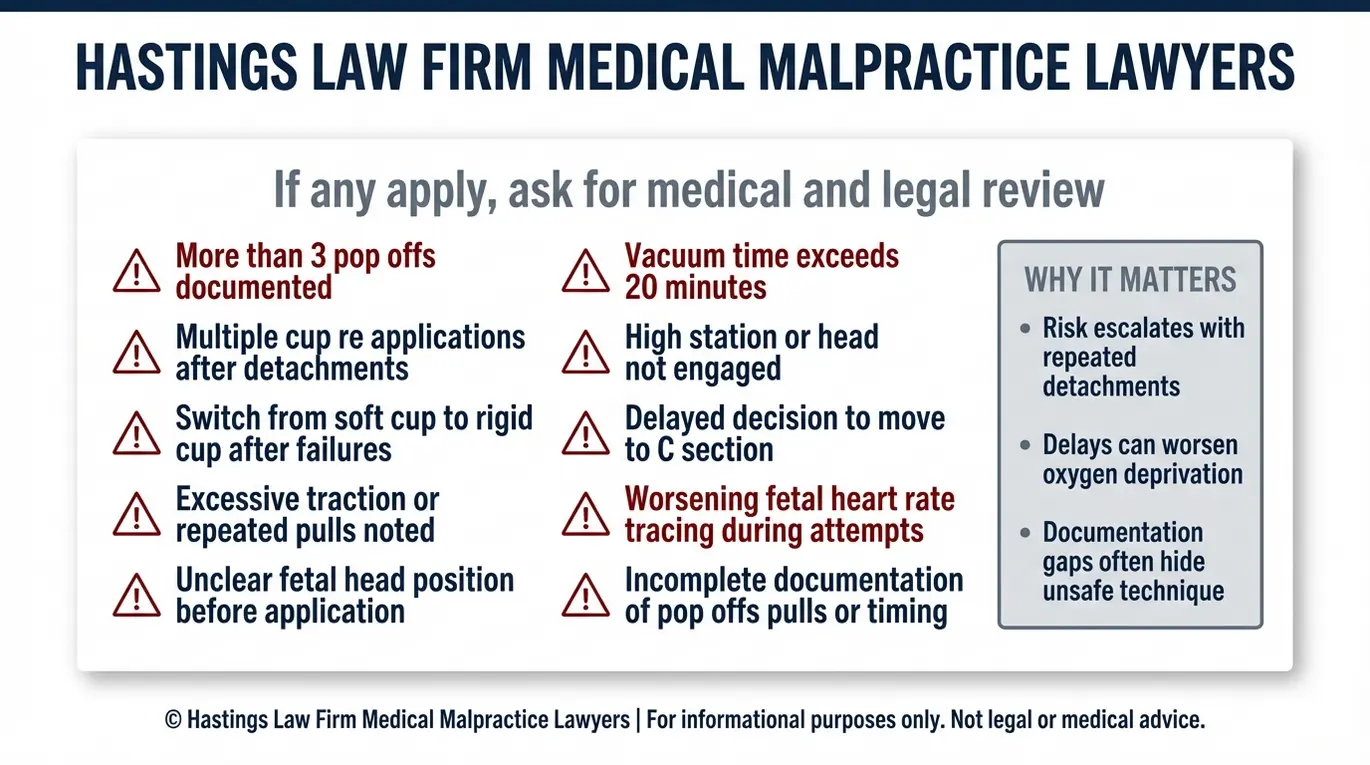
Here are red-flag violations that a vacuum extraction pop-off lawyer in Arizona would look for when reviewing delivery records:
- More than three cup detachments during a single delivery
- Total vacuum application time exceeding 20 minutes
- Switching from a soft cup to a rigid cup after a failed attempt
- Continued vacuum traction despite a non-reassuring fetal heart rate pattern
- No documented reassessment or consideration of C-section after a pop-off
- Failure to inform the mother of the risks of continued vacuum use
- Absence of informed consent for the vacuum procedure itself
If you recognize any of these patterns in your child’s birth, seeking legal help for pop-off injuries may be an important step toward understanding what happened.
Manufacturer Liability and FDA Warnings
The U.S. Food and Drug Administration has issued Public Health Advisories specifically addressing vacuum extraction devices. Medical devices used during delivery are subject to safety warnings and manufacturer guidelines to prevent newborn trauma. These advisories warn practitioners about the risk of serious injury, including subgaleal hemorrhage and intracranial hemorrhage, when the devices are used improperly or beyond recommended limits.
An FDA Public Health Advisory on vacuum extractors is a formal safety communication that alerts healthcare providers to known device-related risks and reinforces proper usage protocols. When a physician disregards these warnings, it can support a claim of negligence. In birth injury cases involving equipment failure, evaluating the device is a necessary step.
Proper informed consent requires that parents be made aware of these specific device risks. Informed consent means your doctor explained the risks and you agreed to the treatment. This means the doctor must explain the potential complications so you can make an informed decision before the procedure begins. Our team evaluates both the clinical decisions and the device liability to identify every potential source of accountability.
The Hastings Law Firm Difference
Results matter, but what truly sets us apart is how we achieve them. Every verdict, every settlement, and every Arizona courtroom victory comes from one guiding promise: To treat each client’s fight for justice as if it were our own.
This balance of skill, experience, and empathy reflects our core philosophy that justice should not only compensate the injured, but also make healthcare safer nationwide.

Severe Injuries Associated with Multiple Vacuum Detachments
Repeated vacuum detachments can cause life-altering trauma, ranging from superficial scalp swelling to lethal subgaleal hemorrhages and permanent hypoxic-ischemic encephalopathy (HIE). These traumatic injuries often occur when the vacuum cup pulls too hard or is applied incorrectly. The severity of the birth injury often correlates directly with how many times the vacuum was reapplied and how much force was used.
Subgaleal hemorrhage, the most dangerous complication associated with vacuum pop-offs, occurs when blood collects in the potential space between the skull’s periosteum and the scalp’s connective tissue layer. The periosteum is the membrane covering the bone. Unlike more contained forms of bleeding, a subgaleal hemorrhage can spread across a large area, and a newborn can lose a significant percentage of their blood volume into this space before external symptoms become obvious.
Research published in Precision of vacuum cup placement and its association with subgaleal hemorrhage and associated morbidity in term neonates confirms the link between improper cup positioning and this type of hemorrhage. Without rapid identification and treatment, the results can be fatal.
Intracranial hemorrhage, or bleeding inside the brain itself, is another serious risk. This includes subdural, subarachnoid, and intraventricular bleeding, all of which can lead to seizures, cognitive deficits, developmental delays, and long-term neurological impairment. The repeated mechanical stress of multiple vacuum attempts can rupture delicate blood vessels in and around the infant’s brain.
Skull fractures can result from the rigid edge of the vacuum cup pressing against the infant’s still-developing cranial bones. These fractures may be linear or depressed, and in some cases they are not detected immediately without imaging. A depressed skull fracture can place direct pressure on brain tissue, compounding the damage from any associated bleeding. In severe cases, the fracture may require surgical elevation to relieve pressure on the brain.
Hypoxic-ischemic encephalopathy (HIE), a form of brain damage caused by oxygen deprivation and reduced blood flow to the brain, results when vacuum extraction fails and delivery is significantly delayed. The baby may experience prolonged periods without adequate oxygenation. HIE can result in cerebral palsy, intellectual disability, and seizure disorders.
Other injuries a vacuum pop-off injury lawyer may encounter in these cases include:
| Injury | Description | Potential Long-Term Effects |
|---|---|---|
| Cephalohematoma | Blood pooling between the skull bone and its covering (periosteum) | Usually resolves; rarely causes jaundice or calcification |
| Caput succedaneum | Swelling of the soft tissue on the scalp | Typically resolves on its own within days |
| Retinal hemorrhage | Bleeding in the blood vessels of the eye | Can resolve, but severe cases may affect vision |
| Facial palsy | Nerve damage affecting facial muscles | May be temporary or permanent depending on severity |
| Brachial plexus injury | Damage to the nerve bundle controlling the arm and hand | Can cause partial or complete paralysis of the affected limb |
Each of these injuries requires careful medical documentation and expert review to determine whether the vacuum extraction caused or worsened the condition.
Proving Medical Malpractice in Arizona Pop-Off Cases
Proving malpractice requires demonstrating that the obstetrician continued to use the vacuum beyond the safe limit of detachments, directly causing the infant’s injury. Legal claims for birth injuries depend on showing that medical providers failed to meet accepted standards. This is a process that requires expert medical testimony under Arizona law.
An Arizona vacuum extraction malpractice lawyer builds this proof through a structured, evidence-driven approach. Here is how we work through the elements of a birth injury case involving vacuum extraction:
- Establishing Duty: The first element is confirming that a doctor-patient relationship existed. In a delivery setting, the obstetrician who managed the labor and performed the vacuum extraction owed a duty of care to both the mother and the baby.
- Proving Breach: Expert analysis is essential to prove a breach of duty. We work with our national expert network of board-certified obstetricians and specialists to review delivery records and determine whether negligence caused the injury. Exceeding three pop-offs, applying the vacuum for more than 20 minutes, or escalating to a rigid cup after failure can each constitute a breach.
- Filing Requirements: Arizona requires an affidavit of merit from a qualified expert witness to certify the validity of the claim before it proceeds.
- Establishing Causation: Causation is often the most contested element. The defense will almost always argue that the injury was caused by the labor itself, not the vacuum.
Our medical team conducts a detailed timeline analysis using electronic fetal monitoring (EFM) strips, which are continuous recordings of the fetal heart rate during labor, along with delivery logs, nursing notes, and imaging results. By correlating heart rate decelerations with vacuum application times, we can link the specific injury to the vacuum trauma rather than general birth complications.
- Calculating Damages: When a child suffers a permanent brain injury or physical disability, the damages extend across a lifetime. We work with life-care planners, economists, and medical specialists to calculate the full scope of future medical care, therapy, adaptive equipment, lost earning capacity, and pain and suffering.
If you are looking for a lawyer for failed vacuum delivery, the strength of the case depends heavily on the quality of the investigation. Our firm uses a structured, evidence-driven approach to prepare every case. At Hastings Law Firm, every case is prepared from day one as if it will go to trial. That level of preparation is what gives our clients the strongest position, whether the case resolves through negotiation or before a jury.

Arizona Statute of Limitations for Birth Injury Claims
In Arizona, the statute of limitations for medical malpractice is generally two years, but specific tolling rules apply to minors, allowing children injured at birth to file claims until they reach a certain age. Parents must understand the specific time limits for filing a lawsuit in Arizona. Understanding these deadlines is critical because missing them can permanently bar your family from pursuing a claim.
Under Arizona Revised Statutes § 12-542, an injured person generally has two years from the date of the injury to file a medical malpractice lawsuit. For parents, this means that any claims they hold in their own right, such as for medical expenses they have paid or emotional distress, are subject to this two-year window starting from the date of delivery.
While the discovery rule can sometimes extend deadlines when an injury is not immediately obvious, birth injuries are typically dated from the delivery.
For the minor child‘s own claims, Arizona law provides tolling provisions. Because a minor cannot file a lawsuit on their own behalf, the statute of limitations is paused, or “tolled,” until the child reaches the age of majority.
This gives the child additional time to bring a claim, but it does not mean families should wait. Evidence disappears, and witness memories fade, making early investigation crucial for substantiating medical malpractice claims.
⚠️ Critical Deadlines to Keep in Mind:
- Parents’ claims: Two years from the date of the injury (typically the date of birth).
- Child’s claims: Tolled during minority, but subject to specific age-based deadlines under Arizona law.
- Evidence preservation: Fetal monitoring strips, delivery logs, and nursing notes can be lost or overwritten over time. Early action helps ensure these records are preserved.
Even though the tolling rules give families additional time on the child’s behalf, medical records degrade, memories fade, and witnesses become harder to locate. Speaking with an attorney early allows us to secure the evidence that matters most while it is still available.
Contact the Arizona Birth Injury Attorneys at Hastings Law Firm Today for Help
If your child suffered a brain bleed, skull fracture, or other serious injury after a delivery involving multiple vacuum pop-offs, your family may have a valid medical malpractice claim. These cases are deeply personal, and we understand the weight of what you are carrying.
Hastings Law Firm focuses exclusively on medical malpractice. Our team includes former defense attorneys, in-house nurse consultants, and access to a national network of medical experts, all dedicated to determining what went wrong and holding the responsible parties accountable.
Our firm, founded by board-certified trial attorney Tommy Hastings, handles every case with a trial-ready philosophy to ensure accountability. As an Arizona vacuum extraction pop-off injury lawyer, we are prepared to investigate your child’s delivery and help you understand your legal options.
We handle these cases on a contingency fee basis, which means you pay no attorney fees or costs unless we secure a recovery. Contact us today for a free, confidential case evaluation. Let us help you find the answers your family deserves.
Frequently Asked Questions About Vacuum Extraction Pop-Off Injury in Arizona


This content was researched and written by the Hastings Law Firm editorial team, which includes attorneys, medical professionals, and experienced researchers. Our writing is informed by internal knowledge and practical experience, and we cross-check critical details against authoritative sources cited throughout. Every piece undergoes human-led fact-checking and legal review. Because legal and medical information can change, if you spot an error, please contact us. Learn more about our content standards and review process on our editorial policy page.

Tommy Hastings, founder of Hastings Law Firm, is a board-certified personal injury trial lawyer dedicated exclusively to healthcare injury cases. Since 2001, he has represented injured patients and families in litigation against major hospital systems, pharmaceutical companies, and negligent healthcare providers nationwide. He has handled numerous high-profile cases that have drawn national media attention and resulted in multi-million dollar recoveries. He draws on that experience in his writing, helping readers understand how these cases work and what options may be available to them.
