


Arizona Untreated Infant Seizure Lawyer
Written by: Hastings Law Firm | Reviewed by: Tommy Hastings | Updated: July 27, 2026
Undiagnosed or untreated seizures in a newborn can lead to permanent brain injury and long term disability when warning signs are missed or treatment is delayed. In Arizona hospitals, neonatal care often depends on careful monitoring, timely testing, and prompt intervention when seizure activity is suspected. Families may be left with lasting medical needs and unanswered concerns about whether established protocols were followed. If you or a loved one were harmed or worse due to untreated infant seizures in Phoenix, Arizona, contact Hastings Law Firm for a free, confidential case review.

Top Rated Birth Injury Attorneys Serving Arizona Families
What You Should Know About Neonatal Convulsions Misdiagnosis Claims in Arizona:
- Permanent brain damage can result when neonatal seizures go undiagnosed or untreated and seizure activity continues unchecked.
- Long term neurological disability can follow when fetal distress or oxygen deprivation during labor is not recognized and addressed.
- Missed opportunities for time sensitive treatment can occur when signs of hypoxic ischemic encephalopathy are not identified quickly enough for cooling therapy.
- Serious harm can be compounded when infections in a newborn are not identified and treated promptly.
- Ongoing seizure activity can worsen injury because prolonged seizures can trigger secondary brain injury at the cellular level.
- Options for financial recovery can include coverage for medical expenses, therapy, assistive equipment, and pain and suffering in Arizona birth injury cases.
- Disputes about what clinicians observed can arise when subtle seizure signs are dismissed as normal newborn behavior.
- Gaps in monitoring can become central when continuous video EEG is not ordered for an at risk newborn.
- Clarity about what happened can depend on complete medical records such as nursing notes, physician orders, lab results, and monitoring logs.
- Communication failures can matter when shift change reports do not reflect vital information shared between care teams.

A Healthcare Focused Law Firm
When a newborn suffers seizures that go undiagnosed or untreated, the consequences can be life-altering. If your child experienced a brain injury because medical staff failed to act, you are not alone, and you have every right to ask questions about what happened.
Founded by board-certified trial attorney Tommy Hastings, our firm is dedicated to helping Arizona families harmed by preventable medical errors. Our team includes experienced trial attorneys, in-house nurse consultants, and former defense lawyers who understand how hospitals operate from the inside.
As an Arizona untreated infant seizure lawyer, we focus on identifying where the standard of care broke down and building a case that holds the responsible parties accountable. If you suspect your baby’s injury could have been prevented, contact us for a free, confidential case evaluation. We can review what happened and explain your options.
Failure to Diagnose and Treat Neonatal Seizures in Arizona Hospitals
The failure to diagnose and treat neonatal seizures, which are abnormal electrical discharges in a newborn’s brain occurring within the first 28 days of life, happens when medical staff overlook clinical signs or fail to follow established protocols. When seizure activity goes unchecked, the prolonged disruption can cause permanent brain damage.
Neonatal seizures are abnormal electrical events in a baby’s brain that can signal serious underlying distress. In Arizona NICUs, the standard of care requires continuous monitoring of at-risk newborns. This includes watching for physical signs of seizure activity, ordering appropriate diagnostic testing when symptoms appear, and initiating treatment promptly. Phenobarbital, the first-line antiseizure medication commonly administered to newborns, is typically started as soon as seizures are confirmed or strongly suspected.
A “wait and see” approach to concerning neurological symptoms in a newborn can constitute medical negligence. Newborn brains are especially vulnerable, and delays measured in hours can mean the difference between a manageable condition and irreversible injury. Under Arizona Revised Statutes § 12-563, a medical malpractice claim requires proof that the provider failed to meet the accepted standard of care and that the failure caused the patient’s injury. The standard of care is the level of treatment a reasonably prudent healthcare professional would provide under similar circumstances.
When families come to us as an Arizona lawyer for untreated infant seizures, our in-house medical staff and nurse consultants begin by reviewing the complete medical records. They examine nursing notes, physician orders, lab results, and monitoring logs to pinpoint exactly where the medical team deviated from protocol. For example, our nurse consultants analyze electronic fetal monitoring strips to identify signs of distress that were disregarded during labor, or verify whether medication administration times matched the urgent orders given by physicians.
Our team also cross-references shift change reports to ensure vital information was communicated effectively between teams. This clinical review is the foundation of every case we build, because understanding the medicine is the only way to prove the negligence.
Recognizing Seizure Symptoms and Signs Often Overlooked in the NICU
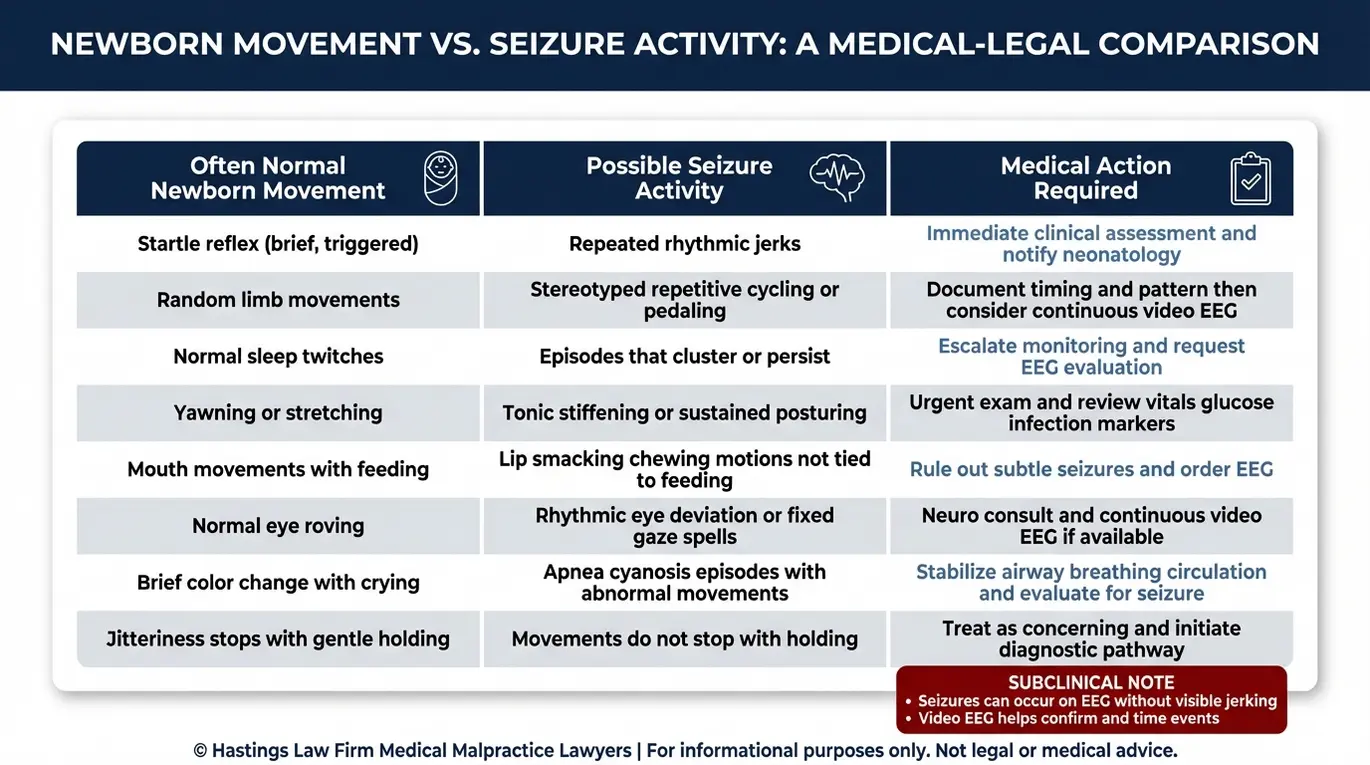
Doctors and nurses may negligently dismiss signs of subtle seizures, such as rhythmic eye movements, pedaling motions, or lip-smacking, as normal newborn reflexes rather than ordering the diagnostic testing those symptoms demand. This is one of the most common breakdowns we see in neonatal care.
Subtle seizures are clinical events that do not involve the whole-body shaking typically associated with adult seizures. Unlike the dramatic, full-body convulsions most people picture, infant seizures are often subtle and easy to miss without proper training and monitoring tools. A newborn might display brief episodes of staring, repetitive sucking movements, or slight trembling of one limb. These episodes can look unremarkable to the untrained eye, but to a qualified neonatal team, they should trigger immediate investigation. Effective monitoring must also account for risk factors like severe jaundice, which if severe and untreated, can progress to kernicterus and cause seizures.
| Normal Newborn Movements | Potential Seizure Activity | Medical Action Required |
|---|---|---|
| Random, brief startle reflexes (Moro reflex) | Rhythmic, repetitive jerking that cannot be stopped by gentle restraint | Bedside evaluation and clinical seizure assessment |
| Occasional trembling of chin or limbs when crying | Sustained eye deviation, fixed staring, or repetitive blinking | Order continuous video EEG monitoring |
| Irregular breathing patterns during sleep | Lip-smacking, tongue thrusting, or pedaling motions without stimulation | Administer antiseizure medication and consult neurology |
| Spontaneous stretching or curling of fingers | Episodes of apnea with color change and tonic posturing | Begin full neurological workup including brain imaging |
The most reliable tool for catching seizure activity is a continuous video EEG (cEEG), a form of brain monitoring that records electrical activity over an extended period while simultaneously capturing video of the infant. According to research published in Frontiers in Pediatrics on continuous EEG use in the NICU, cEEG is essential for detecting both clinical and subclinical seizures in newborns.
Subclinical neonatal seizures are particularly dangerous because the brain is seizing without producing any visible physical movement. The infant may appear calm, even sleeping, while the brain sustains ongoing electrical injury. Without continuous EEG monitoring, these seizures go entirely undetected. When a hospital fails to order cEEG for an at-risk newborn, that gap in monitoring can become a central issue in a medical negligence claim.
The Hastings Law Firm Difference
Results matter, but what truly sets us apart is how we achieve them. Every verdict, every settlement, and every Arizona courtroom victory comes from one guiding promise: To treat each client’s fight for justice as if it were our own.
This balance of skill, experience, and empathy reflects our core philosophy that justice should not only compensate the injured, but also make healthcare safer nationwide.

Common Medical Errors Leading to Untreated Seizures
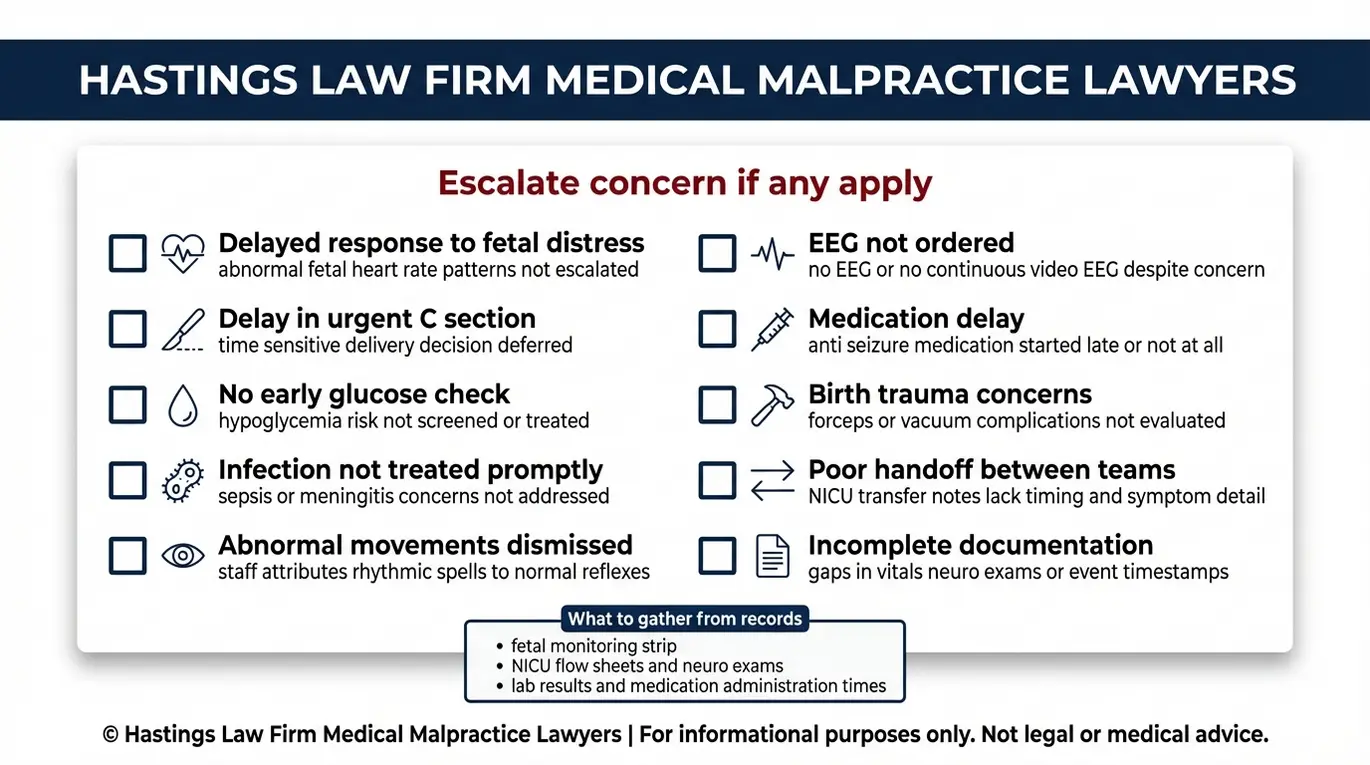
Untreated neonatal seizures frequently result from preventable medical errors, including mismanaged labor, inadequate fetal heart rate monitoring, or delayed responses to infections and metabolic imbalances. In many cases, the seizures themselves are a downstream consequence of an earlier failure.
A breach in the standard of care occurs when a medical provider fails to act as another competent professional would have in the same situation. Oxygen deprivation during labor and delivery is one of the most common causes. When fetal distress goes unrecognized or a necessary cesarean section is delayed, the baby can suffer prolonged hypoxia or birth asphyxia, a dangerous reduction of oxygen to the brain. This can lead to hypoxic-ischemic encephalopathy (HIE), a specific type of brain injury caused by oxygen deprivation and restricted blood flow. HIE is one of the leading causes of neonatal seizures and long-term neurological disability.
Untreated infections also create serious risk. When a newborn develops meningitis or sepsis and the medical team does not identify and treat the infection promptly, the resulting inflammation can damage brain tissue and trigger seizure activity. Signs of infection are often present in lab work and vital signs, making delayed treatment a potential breach of the standard of care.
Other preventable errors that can lead to untreated seizures include:
- Neonatal hypoglycemia (low blood sugar): Persistent low blood sugar in a newborn can cause direct brain injury. Research supported by the National Institute of Child Health and Human Development (NICHD) has helped identify safe glucose thresholds, making it clear when intervention is needed. Failure to monitor and treat low blood sugar is a well-recognized form of negligence.
- Intracranial hemorrhage from birth trauma: Improper or excessive use of forceps or vacuum extraction during delivery can cause bleeding within the skull. This hemorrhage puts pressure on the brain and can produce seizures that require immediate treatment.
Each of these errors creates a chain of injury. When the first mistake is compounded by a failure to recognize and treat the resulting seizures, the damage grows significantly worse.
The Critical Window: Why Prompt Treatment Matters for Brain Injury
Prompt treatment is essential because prolonged seizure activity releases toxic chemicals that destroy brain cells, and missing the narrow window for intervention can make the resulting damage permanent. The newborn brain is resilient in some ways, but it is also uniquely fragile when subjected to sustained neurological stress.
Secondary brain injury refers to the chemical and cellular damage that continues to spread after the initial trauma. When seizures continue without treatment, each episode causes a cascade of injury at the cellular level. Brain cells deprived of normal oxygen and glucose metabolism begin to die, and the surrounding tissue suffers secondary damage from inflammation and toxic byproducts. Over time, this can lead to cerebral palsy, developmental delays, and periventricular leukomalacia (PVL), a condition where the white matter surrounding the brain’s ventricles is damaged, disrupting the brain’s ability to send signals to the body.
For newborns with HIE, there is an important six-hour window during which therapeutic hypothermia, also known as cooling therapy, can be initiated. This treatment involves carefully lowering the baby’s body temperature to slow the metabolic processes that cause secondary brain injury. Research, including studies tracking NICU outcomes documented in PubMed Central, has reinforced the importance of identifying HIE candidates quickly so cooling therapy can begin within that window. When a hospital fails to recognize the signs of HIE or delays the referral for cooling, the opportunity may be lost entirely.
Ventilator management errors can also compound the problem. If a newborn on a ventilator is over-ventilated, the resulting condition, known as hypocarbia, can reduce blood flow to the brain and worsen existing injury. Proper resuscitation and respiratory management in the hours after birth are part of the standard of care, and errors during this period are something our medical-legal team examines closely.
Securing Compensation for Long-Term Care and Rehabilitation
Compensation in Arizona birth injury cases can cover past and future medical expenses, life-care plans, specialized therapy, assistive equipment, and non-economic damages for the child’s pain and suffering. The goal is to ensure the child has the resources needed for a lifetime of care.
Economic damages refer to the calculable financial losses a family suffers, such as medical bills and future care costs. Raising a child with cerebral palsy or severe brain injury involves extraordinary costs that most families cannot absorb on their own. Specialized medical care, physical and occupational therapy, speech therapy, adaptive equipment, home modifications, and special education services add up quickly. For a child with a serious neurological injury, these needs often extend across an entire lifetime.
That is why a lawyer for untreated infant seizures in Arizona will work with medical and economic experts to develop a life-care plan. This document calculates the projected cost of every category of care the child will need over the next 50, 60, or even 70 years. It accounts for inflation, evolving medical needs, and the level of daily assistance required. A well-supported life-care plan is one of the most important tools in securing a fair recovery because it puts concrete numbers behind the family’s actual needs.
We also seek full compensation for non-economic damages. This category addresses the intangible but profound impact of the injury, including your child’s physical impairment, disfigurement, pain, and the loss of enjoyment of life. We ensure no category of loss is overlooked.
At Hastings Law Firm, we handle these cases on a contingency fee basis. That means your family pays no attorney fees and no costs unless we obtain a recovery on your behalf. We believe that families already carrying the weight of a child’s injury should never face a financial barrier to pursuing the truth.
Contact the Arizona Birth Injury Attorneys at Hastings Law Firm Today for Help
Our firm was built on a simple belief: holding negligent providers accountable is the most effective way to prevent the same harm from happening to another family. Every case we take is an opportunity to find the truth about what happened to your child and to make sure your family’s future is protected.
A confidential case evaluation is a risk-free way to share the details of your situation with a legal professional. You are not just a case file to us. From the moment you reach out, you become a partner in the process. Our team of trial attorneys, nurse consultants, and medical experts will walk with you through every step, keeping you informed and supported along the way.
If your baby suffered a brain injury that you believe could have been prevented, we encourage you to take the first step. Contact our Phoenix office for a free, confidential case evaluation. There is no fee unless we secure a recovery for your family, and no pressure to make any decisions before you are ready. Let us help you find the answers you deserve.
Frequently Asked Questions About Untreated Infant Seizure in Arizona


This content was researched and written by the Hastings Law Firm editorial team, which includes attorneys, medical professionals, and experienced researchers. Our writing is informed by internal knowledge and practical experience, and we cross-check critical details against authoritative sources cited throughout. Every piece undergoes human-led fact-checking and legal review. Because legal and medical information can change, if you spot an error, please contact us. Learn more about our content standards and review process on our editorial policy page.

Tommy Hastings, founder of Hastings Law Firm, is a board-certified personal injury trial lawyer dedicated exclusively to healthcare injury cases. Since 2001, he has represented injured patients and families in litigation against major hospital systems, pharmaceutical companies, and negligent healthcare providers nationwide. He has handled numerous high-profile cases that have drawn national media attention and resulted in multi-million dollar recoveries. He draws on that experience in his writing, helping readers understand how these cases work and what options may be available to them.
