


Texas Untreated Infant Hypoglycemia Lawyer
Written by: Hastings Law Firm | Reviewed by: Tommy Hastings | Updated: July 27, 2026
Untreated low blood sugar in a newborn can lead to preventable brain injury when risk factors or warning signs are missed and care is delayed. Medical standards emphasize early screening for at risk infants, prompt testing when symptoms appear, and rapid escalation of treatment when feeding does not stabilize glucose. Families may later face lasting neurological harm and extensive care needs, and the medical record often holds key clues about what happened. If you or a loved one were harmed or worse due to untreated infant hypoglycemia in Texas, contact Hastings Law Firm for a free, confidential case review.
Legal Advocacy for Newborns Suffering from Preventable Brain Injuries
What You Should Know About Neonatal Low Blood Sugar Injury Claims in Texas:
- Lifelong neurological harm can result when newborn low blood sugar is not identified and treated promptly.
- Accountability can turn on whether documented risk factors triggered proactive glucose monitoring.
- Serious injury risk increases when symptoms are dismissed as normal newborn behavior instead of prompting immediate evaluation.
- Options can narrow if required pre suit notice is not provided to each health care provider.
- Preventable harm can occur when treatment is not escalated quickly after feeding fails to stabilize blood sugar.
- Complications can worsen when hypothermia and hypoglycemia are not managed at the same time.
- Recovery for long term needs can be shaped by Texas limits on non economic damages while economic damages are not capped.
- Causation disputes can be influenced by MRI patterns that align with hypoglycemic brain injury rather than other causes.
- Proof issues can hinge on gaps in glucose monitoring logs, missing nursing assessments, or discharge documentation.
- Future care costs can be substantial when a child needs ongoing therapy, specialized education, or adaptive equipment.

A Healthcare Focused Law Firm
When a newborn suffers a brain injury because low blood sugar went undiagnosed or untreated, families are often left searching for answers. You may sense that something went wrong during your baby’s care but feel uncertain about what should have happened or what options exist. That instinct deserves attention, not dismissal.
A Texas untreated infant hypoglycemia lawyer can help you understand whether the medical team met its obligations and, if not, what your family can do about it. At Hastings Law Firm, our team of attorneys, nurse consultants, and medical experts focuses exclusively on medical malpractice cases. We can review what happened, explain your options, and help you take the first step toward protecting your child’s future.
Understanding Neonatal Hypoglycemia and Medical Liability
Neonatal hypoglycemia occurs when a newborn’s blood sugar drops to dangerously low levels, depriving the brain of the glucose it needs to function. Our team includes former defense attorneys and hospital nurses who provide insider insight into how facilities manage glucose monitoring protocols.
Glucose is the primary fuel source for a newborn’s developing brain. Unlike adults, newborns have limited glycogen reserves and a high metabolic rate, which means their brains are especially vulnerable when blood glucose levels fall too low. When brain cells are starved of glucose, a condition called neuroglycopenia (the deprivation of glucose to brain tissue) can set in, causing irreversible cellular damage.
Not every episode of low blood sugar causes harm. Many newborns experience a brief, transient dip in blood glucose shortly after birth as they adjust to life outside the womb. This is expected, and it typically resolves with early feeding. The medical and legal concern arises when hypoglycemia is persistent, severe, or symptomatic and the medical team fails to respond.
What the newborn brain requires:
The brain consumes glucose at a rate far higher than any other organ. When blood glucose levels remain critically low for an extended period, the damage can be permanent. That is why hospitals are expected to have glucose monitoring protocols in place for every at-risk newborn, and why delays in screening or treatment carry serious medical and legal consequences.
The distinction between a normal adjustment and a dangerous medical event depends on how quickly providers identify the problem and act. A Texas infant hypoglycemia attorney knows that when the standard of care calls for timely blood glucose checks and intervention, and those steps are missed, the path from treatable condition to lifelong brain injury becomes a question of accountability.
Risk Factors Requiring Heightened Monitoring
Medical standards require hospitals to identify high-risk infants immediately after birth and begin specific screening protocols. Identifying these specific screening protocols is necessary because many newborns, such as those born to mothers with diabetes, cannot regulate their own blood sugar effectively in the first hours of life.
Several conditions increase a newborn’s likelihood of developing dangerously low blood sugar. Providers are trained to recognize these categories and should begin glucose screening within the first hours of life. According to the University of Rochester Medical Center, the following are among the most well-established risk factors:
- Maternal diabetes or gestational diabetes: Babies born to mothers with diabetes are often exposed to high blood sugar levels in the womb, which causes the infant to produce excess insulin. This condition, known as hyperinsulinism (an overproduction of insulin that drives blood sugar dangerously low), means the baby’s glucose drops rapidly after birth once the maternal supply is cut off.
- Premature birth: Premature infants have smaller glycogen stores and less developed metabolic systems, making them far more susceptible to sustained low blood sugar.
- Intrauterine growth restriction (IUGR) and small for gestational age infants: Babies who did not grow adequately in the womb often have depleted energy reserves at birth and limited ability to regulate glucose.
- Large for gestational age infants: These newborns, often associated with maternal diabetes, may also have elevated insulin levels that cause rapid glucose consumption.
- Birth complications such as asphyxia: Oxygen deprivation during delivery increases the body’s metabolic demand, burning through glucose reserves at an accelerated rate.
- Infection (sepsis): A newborn fighting an infection uses glucose at a much higher rate, and if providers are not screening for both conditions simultaneously, the hypoglycemia can go undetected.
When any of these risk factors are present and documented, the standard of care requires proactive monitoring. A failure to act on known risk factors is not a judgment call; it is a departure from what every qualified provider should do.
The Hastings Law Firm Difference
Results matter, but what truly sets us apart is how we achieve them. Every verdict, every settlement, and every Texas courtroom victory comes from one guiding promise: To treat each client’s fight for justice as if it were our own.
This balance of skill, experience, and empathy reflects our core philosophy that justice should not only compensate the injured, but also make healthcare safer nationwide.

Recognizing Signs and Symptoms of Low Blood Sugar
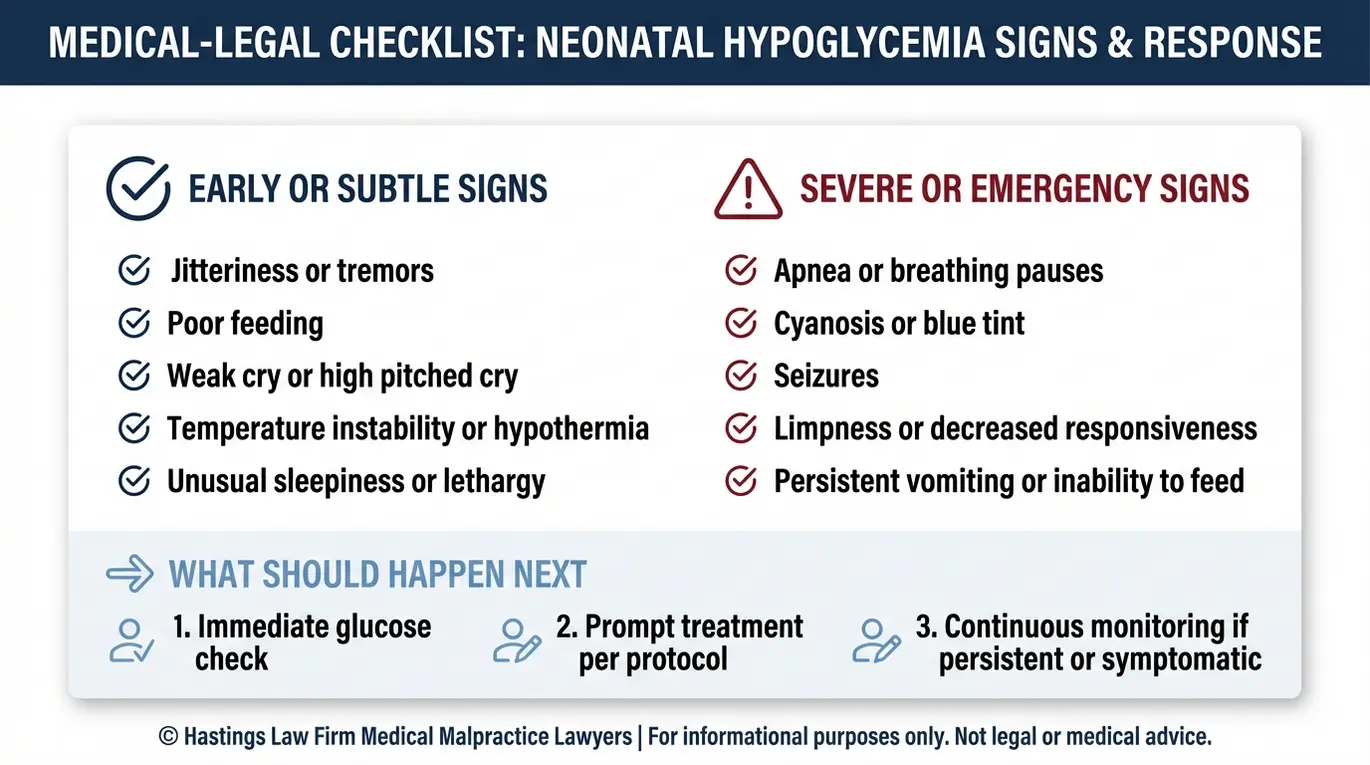
Symptoms of hypoglycemia in newborns can be subtle, ranging from jitteriness and poor feeding to more severe indicators like apnea and seizures. Medical staff have a responsibility to perform an immediate evaluation when these symptoms appear, as they indicate the brain is already being deprived of necessary fuel.
According to MedlinePlus, the following symptoms should prompt immediate evaluation and glucose testing:
Early warning signs:
- Jitteriness or tremors
- High-pitched or weak crying
- Poor feeding or refusal to latch
- Irritability
- Abnormal eye movements
Signs of worsening hypoglycemia:
- Lethargy or difficulty waking
- Apnea, which is a pause in breathing lasting more than 20 seconds
- Cyanosis, a bluish tint to the skin or lips caused by low oxygen levels
- Hypothermia or low body temperature
- Seizures
The difference between symptomatic and asymptomatic hypoglycemia matters both medically and legally. A baby who is showing visible symptoms already has blood sugar low enough to affect brain function. At that point, treatment should not wait for a second confirmatory test. Symptomatic hypoglycemia is a medical emergency that demands immediate intervention.
One of the patterns hypoglycemia lawyers in Texas frequently see in these cases involves staff charting symptoms like jitteriness or poor feeding but attributing them to “normal newborn behavior” rather than ordering a glucose check. That kind of documentation gap can be powerful evidence when building a case. If your baby showed warning signs that were overlooked or dismissed, those medical records may tell a very different story than what you were told at the time.
The Standard of Care for Diagnosing and Treating Hypoglycemia
The standard of care requires medical providers to perform timely blood glucose checks on at-risk infants and intervene immediately with feedings, IV dextrose, or glucagon if levels remain low. Following a recognized Treatment Escalation Protocol ensures that if simple feedings do not stabilize blood sugar, more intensive medical interventions begin before brain damage occurs.
According to the Diagnosis and Management of Neonatal Hypoglycemia guidelines reviewed in PubMed Central, hospitals should follow a structured approach to screening and treatment. The process begins with a heel stick blood glucose screening, a quick bedside test where a small blood sample is taken from the infant’s heel to measure glucose levels. If the result is abnormally low, a confirmatory lab test should follow, and treatment should begin without waiting for lab confirmation if the baby is symptomatic.
Treatment Escalation Protocol:
| Stage | Intervention | When It Applies |
|---|---|---|
| First-line | Early and frequent oral feeding (breast milk or formula) | Mild, asymptomatic low glucose in an otherwise stable infant |
| Second-line | IV dextrose (a sterile sugar solution delivered directly into the bloodstream) | Oral feeding fails to raise levels, or the infant is symptomatic |
| Third-line | Glucagon injection | Glucose remains critically low despite IV dextrose, or IV access is delayed |
| Escalation | NICU admission for continuous monitoring | Persistent or recurrent hypoglycemia requiring ongoing stabilization |
Each step in this protocol exists because the consequences of delay are severe. When oral feeding does not raise blood sugar within the expected window, the standard of care calls for IV dextrose without hesitation. Waiting too long to escalate treatment, or administering an incorrect dextrose concentration, can allow brain injury to progress.
Cold Stress and Hypothermia Complications
Cold stress, also called neonatal hypothermia, occurs when a newborn’s body temperature drops below the normal range. This condition accelerates glucose depletion because the infant’s body burns through energy reserves trying to generate heat. When hypothermia and hypoglycemia occur together, they create a compounded emergency that demands simultaneous management. Staff must maintain proper thermoregulation while also treating the low blood sugar, because addressing only one condition while ignoring the other can allow brain injury to progress.
Under Texas Civil Practice and Remedies Code § 74.051, families pursuing a medical malpractice claim must provide written notice to each health care provider at least 60 days before filing suit. An infant injury attorney familiar with these procedural requirements can help ensure your claim is preserved while the focus remains on building the strongest possible case.

Common Medical Errors Leading to Brain Injury
Malpractice in these cases often involves a failure to screen at-risk infants, delayed glucose administration, or discharging a baby before blood sugar has stabilized. These errors breach the standard of care and can directly cause preventable brain damage.
Our team reviews medical records looking for specific patterns of failure. Below are some of the most common errors we evaluate when investigating these claims:
| What the Standard Requires | Common Error |
|---|---|
| Glucose screening within 1–2 hours of birth for at-risk infants | No screening ordered despite documented risk factors (e.g., infant of a diabetic mother) |
| Repeat testing at scheduled intervals until levels stabilize | Missed or delayed follow-up glucose checks |
| Immediate treatment when symptoms appear | Symptoms like jitteriness or poor feeding charted but attributed to “normal newborn behavior” |
| Escalation to IV dextrose when oral feeding fails | Continued oral feeding attempts despite persistently low readings |
| Correct IV dextrose concentration administered and monitored | Incorrect concentration or rate of dextrose infusion |
| Discharge only after documented glucose stability | Baby discharged before glucose levels were confirmed stable over multiple readings |
Each of these failures represents a point where the medical team had an opportunity to prevent harm and did not act. As a Texas malpractice counsel, we reconstruct the timeline from admission through discharge, comparing what happened against what the protocols required.
Medical malpractice in these cases often involves a failure to screen at-risk infants, delayed treatment, or premature discharge before blood sugar has stabilized. In many cases, the evidence is already in the chart. Gaps in glucose monitoring logs, missing nursing assessments, and discharge orders issued before stability was confirmed can all support a claim that the standard of care was not met. What matters is having the medical and legal expertise to identify those gaps and connect them to causation and your child’s injury.

Long-Term Consequences of Untreated Hypoglycemia
Prolonged low blood sugar destroys brain cells, potentially resulting in cerebral palsy, epilepsy, cortical visual impairment, and severe cognitive or developmental delays that require lifelong care. This neurological damage often occurs in the parts of the brain responsible for vision and sensory processing, leading to challenges that may not be fully apparent until a child reaches school age.
According to a systematic review published in Cureus on neonatal hypoglycemia and long-term pediatric neurodevelopmental outcomes, untreated hypoglycemia is associated with damage to specific regions of the brain, particularly the occipital and parietal lobes. These areas control vision and sensory processing, which is why children with hypoglycemic brain injuries often develop cortical visual impairment or difficulties with spatial awareness.
The full scope of neurological damage may not become apparent for months or even years. Some children appear to develop normally in infancy but begin showing signs of learning disabilities, attention deficits, or motor coordination problems once they reach school age.
Long-term care needs families may face include:
- Ongoing physical, occupational, and speech therapy
- Specialized educational programs and learning support
- Adaptive equipment such as wheelchairs, communication devices, or modified vehicles
- In-home nursing care or personal care attendants
- Behavioral health services and developmental monitoring
- Surgeries or medical interventions as the child grows
MRI Patterns and Proving Causation
Specific MRI findings can help prove that hypoglycemia, not a genetic condition or other cause, was responsible for the injury. A posterior injury pattern on MRI, meaning damage concentrated in the occipital and parietal lobes at the back of the brain, is a well-recognized marker of hypoglycemic brain injury. This pattern differs from the damage caused by oxygen deprivation or inherited metabolic disorders, allowing medical experts to establish a direct link between untreated low blood sugar and the resulting neurological harm.
Our team works with independent neuroradiology and neonatology experts who analyze MRI findings alongside the clinical timeline. By using timing reconstruction to match the imaging evidence to documented gaps in glucose monitoring or treatment, we can build a fact-based causation argument that a birth injury lawyer needs to pursue these claims effectively.
Recovering Damages for Your Child’s Future
Texas law allows families to recover economic damages for past and future medical care, as well as non-economic damages for pain, suffering, and physical impairment. Pursuing these damages is often the only way for families to afford the high cost of specialized care required for a permanent brain injury.
A Texas birth injury legal team typically uses life care planning and economists to calculate the true cost of your child’s future needs. Economic damages are based on documented expenses and projected costs, and under Texas law, there is no cap on these amounts. That means every dollar your child will need for medical care, therapy, and support can be pursued in full.
Compensable damages in these cases may include:
- Past and future medical costs, including hospitalizations, surgeries, and specialist visits
- Physical, occupational, and speech therapy costs
- Specialized education and developmental support services
- Home modifications and adaptive equipment
- In-home nursing or attendant care
- Loss of the child’s future earning capacity
- The child’s physical pain and suffering
- The child’s physical impairment and disfigurement
- Parents’ mental anguish stemming from the injury
Each of these categories requires careful documentation and expert testimony. The goal is to ensure your child’s settlement or verdict reflects the reality of what their life will require, not just what the first few years of treatment have cost.
Contact the Texas Birth Injury Attorneys at Hastings Law Firm Today for Help
If your child suffered a preventable brain injury because low blood sugar was not properly diagnosed or treated, you deserve a team that focuses exclusively on medical negligence. As a board-certified trial lawyer, founder Tommy Hastings has spent over two decades representing families in complex medical negligence cases.
We understand how overwhelming this situation feels. You may still be processing what happened while also managing your child’s ongoing medical needs. Our process begins with a free case evaluation led by a patient advocate who can help you understand whether your family has a claim.
There are no upfront costs. We work on a contingency fee basis, which means you pay no attorney fees unless we recover compensation for your family. Contact us today to speak with a patient advocate and take the first step toward answers.
Frequently Asked Questions About Untreated Infant Hypoglycemia in Texas


This content was researched and written by the Hastings Law Firm editorial team, which includes attorneys, medical professionals, and experienced researchers. Our writing is informed by internal knowledge and practical experience, and we cross-check critical details against authoritative sources cited throughout. Every piece undergoes human-led fact-checking and legal review. Because legal and medical information can change, if you spot an error, please contact us. Learn more about our content standards and review process on our editorial policy page.

Tommy Hastings, founder of Hastings Law Firm, is a board-certified personal injury trial lawyer dedicated exclusively to healthcare injury cases. Since 2001, he has represented injured patients and families in litigation against major hospital systems, pharmaceutical companies, and negligent healthcare providers nationwide. He has handled numerous high-profile cases that have drawn national media attention and resulted in multi-million dollar recoveries. He draws on that experience in his writing, helping readers understand how these cases work and what options may be available to them.
