


Texas Untreated Chorioamnionitis Lawyer
Written by: Hastings Law Firm | Reviewed by: Tommy Hastings | Updated: July 27, 2026
Untreated chorioamnionitis during labor and delivery can escalate quickly and lead to severe infection related complications for a baby and serious risks for a mother. The condition is linked to intraamniotic infection and inflammation, and the article highlights how missed warning signs and delayed antibiotics can contribute to brain injury, long term disability, or worse. It also discusses how clinical guidelines and medical records can clarify whether care met accepted standards. If you or a loved one were harmed or worse due to untreated chorioamnionitis in Texas, contact Hastings Law Firm for a free, confidential case review.

Nationally Recognized Birth Injury Representation in Texas
What You Should Know About Intraamniotic Infection Birth Injury Claims in Texas:
- Severe and lasting harm can follow when chorioamnionitis is not treated promptly, because intraamniotic infection can lead to brain injury and serious infection related complications.
- Options for financial recovery can be affected in Texas, because procedural requirements can lead to dismissal when they are not met.
- Recovery for pain and suffering can be limited in Texas, because state law places caps on non economic damages while economic damages are not capped.
- Disputes about what caused the injury can shape outcomes, because defense arguments may point to genetics or unavoidable complications instead of delayed treatment.
- A missed opportunity for timely treatment can occur, because relying on lab confirmation instead of the full clinical picture can waste valuable time.
- A need for urgent intervention can be signaled early, because fetal tachycardia is described as a reliable indicator of fetal stress during infection.
- Proof that infection was present before birth can be central, because placental pathology findings can show established inflammation that conflicts with the labor and delivery documentation.
- The strength of the timeline can matter, because fetal monitoring strips, nursing notes, and antibiotic timing are used to compare documented care to clinical guidelines.

A Healthcare Focused Law Firm
Hastings Law Firm represents families across Texas in birth injury cases caused by failures to diagnose and treat dangerous infections during delivery. Founded by Tommy Hastings in 2005, our firm is led by a board-certified trial lawyer who has spent over 20 years focusing exclusively on medical malpractice.
As a Texas untreated chorioamnionitis lawyer, our team of attorneys, in-house nurses, and medical consultants can review your child’s medical records, identify what went wrong, and explain your options. We focus on providing clarity to families who suspect that medical negligence involving chorioamnionitis caused their child’s condition. Contact us for a free, confidential case evaluation.
Understanding Chorioamnionitis and Intraamniotic Infection Risks
Chorioamnionitis, also known as intraamniotic infection or “Triple I,” is an acute bacterial infection of the fetal membranes that can cause severe brain injury or death if not promptly treated with antibiotics and expedited delivery. These membranes, the amnion and chorion, surround the baby and contain the amniotic fluid. When bacteria such as Group B Streptococcus (GBS) or E. coli migrate into the amniotic sac, they can trigger a dangerous inflammatory response that threatens both the mother and the baby.
The American College of Obstetricians and Gynecologists (ACOG) now classifies this condition under the “Triple I” framework, which stands for intrauterine inflammation, infection, or both. This updated terminology reflects the fact that not every case involves a confirmed bacterial culture; sometimes the clinical signs of inflammation alone are enough to require urgent treatment. According to the Chorioamnionitis Case Definition Guidelines published on PubMed Central, standardized diagnostic criteria help clinicians identify the intraamniotic infection early and initiate appropriate interventions.
One of the most significant risk factors is prolonged rupture of membranes (PROM), which occurs when the fluid-filled sac surrounding the baby breaks well before delivery begins or progresses. Once the protective barrier is broken, bacteria from the vaginal canal can ascend into the uterine cavity. The longer the interval between membrane rupture and delivery, the greater the risk of infection.
As a Texas untreated chorioamnionitis lawyer, we investigate whether the medical team recognized these risk factors and acted within the appropriate time frame. Families who suspect that a delayed response contributed to their child’s injury should know that an untreated chorioamnionitis attorney can help determine whether the standard of care was met.
Identifying Missed Signs of Intraamniotic Infection
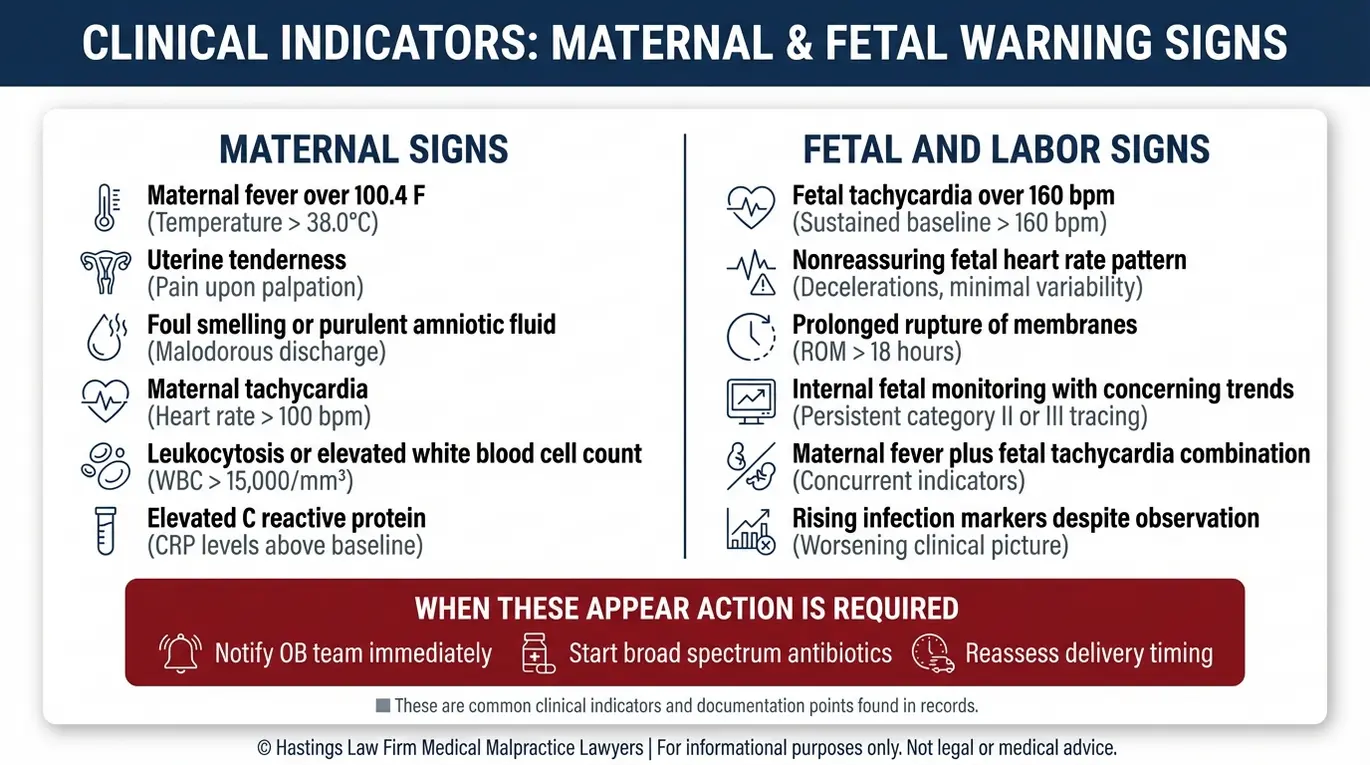
Medical providers are expected to monitor for clinical signs of infection throughout labor, including maternal fever (temperature over 100.4°F), uterine tenderness, foul-smelling amniotic fluid, maternal tachycardia, and, most critically, fetal tachycardia, a sustained fetal heart rate above 160 beats per minute. A heart rate above this threshold is one of the most reliable indicators of fetal stress during an infection.
Fetal tachycardia is often the earliest warning sign that something is wrong. It appears on the electronic fetal monitor and can indicate that the baby is mounting a stress response to an active infection. According to the Basic Terms of Fetal Heart Rate and Contraction Patterns from Medicine LibreTexts/16:_Electronic_Fetal_and_Uterine_Contraction_Monitoring/16.02:_Basic_Terms_of_Fetal_Heart_Rate_and_Contraction_Patterns), a baseline fetal heart rate above 160 bpm is classified as tachycardia and should prompt immediate clinical evaluation.
Maternal symptoms to watch for:
- Fever at or above 100.4°F (38.0°C)
- Uterine tenderness or pain between contractions
- Foul-smelling or purulent amniotic fluid
- Maternal heart rate above 100 bpm
Fetal warning signs:
- Fetal tachycardia (sustained heart rate above 160 bpm)
- Decreased fetal heart rate variability
- Late or variable decelerations on the fetal monitor
Some providers rely heavily on lab work, specifically leukocytosis, an elevated white blood cell count, or C-reactive protein levels, before making a clinical diagnosis. But waiting for lab confirmation when the clinical picture already suggests infection can waste valuable time. While fever is a clear indicator, other symptoms like uterine tenderness can be subtle and easily overlooked during a chaotic delivery. Reliance on a single symptom rather than the entire clinical picture often leads to missed diagnoses.
An untreated chorioamnionitis lawyer in Texas can examine the fetal monitoring strips and nursing notes to determine whether warning signs were present, documented, and acted upon. As a Texas birth injury lawyer, our team traces the timeline of events to identify where the breakdown in clinical judgment occurred.
The Hastings Law Firm Difference
Results matter, but what truly sets us apart is how we achieve them. Every verdict, every settlement, and every Texas courtroom victory comes from one guiding promise: To treat each client’s fight for justice as if it were our own.
This balance of skill, experience, and empathy reflects our core philosophy that justice should not only compensate the injured, but also make healthcare safer nationwide.

Standard of Care for Diagnosing and Treating Chorioamnionitis
The standard of care requires immediate administration of broad-spectrum antibiotics, such as ampicillin and gentamicin (medications designed to target a wide range of bacteria), upon clinical diagnosis. In many cases, an expedited delivery, often by cesarean section (C-section), is also necessary to remove the baby from the infected environment before further harm occurs. Our firm uses a trial-ready approach, preparing every case for a jury from the first day of investigation to ensure the strongest possible position.
Time-to-treatment is one of the most important factors in these cases. Research consistently shows that earlier antibiotic administration reduces the risk of neonatal sepsis and other serious complications. Every hour of delay increases the baby’s exposure to the infection and the inflammatory cascade it triggers.
The decision between vaginal delivery and C-section depends on how far labor has progressed, the severity of infection, and the baby’s tolerance of labor as reflected on the fetal monitor. When the fetal heart rate tracing shows signs of distress in the setting of suspected or confirmed infection, the standard of care may require an emergency cesarean delivery.
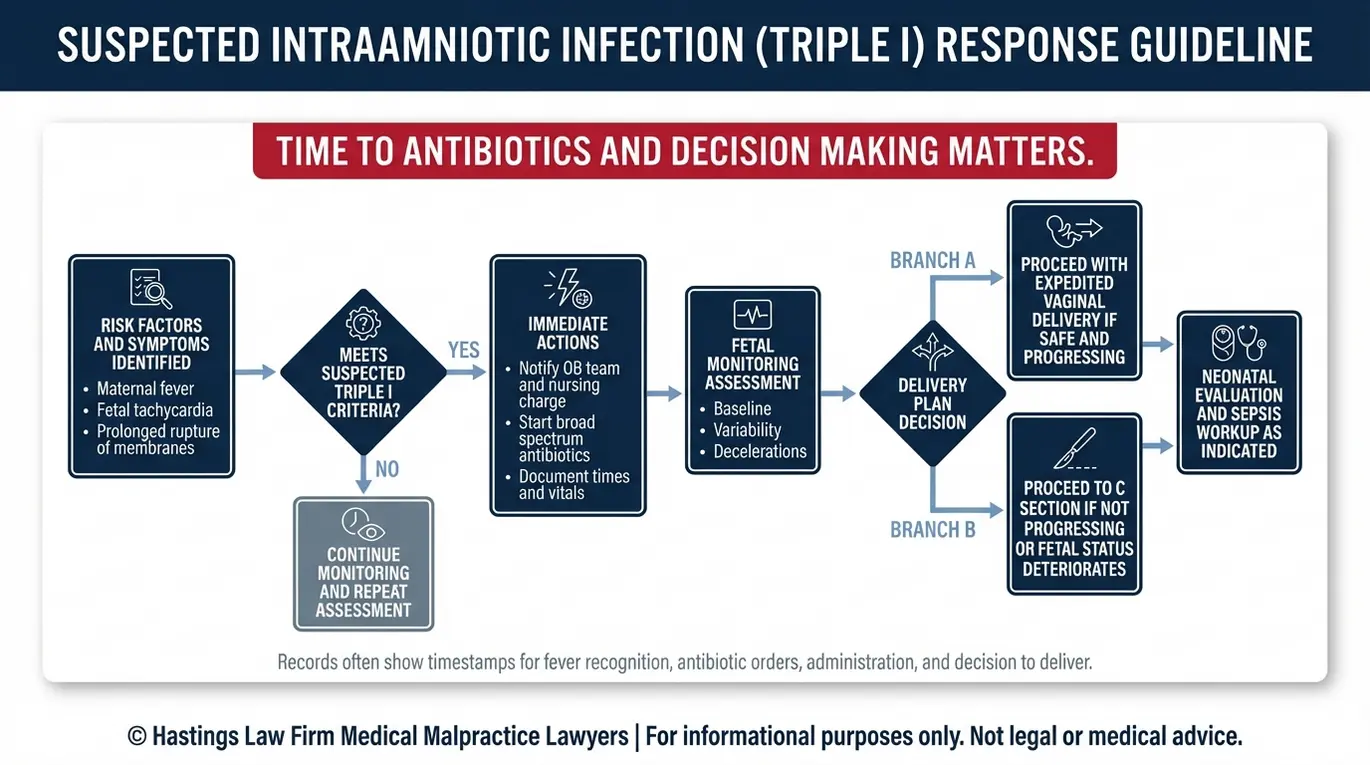
ACOG’s clinical guidelines outline a protocol that generally follows this sequence:
- Recognize clinical signs of intraamniotic infection (fever, tachycardia, tenderness)
- Confirm the diagnosis based on clinical criteria; do not wait for culture results
- Start intravenous broad-spectrum antibiotics immediately
- Continuously monitor the fetal heart rate for signs of worsening distress
- Evaluate the need for expedited delivery based on fetal status and labor progress
- Proceed with C-section if vaginal delivery is not imminent or if fetal condition deteriorates
These guidelines are the benchmark for legal liability in medical malpractice claims. If a physician deviates from the ACOG protocol, such as by waiting for a fever to spike when fetal tachycardia is already persistent, that deviation establishes the breach of duty necessary for a claim. According to the study on Implementing Updated Intraamniotic Infection Guidelines at a Large Academic Medical Center published by Oxford Academic, structured protocols improve compliance with timely treatment and reduce adverse neonatal outcomes.
As a Texas untreated chorioamnionitis lawyer, we compare the documented timeline in your child’s medical records against these established guidelines. When a malpractice lawyer for infection cases identifies gaps between the protocol and what actually happened, that gap often forms the foundation of a negligence claim.
Severe Birth Injuries Caused by Untreated Infection
Untreated chorioamnionitis can trigger a fetal inflammatory response syndrome (FIRS), a condition in which the baby’s own immune system releases a surge of inflammatory proteins called cytokines. This cytokine-driven inflammation can damage the developing brain, leading to permanent conditions such as cerebral palsy, hypoxic-ischemic encephalopathy (HIE), periventricular leukomalacia (PVL), and neonatal sepsis.
What makes this mechanism especially devastating is that cytokine-driven inflammation can injure the brain even without a prolonged period of oxygen deprivation. The inflammation specifically targets the periventricular white matter, which is the area responsible for transmitting signals between different brain regions. This white matter damage interrupts the neural pathways essential for motor control, resulting in the spasticity and movement disorders characteristic of cerebral palsy. Because the damage occurs at the cellular level, it often happens before the baby shows obvious external signs of distress.
When this tissue is damaged, the result is often PVL, which is one of the most common precursors to cerebral palsy. Babies born with active, untreated infections may also develop neonatal sepsis, meningitis, or pneumonia. These conditions require intensive care and can compound the neurological damage already underway.
| Immediate Complications | Long-Term Disabilities |
|---|---|
| Neonatal sepsis | Cerebral palsy |
| Meningitis | Cognitive and developmental delays |
| Pneumonia | Seizure disorders |
| Respiratory distress | Vision or hearing impairment |
| FIRS / systemic inflammation | Periventricular leukomalacia (PVL) |
| Hypoxic-ischemic encephalopathy (HIE) | Lifelong need for therapy and assisted care |
The lifetime care costs associated with these injuries can be staggering. Children diagnosed with cerebral palsy or HIE may require ongoing physical therapy, adaptive equipment, and home modifications. These expenses often reach into the millions of dollars over a lifetime.
A Texas untreated chorioamnionitis lawyer works with life-care planning experts and medical specialists to calculate the full scope of future needs. A lawyer for infection birth injury cases ensures that every dimension of the child’s condition is accounted for when pursuing a claim.

Proving Negligence in Failure to Treat Infection Cases
Proving malpractice requires demonstrating that the medical team breached their duty by failing to recognize infection signs or delaying treatment, and that this specific delay directly caused the child’s brain injury or infection-related complications. Our legal team includes former defense attorneys and experienced nurses who provide an insider’s view on how hospital systems handle infection cases.
Every medical malpractice case rests on four elements: duty, breach, causation, and damages. The medical team owed your child a duty of care during labor and delivery. A breach occurs when that team fails to meet the accepted standard of care, such as ignoring fetal tachycardia or delaying antibiotics. Causation requires showing that the breach, not some unrelated factor, led to the injury. And damages reflect the physical, emotional, and financial harm the child and family have suffered.
One of the most powerful pieces of evidence in these cases is the placental pathology report, a microscopic examination of the placenta, umbilical cord, and membranes performed after delivery. This report can reveal conditions like funisitis, which is inflammation of the umbilical cord vessels, or other patterns that confirm a bacterial infection was present well before the baby was born. If the pathology shows deep, established inflammation but the medical team failed to diagnose the infection during labor, that discrepancy becomes critical evidence of medical negligence.
When building a case, we examine:
- Fetal monitoring strips and nursing documentation
- The timing of antibiotic administration relative to diagnosis
- Placental pathology findings (funisitis, villitis, or membrane inflammation)
- Lab results and when they were ordered versus when they were reviewed
- Communication records between nursing staff and physicians
Defense teams in these cases often argue that the injury was caused by genetics or unavoidable complications rather than a delay in treatment. As a Texas untreated chorioamnionitis lawyer, we retain qualified medical experts who can review the clinical evidence and provide testimony linking the delay to the injury. An attorney for untreated infection cases builds the causation analysis needed to establish whether a breach occurred, still framed as an investigation of clinical outcomes.
Filing a Birth Injury Lawsuit for Infection Complications
Families may file a medical malpractice lawsuit to recover damages for medical expenses, future life-care plans, pain and suffering, and loss of earning capacity, provided they meet Texas procedural requirements, including a mandatory expert report deadline. This legal process ensures that only cases with merit proceed to court.
Texas medical malpractice law, outlined in Civil Practice and Remedies Code Chapter 74, requires that plaintiffs serve a qualified expert report within 120 days after the defendant files an answer to the lawsuit. This report must identify the applicable standard of care, explain how the provider deviated from it, and describe how that deviation caused the injury. Failing to meet this deadline can result in dismissal of the case, which is why early investigation is important.
The process generally follows three stages. First, the legal and medical team conducts a thorough investigation, reviewing all delivery records, fetal monitoring data, and the placental pathology report. Second, qualified medical experts analyze the evidence and provide an opinion on whether the standard of care was met. Third, if the evidence supports a claim, the lawsuit is filed and the case is prepared for trial.
At Hastings Law Firm, we prepare every case as though it will go before a jury. This trial-ready approach means that from the first day of investigation, we are building a case designed to secure a favorable jury verdict. That level of preparation also strengthens settlement negotiations, because insurance carriers recognize when a firm is willing and able to try the case.
Our firm handles these cases on a contingency fee basis, meaning you pay no attorney fees or costs unless we secure a recovery for your family. A Texas untreated chorioamnionitis lawyer at our firm can walk you through each step during a free, confidential evaluation. Filing a chorioamnionitis lawsuit starts with understanding what happened, and we can help you get those answers.
Contact the Texas Birth Injury Attorneys at Hastings Law Firm Today for Help
If your child suffered a brain injury or serious infection after delivery, and you believe the medical team failed to recognize or treat chorioamnionitis in time, our team is here to help you find the truth. Many of our clients are motivated not only by the need for financial security but also by a desire to understand what happened and prevent it from happening to another family.
Time is limited to file a claim under Texas law, so we encourage you to reach out sooner rather than later. Contact our Texas birth injury law firm for a free, confidential case review with a board-certified attorney. You pay nothing unless we win your case.
Call Hastings Law Firm today or submit your information online to get started.
Frequently Asked Questions About Untreated Chorioamnionitis in Texas


This content was researched and written by the Hastings Law Firm editorial team, which includes attorneys, medical professionals, and experienced researchers. Our writing is informed by internal knowledge and practical experience, and we cross-check critical details against authoritative sources cited throughout. Every piece undergoes human-led fact-checking and legal review. Because legal and medical information can change, if you spot an error, please contact us. Learn more about our content standards and review process on our editorial policy page.

Tommy Hastings, founder of Hastings Law Firm, is a board-certified personal injury trial lawyer dedicated exclusively to healthcare injury cases. Since 2001, he has represented injured patients and families in litigation against major hospital systems, pharmaceutical companies, and negligent healthcare providers nationwide. He has handled numerous high-profile cases that have drawn national media attention and resulted in multi-million dollar recoveries. He draws on that experience in his writing, helping readers understand how these cases work and what options may be available to them.
