


Texas Umbilical Cord Entrapment Lawyer
Written by: Hastings Law Firm | Reviewed by: Tommy Hastings | Updated: July 27, 2026
Umbilical cord compression and entrapment during labor can cut off oxygen to a baby and lead to permanent brain injury or worse when warning signs are missed or response is delayed. Key issues often involve how fetal heart rate patterns were monitored, whether fetal distress was recognized, and whether an emergency delivery was performed in time. Medical records such as fetal monitoring strips and cord blood gas results can clarify the timing and severity of oxygen deprivation. If you or a loved one were harmed or worse due to umbilical cord entrapment in Texas, contact Hastings Law Firm for a free, confidential case review.

Top Rated Birth Injury Attorneys Representing Families in Texas
What You Should Know About Infant Cord Compression Injury Claims in Texas:
- Lifelong disability or fatal outcomes can result when umbilical cord compression is not resolved quickly enough to restore oxygenated blood flow.
- Preventable brain injury can be linked to missed or misread fetal monitoring warning signs that indicate fetal distress.
- Options for recovery can turn on whether an emergency C section was delayed after conservative measures failed.
- The strength of a claim can depend on objective records that show oxygen deprivation at birth, including fetal monitoring strips and cord blood gas results.
- Financial recovery can be shaped by the need to account for lifetime care costs through a detailed life care plan.
- Recovery for non economic harms can be limited in Texas even when economic losses like medical care and lost earning capacity remain substantial.
- The ability to pursue compensation can be lost if Texas timing rules are missed, with different impacts on parents claims and a child claims.
- Case outcomes can hinge on expert medical opinions about whether the care team met the standard of care when cord problems were present.
- Disputes often focus on whether providers detected and managed cord emergencies such as a prolapsed cord or a nuchal cord.
- Hospital protocols and escalation within the care team can be central when delays occur in mobilizing an operating room for emergency delivery.

A Healthcare Focused Law Firm
When your child has been harmed during delivery because of umbilical cord complications, the weight of that experience can feel impossible to carry alone. You may have questions about what went wrong, whether it could have been prevented, and what options your family has now. These are the kinds of questions a Texas umbilical cord entrapment lawyer can help answer.
At Hastings Law Firm, our legal team works alongside in-house nurse consultants and board-certified patient advocates to investigate birth injury claims involving cord compression. Tommy Hastings is board-certified in personal injury trial law, a distinction held by fewer than 2% of attorneys in Texas. If your family is searching for answers, we can review what happened and explain your options in a free, confidential consultation.
Understanding Umbilical Cord Compression and Entrapment
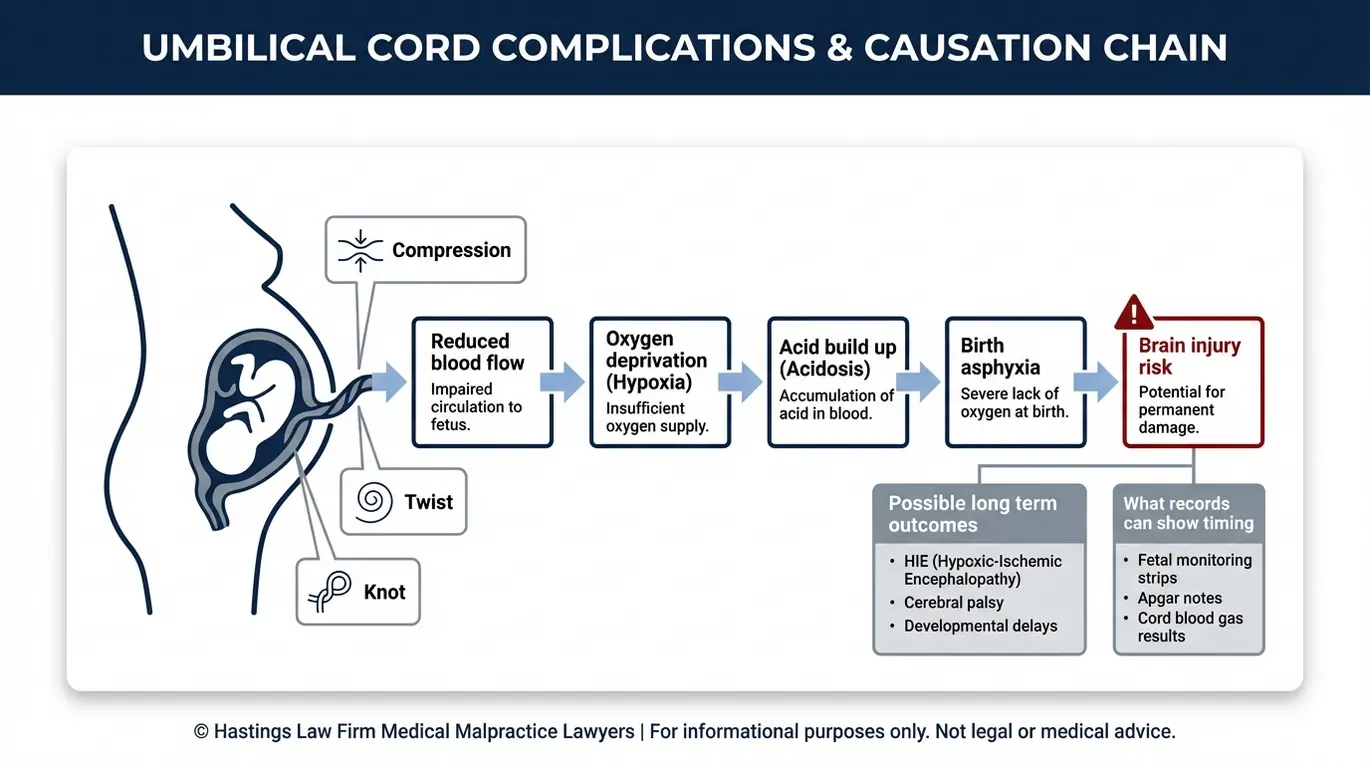
Umbilical cord entrapment occurs when the infant’s cord becomes compressed or twisted, restricting the flow of oxygenated blood and potentially causing permanent brain damage or death if not immediately resolved.
The umbilical cord is the baby’s vital lifeline throughout pregnancy and delivery, responsible for carrying oxygen-rich blood from the placenta to the baby and returning deoxygenated blood. When mechanical forces compress or obstruct the cord during labor, that critical oxygenated blood flow drops significantly. This reduction in oxygen reaching the baby’s tissues is called hypoxia, a condition that can rapidly damage the brain and vital organs if blood flow is not restored.
If hypoxia is severe or prolonged, it progresses to birth asphyxia, a dangerous state where oxygen deprivation causes measurable and often irreversible injury to the brain structures. The longer the developing baby goes without adequate blood flow, the greater the likelihood of suffering lasting physical and cognitive harm.
The potential long-term consequences of unresolved cord compression include:
- Hypoxic-ischemic encephalopathy (HIE), a severe brain injury caused by oxygen deprivation
- Cerebral palsy, a permanent movement and posture disorder linked to brain damage
- Developmental delays affecting speech, cognition, and motor skills
- Seizure disorders requiring lifelong medication and management
- Death in the most severe and tragic cases
Medical teams can prevent these outcomes when they detect cord problems early and act quickly. That is exactly what an umbilical cord entrapment lawyer investigates: whether the care team recognized the warning signs and responded appropriately.
Recognizing Fetal Distress and Variable Decelerations on EFM Strips
Doctors identify cord compression by observing variable decelerations on Electronic Fetal Monitoring (EFM) strips, which appear as sharp drops in the baby’s heart rate coinciding with contractions.
Medical teams rely on electronic fetal monitoring (EFM), a technology used during labor to continuously track the baby’s heart rate, to assess well-being. This process, often referred to as fetal heart rate monitoring, produces a paper readout or fetal monitoring strip that gives the team real-time information. Doctors and nurses must monitor these strips closely throughout delivery to meet the standard of care.
Providers must watch for variable decelerations, which are abrupt decreases in the fetal heart rate that vary in timing, depth, and duration. According to the American Academy of Family Physicians’ guide on interpreting electronic fetal heart rate patterns, these decelerations are the hallmark sign of umbilical cord compression. When they become recurrent, deep, or prolonged, they signal that the baby is in fetal distress and may not be receiving enough oxygen.
Here are warning signs on EFM strips that should prompt immediate clinical action:
- Recurrent variable decelerations that grow deeper or longer over time
- Late decelerations, where the heart rate drop occurs after the peak of a contraction
- Minimal or absent heart rate variability, suggesting the baby’s nervous system may be compromised
- Prolonged bradycardia, a sustained drop in heart rate below the normal baseline
- A combination of non-reassuring patterns that worsen despite repositioning or other interventions
When a Texas umbilical cord entrapment attorney investigates these cases, the fetal monitoring strips are among the first pieces of evidence reviewed. A pattern of ignored or misread warning signs on EFM tracings can be strong evidence that the care team failed to meet the standard of care.
The Role of Umbilical Cord Blood Gas Analysis
Medical teams perform umbilical cord blood gas analysis, a test that measures the levels of oxygen and acid in the baby’s cord blood immediately after delivery. These results provide a scientific snapshot of the baby’s oxygen status at the time of birth.
One key measurement is the umbilical arterial pH and base deficit, which together indicate whether the baby experienced acidosis, a dangerous buildup of acid in the blood caused by prolonged oxygen deprivation. A low pH combined with a high base deficit is strong objective evidence that the baby suffered significant hypoxia during labor. These results become critical medical records in any legal investigation because they help establish the timing and severity of injury.
The Hastings Law Firm Difference
Results matter, but what truly sets us apart is how we achieve them. Every verdict, every settlement, and every Texas courtroom victory comes from one guiding promise: To treat each client’s fight for justice as if it were our own.
This balance of skill, experience, and empathy reflects our core philosophy that justice should not only compensate the injured, but also make healthcare safer nationwide.

Common Causes of Cord Entrapment and Obstetric Negligence
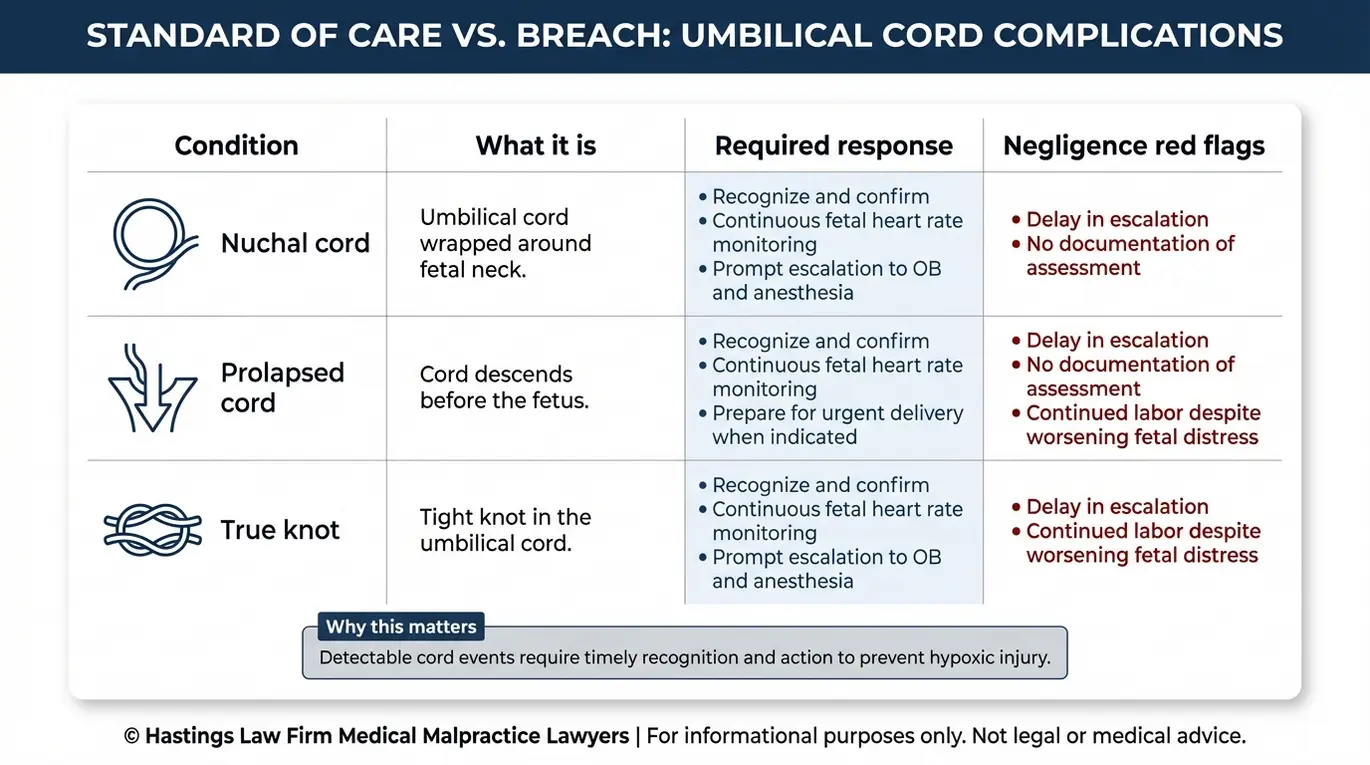
While some umbilical cord issues develop naturally during pregnancy, negligence arises when obstetricians fail to detect and manage conditions like a prolapsed cord or nuchal cord during labor.
Several cord conditions are known to cause compression. A nuchal cord, a condition where the umbilical cord wraps around the baby’s neck, can restrict blood flow if it tightens. A prolapsed umbilical cord, a medical emergency where the cord drops through the cervix ahead of the baby, becomes compressed between the baby and the birth canal. A true knot, which forms when the cord ties into an actual knot that tightens as the baby descends, creates a risk of cutoff.
Each of these conditions is detectable, and each requires a specific clinical response. Research published in PubMed on perinatal death associated with umbilical cord prolapse underscores the critical nature of prompt intervention. Our firm consults a national network of medical experts to identify exactly where the standard of care was breached.
| Cord Condition | Required Clinical Response |
|---|---|
| Nuchal Cord | Continuous fetal monitoring; preparation for emergency delivery if distress develops |
| Prolapsed Cord | Immediate manual elevation of the presenting part off the cord; emergency C-section |
| True Knot | Close monitoring for signs of fetal distress; rapid delivery if heart rate patterns deteriorate |
When a provider detects these conditions and fails to act, or fails to monitor for them at all, the result can be preventable brain injury. A lawyer for umbilical cord entrapment examines the medical records and fetal strips to determine whether the care team’s response matched what the situation required.
Failure to Perform an Emergency C-Section
When conservative measures to relieve cord compression fail, the standard of care mandates an immediate emergency C-section, a surgical delivery performed to prevent permanent brain injury or death.
In obstetric practice, the decision-to-incision time is an important consideration in emergency cesarean deliveries. While some professional organizations have suggested that delivery should ideally occur within approximately 30 minutes of the decision to perform an emergency cesarean, the application of this timeframe varies by hospital and clinical circumstances. Research indexed in PubMed on decision-to-incision time and neonatal outcomes has examined how delays in emergency delivery can significantly affect the baby’s condition at birth.
A delay of even a few minutes, when a baby is already oxygen-deprived, can mean the difference between a healthy delivery and a lifetime of disability. In the cases we investigate as a Texas cord entrapment injury lawyer, we often look at whether the nursing staff escalated concerns to the attending physician in time, whether the operating room was mobilized promptly, and whether the hospital had adequate protocols in place.
Medical negligence in these situations may involve a failure to interpret the fetal monitoring strips correctly or a delayed call to the surgeon. These errors constitute medical malpractice when they deviate from accepted standards. We examine the full timeline to determine where the standard of care was or was not met.
Calculating Damages and Life Care Planning Requirements
Compensation in birth injury cases must account for the lifetime cost of care, including ongoing medical treatment, therapy, assistive equipment, and lost earning capacity, often requiring a detailed life care plan to properly quantify.
When a child suffers brain damage from cord compression, the financial impact on a family can stretch across decades. A successful claim seeks to recover damages that reflect the true lifetime cost of care for the child.
The types of damages typically pursued include:
- Economic damages such as past and future medical expenses, surgeries, hospitalizations, and medications
- Rehabilitative therapies including physical, occupational, and speech therapy
- Specialized equipment and home modifications like wheelchairs and accessible housing
- 24-hour care or nursing assistance for children who cannot live independently
- Lost earning capacity over the child’s projected working lifetime
- Non-economic damages for pain, suffering, mental anguish, and physical impairment
- Punitive damages in cases involving especially reckless conduct
An umbilical cord entrapment attorney in Texas will work with life care planners, specialists who map out the child’s projected medical, therapeutic, and support needs for the next 40 to 50 or more years. This detailed projection is essential for ensuring that any compensation fully covers the child’s future, not just immediate bills.
Texas Statute of Limitations for Birth Injury Claims
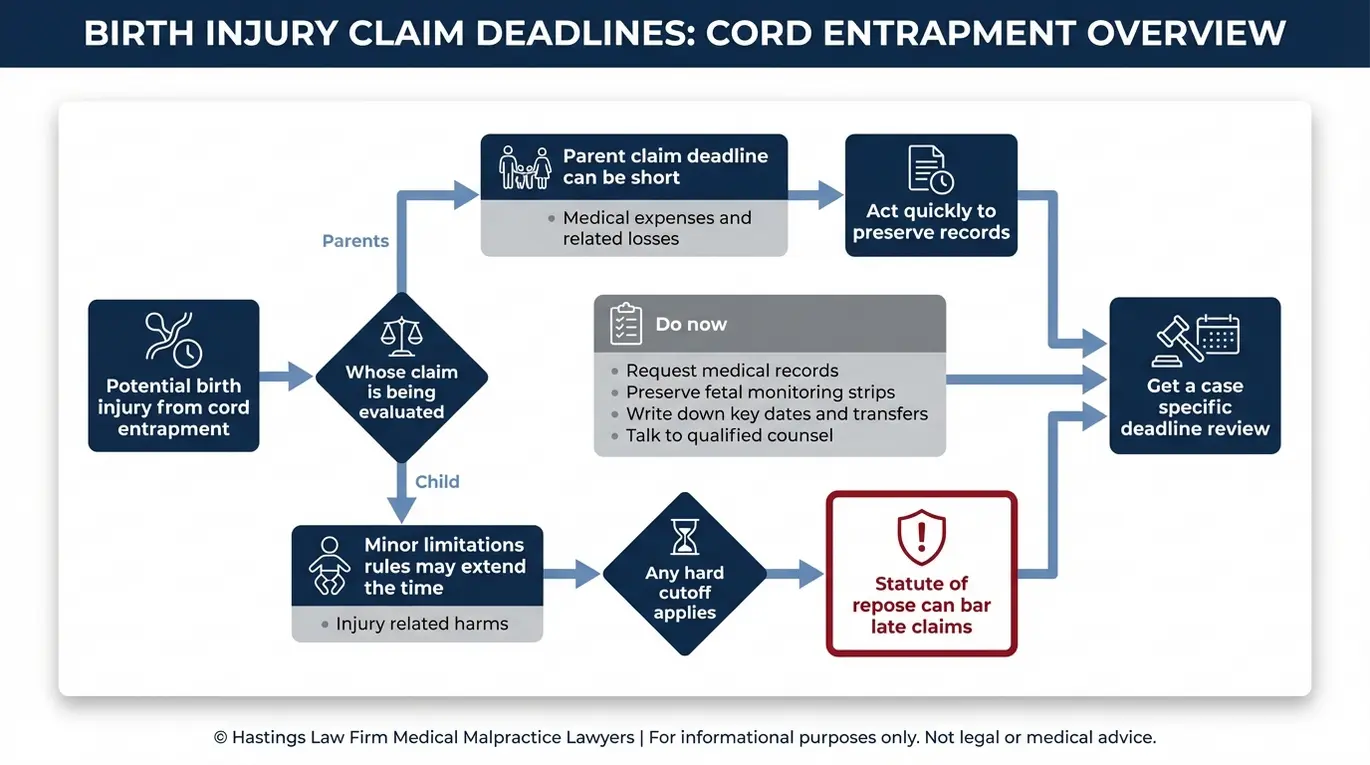
In Texas, parents generally have two years from the date of injury to file a medical malpractice claim, but the statute of limitations for minors is tolled (paused) until the child turns 12, which means the child’s claims generally must be filed before the child turns 14.
For the parents’ claims, which typically involve recovery for medical bills and related out-of-pocket costs, the standard two-year deadline applies. Liability for these costs must be established quickly. Missing this window can permanently bar those claims.
For the child’s claims, which cover pain, suffering, and physical impairment, the tolling provision means the deadline may not expire until the child’s 14th birthday. However, Texas law also imposes a statute of repose, a hard outer deadline that can bar claims filed more than 10 years after the date of the alleged negligence, regardless of when the injury was discovered. These overlapping deadlines can be found in Texas Civil Practice and Remedies Code, Chapter 74.
Because these rules interact in ways that vary depending on the specific facts of each case, consult a Texas umbilical cord entrapment lawyer as soon as possible to protect your family’s rights. *This information is general in nature and does not constitute legal advice. Please consult an attorney for guidance specific to your situation.*
Why Choose Hastings Law Firm for Complex Birth Injury Litigation
Birth injury cases involving cord compression demand significant financial resources and deep medical expertise. Hastings Law Firm provides both, advancing all litigation costs so families never carry financial risk while pursuing accountability.
Properly investigating a birth injury case can cost well over $100,000 when you factor in expert testimony, medical record analysis, and trial preparation. Tommy Hastings is a 2025 inductee into the American Board of Trial Advocates (ABOTA), an invitation-only organization for elite trial lawyers.
Our approach includes:
- In-house nurse consultants who review medical records with clinical precision
- Former defense attorneys who know how hospitals build their cases
- National medical experts who provide credible support for your claim
- No-fee guarantee meaning you pay nothing unless we recover compensation
Our team of Texas umbilical cord entrapment lawyers is dedicated to helping families find the truth. We exist to restore the trust that was broken and to help prevent the same failures from harming another child.
Contact the Texas Birth Injury Attorneys at Hastings Law Firm Today for Help
If your child was injured during delivery because warning signs of cord compression were missed or ignored, what happened deserves a thorough, honest investigation. You are not alone in wanting answers, and asking questions about your child’s care is not only your right but an important step toward protecting your family’s future.
At Hastings Law Firm, our nurse consultants can review your medical records and fetal monitoring strips to help determine whether malpractice may have occurred. The consultation is free, confidential, and carries no obligation.
Contact Hastings Law Firm today to speak with a Texas Umbilical Cord Entrapment Lawyer. There is no fee unless we win your case.
Frequently Asked Questions About Umbilical Cord Entrapment in Texas


This content was researched and written by the Hastings Law Firm editorial team, which includes attorneys, medical professionals, and experienced researchers. Our writing is informed by internal knowledge and practical experience, and we cross-check critical details against authoritative sources cited throughout. Every piece undergoes human-led fact-checking and legal review. Because legal and medical information can change, if you spot an error, please contact us. Learn more about our content standards and review process on our editorial policy page.

Tommy Hastings, founder of Hastings Law Firm, is a board-certified personal injury trial lawyer dedicated exclusively to healthcare injury cases. Since 2001, he has represented injured patients and families in litigation against major hospital systems, pharmaceutical companies, and negligent healthcare providers nationwide. He has handled numerous high-profile cases that have drawn national media attention and resulted in multi-million dollar recoveries. He draws on that experience in his writing, helping readers understand how these cases work and what options may be available to them.
