


Texas Umbilical Catheter Birth Injury Lawyer
Written by: Hastings Law Firm | Reviewed by: Tommy Hastings | Updated: July 27, 2026
Umbilical catheters are commonly used in the NICU to deliver fluids and medications or to monitor vital signs, but placement and monitoring errors can cause severe internal injury. Problems such as tip malposition, missed imaging confirmation, line migration, and delayed recognition of distress can lead to rapid deterioration and long term harm. These cases are often complicated by diagnostic confusion when catheter related injury is mistaken for another condition, which can delay appropriate intervention and obscure what went wrong. If you or a loved one were harmed or worse due to umbilical catheter errors in Texas, contact Hastings Law Firm for a free, confidential case review.
Top-Rated Legal Representation for NICU Line Placement Errors
What You Should Know About UAC/UVC Line Placement Injury Claims in Texas:
- Life altering injury can follow NICU line errors when an umbilical catheter is placed too deep, positioned incorrectly, or used without imaging confirmation.
- Catastrophic outcomes can occur when a malpositioned UVC leads to pericardial effusion that can rapidly progress to cardiac tamponade.
- Serious harm can be missed or delayed when clinical deterioration is attributed to another diagnosis rather than a catheter related injury.
- Options for recovery in Texas can be limited for non economic damages in medical malpractice cases even when long term care needs are extensive.
- Liability can extend beyond the bedside team when radiology interpretation or follow up on imaging findings fails to address a misplaced catheter tip.
- Long term financial impact can be substantial when catheter related injury results in ongoing medical care, therapies, or other lifetime support needs.
- Key evidence can be lost or overlooked when imaging, nursing documentation, and infusion records do not clearly show tip position checks and responses to distress.
- Causation disputes can turn on whether repeated repositioning or line migration preceded organ injury or multi organ failure.

A Healthcare Focused Law Firm
When your newborn is in the NICU, you trust the medical team to handle every procedure with precision. An umbilical catheter, a thin tube inserted through a baby’s umbilical stump to deliver medications or monitor vital signs, is one of the most common lines placed in critically ill newborns. These catheters come in two forms: umbilical arterial catheters (UACs) and umbilical venous catheters (UVCs). When placed or managed incorrectly, they can cause devastating internal injuries that change a child’s life.
If your child suffered an injury linked to a catheter error in the NICU, you deserve honest answers about what happened and whether it could have been prevented. As a Texas umbilical catheter birth injury lawyer, Hastings Law Firm focuses exclusively on medical malpractice, and our team includes in-house medical professionals who know how to read NICU records and identify exactly where the standard of care broke down.
Contact us for a free, confidential case evaluation. We can review what happened and explain your options.
Understanding Umbilical Catheter Risks and Placement Errors
Umbilical catheter errors occur when a UAC or UVC is inserted too deeply, positioned incorrectly, or fails to be confirmed via radiology, leading to organ perforation, chemical burns from TPN extravasation, or cardiac tamponade.
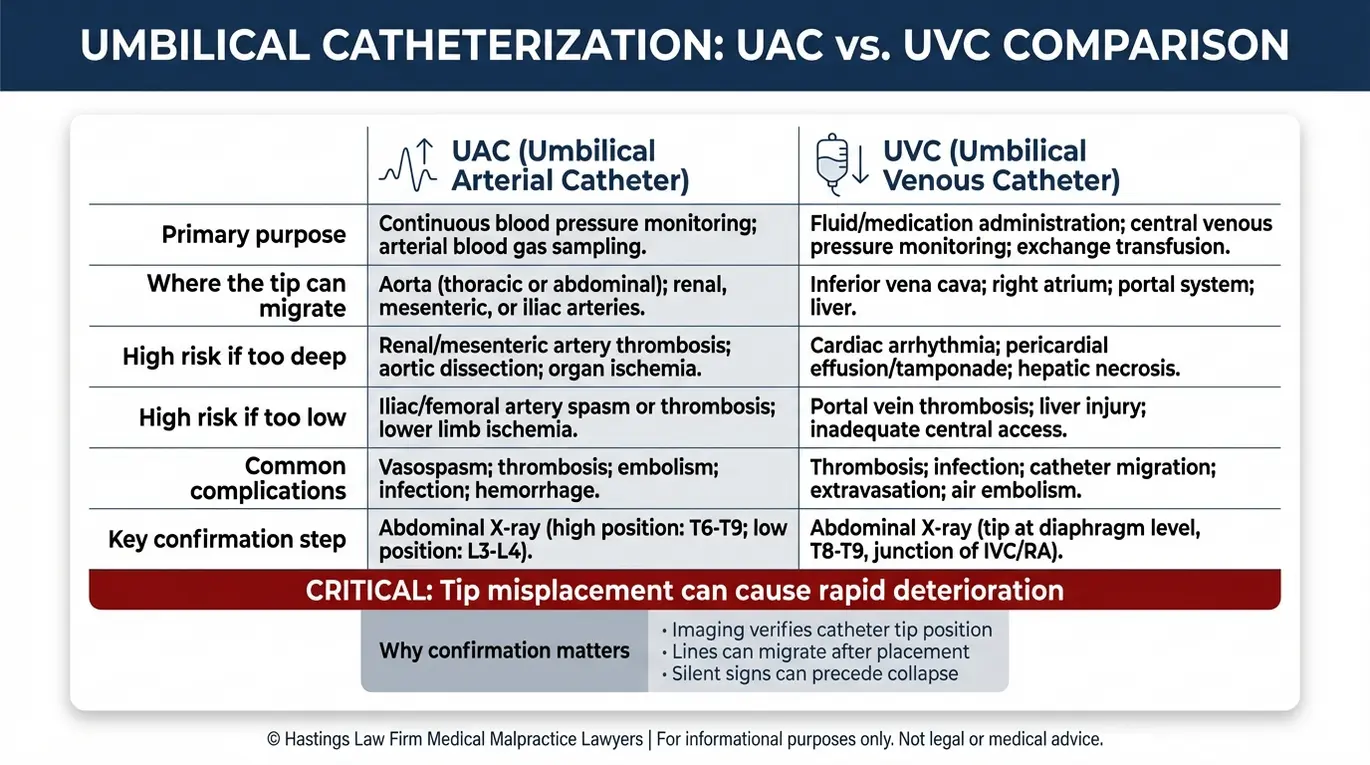
A UAC (umbilical arterial catheter) monitors blood pressure and blood gases via the artery, while a UVC (umbilical venous catheter) delivers fluids and medications through the vein. Each type of catheter has a designated safe zone. Catheter tip malposition, defined as placement outside the ideal “high line” or “low line” spinal levels, creates significant risk. Confirming this tip position through imaging is a basic requirement before the line is used. This follows clinical protocols from the University of Wisconsin Health NICU.
| Feature | UAC (Umbilical Arterial Catheter) | UVC (Umbilical Venous Catheter) |
|---|---|---|
| Primary Purpose | Blood pressure monitoring, blood gas sampling | Fluid delivery, TPN, medication administration |
| Insertion Route | Umbilical artery | Umbilical vein |
| Ideal Tip Position | High line: T6-T9; Low line: L3-L5 | Junction of the inferior vena cava and right atrium |
| Key Risks of Malposition | Leg ischemia, arterial blood clots, kidney damage | Liver damage, pericardial effusion, cardiac perforation |
One of the most dangerous outcomes of UVC malposition is pericardial effusion, where the catheter tip migrates into or near the heart and allows fluid to leak into the pericardial sac. This can rapidly progress to cardiac tamponade. A study published in PubMed Central on pericardial effusion and cardiac tamponade in preterm neonates confirms that UVC tip malposition is a recognized cause of this emergency, particularly in premature infants. Without immediate intervention, tamponade can be fatal.
As a Texas birth injury law firm, we determine whether these known risks were managed properly or whether the medical team failed to follow established protocols.
Proving Negligence in UAC and UVC Line Placement Cases
Proving negligence requires demonstrating that the medical team deviated from the standard of care, typically by failing to confirm catheter tip placement with an X-ray, failing to reposition a migrated line, or ignoring clinical signs of distress like abdominal distention or hypotension.
Radiology failures
Radiology failures are among the most common issues we see in these cases. After a UAC or UVC is inserted, imaging should confirm the tip is in its correct position. If an X-ray shows misplacement, such as the line sitting too deep, and no one acts on that finding, the delay can cause serious harm. We review the imaging timeline closely: when the X-ray was ordered, when it was read, and what action was taken afterward.
Monitoring failures
Monitoring failures are equally important. Total parenteral nutrition (TPN) is a nutrition solution delivered directly into the bloodstream for newborns who cannot yet process food.
Monitoring failures can lead to TPN extravasation, where concentrated nutrition fluid leaks out of the catheter and into surrounding tissue. This can cause severe chemical burns to the liver, bowel, or peritoneal cavity. Line migration, meaning the catheter tip shifts from its original confirmed position, can happen gradually over hours or days. If nursing staff did not routinely verify line position or failed to recognize signs of metabolic acidosis, we examine why.
diagnostic confusion
One issue that makes these cases particularly challenging is diagnostic confusion. Hospitals may attribute a baby’s deteriorating condition to necrotizing enterocolitis (NEC), a serious bowel disease common in premature infants, when the actual cause is catheter-related injury.
Research published in PubMed on umbilical catheter extravasation mimicking NEC documents how TPN leaking into the abdomen from a malpositioned catheter can produce symptoms nearly identical to NEC, including distention, feeding intolerance, and imaging abnormalities. If a hospital labels the injury as NEC without ruling out a catheter error, critical evidence can be overlooked.
We also examine whether the catheter required frequent repositioning after insertion. Repeated adjustments to a line can indicate difficulty with initial placement, instability of the tip, or both. A pattern of repositioning followed by organ injury may point to a breach in the standard of care.
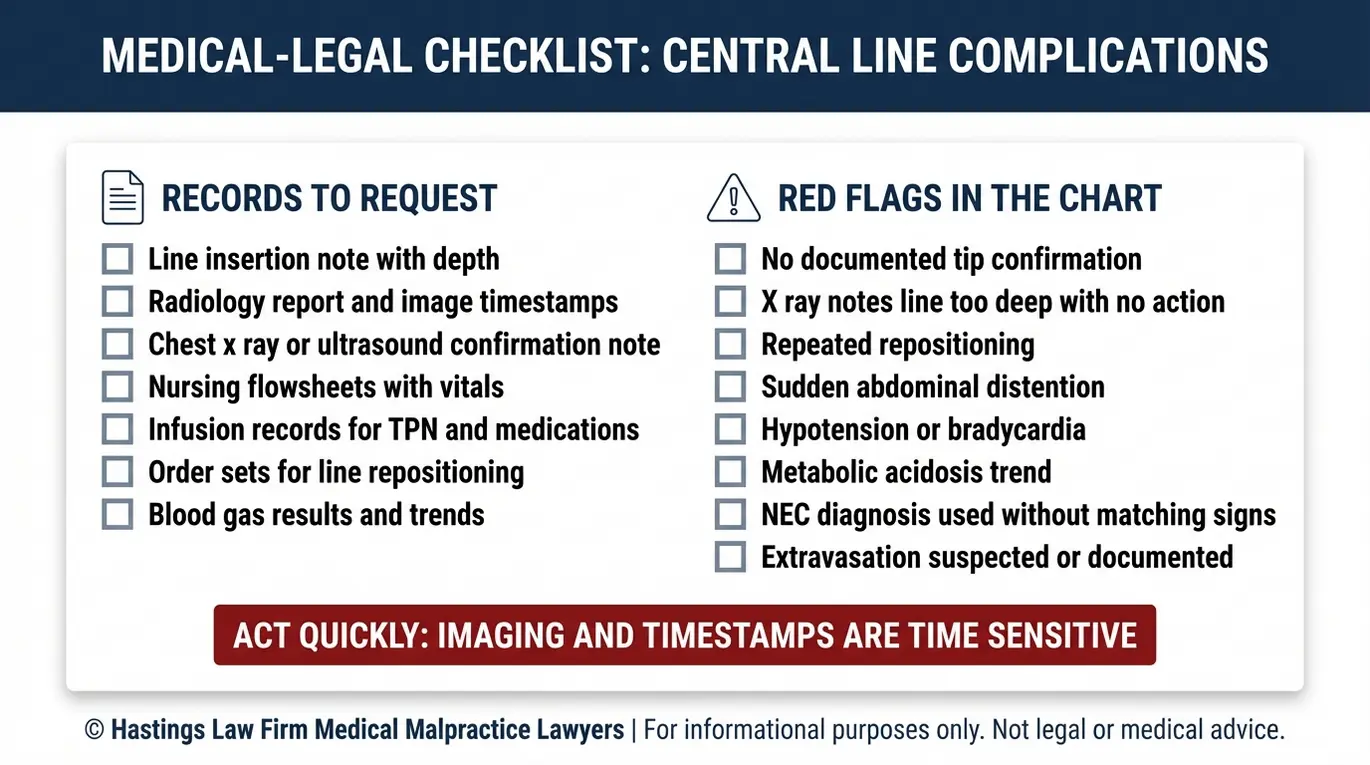
As a Texas umbilical catheter birth injury lawyer, Hastings Law Firm examines the following evidence when building a case:
- Radiology reports and imaging timestamps for post-insertion X-rays or ultrasounds
- Nursing flowsheets documenting line checks, tip position, and vital signs
- TPN infusion records showing concentration, rate, and duration
- Lab results indicating metabolic acidosis or organ dysfunction
- Physician orders for line repositioning or removal
- Documentation of clinical signs such as hypotension, bradycardia, or abdominal distention
- Differential diagnosis records to determine whether NEC was used to explain a catheter injury
The Hastings Law Firm Difference
Results matter, but what truly sets us apart is how we achieve them. Every verdict, every settlement, and every Texas courtroom victory comes from one guiding promise: To treat each client’s fight for justice as if it were our own.
This balance of skill, experience, and empathy reflects our core philosophy that justice should not only compensate the injured, but also make healthcare safer nationwide.

Anatomy of an Injury: Timeline of a Catheter Error
A catheter injury timeline often begins with a difficult insertion, followed by a failure to verify tip location, leading to silent symptoms like acidosis or bradycardia, and culminating in catastrophic multi-organ failure or hypoxic brain injury.
Phase 1: The Insertion
The umbilical catheter is a small tube used for central access in newborns. Placement of an umbilical catheter in a premature or critically ill newborn can be technically difficult. Multiple insertion attempts may cause trauma to the vessel wall or result in an unstable line that is more likely to migrate.
Phase 2: The Latency Period
This is often the most dangerous window. During the latency period, the baby may slowly deteriorate while clinical staff attribute changes to prematurity or an unrelated condition. Signs like dropping blood pressure (hypotension), slowing heart rate (bradycardia), or rising acid levels in the blood can go unrecognized as catheter-related. If TPN or medications are infusing into the wrong location, the damage compounds with every hour.
Phase 3: The Discovery
The injury may not become apparent until the baby crashes, requiring emergency intervention. In some cases, fluid is discovered in the abdomen or chest during an emergency procedure. Pericardial effusion, a buildup of fluid around the heart, or cardiac tamponade, a condition where fluid pressure restricts heart function, may require immediate drainage.
By this point, the baby may have sustained kidney damage, liver damage, bowel perforation, or multi-organ failure from prolonged cardiovascular compromise. Understanding this progression matters because it establishes the connection between the initial placement error and the resulting harm. An experienced umbilical catheter lawyer knows that connecting this catheter injury timeline is the foundation of proving causation. For parents preparing for a child’s long-term recovery, resources like the Massachusetts NICU discharge planning guide can help with the transition home.

Securing Compensation for Catheter-Related Birth Injuries
Resolving a birth injury case involves calculating both economic damages, such as lifetime medical care and therapies, and non-economic damages for the child’s pain and suffering and the parents’ emotional anguish.
Liability extends to the neonatologist, nurse, and radiologist. Identifying every liable party is essential. Hastings Law Firm prepares every case for verdicts or settlements using a trial-ready approach.
We use life care planners to project the costs of necrotizing enterocolitis (NEC), a severe bowel disease, or arterial thrombosis (blood clots caused by catheter-related vessel damage). This rigorous preparation ensures any medical malpractice resolution accounts for the child’s needs over an entire lifetime.
Contact the Texas Birth Injury Attorneys at Hastings Law Firm Today for Help
NICU teams perform life-saving work every day. But when preventable line placement errors cause serious injury to a vulnerable newborn, accountability matters. It matters for your child’s future, and it matters for the next family.
Hastings Law Firm was built for cases like these. Our team includes former defense attorneys who understand how hospitals respond to claims, and in-house medical professionals who can interpret NICU records, radiology reports, and nursing documentation with clinical precision. Founder Tommy Hastings, a board-certified trial attorney, has spent over two decades holding healthcare providers to the standard their patients deserve.
We work on a contingency fee basis, which means you pay no attorney fees or costs unless we recover compensation for your family. If you believe your child was harmed by an umbilical catheter error, a Texas umbilical catheter birth injury lawyer at our firm can review your case, explain what the records show, and help you understand your legal options.
Call us for a free, confidential case evaluation. Let us help you find the answers you deserve.
Frequently Asked Questions About Umbilical Catheter Birth Injury in Texas


This content was researched and written by the Hastings Law Firm editorial team, which includes attorneys, medical professionals, and experienced researchers. Our writing is informed by internal knowledge and practical experience, and we cross-check critical details against authoritative sources cited throughout. Every piece undergoes human-led fact-checking and legal review. Because legal and medical information can change, if you spot an error, please contact us. Learn more about our content standards and review process on our editorial policy page.

Tommy Hastings, founder of Hastings Law Firm, is a board-certified personal injury trial lawyer dedicated exclusively to healthcare injury cases. Since 2001, he has represented injured patients and families in litigation against major hospital systems, pharmaceutical companies, and negligent healthcare providers nationwide. He has handled numerous high-profile cases that have drawn national media attention and resulted in multi-million dollar recoveries. He draws on that experience in his writing, helping readers understand how these cases work and what options may be available to them.
