


Texas Twin-To-Twin Transfusion Syndrome Lawyer
Written by: Hastings Law Firm | Reviewed by: Tommy Hastings | Updated: July 27, 2026
Twin to Twin Transfusion Syndrome is a serious complication of monochorionic twin pregnancies that can progress quickly and cause severe, lasting harm when warning signs are missed or treatment is delayed. Uneven blood flow through shared placental vessels can affect each twin differently, and outcomes can include permanent disability or worse. Care often turns on timely ultrasound monitoring, accurate interpretation of fluid differences, and prompt referral for appropriate intervention. If you or a loved one were harmed or worse due to Twin to Twin Transfusion Syndrome malpractice in Texas, contact Hastings Law Firm for a free, confidential case review.

Top-Rated Birth Injury Attorneys Serving Texas Families
What You Should Know About Failure to Treat Twin Transfusion Claims in Texas:
- Severe and permanent outcomes can follow when Twin to Twin Transfusion Syndrome is not detected and treated in time.
- Different injury patterns can occur for each twin, which can shape how the medical timeline is evaluated.
- Options can narrow when referral for fetoscopic laser treatment is delayed as the condition advances.
- Accountability can extend beyond an individual clinician when hospital level failures contribute to missed signs or delayed care.
- Disputes often turn on whether ultrasound monitoring and follow up matched accepted expectations for monochorionic twin pregnancies.
- A missed opportunity for specialist involvement can be central when high risk twin care is managed without Maternal Fetal Medicine oversight.
- Recovery can include both economic losses and non economic harms when a TTTS related birth injury is proven.
- Legal options can be lost if Texas medical malpractice time limits are missed.
- Placental pathology findings can be pivotal when causation is contested.
- Expert testimony can be decisive when the defense claims the outcome was inevitable due to the high risk nature of twin pregnancies.

A Healthcare Focused Law Firm
Learning that your twins were harmed by a condition that may have been caught earlier or treated differently is deeply painful. Twin-to-Twin Transfusion Syndrome can cause devastating injuries, and when those injuries result from delayed diagnosis or inadequate treatment, families deserve honest answers about what went wrong.
At Hastings Law Firm, we focus exclusively on medical malpractice. Our team includes in-house nurses, former defense attorneys, and board-certified trial lawyer Tommy Hastings, who has spent over two decades holding healthcare providers accountable for preventable harm. As a Texas Twin-to-Twin Transfusion Syndrome lawyer, Tommy and our team understand the medical complexity of these cases and what it takes to build them.
If your family has been affected, we welcome you to contact us for a free, confidential case review. We can examine what happened and explain your legal options.
Understanding Twin-to-Twin Transfusion Syndrome and Its Risks
Twin-to-Twin Transfusion Syndrome (TTTS) is a serious condition that develops in monochorionic twin pregnancies, where abnormal blood vessel connections in a shared placenta cause uneven blood flow between the two fetuses. In a monochorionic pregnancy, both twins share a single placenta, and communicating placental blood vessels, known medically as placental vascular anastomoses, can allow blood to flow disproportionately from one twin to the other.
This blood flow imbalance creates a dangerous situation. One twin, called the “donor twin,” loses blood volume to the other. The second twin, the “recipient twin,” receives too much. Without timely detection and treatment, TTTS can be fatal or cause severe, permanent disability in one or both children.
Several factors increase the clinical risk:
- Shared placenta in monochorionic twins: The single placenta creates the vascular connections that make TTTS possible.
- Abnormal amniotic fluid levels: Significant differences in fluid between the two sacs are often the earliest warning sign.
- Rapid onset and progression: TTTS can advance quickly through stages, making frequent monitoring essential.
- Gestational timing: The condition most commonly presents between 16 and 26 weeks, a window where early detection directly affects outcomes.
Because the consequences of delayed diagnosis can be so severe, families who suspect their care team missed or overlooked the signs of TTTS should consider speaking with a Twin-to-Twin Transfusion Syndrome attorney who understands both the medicine and the law. Our Twin-to-Twin Transfusion Syndrome attorneys know how to investigate these complex claims. Our TTTS birth injury lawyers can help determine whether the care provided met accepted medical standards, and an experienced attorney for TTTS cases can identify where breakdowns may have occurred.
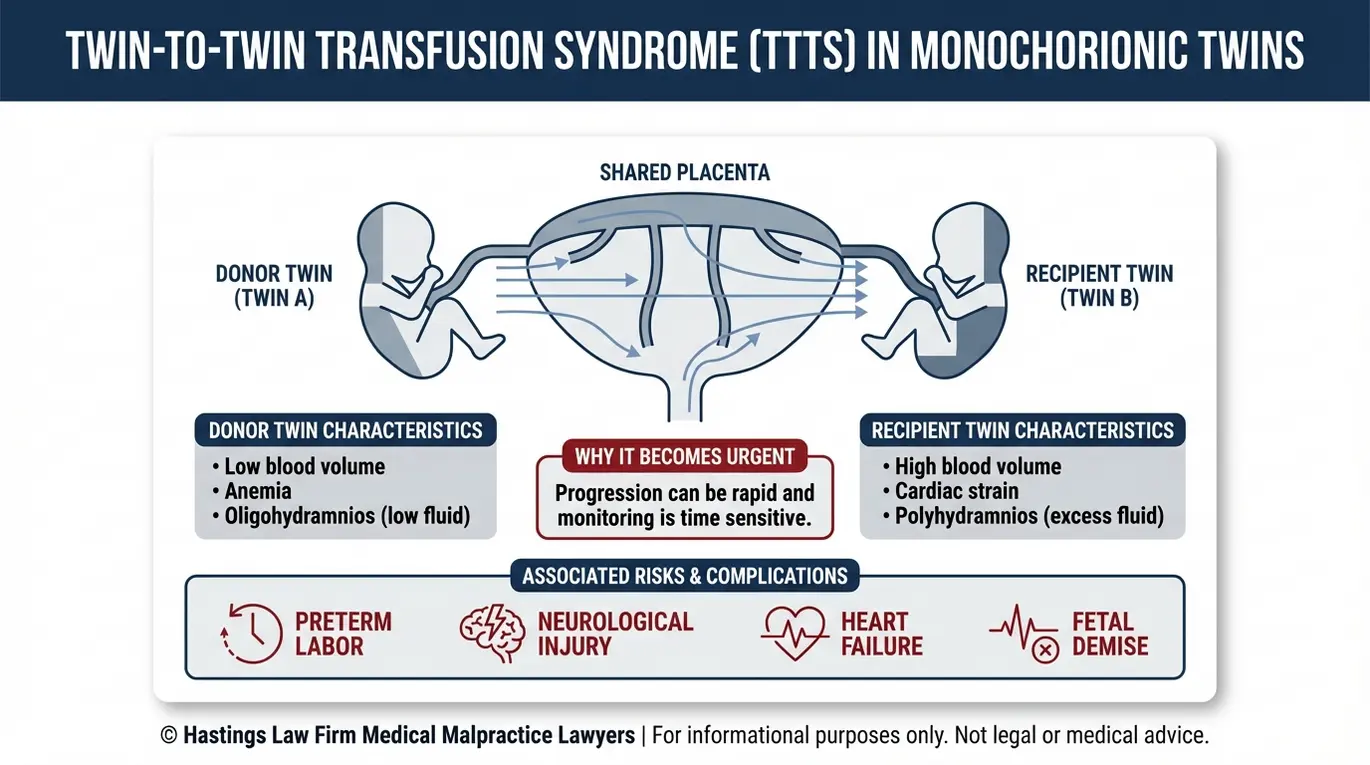
The Differential Impact on Twins Donor vs Recipient Injuries
The donor twin typically suffers from anemia and dangerously low amniotic fluid, a condition called oligohydramnios (abnormally reduced amniotic fluid surrounding the fetus). In cases of Twin-to-Twin Transfusion Syndrome, the donor and recipient twins experience different physical changes. The recipient twin faces the opposite problem: excess fluid known as polyhydramnios (an abnormal accumulation of amniotic fluid) and increasing cardiac dysfunction or strain from fluid overload.
The donor twin can become growth-restricted and malnourished. In severe cases, the lack of amniotic fluid causes the donor to become pressed against the uterine wall, sometimes called the “stuck twin” phenomenon. The recipient twin, meanwhile, may develop heart failure or a condition called hydrops, where fluid accumulates in the body’s tissues and organs.
Both twins are at risk for brain bleeds, neurological injury, and cerebral palsy if the condition is not properly managed. Families dealing with these outcomes may benefit from legal help for TTTS injuries to understand whether earlier intervention could have changed the result. A Texas TTTS attorney can evaluate the medical timeline, and a TTTS lawyer in Texas can identify potential failures in care.
| Feature | Donor Twin | Recipient Twin |
|---|---|---|
| Blood Volume | Decreased (blood loss to recipient) | Increased (excess blood received) |
| Amniotic Fluid Level | Low (oligohydramnios) | High (polyhydramnios) |
| Primary Risks | Anemia, growth restriction, organ failure | Cardiac dysfunction, heart failure, hydrops |
| Long-Term Outcomes | Cerebral palsy, neurological injury, fetal demise | Cerebral palsy, neurological injury, fetal demise |
The Hastings Law Firm Difference
Results matter, but what truly sets us apart is how we achieve them. Every verdict, every settlement, and every Texas courtroom victory comes from one guiding promise: To treat each client’s fight for justice as if it were our own.
This balance of skill, experience, and empathy reflects our core philosophy that justice should not only compensate the injured, but also make healthcare safer nationwide.

Standard of Care for Diagnosing and Treating TTTS
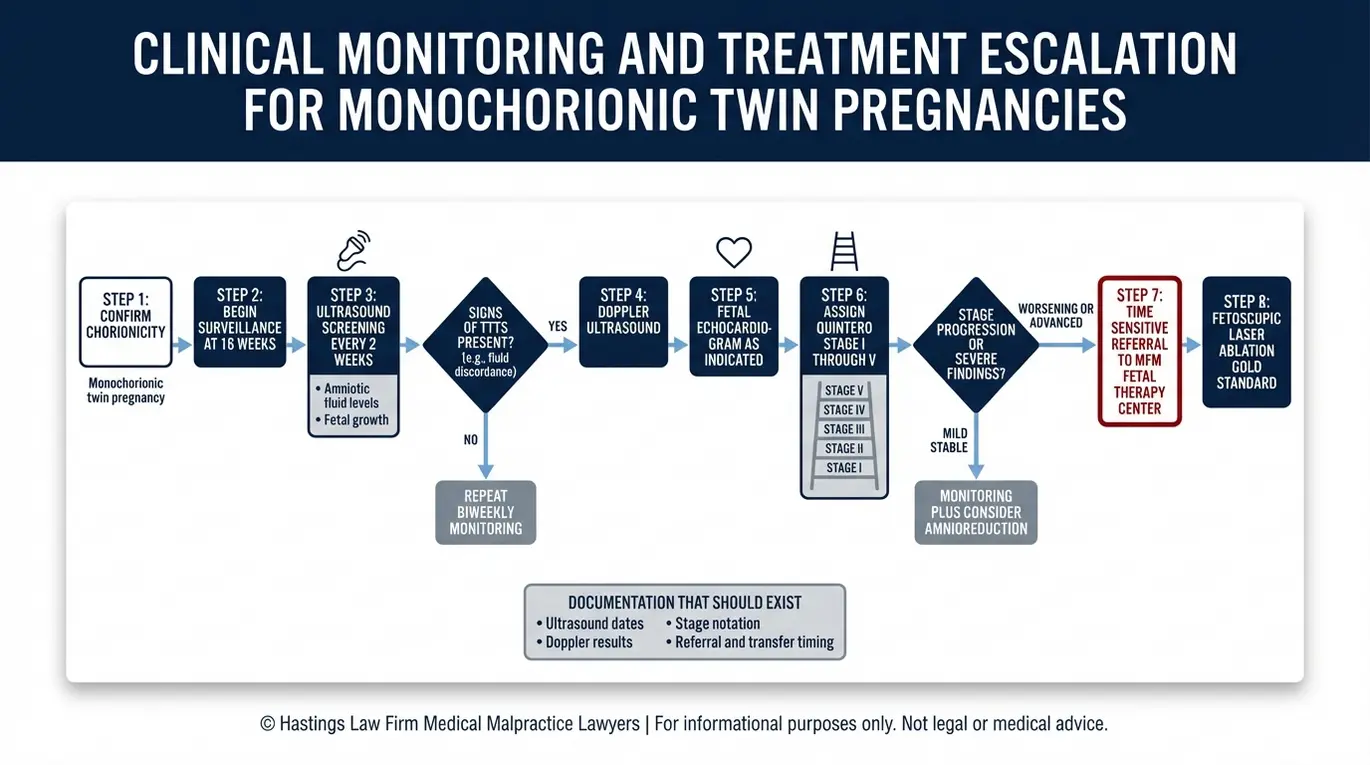
The standard of care requires frequent ultrasound screening, often every two weeks, starting at 16 weeks for all monochorionic twin pregnancies to monitor amniotic fluid levels and fetal growth discrepancies. According to the Twin to Twin Transfusion Syndrome overview on NCBI Bookshelf, early and consistent surveillance is the foundation of TTTS management.
Diagnosis depends on detecting fluid differences between the twins’ amniotic sacs. Doppler ultrasound, which measures blood flow through the umbilical cord and fetal vessels, and fetal echocardiogram are standard tools used to assess severity and guide treatment decisions.
Once TTTS is identified, clinicians use the Quintero staging system, a five-stage classification that grades the severity of the syndrome based on ultrasound findings:
- Stage I: Fluid discrepancy is visible, but Doppler blood flow studies remain normal.
- Stage II: The donor twin’s bladder is not visible on ultrasound.
- Stage III: Abnormal Doppler findings in one or both twins.
- Stage IV: One or both twins develop hydrops (fluid accumulation in tissues).
- Stage V: Fetal demise of one or both twins.
The gold standard treatment is fetoscopic laser ablation, a minimally invasive surgery where a laser is used to seal the abnormal blood vessel connections in the placenta. Research published in a PubMed Central economic evaluation of fetoscopic laser versus amnioreduction supports fetoscopic laser surgery as the preferred intervention over amnioreduction, a procedure that drains excess fluid but does not address the underlying cause. Delaying referral for laser surgery until the condition reaches Stage III or IV can constitute a failure to treat TTTS and significantly worsen outcomes.
Under Texas Civil Practice and Remedies Code, Chapter 74, a Texas Twin-to-Twin Transfusion Syndrome lawyer must work with qualified experts to establish that the care provided fell below these accepted standards. A malpractice attorney handling TTTS cases will evaluate whether screening intervals, diagnostic tools, and treatment decisions aligned with what the medical community requires. When those standards are not met, a lawyer for TTTS negligence can help determine if the family has a viable claim. Skilled TTTS malpractice attorneys and TTTS birth injury attorneys can ensure your rights are protected.
Identifying Medical Malpractice in TTTS Cases
Medical malpractice in TTTS cases occurs when a healthcare provider fails to follow the standard of care by missing diagnostic signs, failing to refer to the right specialist, or delaying necessary surgical intervention. Not every bad outcome is malpractice, but when the medical evidence shows that accepted protocols were not followed, a TTTS malpractice claim or TTTS lawsuit may be warranted.
Failure to Diagnose: A provider may fail to schedule ultrasounds frequently enough for a monochorionic pregnancy, or overlook early signs of fluid imbalance. If amniotic fluid discrepancies are noted but not acted upon, that gap in care can form the basis of a medical negligence claim for failure to diagnose TTTS.
Failure to Refer: Monochorionic twin pregnancies are high-risk by definition. When a general OB/GYN manages the pregnancy without involving a Maternal-Fetal Medicine (MFM) specialist, a physician with advanced training in high-risk pregnancies, the patient may not receive the level of surveillance or intervention the condition demands.
Failure to Treat: Even when TTTS is diagnosed, delays in scheduling fetoscopic laser surgery or relying solely on amnioreduction can allow the condition to advance. If treatment is not escalated appropriately, it can result in preterm labor, fetal demise, or permanent birth injury.
Hospital Liability: Hospitals may bear responsibility through vicarious liability for the actions of their staff, or through institutional failures such as inadequate equipment, insufficient staffing, or the absence of protocols for managing TTTS. A TTTS injury attorney can investigate these institutional failures.
A Texas medical malpractice lawyer experienced in TTTS cases will look for patterns like these when evaluating your claim. Common indicators of potential negligence in suing for TTTS negligence include:
- Ultrasound intervals longer than two weeks after 16 weeks’ gestation
- No referral to an MFM specialist after a monochorionic diagnosis
- Documented fluid discrepancies with no follow-up or escalation
- Delayed referral for fetoscopic laser surgery despite advancing Quintero stage
- Absence of Doppler ultrasound assessment, a specialized ultrasound that measures blood flow velocity through fetal and placental vessels
- Failure to document or communicate abnormal findings between providers

Proving Negligence Using Pathology and Expert Testimony
Winning a TTTS case relies on expert witness testimony. Establishing negligence in a TTTS claim requires a thorough look at the medical data. Under Texas Civil Practice and Remedies Code, Chapter 74, a Texas Twin-to-Twin Transfusion Syndrome lawyer must work with qualified experts to prove the breach. As a PubMed Central case study notes, distinguishing between chronic TTTS, which develops gradually, and acute TTTS, which occurs suddenly, is critical for the trial strategy and discovery process. Our TTTS litigation experts and attorneys for TTTS claims prepare every case for trial.
Why Placental Pathology Matters in Litigation
Placental pathology, the laboratory examination of the placenta, is important medical evidence. It proves communicating placental blood vessels existed, establishing causation. This report counters defense arguments that injuries were genetic or inevitable. As a law firm for birth injuries, we secure this report immediately to confirm the mechanism of injury.
Contact the Texas Birth Injury Attorneys at Hastings Law Firm Today for Help
Texas law imposes strict time limits on medical malpractice claims. Waiting too long can mean losing your right to seek accountability, regardless of how strong the evidence may be. If your family has been affected by TTTS and you believe the care you received fell short, the time to act is now.
Hastings Law Firm offers free, confidential case evaluations. Our team of attorneys, nurses, and patient advocates will review your medical records, consult with qualified experts, and give you an honest assessment of your legal options. We work on a contingency fee basis, which means you pay no attorney fees or costs unless we recover compensation for your family.
Seeking answers is not just about your family. It is about making sure this does not happen to someone else’s children. Contact a Texas TTTS attorney at Hastings Law Firm today by calling our office or completing our online form to schedule your confidential case review.
Frequently Asked Questions About Twin-To-Twin Transfusion Syndrome in Texas


This content was researched and written by the Hastings Law Firm editorial team, which includes attorneys, medical professionals, and experienced researchers. Our writing is informed by internal knowledge and practical experience, and we cross-check critical details against authoritative sources cited throughout. Every piece undergoes human-led fact-checking and legal review. Because legal and medical information can change, if you spot an error, please contact us. Learn more about our content standards and review process on our editorial policy page.

Tommy Hastings, founder of Hastings Law Firm, is a board-certified personal injury trial lawyer dedicated exclusively to healthcare injury cases. Since 2001, he has represented injured patients and families in litigation against major hospital systems, pharmaceutical companies, and negligent healthcare providers nationwide. He has handled numerous high-profile cases that have drawn national media attention and resulted in multi-million dollar recoveries. He draws on that experience in his writing, helping readers understand how these cases work and what options may be available to them.
