


Houston Over Prescribing of Medication Lawyer
Negligent prescribing can turn treatment into a source of serious harm, especially when medications are ordered in unsafe amounts or without appropriate monitoring. Over prescribing can increase the risk of addiction, organ damage, and fatal outcomes, and responsibility may involve a prescriber, a pharmacist, or a clinic that ignores warning signs. Texas uses tools like prescription monitoring to help flag dangerous patterns, but failures still happen. If you or a loved one were harmed or worse due to over prescribing of medication in Houston, Texas, contact Hastings Law Firm for a free, confidential case review.
Last Updated: July 27, 2026
Trusted Medical Attorneys in Houston for Negligent Prescribing
When a doctor prescribes medication that causes more harm than healing, the experience can leave you feeling confused, betrayed, and unsure of what to do next. You trusted a medical professional to help you, and that trust was broken. If you or a loved one has been harmed by excessive or unnecessary prescriptions, you deserve answers.
At Hastings Law Firm, we focus exclusively on medical malpractice, including cases involving pill mills, clinics that prescribe large quantities of controlled substances with little or no legitimate medical purpose. Our founder, Tommy Hastings, secured a landmark verdict against operators of a pill mill, a national first of its kind. As a Houston Over Prescribing of Medication Lawyer, our team has the medical and legal experience to investigate what happened and hold the responsible parties accountable.
Contact us for a free, confidential case evaluation. We can review what happened and explain your options.

Understanding Medication Errors and Over Prescribing in Texas
Over-prescribing occurs when a physician or healthcare provider authorizes medication in quantities, dosages, or frequencies that exceed the medical standard of care, placing the patient at unreasonable risk of harm or addiction. The medical standard of care is the level of care and skill that a reasonably competent healthcare professional would provide under similar circumstances. These medication errors are not rare, and they can be devastating for patients and their families who expect healing rather than harm.
An adverse drug event (ADE), meaning any harm caused by the use of a medication, can range from organ damage and dependency to fatal overdose. While many prescription medications provide necessary relief, they become dangerous when mismanaged by providers. Data from the Centers for Disease Control and Prevention’s SUDORS Dashboard confirms that drug overdose deaths remain a serious public health crisis across the country, including in Texas.
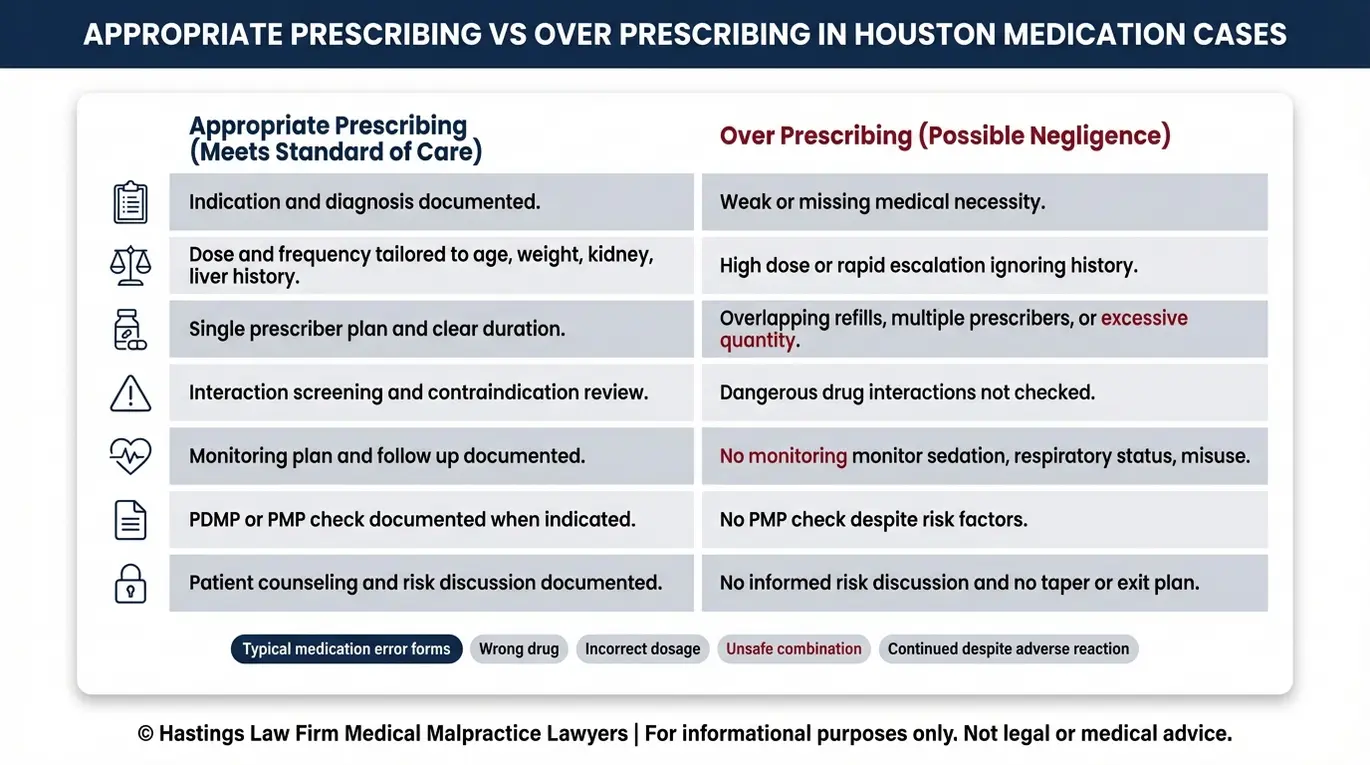
A Houston medication error attorney evaluates prescription patterns to determine whether the prescribing crossed the line from appropriate care into negligence. Common types of over-prescribing include:
- Prescribing excessive quantities of opioids or benzodiazepines beyond what the condition requires
- Ordering high doses that ignore the patient’s medical history, weight, or age
- Continuing prescriptions despite clear signs of addiction or worsening adverse reactions
- Prescribing the wrong drug or an incorrect dosage for the diagnosed condition
Recognizing Negligence in the Administration Process
The prescribing process involves multiple steps, and a breakdown at any point can lead to patient harm. It starts with the doctor’s order, moves through pharmacy dispensing and administering the medication, and continues with ongoing monitoring.
Pharmacists have an independent duty to verify prescriptions. If a pharmacist fills a prescription without checking for dangerous drug interactions, a situation where two or more medications combine to produce harmful or unpredictable effects, that pharmacist may share liability.
Texas also maintains a Prescription Monitoring Program (PMP), a statewide electronic database that tracks controlled substance prescriptions dispensed to individual patients. The PMP exists specifically to flag patterns of overuse. When a prescriber or pharmacist fails to check the PMP before issuing or filling a prescription, that failure can be a significant indicator of negligence.
Common Causes of Dangerous Over Prescribing by Physicians
Over-prescribing often stems from a physician’s failure to review a patient’s full history, financial incentives to push specific drugs, or a lack of monitoring for dangerous drug interactions. These prescription malpractice cases frequently involve one or more of these root causes, representing a departure from the accepted standard of care.
Opioids, a class of powerful pain medications that include drugs like oxycodone and fentanyl, and benzodiazepines, sedatives commonly prescribed for anxiety such as Xanax or Valium, are among the most commonly over-prescribed drugs. Both carry a high risk of dependency and overdose.
| Cause | How It Leads to Harm |
|---|---|
| High-volume prescribing practices | Doctors running pill mills or prioritizing patient volume over safety may neglect proper screening |
| Failure to check the PMP | Prescribers miss existing prescriptions from other providers, leading to dangerous overlap |
| Failure to monitor | Signs of addiction, tolerance, or adverse reactions go unaddressed |
| System-level protocol failures | Hospital or clinic procedures that prioritize speed over careful review of patient records |
The Texas Prescription Monitoring Program (PMP AWARxE), administered by the Texas State Board of Pharmacy, is one of the primary tools designed to prevent these failures.
The Hastings Law Firm Difference
Results matter, but what truly sets us apart is how we achieve them. Every verdict, every settlement, and every Houston courtroom victory comes from one guiding promise: To treat each client’s fight for justice as if it were our own.
This balance of skill, experience, and empathy reflects our core philosophy that justice should not only compensate the injured, but also make health care safer nationwide.

Holding Doctors Responsible for Negligent Prescriptions Leading to Overdoses
To hold a doctor or other liable parties responsible for an overdose, the patient or their family must prove the physician breached the accepted standard of care and that this breach directly caused the overdose or injury. A medication overdose, the body’s toxic response to receiving more of a drug than it can safely process, is one of the most serious consequences of negligent prescribing.
Medical malpractice claims involving over-prescribing require proof of four legal elements of negligence. These components must be established to successfully demonstrate liability. Each one must be supported by evidence:
- Duty: A doctor-patient relationship existed, creating a legal duty of care to provide competent care
- Breach: The wrongful prescription was medically unnecessary, excessive, or inconsistent with accepted standards
- Causation: The medication directly caused or substantially contributed to the overdose or injury
- Damages: The patient suffered measurable harm, whether physical, financial, or both
Negligence in prescribing cases is rarely obvious from the surface. Our legal team, which includes in-house nurse practitioners and former defense attorneys, reviews medical records, hospital charts, pharmacy logs, and prescribing histories to identify exactly where the standard of care was violated. We work with qualified medical experts to build a clear, evidence-based timeline that connects the prescribing decision to the harm.

Filing a Lawsuit Against a Doctor for a Drug Overdose
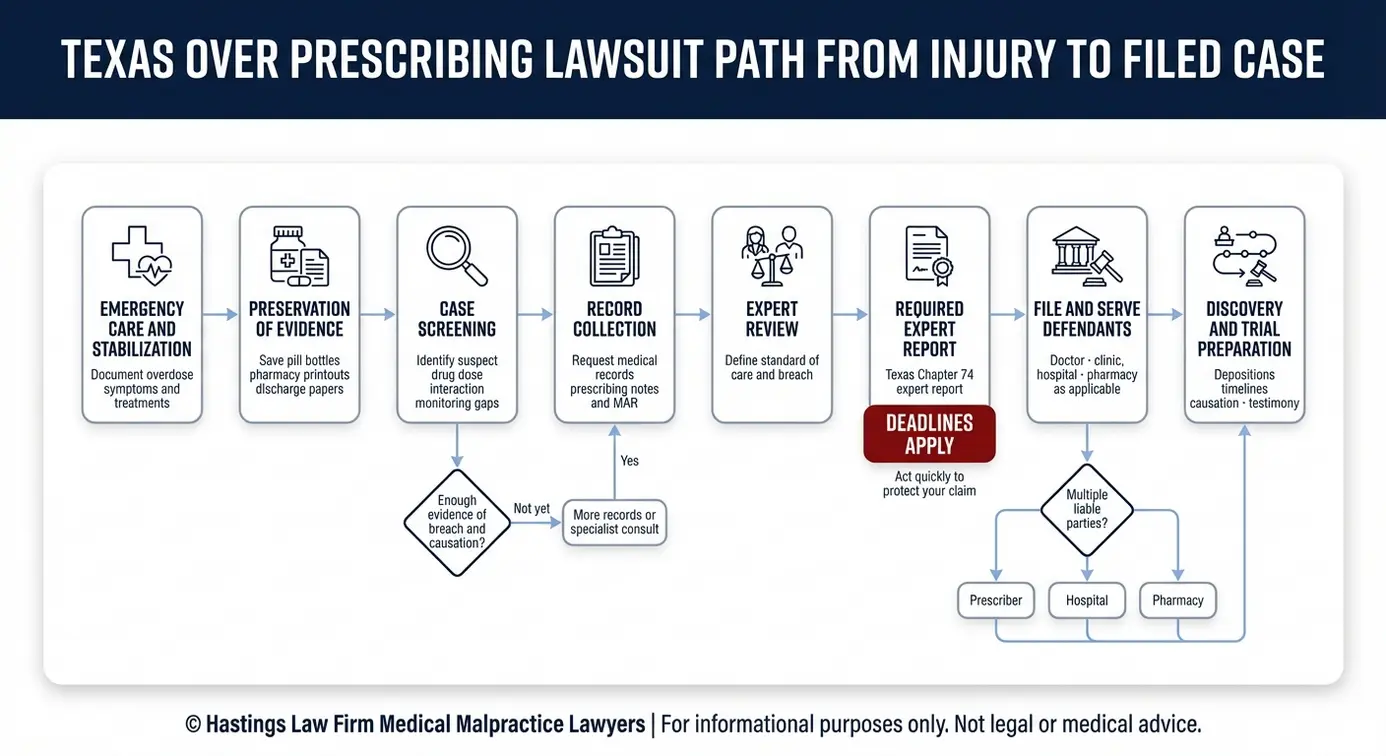
Filing a medical malpractice lawsuit involves gathering medical records, securing expert testimony to validate the breach of care, and submitting a claim for economic and non-economic damages before the Texas statute of limitations expires. Here is how the process typically works:
- Case screening and record collection: We begin with a free evaluation led by a patient advocate. If the case has merit, our medical team collects and analyzes all relevant records, including prescribing histories, pharmacy logs, and monitoring notes.
- Expert report: Texas law requires a qualified medical expert to provide a written expert report supporting the claim. This document serves to prove that the healthcare provider’s actions fell below the accepted medical standard. Under Texas Civil Practice and Remedies Code § 74.351, this report must be served within 120 days after the date each defendant’s original answer is filed.
- Litigation and trial preparation: We handle all filings, depositions, and discovery. Because we prepare every case from day one as if it will go to a jury, we negotiate compensation from a position of strength.
Potential damages include economic losses, such as medical bills and lost wages, and non-economic losses, like physical pain and emotional suffering. In cases involving a defective or contaminated drug, product liability claims against the drug manufacturer or pharmacy may also apply.
Contact the Houston Healthcare Malpractice Attorneys at Hastings Law Firm Today for Help
If you or a loved one has been harmed by negligent prescribing, you do not have to face the medical and legal systems alone. We understand how difficult it can be to question a doctor’s decisions, especially when you are still dealing with the physical and emotional consequences of what happened.
At Hastings Law Firm, our entire team is dedicated to one thing: holding healthcare providers accountable when their actions cause preventable harm. As a Houston over-prescribed medication lawyer, we bring the medical knowledge and trial experience needed to pursue the answers and financial security your family deserves.
We operate on a contingency fee basis, which means there is no cost to you unless we recover compensation on your behalf. Call us or reach out online for a free, confidential case evaluation. Let us help you understand what happened and what your options are moving forward.
Frequently Asked Questions About Over Prescribing of Medication in Houston


This content was researched and written by the Hastings Law Firm editorial team, which includes attorneys, medical professionals, and experienced researchers. Our writing is informed by internal knowledge and practical experience, and we cross-check critical details against authoritative sources cited throughout. Every piece undergoes human-led fact-checking and legal review. Because legal and medical information can change, if you spot an error, please contact us. Learn more about our content standards and review process on our editorial policy page.

Tommy Hastings, founder of Hastings Law Firm, is a board-certified personal injury trial lawyer dedicated exclusively to healthcare injury cases. Since 2001, he has represented injured patients and families in litigation against major hospital systems, pharmaceutical companies, and negligent healthcare providers nationwide. He has handled numerous high-profile cases that have drawn national media attention and resulted in multi-million dollar recoveries. He draws on that experience in his writing, helping readers understand how these cases work and what options may be available to them.
