


Houston Nurse Malpractice Lawyer
Nursing negligence can cause serious, lasting harm when basic patient care breaks down in a hospital setting. Medication mistakes, missed warning signs, poor communication, and incomplete documentation can turn a treatable situation into a life changing injury or worse. Accountability can be complicated because hospitals may be responsible for employee nurses, while staffing agency arrangements can create disputes about who is liable. Texas law also places limits on certain damages, which can affect recovery. If you or a loved one were harmed or worse due to nursing negligence in Houston, Texas, contact Hastings Law Firm for a free, confidential case review.
Last Updated: July 27, 2026
Trusted Medical Attorneys for Nursing Negligence Claims in Houston
When a nurse’s error causes serious harm, the impact reaches far beyond the hospital room. You may be dealing with unexpected medical costs, ongoing pain, and the difficult realization that someone you trusted with your care made a preventable mistake. Those feelings of confusion and frustration are valid.
At Hastings Law Firm, we focus exclusively on medical malpractice litigation and have since 2005. Founded by Tommy Hastings, a board-certified trial attorney, our team includes in-house nurse consultants and former defense attorneys who understand hospital systems from the inside. As a Houston nurse malpractice lawyer team, we know how to identify where nursing care broke down and build a case around the evidence.
If you believe a nursing error caused harm to you or someone you love, we are here to listen. Contact us for a free, confidential case evaluation to understand your options.

Defining Nurse Malpractice in Houston Hospitals
Nursing malpractice occurs when a nurse fails to meet the accepted standard of care, the level of treatment a reasonably competent nurse would have provided under similar circumstances, and that failure results in injury or harm to a patient. The standard of care acts as the legal benchmark for measuring whether the medical treatment provided was appropriate. The distinction lies in whether the nurse’s actions constituted a breach of duty that fell below what the profession demands.
Nurses operate within a defined nursing scope of practice, which outlines the patient care tasks and responsibilities they are authorized to perform based on their training and licensure. In many care settings, nurses also receive tasks through delegation, where a physician assigns clinical duties that the nurse is expected to carry out competently and monitor independently. These boundaries matter because a nurse who acts outside their scope, or who fails to properly execute a delegated task, may be liable for the resulting harm.
Nurses are often the last line of defense between a patient and a preventable injury. They spend more continuous time with patients than most other providers, which places them in a unique position to uphold their duty of care and catch problems early. According to the American Nurses Association, core nursing responsibilities include:
- Continuous monitoring of patient vital signs and condition changes
- Administering medications safely and accurately
- Advocating for the patient when clinical concerns arise
- Communicating changes in patient status to physicians promptly
- Maintaining accurate and timely medical records
When these duties are ignored or performed carelessly, the consequences can be severe. Texas medical liability claims, including those involving nursing negligence, are governed by the Texas Civil Practice and Remedies Code, Chapter 74, which sets the procedural framework for how these cases must be filed and proven. A nurse malpractice attorney can help determine whether the care you or your loved one received crossed the line from an unfortunate outcome into actionable professional negligence.
Common Nursing Errors in Houston Medical Facilities
Common nursing errors include medication mistakes, failure to monitor vital signs, improper documentation, and failure to communicate significant changes in a patient’s condition to a physician. These breakdowns in patient care can lead to catastrophic injuries, making patient safety protocols essential.
Medication Errors
One of the most preventable forms of nursing negligence involves violations of the Five Rights of medication administration: the right patient, right drug, right dose, right route, and right time. These protocols are designed to ensure every patient receives the correct medication safely. When any of these checkpoints are missed, a patient may receive the wrong medication, an incorrect dosage, or a drug intended for someone else entirely. These errors can cause dangerous drug interactions, organ damage, or allergic reactions.
Failure to Monitor and Rescue
Failure to Rescue refers to a clinical situation where a nurse does not recognize or respond to signs of patient deterioration in time to prevent serious harm. This process involves identifying early warning signals that a patient’s health is declining. This can include ignoring alarms, overlooking dropping oxygen levels, or failing to act on signs of distress such as hypoxia, which may lead to brain injuries. Patient safety data tracked by the Agency for Healthcare Research and Quality (AHRQ) Patient Safety Indicators highlights how common these preventable events remain across hospital settings.
Documentation Errors
Accurate charting protects patients. Some facilities use a practice called charting by exception, where nurses only document findings that fall outside normal parameters. This method assumes that everything else is normal unless stated otherwise. While this approach saves time, it can create dangerous gaps in the medical record. Missing entries in shift logs or incomplete notes can obscure what actually happened during a patient’s care, making it harder to identify negligence after the fact. Under the Texas Health and Safety Code Chapter 241, hospitals are required to maintain proper medical records, and gaps in documentation can become key evidence in a malpractice case.
Our malpractice lawyers in Houston examine these records closely, looking for inconsistencies that reveal where the standard of care was breached.
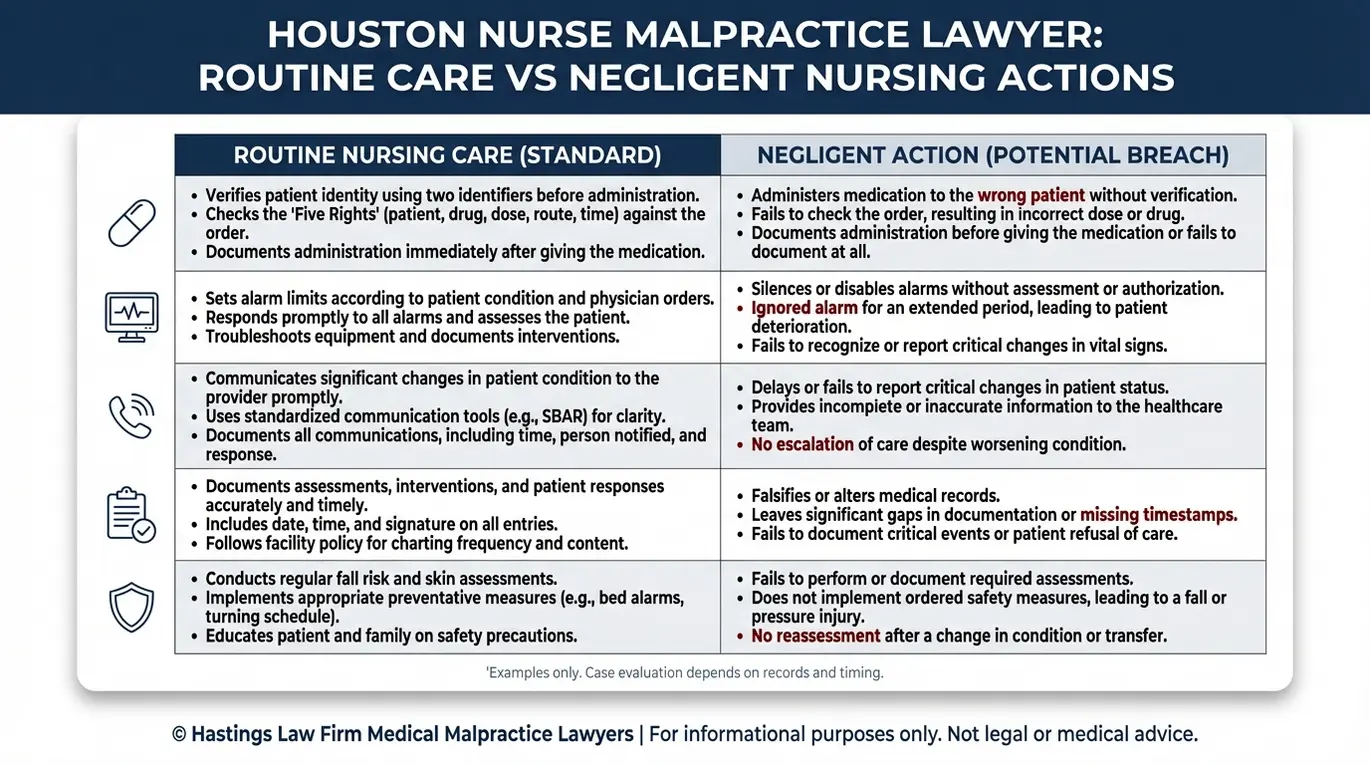
| Scenario | Routine Care | Negligent Action |
|---|---|---|
| Fall Prevention | Assessing fall risk on admission; bed rails raised; call light within reach | No fall risk assessment performed; patient left unattended without safety precautions |
| Pressure Injuries (Bedsores) | Repositioning immobile patients every two hours; regular skin assessments | Failing to reposition patient for extended periods; no skin checks documented |
| Medication Administration | Verifying patient identity, drug, dose, route, and time before giving medication | Administering medication without checking patient ID or confirming the correct dosage |
| Post-Surgical Monitoring | Checking vitals at ordered intervals; reporting abnormal readings immediately | Missing scheduled vital sign checks; failing to escalate signs of surgical error or complications |
The Hastings Law Firm Difference
Results matter, but what truly sets us apart is how we achieve them. Every verdict, every settlement, and every Houston courtroom victory comes from one guiding promise: To treat each client’s fight for justice as if it were our own.
This balance of skill, experience, and empathy reflects our core philosophy that justice should not only compensate the injured, but also make health care safer nationwide.

Liability and Holding Hospitals Accountable for Nursing Staff
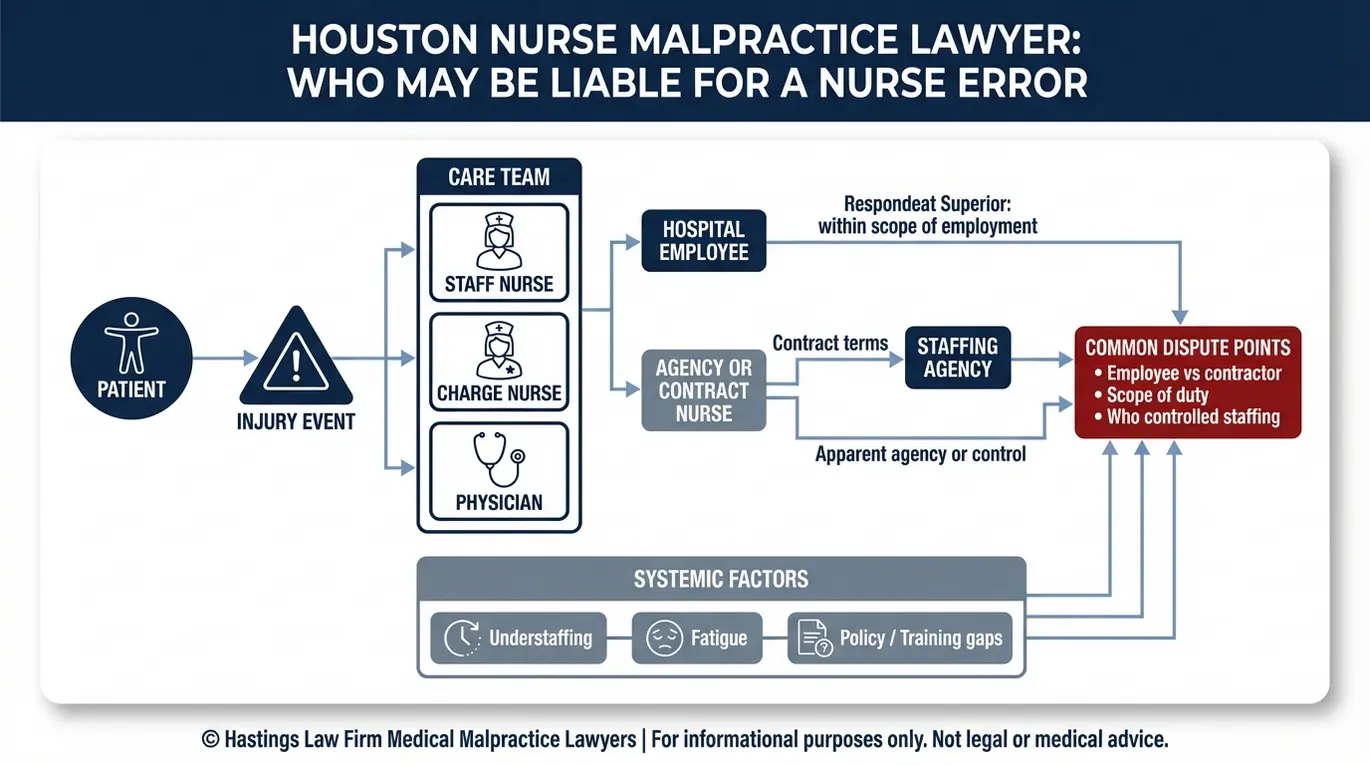
Hospitals can often be held vicariously liable for the negligence of their nursing staff, provided the nurse was acting within the scope of their employment at the time the error occurred. This concept of being vicariously liable ensures that facilities are accountable for the actions of their employees.
This is significant because it allows your Houston nursing negligence lawyer to pursue a nursing negligence claim against the hospital itself, not just the individual nurse. Hospitals have greater resources and carry institutional liability insurance, which can affect the amount of compensation available.
However, the liability picture becomes more complicated when a nurse is not a direct hospital employee. Many facilities use nurses and other health care providers supplied by third-party staffing agencies. In those cases, the hospital may argue it is not responsible for the contractor’s conduct, creating a dispute over who the actual employer was. Identifying the correct liable parties early is an important part of the investigation into hospital nursing errors.
Beyond individual nurse errors, systemic failures within the facility itself can contribute to patient harm. Inadequate nurse-to-patient ratios, the number of patients assigned to each nurse during a shift, can stretch staff too thin. Alarm fatigue, a condition where nurses become desensitized to constant monitor alerts and begin ignoring or silencing them, is another institutional problem. When hospitals create conditions where errors are more likely to happen, the facility shares responsibility for the resulting harm, including wrongful death.
Proving Negligence and The Standard of Care for Texas Nurses
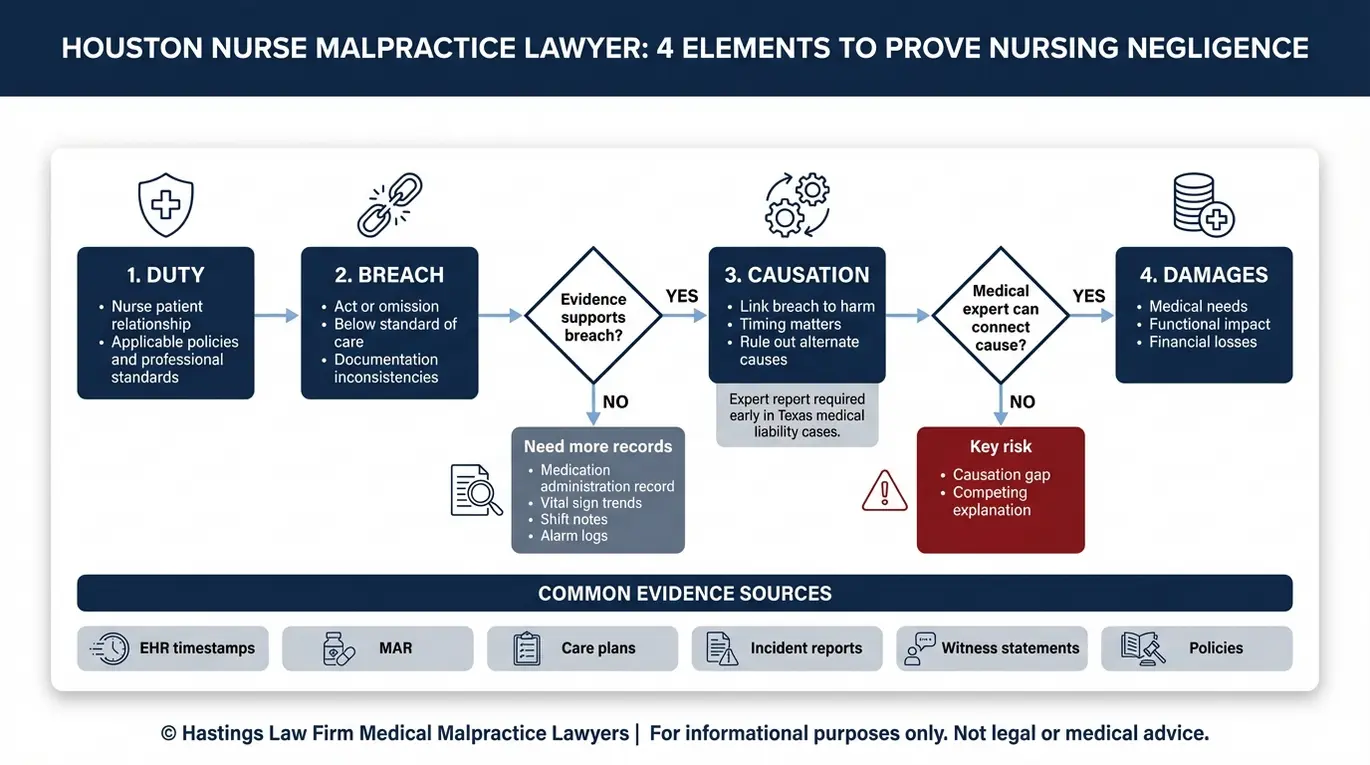
Proving a nursing negligence claim requires clear evidence that a duty existed, the nurse breached that duty, and that specific breach directly caused the patient’s injury or financial damages. Establishing professional negligence requires meeting specific legal requirements set by Texas medical malpractice law.
The Four Elements of a Nursing Negligence Claim:
Establishing the legal standard for negligence requires proving four specific elements in court.
- Duty: The nurse had a professional obligation to provide competent care to the patient.
- Breach: The nurse’s actions or omissions fell below the accepted standard of care.
- Causation: The breach directly caused or contributed to the patient’s injury, rather than the injury being a result of the underlying medical condition.
- Damages: The patient suffered measurable harm, whether physical, financial, or emotional.
Under the Texas Civil Practice and Remedies Code § 74.351, an expert report must be served within 120 days of the defendant’s original answer. This report must be authored by a qualified medical professional, often a senior nurse or physician, who confirms that the care fell below the standard and caused the injuries in question. Without this expert testimony, the case faces dismissal.
Our nurse malpractice law firm team works with in-house medical staff and a national network of experts to build this evidence. We review medical records, shift logs, and electronic health record (EHR) audit trails. These are the system-generated logs that track every entry, edit, and access point in a patient’s digital chart. Charting by exception, where nurses only record deviations from the norm, can leave critical gaps that our team knows how to identify and interpret.
Recovering Damages for Nursing Errors in Texas
Patients harmed by nursing negligence may recover economic damages for medical bills and lost wages, as well as non-economic damages for pain and suffering, subject to Texas state caps. Understanding how Texas state caps affect your potential recovery is a vital part of the legal process.
Economic damages cover the measurable financial losses caused by the injury:
- Past and future medical expenses, including surgeries, rehabilitation, and ongoing care
- Lost wages and diminished earning capacity
- Costs of assistive devices, home modifications, or long-term care needs
Non-economic damages address the personal toll of the injury, including physical pain, emotional suffering, loss of enjoyment of life, and disfigurement. Texas law caps non-economic damages in medical malpractice cases at $250,000 per individual health care provider and $250,000 per health care institution, with total non-economic damages across all institutions capped at $500,000, regardless of the severity of the injury. Understanding these caps is essential when evaluating the full value of your claim.
In cases involving wrongful death, surviving family members may pursue compensation for funeral expenses, loss of financial support, and loss of companionship. A medical malpractice attorney can help your family understand which categories of damages apply to your situation and work to recover the full value allowed under the law, often on a contingency fee basis.
Contact the Houston Nurse Malpractice Attorneys at Hastings Law Firm Today for Help
If you suspect a nursing error caused harm to you or someone in your family, the next step is getting answers. At Hastings Law Firm, we prepare every case as if it will go to trial. We offer a free, confidential case evaluation to help you understand the merits of your claim.
Our team includes in-house nurse consultants and former defense attorneys who know how hospital systems work and where the evidence of negligence is found. We handle every aspect of the investigation, from medical record analysis to expert testimony, so you can focus on healing.
We take these cases on a contingency fee basis, which means you pay no attorney fees or costs unless we recover compensation for you. For many of our clients, this work is about more than a financial recovery. It’s about finding out what really happened and helping to make sure it doesn’t happen to someone else.
Contact our Houston nurse malpractice lawyer team today for a free, confidential case evaluation. Let us review what happened and explain your options.
Frequently Asked Questions About Nurse Malpractice in Houston


This content was researched and written by the Hastings Law Firm editorial team, which includes attorneys, medical professionals, and experienced researchers. Our writing is informed by internal knowledge and practical experience, and we cross-check critical details against authoritative sources cited throughout. Every piece undergoes human-led fact-checking and legal review. Because legal and medical information can change, if you spot an error, please contact us. Learn more about our content standards and review process on our editorial policy page.

Tommy Hastings, founder of Hastings Law Firm, is a board-certified personal injury trial lawyer dedicated exclusively to healthcare injury cases. Since 2001, he has represented injured patients and families in litigation against major hospital systems, pharmaceutical companies, and negligent healthcare providers nationwide. He has handled numerous high-profile cases that have drawn national media attention and resulted in multi-million dollar recoveries. He draws on that experience in his writing, helping readers understand how these cases work and what options may be available to them.
