


Texas Hospital Bedsores Lawyer
Written by: Hastings Law Firm | Reviewed by: Gabe Sassin | Updated: July 27, 2026
Hospital acquired bedsores can signal a serious breakdown in basic nursing care during a hospital stay. Pressure injuries often develop when immobile or medically vulnerable patients are not properly assessed, repositioned, and protected from moisture and friction. As wounds worsen, they can require extensive treatment and may lead to severe infection, organ failure, or worse. Understanding risk factors, staging, and prevention standards can help families recognize when harm may have been avoidable. If you or a loved one were harmed or worse due to hospital bedsores in Texas, contact Hastings Law Firm for a free, confidential case review.

Trusted Legal Representation for Hospital Negligence in Texas
What You Should Know About Decubitus Ulcer Negligence Claims in Texas:
- Severe pressure injuries can create life threatening complications, including sepsis, organ failure, and death.
- Major financial and personal losses can follow hospital acquired bedsores, including added medical care needs and lasting pain, impairment, and disfigurement.
- Options for recovering non economic damages can be limited in Texas, even when the injury is serious.
- A hospital defense often turns on whether the bedsore is labeled avoidable or clinically unavoidable.
- A missed or incomplete risk assessment can leave a hospital without a credible explanation for why prevention steps were not taken.
- Gaps in turning schedules and repositioning documentation can indicate that basic prevention protocols were not followed.
- Inconsistent wound measurements or missing skin assessments can make it harder to verify when the injury started and how it progressed.
- Claims can be lost entirely if Texas medical malpractice procedural requirements are not met.
- Staffing records and nurse to patient ratios can be central when a hospital argues that repositioning was not feasible.
- Reporting to Texas Health and Human Services Commission can create an official record of alleged neglect.

A Healthcare Focused Law Firm
When a loved one develops bedsores during a hospital stay, it can feel like a betrayal. These injuries, clinically known as hospital-acquired pressure injuries (HAPIs), are wounds that develop while a patient is under a facility’s care and are widely recognized as preventable with proper nursing protocols. Their presence often points to a breakdown in the most basic responsibilities a hospital owes its patients.
If your family member has suffered serious pressure ulcers in a Texas hospital, you may be dealing with mounting medical costs, emotional distress, and unanswered questions about how this happened. As a Texas hospital bedsores lawyer, Hastings Law Firm focuses exclusively on medical malpractice and has the medical and legal resources to investigate what went wrong. Our team includes in-house nurses and former defense attorneys who know how hospitals operate from the inside. Contact us for a free, confidential case evaluation to learn more about your options.
Understanding How Pressure Ulcers Form in Medical Facilities
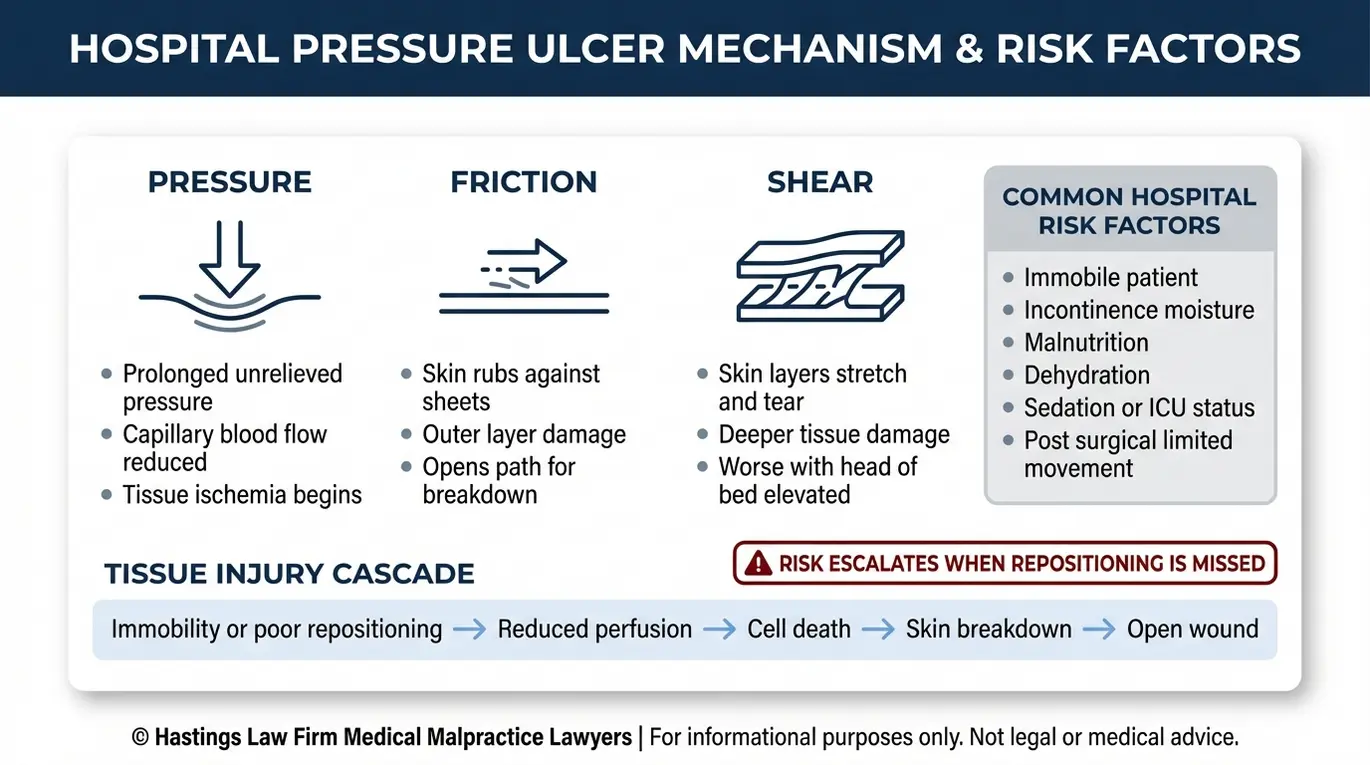
Pressure ulcers form when prolonged pressure cuts off blood supply to the skin and underlying tissue, a process called ischemia, which is the dangerous reduction of blood flow that starves cells of oxygen and nutrients. This is the core mechanism behind every bedsore, often referred to medically as decubitus ulcers. It most commonly affects immobile patients who are unable to shift their own weight, including those recovering from surgery or confined to an ICU bed. While pressure compresses blood vessels vertically, shear forces can distort them horizontally, compounding the damage and accelerating tissue death significantly.
But pressure alone is not the only factor. Friction, caused by skin dragging across bedding, and shear force, the internal stretching that occurs when deeper tissue layers slide in different directions as a patient slumps in a bed or chair, both accelerate skin breakdown. Together, these mechanical forces can cause tissue damage far more quickly in patients who are already medically vulnerable. This process of localized cell death, known as ischemia, can lead to significant wounds in a matter of hours if a patient is not moved.
Several well-documented risk factors make certain hospital patients especially susceptible to developing pressure injuries:
- Immobility: Patients who cannot reposition themselves, whether due to sedation, paralysis, or post-operative restrictions, are at the highest risk.
- Malnutrition: Poor nutritional intake weakens skin integrity and slows the body’s ability to repair damaged tissue.
- Dehydration: Inadequate hydration reduces skin elasticity, making it more fragile under pressure.
- Incontinence: Prolonged exposure to moisture from urine or stool breaks down the skin’s protective barrier and dramatically increases vulnerability.
Research published through PubMed Central on inpatient falls and pressure ulcers as nursing quality indicators confirms that pressure ulcers are directly tied to the quality of bedside nursing care. When hospital staff fail to monitor and address these risk factors, the consequences fall entirely on the patient. Texas hospital bedsore attorneys at our firm work with in-house medical professionals to trace these failures back to their root cause.
Identifying the Stages of Pressure Injuries and Warning Signs
Pressure injuries are classified into four stages based on severity, ranging from Stage 1 (reddened skin that does not blanch when pressed) to Stage 4 (deep wounds exposing bone or muscle). Understanding these staging categories helps families recognize the seriousness of the neglect and the level of care required. Two additional categories include unstageable pressure injuries and deep tissue injuries. These describe wounds where the full depth of tissue damage cannot yet be determined.
The Revised National Pressure Ulcer Advisory Panel Pressure Injury Staging System provides the clinical framework used by medical professionals nationwide:
| Stage | Physical Description |
|---|---|
| Stage 1 | Intact skin with a localized area of non-blanchable redness, often over a bony prominence. The area may feel warmer or firmer than surrounding skin. |
| Stage 2 | Partial-thickness skin loss presenting as a shallow open wound with a red or pink wound bed. Blisters may be present. |
| Stage 3 | Full-thickness skin loss. Subcutaneous fat may be visible, but bone, tendon, and muscle are not exposed. |
| Stage 4 | Full-thickness tissue loss with exposed bone, tendon, or muscle. Risk of osteomyelitis (bone infection) and sepsis is severe. |
| Unstageable | An unstageable pressure injury is a full-thickness wound obscured by slough (yellow, tan, or gray tissue) or eschar (dark, hardened dead tissue), making the true depth impossible to assess until the wound is debrided. |
| Deep Tissue Injury (DTI) | A deep tissue injury, or DTI, is an area of persistent, non-blanchable deep red, maroon, or purple discoloration indicating damage to underlying soft tissue from pressure or shear, even when the skin surface appears relatively intact. |
Stage 3 and Stage 4 wounds carry life-threatening risks. Osteomyelitis, a deep bone infection, can develop when bacteria reach exposed skeletal structures. If infection enters the bloodstream, it can progress to sepsis, a systemic inflammatory response that can lead to organ failure and death. For a lawyer for hospital bedsores in Texas, the staging of the wound is a critical piece of evidence in establishing the severity of the negligence.
The Hastings Law Firm Difference
Results matter, but what truly sets us apart is how we achieve them. Every verdict, every settlement, and every Texas courtroom victory comes from one guiding promise: To treat each client’s fight for justice as if it were our own.
This balance of skill, experience, and empathy reflects our core philosophy that justice should not only compensate the injured, but also make healthcare safer nationwide.

Standard of Care for Pressure Ulcer Prevention in Hospitals
The standard of care requires hospitals to assess each patient’s risk using validated tools like the Braden Scale, a scoring system that evaluates six factors (sensory perception, moisture, activity, mobility, nutrition, and friction/shear) to predict a patient’s likelihood of developing a pressure ulcer. This assessment should be completed upon admission and updated regularly throughout the hospital stay. When the Braden Scale identifies a patient as at-risk, the hospital is obligated to act on that finding immediately.
Preventative protocols that meet the accepted standard of care include:
- Repositioning or turning the patient at least every two hours to relieve sustained pressure on vulnerable areas
- Using offloading devices, which are specialized surfaces designed to redistribute body weight, such as pressure-relief cushions and air mattresses
- Maintaining adequate nutrition and hydration to support skin health
- Keeping skin clean and dry, especially for patients dealing with incontinence
- Documenting every assessment, intervention, and repositioning event in the patient’s medical chart
The Braden Scale for Predicting Pressure Sore Risk is the industry-standard tool referenced by accreditation bodies and clinical guidelines alike. A hospital that fails to complete or act on this assessment is not meeting the minimum threshold of acceptable care.
Analyzing Federal Regulations as a Prevention Benchmark
Federal regulation 42 CFR § 483.25(b), which governs long-term care facilities, reinforces the principle that pressure ulcers are generally preventable in clinical settings. This regulation establishes that a facility must ensure a resident who enters without pressure sores does not develop them unless the resident’s clinical condition makes them clinically unavoidable. While this regulation applies directly to skilled nursing facilities and nursing facilities rather than acute-care hospitals, the underlying prevention standards reflect widely accepted clinical principles that courts and experts also apply in the hospital context.
When a bedsore develops and the hospital cannot demonstrate full compliance with prevention protocols, the injury is treated as avoidable, and that distinction carries significant weight in a negligence claim. Our Texas hospital bedsore legal team uses federal benchmarks alongside state standards to build a clear picture of where care broke down.
Distinguishing Between Avoidable and Unavoidable Injuries
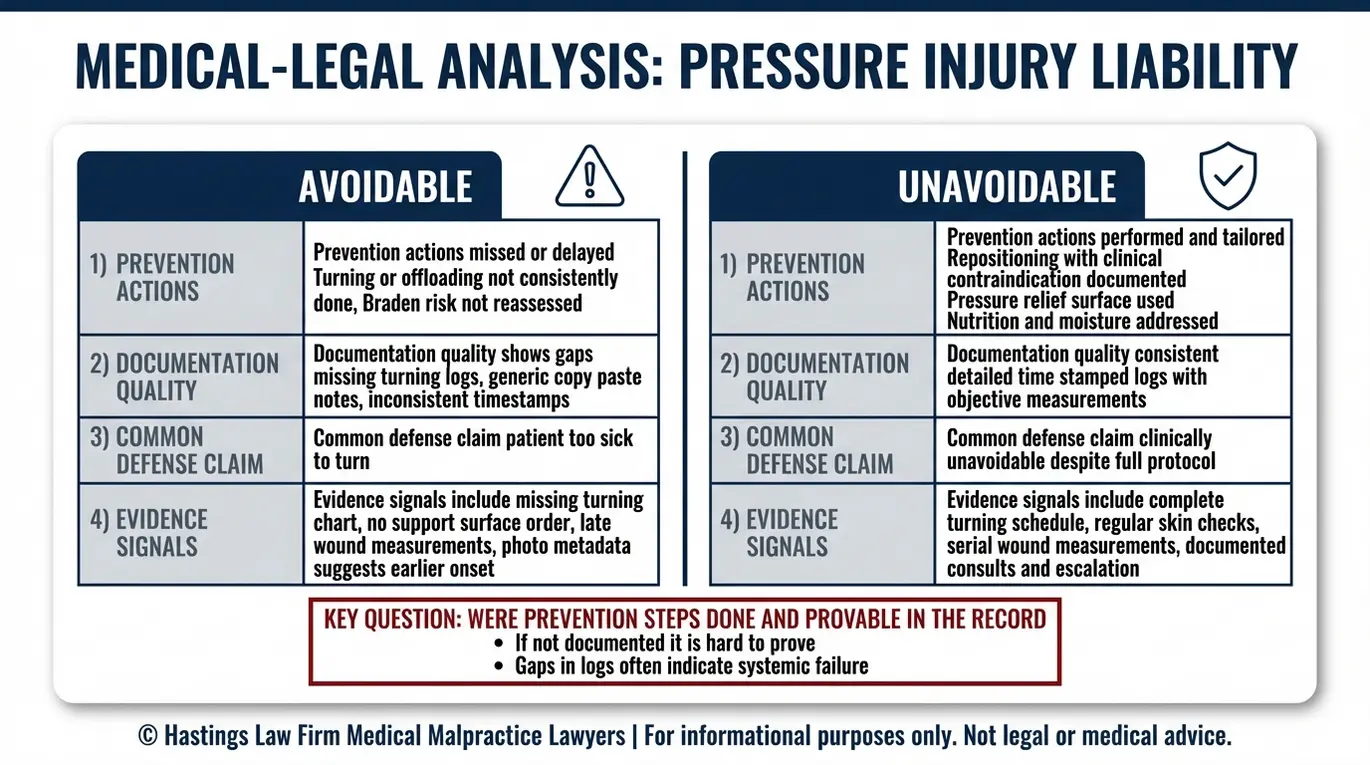
An avoidable pressure ulcer occurs when a provider fails to take the necessary preventive actions, whereas an unavoidable ulcer develops despite strict adherence to every recognized prevention protocol. This distinction is the central question in nearly every medical malpractice case involving bedsores, and it is the defense hospitals rely on most heavily.
The legal definition of “clinically unavoidable” is narrow. To qualify, the hospital must demonstrate that the patient was properly assessed, that an individualized care plan was developed, that every appropriate intervention was implemented, and that the wound still developed. The CMS Manual System outlines the specific criteria for determining preventability. Documentation is the key to identifying an avoidable pressure ulcer. For instance, the presence of slough and eschar, types of necrotic tissue that must be removed for staging, should be consistently noted in wound records. Similarly, failure to use an air-fluidized mattress, a specialized bed containing ceramic beads that floats the patient, must be clinically justified.
Hospitals frequently argue that the patient “was too sick to turn” or that the injury was an inevitable consequence of the patient’s underlying condition. The reality is often different.
| Common Defense Argument | What the Evidence May Actually Show |
|---|---|
| “The patient was too critically ill to reposition.” | Turning schedules were not documented, or staffing logs reveal inadequate nurse-to-patient ratios during the relevant shifts. |
| “The pressure ulcer was unavoidable given the patient’s medical history.” | The Braden Scale assessment was incomplete, delayed, or never performed on admission. |
| “We provided appropriate wound care.” | Wound measurements are inconsistent or missing, suggesting the injury was not monitored as it worsened. |
| “The patient developed the ulcer before arriving at our facility.” | Admission skin assessments were not completed, or photos were not taken at intake. |
A Texas bedsore injury lawyer examines staffing records, nursing notes, repositioning logs, and wound care documentation to determine whether the hospital actually followed through on the care it claims to have provided. When gaps appear in the record, they can indicate that the injury was avoidable and that the facility’s defense does not hold up. A hospital negligence attorney experienced in these cases knows exactly where to look and what those gaps mean.
Proving Medical Malpractice Under Texas Law
Proving a bedsore case in Texas requires clear evidence that the hospital breached the standard of care and that this breach directly caused the injury, confirmed by a qualified expert medical report. Texas imposes strict procedural requirements on medical malpractice claims, and missing any of them can end a case before it truly begins.
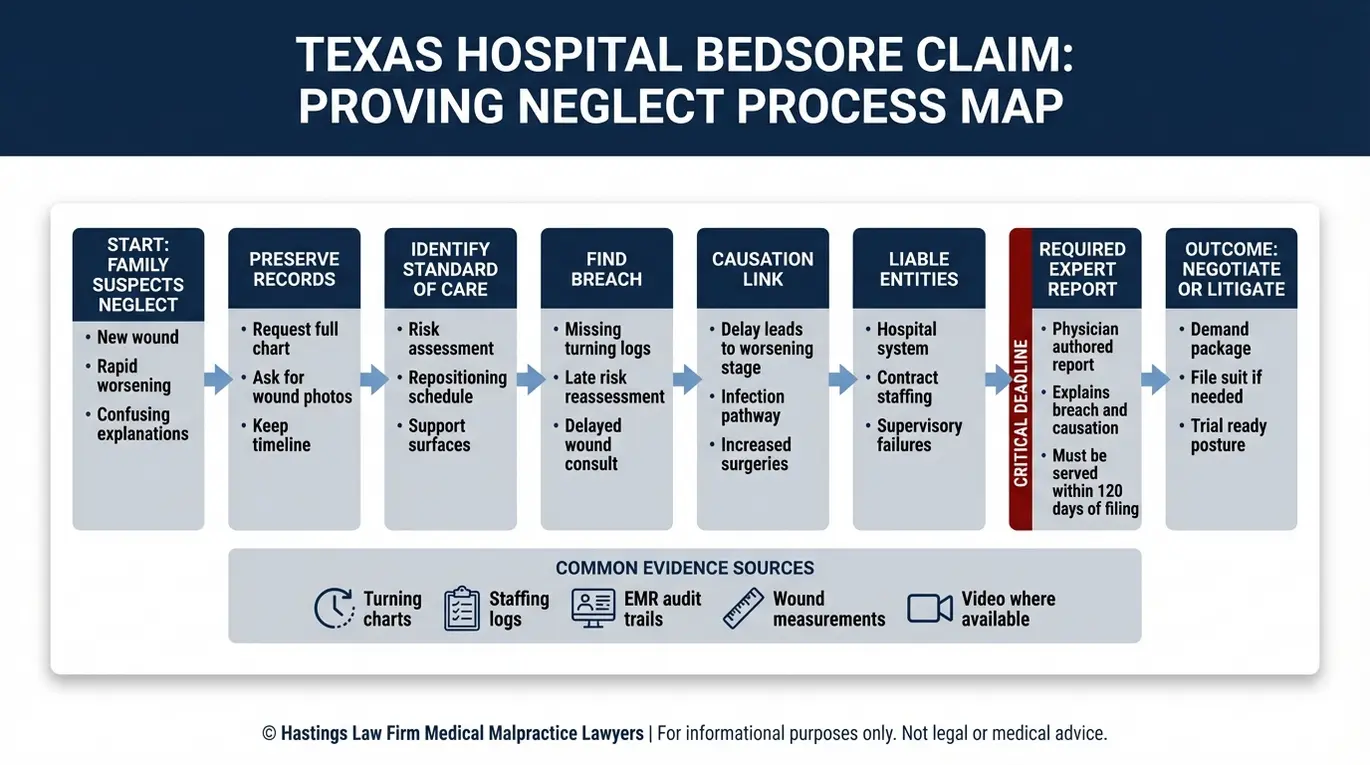
Here is the general process our team uses for building a pressure ulcer malpractice case in Texas:
- Obtain and review all medical records. This includes nursing notes, repositioning logs, Braden Scale assessments, wound care documentation, staffing schedules, and any internal incident reports. Our in-house nursing team analyzes these records to identify gaps, inconsistencies, and deviations from protocol.
- Secure a qualified medical expert. Under Texas Civil Practice and Remedies Code Chapter 74.351, a detailed expert medical report must be served on each defendant within 120 days after that defendant files an original answer. This report must identify the applicable standard of care, explain how it was breached, and establish that the breach caused the patient’s injury. Failure to meet this deadline results in mandatory dismissal, so early preparation is essential.
- Establish causation. It is not enough to show that the hospital made mistakes. The expert must connect the specific failures, such as missed turning schedules or a failure to use specialized pressure-relief surfaces, to the development or worsening of the pressure ulcer.
- Identify all liable entities. Liability may extend beyond the individual nurse. Hospitals, staffing agencies, and corporate management companies can be held responsible under theories of corporate negligence when systemic failures, like chronic understaffing or inadequate training policies, contributed to the injury. Identifying every liable party ensures that the full extent of the damages can be covered.
A Texas hospital bedsore malpractice lawyer at Hastings Law Firm prepares every case as if it will go to trial. Our team includes former defense attorneys who understand the strategies hospitals use to deflect responsibility, and our national network of medical experts provides the credible, authoritative testimony these cases require. As an attorney for pressure ulcers, we know that thorough preparation from day one is what positions a case for a fair outcome.
Damages and Compensation Recoverable in Texas
Patients and families affected by hospital-acquired bedsores may recover both economic and non-economic damages through a successful medical malpractice claim in Texas.
Economic damages cover the measurable financial losses tied to the injury. These include past and future medical expenses such as wound vac therapy, surgical debridement, skin grafts, extended hospital stays, and ongoing wound care. Lost wages and reduced earning capacity also fall into this category. There is no cap on economic damages in Texas.
Non-economic damages compensate for pain and mental anguish, physical impairment, and disfigurement caused by the pressure ulcers. Texas does impose a cap on these damages in medical malpractice cases: $250,000 per claimant for all physicians and individual healthcare providers combined, with a separate $250,000 cap per healthcare institution (up to $500,000 total across multiple institutions), for a potential combined maximum of $750,000 in non-economic damages. In cases involving gross negligence, where the conduct was malicious or intentionally reckless, punitive damages may also be awarded to punish the wrongdoer.
In cases where a patient’s pressure ulcers led to sepsis, organ failure, or death, surviving family members may pursue a wrongful death claim. These claims can recover compensation for loss of companionship, loss of financial support, and funeral expenses. Texas bedsore litigation requires careful damage analysis, and Hastings Law Firm works with medical and economic experts to present the full scope of harm a family has experienced.
Statute of Limitations for Pressure Ulcer Claims
In Texas, the statute of limitations for medical malpractice is generally two years from the date of the negligence or the date the injury was discovered. This deadline is established under Civil Practice and Remedies Code Section 74.251 and applies to virtually all hospital bedsore claims. This two years timeframe is a strict legal window that requires immediate attention to protect your rights.
⚠️ Time-Sensitive Warning: Texas pre-suit requirements, including notice letters and the 120-day expert report deadline, run on strict timelines that begin before and after filing. Delaying consultation with a Texas hospital bedsore counsel can jeopardize your ability to pursue a claim at all.
Limited exceptions exist. The discovery rule may apply when the injury was not immediately apparent, though Texas courts interpret this exception narrowly. Claims involving minors may be tolled until the child reaches the age of majority, subject to an overall statute of repose.
Acting quickly also matters for practical reasons. Strict time limits apply to these pre-suit notices, and evidence such as staffing logs and repositioning records can be lost over time. The sooner an investigation begins, the more evidence is available to support the claim.
Contact the Texas Hospital Malpractice Attorneys at Hastings Law Firm Today for Help
Bedsores are not a natural or expected part of hospitalization. When they develop under a hospital’s watch, they are a sign that fundamental care responsibilities were not met. You and your family deserve to understand exactly what happened and whether the hospital can be held accountable.
Hastings Law Firm was built for cases like these. Founded by Tommy Hastings, a board-certified trial attorney who has achieved distinctions held by less than 2% of Texas lawyers, our team includes former hospital defense attorneys and experienced nurses who know how to uncover the truth behind a facility’s records. We prepare every case as though it will go before a jury, and that level of preparation makes a difference at every stage.
We work on a no-win, no-fee basis, meaning you pay nothing unless we recover compensation for your family. If your loved one has suffered serious pressure ulcers in a Texas hospital, contact us today for a free case evaluation. Let us review what happened and explain your options.
Frequently Asked Questions About Hospital Bedsores in Texas


This content was researched and written by the Hastings Law Firm editorial team, which includes attorneys, medical professionals, and experienced researchers. Our writing is informed by internal knowledge and practical experience, and we cross-check critical details against authoritative sources cited throughout. Every piece undergoes human-led fact-checking and legal review. Because legal and medical information can change, if you spot an error, please contact us. Learn more about our content standards and review process on our editorial policy page.

Gabe Sassin has focused exclusively on medical malpractice law since 2007. After spending more than a decade as a malpractice defense attorney, he knows exactly how the other side works. He has seen firsthand how healthcare providers, insurers, corporate defendants, and their legal teams think, prepare, and build their defense against claims. That knowledge works for the people who need it most today, injured patients and their families. His unique experience shapes everything he writes, giving readers a look at how these cases actually work from someone who has handled them from both sides.
