


Houston Failure To Diagnose Lawyer
A missed or delayed diagnosis can leave a treatable condition to worsen, leading to more invasive care, lasting complications, and sometimes fatal outcomes. In Texas, not every wrong diagnosis is negligence, and the difference often turns on whether the care fell below the accepted standard for the setting. These cases can involve overlooked symptoms, misread tests, or breakdowns in follow up and communication. Understanding how harm is linked to the diagnostic failure is central to evaluating what happened. If you or a loved one were harmed or worse due to failure to diagnose in Houston, Texas, contact Hastings Law Firm for a free, confidential case review.

Last Updated: July 27, 2026
Trusted Legal Representation for Diagnosis Failures in Houston
When a doctor overlooks a serious medical condition, the consequences can alter the course of your life or the life of someone you love. A missed or delayed diagnosis may allow a treatable illness to progress, sometimes to a point where recovery becomes far more difficult or impossible.
If you believe a healthcare provider failed to identify a condition that should have been caught, you are not alone in feeling uncertain about what to do next. The medical system can feel overwhelming, and questioning a doctor’s judgment takes courage.
As a Houston failure to diagnose lawyer, Hastings Law Firm focuses exclusively on medical malpractice. Our team of trial attorneys, former defense lawyers, and in-house nurse consultants understands both the medicine and the law behind these cases. We can review what happened, explain your options, and help you decide whether you have a path forward. The initial consultation is free and confidential.

What Constitutes a Failure to Diagnose Under Texas Law
A failure to diagnose occurs when a doctor does not identify a medical condition that a reasonably competent physician would have recognized under similar circumstances, resulting in delayed treatment and a worse outcome for the patient.
Under Texas law, specifically the Texas Civil Practice and Remedies Code Chapter 74, a medical negligence claim requires proof that a healthcare provider breached the standard of care. This standard reflects the level of skill a qualified doctor would provide in the same situation, assuming a formal doctor-patient relationship exists. Not every incorrect diagnosis is negligence. A reasonable mistake, where the doctor followed proper procedures but reached the wrong conclusion, differs from a process that fell below accepted medical practices.
A failure to diagnose and a delayed diagnosis, where the correct condition is eventually identified but only after preventable harm has occurred, can take several forms:
- Dismissing symptoms without testing: A patient reports warning signs, but the doctor orders no workup.
- Misinterpreting test results: Lab work or imaging indicating a serious condition is read incorrectly.
- Identifying the condition too late: The diagnosis comes after the disease has advanced past effective treatment.
Each scenario can form a claim if the breach of duty caused harm. A failure to diagnose attorney in Houston can help determine if your situation qualifies.

Why Do Medical Providers Fail to Identify Critical Conditions
Diagnostic errors often result from systemic failures, including rushed patient encounters, communication breakdowns between departments, or a healthcare provider‘s failure to order the right diagnostic tests at the right time. According to research published by the National Academy of Medicine on the NCBI Bookshelf, most diagnostic errors are not caused by a single mistake but by a chain of failures across the patient safety process.
One common factor is anchoring bias, a form of cognitive tunnel vision where a doctor fixates on an initial impression and stops considering other possibilities. Another is the failure to pursue a differential diagnosis, the systematic process of evaluating multiple potential conditions before settling on one.
Here are some of the most common causes and how they appear in practice:
| Cause | Real-World Example |
|---|---|
| Fatigue or understaffing | An ER physician working a double shift misses subtle signs of a cardiac event, attributing chest pain to acid reflux. |
| Laboratory or imaging errors | A lab mixes up patient samples, returning a false-normal result that delays a cancer diagnosis. |
| Cognitive bias (anchoring) | A doctor assumes a young patient’s headaches are stress-related and does not order imaging that would reveal a stroke. |
| Failure to consult a specialist | A primary care provider manages a complex condition alone instead of referring to a specialist with deeper expertise. |
Houston failure to diagnose attorneys examine these systemic factors closely when evaluating whether negligence contributed to a missed diagnosis.
The Hastings Law Firm Difference
Results matter, but what truly sets us apart is how we achieve them. Every verdict, every settlement, and every Houston courtroom victory comes from one guiding promise: To treat each client’s fight for justice as if it were our own.
This balance of skill, experience, and empathy reflects our core philosophy that justice should not only compensate the injured, but also make health care safer nationwide.

Commonly Misdiagnosed Conditions in Houston Hospitals
While any medical condition can be missed, life-threatening events like heart attacks, strokes, and aggressive cancers are among the most frequently misdiagnosed. According to the Agency for Healthcare Research and Quality’s Patient Safety Network (PSNet), diagnostic errors affect an estimated 12 million Americans each year in outpatient settings alone.
Misdiagnosis, which includes receiving an incorrect diagnosis or no diagnosis at all, often occurs when a condition presents with atypical presentation. This means the symptoms do not follow the textbook pattern a doctor might expect.
The conditions we see most often include:
- Cancer: A cancer misdiagnosis involving breast, lung, or colorectal tumors often occurs when early-stage signs are dismissed as benign. Delayed diagnosis can mean the difference between a treatable condition and metastasis.
- Heart attacks: Heart attack misdiagnosis frequently affects women, whose non-classic symptoms like jaw pain or nausea are mistaken for anxiety.
- Strokes: Stroke misdiagnosis often happens with younger patients, where urgent imaging is not ordered within the critical window.
- Sepsis and meningitis: These fast-moving infections can be mistaken for the flu in emergency departments.
Failure to diagnose lawyers in Houston work with a medical expert to identify where the process broke down.
The Distinction in Standard of Care for ER vs. Primary Care
Texas law treats emergency room negligence differently. The standard of care represents the legal benchmark for quality medical treatment that a patient should expect.
For ER claims, the patient must generally prove the physician’s actions amounted to willful and wanton negligence, reflecting a conscious indifference to the patient’s welfare. This differs from the standard of care in private practice. Triage, the process of prioritizing patients by the severity of their condition upon arrival, can also be a point of failure if it leads to dangerous delays.
Establishing Liability: Can You Sue for Misdiagnosis
Yes. You can file a malpractice lawsuit against a doctor or hospital for misdiagnosis if you can demonstrate that the provider’s failure to diagnose directly caused you harm. Establishing liability under Texas law requires proof of four legal elements.
1. Duty (Doctor-Patient Relationship) You must show that a formal doctor-patient relationship existed. This creates the provider’s legal obligation to deliver competent care. If you were seen by a physician, even briefly in an ER, this relationship is typically established.
2. Breach (Deviation from the Standard of Care) You must prove the doctor failed to act as a reasonably competent physician would have. This includes negligence such as failing to order appropriate tests, ignoring symptoms, or prescribing the wrong treatment based on an incorrect diagnosis.
3. Causation (The Breach Led to Harm) You must connect the diagnostic failure to a worsened outcome. For example, if a cancer treatable at stage 1 progressed to stage 4 because a biopsy was not ordered, the delay caused the harm.
4. Damages (Measurable Loss) You must show that the breach resulted in actual losses, whether physical, financial, or both. This includes medical bills incurred to fix the error and income lost during recovery.
A Houston misdiagnosis lawyer evaluates these elements to determine if a malpractice claim can move forward. Preparing a hospital stay checklist from the Florida Health Finder can also help patients organize their care interactions and preserve useful information.

How We Prove a Failure to Diagnose Claim
Proving these claims requires a detailed reconstruction of the medical timeline, supported by expert testimony that establishes what a competent doctor should have done at each decision point.
At Hastings Law Firm, Tommy Hastings is board-certified in Personal Injury Trial Law by the Texas Board of Legal Specialization. Our in-house medical staff, including nurse practitioners and Board Certified Patient Advocates, begins by collecting and reviewing every relevant record. This includes office visit notes, imaging studies, lab results, pathology reports, and referral documentation.
From there, we build what we call “the timeline,” a chronological reconstruction that maps the patient’s symptoms, the provider’s actions, and the gaps between them. A false-negative test result, where a test incorrectly shows no disease is present, can be a key piece of evidence if the doctor relied on it without ordering follow-up studies. We also look for failures in closed-loop communication, the process that ensures test results are reviewed, acknowledged, and acted upon by the ordering physician.
Here is a summary of the core evidence we gather:
- Complete medical records, including imaging and pathology
- Documentation of reported symptoms and clinical notes
- Lab and diagnostic test results, including any re-reads or corrections
- Communication logs between providers and departments
- Expert witness opinions from specialists in the relevant field of medicine
Our National Expert Network connects us with physicians across the country who can provide objective, credible testimony about what the standard of care required. As a failure to diagnose attorney, Tommy Hastings and his team prepare every case as if it will go to trial, which strengthens our position whether the case resolves through settlement or before a jury.
Recoverable Damages and Texas Compensation Caps
Patients harmed by a misdiagnosis can recover both economic and non-economic damages, though Texas law places specific limits or damages caps on certain categories.
Economic Damages (Uncapped) These cover measurable financial losses, including:
- Past and future medical expenses
- Lost wages and loss of future earning capacity
- Out-of-pocket costs
Non-Economic Damages (Capped) These cover the human toll, including pain and suffering, mental anguish, and disfigurement. Under the Texas Civil Practice and Remedies Code § 74.301, non-economic damages are limited to $250,000 against all individual healthcare providers combined and $250,000 per healthcare institution (up to $500,000 across all institutions), with a maximum total of $750,000.
Wrongful Death Damages When a diagnostic failure results in death, family members may pursue a wrongful death claim for funeral expenses and loss of support.
A Houston failure to diagnose law firm can assess which categories apply to you and calculate compensation.
Specific Types of Recoverable Damages Including Loss of Consortium
Loss of consortium is a category of non-economic damages recognizing the family impact of a serious injury. Loss of consortium refers to the deprivation of family benefits like companionship and support due to injury. A spouse may claim these damages resulting from the patient’s condition.
The Texas Statute of Limitations for Medical Malpractice
In Texas, you generally have two years from the date of the misdiagnosis, or the date you reasonably discovered the injury, to file a malpractice lawsuit. Missing this deadline can permanently bar your claim.
The Two-Year Rule The standard filing deadline is two years from the date the alleged negligence occurred. In many diagnostic failure cases, the date of the missed diagnosis is when the clock starts.
The Discovery Rule Sometimes a patient does not immediately know that a diagnostic error occurred. Texas recognizes a “discovery rule” exception, which can extend the deadline to two years from the date the patient knew or reasonably should have known about the injury.
The 10-Year Statute of Repose Regardless of when the error is discovered, Texas imposes an absolute 10-year legal deadline from the date of the negligent act. After 10 years, no claim can be filed.
Important: These deadlines are strict. If you suspect a diagnostic error caused harm, consulting a failure to diagnose lawyer as early as possible protects your ability to take legal action and proceed with filing a claim.
Application of Texas Statute of Limitations for Minors
For children, the timeline works differently. A minor is a child under the legal age of 18.
Texas law tolls, or pauses, the statute of limitations for minors. Under § 74.251, a child under the age of 12 generally has until their 14th birthday to file, or have filed on their behalf, a medical malpractice claim. We understand this is particularly relevant in pediatric malpractice cases, where the injury may not be apparent for years.
Immediate Steps to Take After Suspecting Diagnostic Error
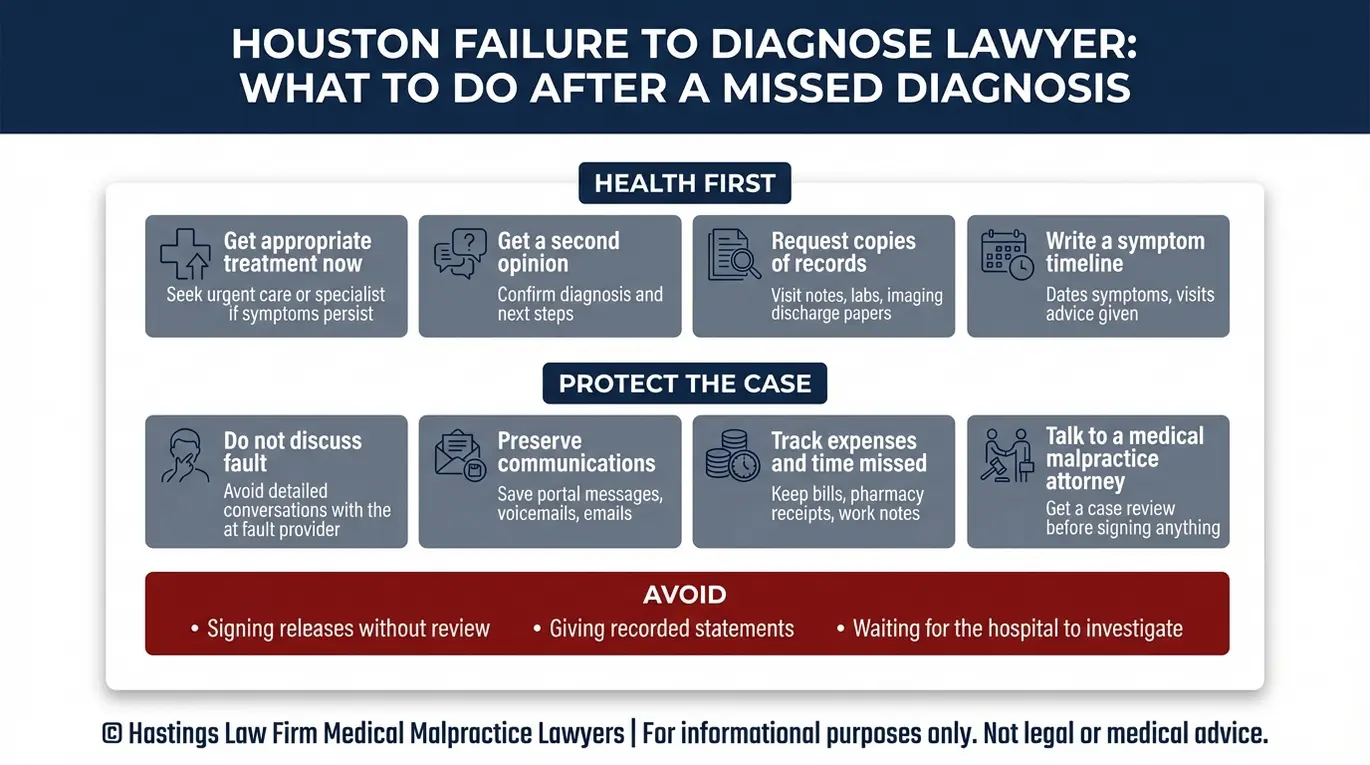
If you suspect a doctor missed or delayed a diagnosis, your first priority should be your health. After that, take these steps to assist in the preservation of evidence for any potential claim.
- Step 1: Seek a second medical opinion. Get an accurate diagnosis and begin proper treatment.
- Step 2: Do not discuss the suspected error with the provider. Anything you say could be used against you.
- Step 3: Request a complete copy of your medical records. Under the U.S. Department of Health and Human Services HIPAA access guidelines, you have a federal right to obtain your health information.
- Step 4: Contact a malpractice attorney for legal advice. A specialized team can review your records and advise on your options.
The Patient’s Role in Seeking a Second Opinion
A second opinion does more than protect your health; it creates independent evidence. When a new doctor succeeds in confirming diagnosis details that the first missed, it supports the claim of negligence. Seeking timely care also demonstrates mitigation of damages, which matters when calculating compensation.
Contact the Houston Diagnosis Failure Attorneys at Hastings Law Firm Today for Help
Hastings Law Firm was built on a single mission: to restore trust for patients who have been failed by the healthcare system and to hold negligent providers accountable so the same mistakes are not repeated.
If you or a loved one suffered harm because a doctor missed a diagnosis, our team is ready to listen. With in-house nurse consultants, former defense attorneys who know how hospitals protect themselves, and a national network of medical experts, we bring a level of preparation that insurance carriers take seriously. Tommy Hastings is a 2025 inductee into the American Board of Trial Advocates (ABOTA), an invitation-only organization for elite trial lawyers.
Time matters. Texas law sets firm deadlines on medical malpractice claims, and the sooner we can review your records, the stronger your case can be.
Your Houston failure to diagnose lawyer consultation is free, confidential, and comes with no obligation. You pay nothing unless we recover compensation on your behalf. Contact Hastings Law Firm today to take the first step toward answers.
Frequently Asked Questions About Failure To Diagnose in Houston


This content was researched and written by the Hastings Law Firm editorial team, which includes attorneys, medical professionals, and experienced researchers. Our writing is informed by internal knowledge and practical experience, and we cross-check critical details against authoritative sources cited throughout. Every piece undergoes human-led fact-checking and legal review. Because legal and medical information can change, if you spot an error, please contact us. Learn more about our content standards and review process on our editorial policy page.

Tommy Hastings, founder of Hastings Law Firm, is a board-certified personal injury trial lawyer dedicated exclusively to healthcare injury cases. Since 2001, he has represented injured patients and families in litigation against major hospital systems, pharmaceutical companies, and negligent healthcare providers nationwide. He has handled numerous high-profile cases that have drawn national media attention and resulted in multi-million dollar recoveries. He draws on that experience in his writing, helping readers understand how these cases work and what options may be available to them.
