


Houston Defective Medical Device Lawyer
A defective medical device can turn a planned treatment into a lasting injury, with complications that may require additional procedures and long recoveries. Some failures stem from unsafe design, manufacturing errors, or inadequate warnings, and certain devices reach the market without comprehensive human trials through the FDA clearance pathway. Manufacturers may still dispute responsibility by pointing to surgical decisions or other health factors, which can make accountability harder to establish. If you or a loved one were harmed or worse due to a defective medical device in Houston, Texas, contact Hastings Law Firm for a free, confidential case review.
Last Updated: July 27, 2026
Trusted Medical Product Liability Attorneys in Houston
When a medical device that was supposed to help you causes harm instead, the experience can feel deeply disorienting. You may be facing unexpected complications, additional procedures like revision surgery to remove or replace faulty hardware, or even the effects of metallosis, a form of metal poisoning caused by corroding implant components. These are serious injuries, and you deserve to know why they happened.
As a Houston defective medical device lawyer, Hastings Law Firm was founded by Tommy Hastings, a board-certified trial lawyer with over 20 years of experience. Our legal team focuses exclusively on holding negligent parties accountable for patient harm. We review every detail of what went wrong and build a case designed for trial from day one.
If you or a loved one has been injured by a medical device, we can evaluate your situation and explain your options at no cost.

Defining Defective Medical Devices Under Texas Law
A defective medical device is any medical instrument, implant, or apparatus that causes injury due to flaws in its design, errors during manufacturing, or insufficient warnings, failing to perform as safely as an ordinary consumer would expect.
Texas product liability law provides two primary legal theories for establishing manufacturer liability: strict liability and negligence. Under strict liability, you do not need to prove the manufacturer was careless. You need to show the product was unreasonably dangerous when it left the manufacturer’s control. Under negligence, the focus shifts to whether the manufacturer failed to exercise reasonable care during design, production, or marketing. Both theories are grounded in the Texas Civil Practice and Remedies Code, Chapter 82.
As Houston defective medical device attorneys and medical device injury counsel, we evaluate each case to determine which legal theory provides the strongest path forward. The type of defect involved shapes that strategy.
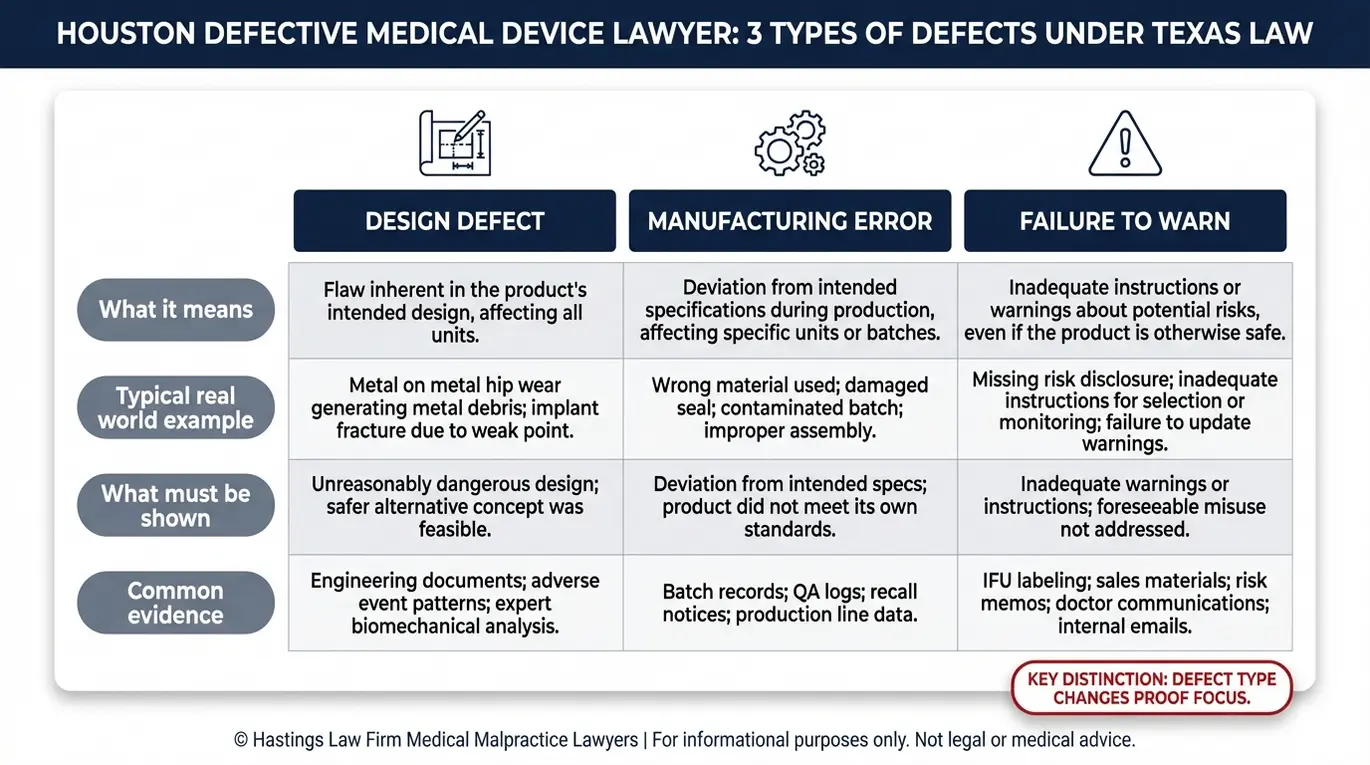
- Design Defects: The device’s blueprint is inherently unsafe. For example, certain metal-on-metal hip implants were designed in a way that caused friction between components, releasing toxic metal debris into the body. The flaw existed before a single unit was ever manufactured.
- Manufacturing Errors: The design itself may be sound, but something went wrong during assembly, sterilization, or shipping. A single contaminated batch or an improperly sealed component can turn a safe product into a dangerous one.
- Marketing Defects (Failure to Warn): The manufacturer knew or should have known about certain risks but provided inadequate instructions or failed to disclose dangers to doctors and patients. This includes downplaying complication rates or omitting known side effects from labeling.
A defective medical device lawyer in Houston will examine which of these defect categories applies and whether the manufacturer bears responsibility under Texas law. When a device causes widespread harm, the FDA may issue a medical device recall, a formal action to remove a product from the market. The most serious category is a Class I recall, a designation indicating there is a reasonable probability the device will cause serious health consequences or death.
The FDA 510(k) Approval Process Loophole
Not all medical devices undergo rigorous clinical testing before reaching patients. Under the FDA’s 510(k) clearance process, a pathway permitting market entry without comprehensive human trials, a manufacturer can bring a device to market by demonstrating it is “substantially equivalent,” meaning it is directly comparable, to an older, legally marketed product. This means the new device may never be tested in human trials.
The result is that some devices with significant design changes receive clearance based on their similarity to predecessors rather than independent proof of safety. When those devices fail, patients pay the price. Our medical device injury counsel investigates whether a device’s 510(k) pathway contributed to inadequate testing and, ultimately, to our client’s injury.
Common Defective Devices Subject to Recalls and Litigation
Frequently litigated devices include metal-on-metal hip implants causing metallosis, transvaginal mesh causing organ perforation, and faulty IVC filters that migrate or fracture within the body.
Transvaginal mesh, a synthetic material implanted to treat pelvic organ prolapse and stress urinary incontinence, has been the subject of thousands of lawsuits after patients experienced erosion through vaginal tissue, chronic pain, and organ perforation. An inferior vena cava (IVC) filter, a small cage-like device placed in the body’s largest vein to catch blood clots, can fracture, tilt, or migrate to the heart or lungs when it fails.
Metal-on-metal hip implants were heavily marketed to younger, active patients, but the grinding of metal components can release cobalt and chromium ions into the bloodstream. This metallosis can lead to tissue necrosis, bone loss, and systemic reactions requiring immediate device removal. When any of these devices fail, the consequences often extend well beyond the initial injury. Patients may require revision surgery to remove broken or corroded components, a procedure that carries its own risks.
Revision surgery is often far more complex than the original implantation, as scar tissue, bone ingrowth, and device fracture can make extraction difficult. This increases the risk of infection, nerve damage, and prolonged recovery. Our medical product liability lawyer team works to identify every instance where a medical device failure has impacted a patient’s long-term health.
The table below outlines several device categories our Houston medical device lawyers frequently handle:
| Device Type | Common Defect / Injury | Associated Brand / Recall Example |
|---|---|---|
| Metal-on-Metal Hip Implants | Metallosis, tissue death, implant loosening | DePuy ASR, Stryker Rejuvenate |
| Transvaginal Mesh | Organ perforation, erosion, chronic pain | Boston Scientific, C.R. Bard |
| IVC Filters | Device migration, fracture, embolism | Cook Medical, Bard Recovery |
| Hernia Mesh | Infection, adhesion, bowel obstruction | Atrium C-Qur, Ethicon Physiomesh |
| Hip Replacements (other) | Component failure, revision surgery | Zimmer Biomet, Wright Medical |
| Defibrillators | Lead failure, unnecessary shocks, cardiac events | Medtronic Sprint Fidelis |
| Stents | Thrombosis, restenosis, device fracture | Various manufacturers |
| Insulin Pumps | Dosing errors, software malfunction | Medtronic MiniMed |
| IUDs | Device migration, perforation, embedment | Paragard |
You can review current safety alerts through the FDA’s Medical Device Recalls and Early Alerts database. Reported device malfunctions and injuries are also tracked through the FDA’s Manufacturer and User Facility Device Experience (MAUDE) database.
As a defective device attorney and medical product liability lawyer, our job is to connect your specific injury to the documented failures of the product and pursue the manufacturer responsible.
The Hastings Law Firm Difference
Results matter, but what truly sets us apart is how we achieve them. Every verdict, every settlement, and every Houston courtroom victory comes from one guiding promise: To treat each client’s fight for justice as if it were our own.
This balance of skill, experience, and empathy reflects our core philosophy that justice should not only compensate the injured, but also make health care safer nationwide.

Individual Lawsuits Versus Class Actions and MDLs
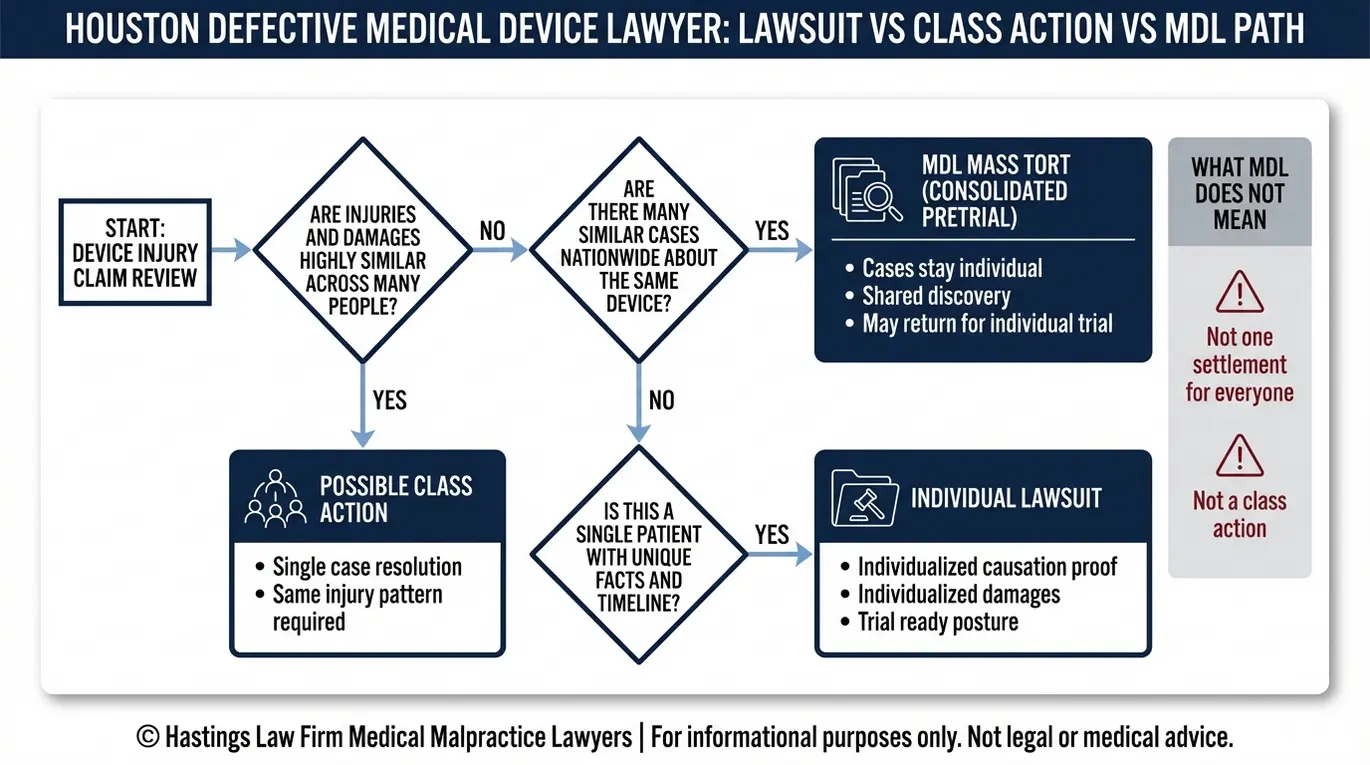
While class actions group many plaintiffs into a single lawsuit with one shared settlement, Multi-District Litigation (MDL) allows individual defective device cases to be consolidated for pretrial proceedings while each case retains its separate value and trial potential.
This distinction matters. In a class action, everyone receives the same outcome regardless of how severely they were harmed. But medical device injuries vary widely from patient to patient. One person may need a single revision surgery; another may suffer permanent disability. A class action cannot account for those differences.
That is why most defective medical device cases proceed through MDL or as individual lawsuits rather than class actions. MDL, authorized under 28 U.S.C. § 1407, consolidates similar cases before one federal judge for efficiency during the pretrial phase, including discovery and depositions.
This consolidation allows for shared discovery, meaning that millions of pages of documents and key depositions of corporate executives are handled once for all plaintiffs, rather than repeated in every single case. This reduces costs and accelerates the timeline. However, unlike a class action, you remain in control of your own settlement decisions.
Once pretrial work is complete, each case can be sent back to its home court for trial or resolved through individual settlement. You can view active consolidations through the Judicial Panel on Multidistrict Litigation’s list of Pending MDLs. Our team includes former defense attorneys and experienced hospital nurses who previously worked for the systems we now challenge.
Here is how the three legal paths compare:
- Individual Lawsuit: Filed on your behalf alone. Your case is evaluated based on your specific injuries, damages, and circumstances. Offers the most control over strategy and timing.
- Multi-District Litigation (MDL): Your individual case is grouped with similar cases for pretrial efficiency, but your claim remains yours. Settlement or trial verdict reflects your personal losses.
- Class Action: All plaintiffs share one outcome. Rarely used in device cases because injury severity differs too much between patients.
As a Houston defective medical device law firm, we prepare every case for trial, not just for inclusion in a settlement pool. Many firms simply warehouse cases hoping for a quick global settlement, but this approach often undervalues serious injuries. By building a trial-ready case, we pressure the manufacturer to offer compensation that truly reflects your unique damages. Our defective product lawyer staff and in-house medical experts work to document each client’s specific injuries so that no detail of your experience is lost in a larger proceeding. Whether your case moves as an individual lawsuit or within an MDL, the goal is the same: your suffering is accounted for on its own terms.
Overcoming Common Defenses Used by Manufacturers
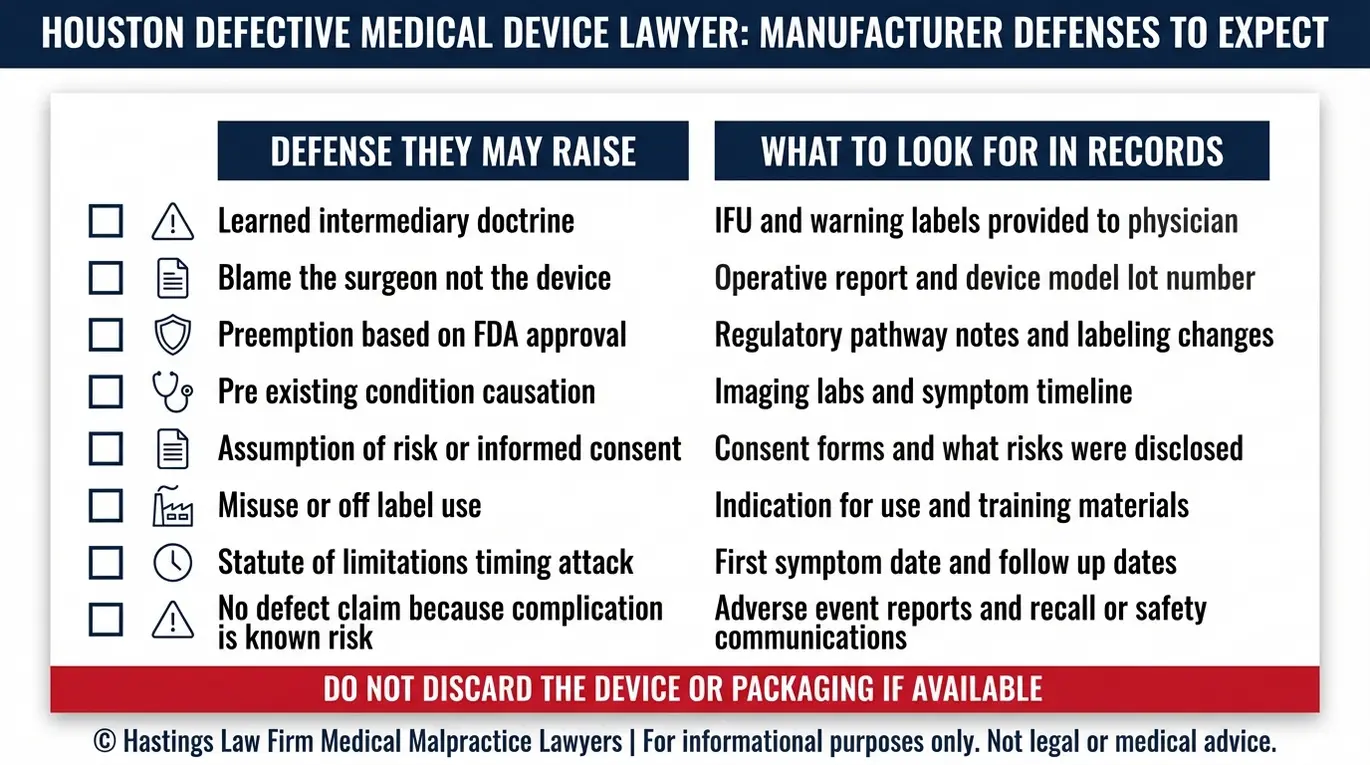
Manufacturers often defend against claims by arguing the “learned intermediary” doctrine, blaming the surgeon for the error, or claiming the patient’s injury was caused by pre-existing conditions rather than the device itself.
Blaming the Doctor. One of the most common tactics is shifting liability from the product to the surgeon who implanted it. The manufacturer argues that the doctor, not the device, caused the harm. This is known as the “learned intermediary” doctrine, which holds that the manufacturer’s duty to warn runs to the prescribing physician rather than directly to the patient. A defective medical device attorney in Houston will investigate whether the device itself was flawed regardless of surgical technique, distinguishing between a product liability claim and a medical malpractice claim to satisfy the burden of proof.
Federal Preemption. Under 21 U.S.C. § 360k, manufacturers sometimes argue that FDA approval shields them from state-level lawsuits. This preemption defense claims that federal regulatory approval overrides state product liability claims. However, this defense has significant limitations, particularly for devices cleared through the less rigorous 510(k) pathway rather than the full premarket approval process.
Causation Disputes. Manufacturers may also argue that the claim is barred by the statute of limitations or that the patient’s injury was inevitable due to age, weight, activity level, or underlying health conditions. They frame the complication as unrelated to any defect, attributing it to pre-existing conditions, or by asserting assumption of risk. Houston medical product lawyers counter this by working with qualified medical experts who can isolate the device’s role in causing harm and rule out alternative explanations through imaging, pathology, and clinical records.
Each of these defenses can be overcome with thorough investigation and credible expert analysis. Our team examines the evidence to build a case that addresses every anticipated argument.
Contact the Houston Medical Device Attorneys at Hastings Law Firm Today for Help
If a medical device has caused you or your loved one harm, you may be entitled to compensation for medical bills, future care costs, lost income, pain and suffering, and mental anguish. In cases of gross negligence, punitive damages may also be available. When a defective device takes a life, families can pursue a wrongful death claim.
At Hastings Law Firm, we work on a contingency fee basis, which means you pay no attorney fees or costs unless we recover compensation for you. Our founder, Tommy Hastings, is board-certified in Personal Injury Trial Law, a distinction held by less than 2% of Texas attorneys. Our team of attorneys, nurse consultants, and medical experts is ready to review your records for a free case evaluation.
You trusted a medical device to improve your health. If that trust was broken, a Houston defective medical device lawyer at Hastings Law Firm can help you find answers and take the next step toward accountability. Contact us today for a free, confidential case evaluation.
Frequently Asked Questions About Defective Medical Device in Houston


This content was researched and written by the Hastings Law Firm editorial team, which includes attorneys, medical professionals, and experienced researchers. Our writing is informed by internal knowledge and practical experience, and we cross-check critical details against authoritative sources cited throughout. Every piece undergoes human-led fact-checking and legal review. Because legal and medical information can change, if you spot an error, please contact us. Learn more about our content standards and review process on our editorial policy page.

Tommy Hastings, founder of Hastings Law Firm, is a board-certified personal injury trial lawyer dedicated exclusively to healthcare injury cases. Since 2001, he has represented injured patients and families in litigation against major hospital systems, pharmaceutical companies, and negligent healthcare providers nationwide. He has handled numerous high-profile cases that have drawn national media attention and resulted in multi-million dollar recoveries. He draws on that experience in his writing, helping readers understand how these cases work and what options may be available to them.
