


Austin Defective Medical Device Lawyer
A defective medical device can turn treatment into a new source of pain, complications, and additional surgery. Implant failure can happen when a device breaks down, shifts from its intended position, or triggers harmful reactions in the body, and the effects can be physically and emotionally overwhelming. Responsibility may involve a manufacturer defect, a surgical implantation error, or both, and the details often matter. If you or a loved one were harmed or worse due to a defective medical device in Austin, Texas, contact Hastings Law Firm for a free, confidential case review.
Last Updated: July 27, 2026
Trusted Medical Product Liability Attorneys in Austin
When a medical device that was supposed to help you heal instead causes new pain or complications, it can feel like a betrayal of the trust you placed in your medical team and the products they recommended. Implant failure, where a device breaks down, migrates, or causes toxic reactions inside the body, can leave you facing additional surgeries, mounting medical bills, and more questions than answers.
You deserve to know what happened and who is responsible. As an experienced Austin Defective Medical Device Lawyer, the team at Hastings Law Firm focuses exclusively on medical negligence and product liability cases. Since 2005, we have dedicated our practice to helping patients recover from medical errors. Our in-house medical staff and former defense attorneys understand how manufacturers and hospitals build their defenses, and we use that insight to protect your rights.
If you or a loved one has been harmed by a medical device, contact us for a free, confidential case evaluation. We can review what happened and explain your options.

Common Defective Medical Devices and Dangerous Implants
Defective medical devices often include failing joint replacements, surgical mesh, and vascular filters that cause severe injury requiring revision surgery. These are not rare occurrences. Thousands of patients across the country have suffered serious complications from devices that were marketed as safe and effective.
The physical toll of implant failure can be devastating. A device that was designed to stay in place may migrate to surrounding tissue. Metal components can corrode, releasing toxic particles into the bloodstream. In some cases, patients do not realize something is wrong until the damage has already progressed.
Several categories of devices have been linked to widespread patient harm:
- DePuy hip implants: Certain metal-on-metal hip replacement systems have been associated with metallosis. This condition occurs when metal debris causes tissue death and chronic pain.
- Hernia mesh: This synthetic material, implanted to reinforce weakened tissue, has been linked to chronic infections, migration, and adhesion to internal organs.
- IVC filters: The inferior vena cava filter, placed in a major vein to catch blood clots, can fracture, tilt, or perforate the vein wall.
- Bone cement implants: Improperly formulated or applied cement used in joint replacements can lead to loosening and toxic reactions.
When any of these devices fail, patients often face revision surgery to remove or replace the implant. Revision procedures are typically more complex and carry higher risks of infection. Surgeons must often reconstruct bone or tissue damaged by the removal of the failed device. An Austin defective medical device attorney can help determine whether the device itself or the surgical technique contributed to the harm.
Understanding FDA Recall Classifications
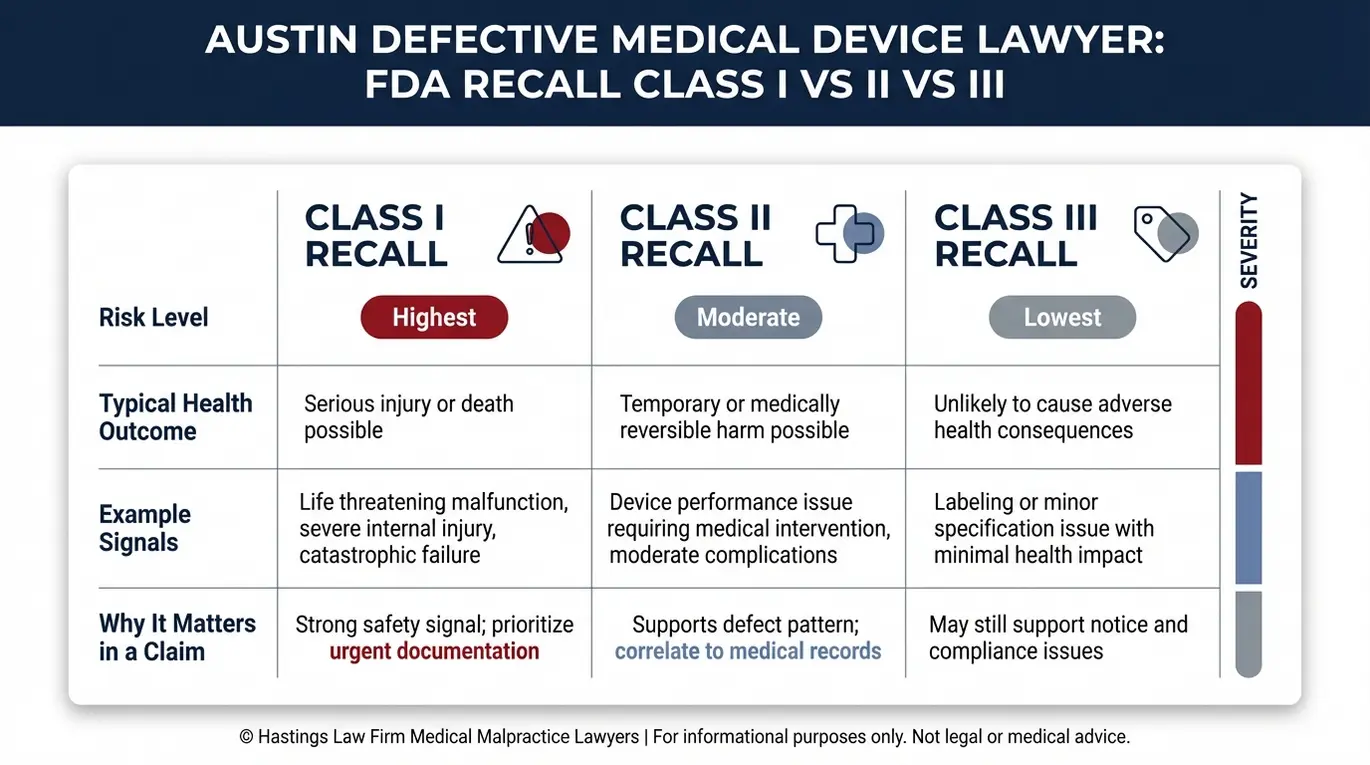
The FDA categorizes recalls into three classes based on severity, with Class I representing the highest risk of serious injury or death. Medical device safety standards are regulated by the FDA to ensure patient protection. Understanding FDA recall classifications matters because a recall can serve as powerful evidence in a product liability claim.
When the FDA or a medical device manufacturer identifies a safety problem, the agency assigns a recall classification based on the potential health risk. These classifications are defined under 21 CFR § 7.41, and they help both the public and legal professionals assess how dangerous a device may be.
| Recall Class | Risk Level | Description |
|---|---|---|
| Class I | Most Serious | The device has a reasonable probability of causing serious health problems or death. |
| Class II | Moderate | The device may cause temporary or medically reversible health problems, or the probability of serious harm is remote. |
| Class III | Lowest Risk | Use of or exposure to the device is not likely to cause adverse health consequences. |
A Class I recall, the most severe designation, signals that the FDA considers the device dangerous enough to pose a real threat of death or serious injury. A Class II recall, applicable to devices that may cause temporary or reversible health problems, indicates a lower but still significant risk.
If a device you received has been subject to an FDA recall, that classification strengthens your position. You can check whether your device has been recalled through the FDA’s Medical Device Recalls database. Even if a recall has not yet been issued, a lawyer can investigate emerging defect patterns and adverse event reports.
The Hastings Law Firm Difference
Results matter, but what truly sets us apart is how we achieve them. Every verdict, every settlement, and every Austin courtroom victory comes from one guiding promise: To treat each client’s fight for justice as if it were our own.
This balance of skill, experience, and empathy reflects our core philosophy that justice should not only compensate the injured, but also make health care safer nationwide.

The Fast Track Loophole and FDA 510(k) Clearance
The FDA 510(k) clearance process allows manufacturers to bypass rigorous safety testing by claiming a new device is “substantially equivalent” to an existing product. The FDA 510(k) clearance process is a regulatory route for clearing medical hardware without new clinical trials. This allows a manufacturer to bring a device to market if they show it is similar to a product already on the market.
Substantial equivalence does not mean the device has been proven safe through its own testing. A manufacturer can reference a device that was itself cleared through the 510(k) process. This creates a chain of clearances that may stretch back decades without any device in the chain ever undergoing full clinical evaluation.
This gap in oversight has contributed to defective medical devices reaching patients before their risks are fully understood. When complications emerge after a product is already in widespread use, the manufacturer may face failure-to-warn claims. This means the company did not adequately disclose known or foreseeable risks to doctors and patients.
Adverse events linked to cleared devices are tracked through the FDA’s MAUDE (Manufacturer and User Facility Device Experience) database. This MAUDE database collects reports from manufacturers, healthcare facilities, and patients. These reports can reveal patterns of failure that support mass tort claims against a manufacturer. Our legal team reviews these filings to find evidence that the manufacturer knew about the risks before the device was implanted.
Who Is Liable: Manufacturers vs. Surgeons
Liability may lie with the manufacturer for a product defect, with the surgeon for medical malpractice if the device was implanted incorrectly, or in some cases, with both. Determining responsibility is a vital step in any defective device case. It requires both legal and medical analysis.
Manufacturer liability applies when the device itself was the problem. If a hip implant was designed with materials prone to corrosion, the medical device manufacturer may be held accountable under product liability law regardless of how well the surgery was performed.
Surgeon liability applies when the device functioned as intended but was implanted through a negligent surgical error. For example, implant malposition, where a device is placed at an incorrect angle, can cause the same pain as a defective product. In these situations, the claim falls under medical malpractice rather than product liability, though the patient may still require revision surgery.
| Factor | Manufacturer Liability | Surgeon Liability |
|---|---|---|
| Cause of Harm | Defect in design, materials, or warnings | Error in surgical technique or judgment |
| Legal Theory | Product liability / strict liability | Medical malpractice / negligence |
| Key Evidence | Device testing data, recall history, FDA filings | Operative reports, imaging, medical records |
| Possible Outcome | Wrongful death or injury claim against manufacturer | Malpractice claim against surgeon or hospital |
In many cases, dual liability exists. A device may have had a known defect, and the surgeon may have also failed to follow proper implantation protocols. A medical device lawyer in Austin with experience in both malpractice and product liability can evaluate the full picture.
Impact of Pre-emption on Medical Device Lawsuits
Federal pre-emption is a legal defense that some manufacturers raise to block state-level lawsuits. This argument suggests that because the FDA cleared the device, federal law should override state product liability claims. This defense has been successful in certain cases involving devices that went through the FDA’s most rigorous pre-market approval process.
However, pre-emption does not apply to all devices, and there are legal strategies to work around it. Devices cleared through the 510(k) pathway generally do not receive the same level of pre-emption protection. Our attorneys evaluate the specific regulatory history of the device involved in your case to determine the strongest path forward.
Texas Product Liability Laws and Burden of Proof
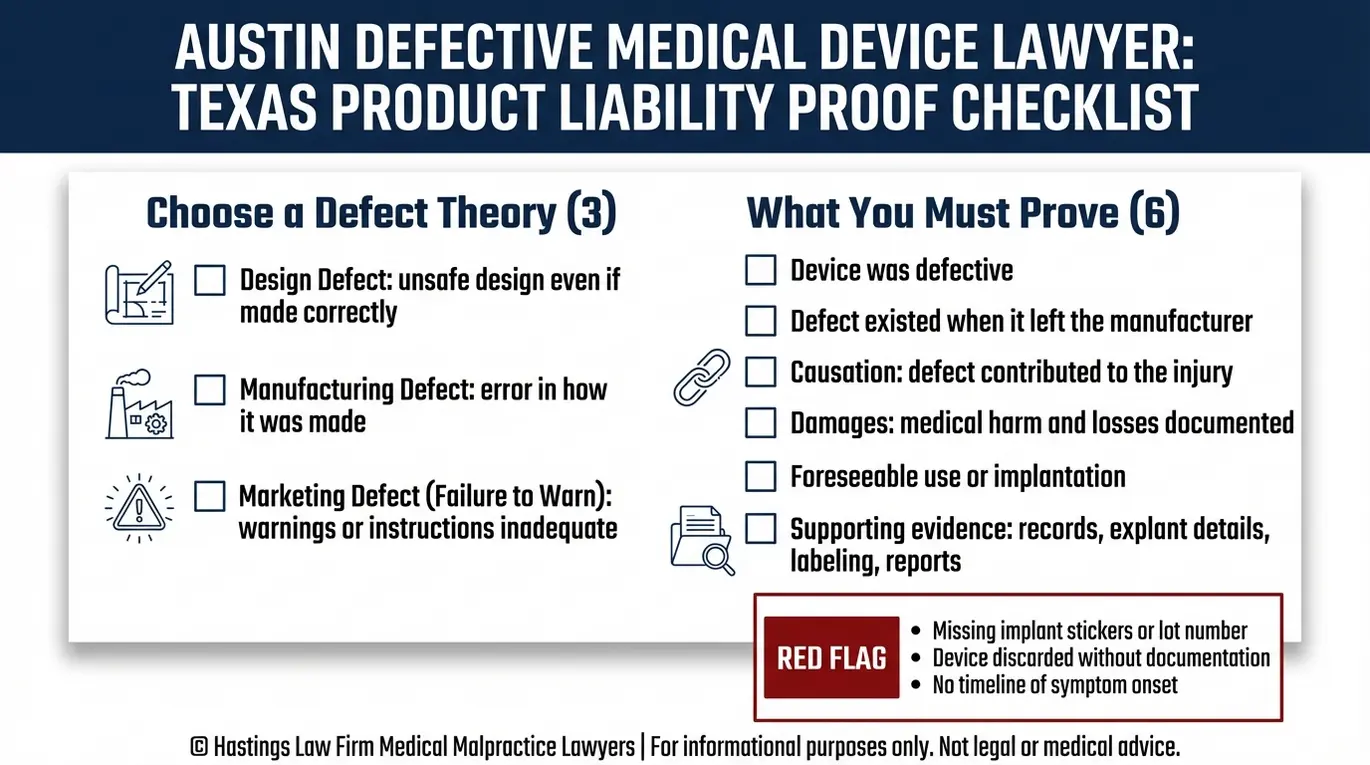
In Texas, plaintiffs must prove that a device had a design, manufacturing, or marketing defect that directly caused their injury under strict liability or negligence standards. The legal framework for these claims is outlined in the Texas Civil Practice and Remedies Code, Chapter 82.
Texas recognizes two primary legal theories in product liability cases. Under strict liability, you do not need to prove the manufacturer was careless. You only need to show that the product was defective and unreasonably dangerous when it left the manufacturer’s control. Under a negligence standard, the focus shifts to whether the manufacturer failed to exercise reasonable care.
Texas law identifies three categories of product defects:
- Design defect: The device’s design made it unreasonably dangerous. You must prove that a safer alternative design was viable and would have prevented the injury without reducing the device’s utility.
- Manufacturing defect: The device deviated from its intended design during production, making the specific unit you received dangerous.
- Marketing defect (failure to warn): The manufacturer failed to provide adequate warnings or instructions about known risks associated with the device.
A breach of warranty claim may also apply if the manufacturer made specific promises about the device’s safety that turned out to be false. To build a strong case, your legal team will generally establish that the defect existed when the product left the manufacturer’s control.
Compensation for Defective Device Injuries
Patients harmed by defective medical devices may recover economic damages for medical bills and lost wages, as well as non-economic damages for pain, suffering, and physical impairment. The type of compensation depends on the specifics of your case and the severity of your injuries.
Economic damages cover the financial losses you can document, such as hospital bills and the cost of revision surgery. According to data from the Agency for Healthcare Research and Quality’s HCUP Statistical Brief, inpatient surgical procedures carry significant costs. Revision surgeries for failed devices often exceed the expense of the original operation.
Non-economic damages address the harm that does not come with a receipt. These include chronic pain, emotional distress, loss of mobility, and the impact on your daily life.
In cases where a medical device manufacturer acted with gross negligence, punitive damages may also be available. These are designed to punish reckless conduct. The FDA’s database on recalls, corrections, and removals can provide evidence that a manufacturer was aware of defects.
An Austin defective medical device lawyer at Hastings Law Firm handles these cases on a contingency fee basis. We operate on a No Recovery, No Fee model, meaning you pay no attorney fees or costs unless we secure a recovery on your behalf.
Contact the Austin Medical Device Attorneys at Hastings Law Firm Today for Help
If a medical device has caused you or someone you love unexpected pain, complications, or additional surgery, you have the right to find out why. At Hastings Law Firm, our team of attorneys, in-house medical professionals, and former defense counsel works together to uncover the truth and hold the responsible parties accountable.
Our founder, Tommy Hastings, is a board-certified trial lawyer with over two decades of experience handling these complex medical claims. We know the medical and legal systems can feel overwhelming when you are dealing with the physical burden of a failed device. We focus on upholding patient safety standards in every case we handle. Our process starts with a free, confidential case evaluation led by a patient advocate who can help you understand your options.
You pay nothing unless we recover compensation for you. Call our Austin office or reach out online to schedule your evaluation. Let us help you get the answers you deserve.
Frequently Asked Questions About Defective Medical Devices in Austin


This content was researched and written by the Hastings Law Firm editorial team, which includes attorneys, medical professionals, and experienced researchers. Our writing is informed by internal knowledge and practical experience, and we cross-check critical details against authoritative sources cited throughout. Every piece undergoes human-led fact-checking and legal review. Because legal and medical information can change, if you spot an error, please contact us. Learn more about our content standards and review process on our editorial policy page.

Gabe Sassin has focused exclusively on medical malpractice law since 2007. After spending more than a decade as a malpractice defense attorney, he knows exactly how the other side works. He has seen firsthand how healthcare providers, insurers, corporate defendants, and their legal teams think, prepare, and build their defense against claims. That knowledge works for the people who need it most today, injured patients and their families. His unique experience shapes everything he writes, giving readers a look at how these cases actually work from someone who has handled them from both sides.
