


Houston Dangerous Drug Injury Lawyer
Prescription drug injuries can leave people facing serious health consequences, financial strain, and uncertainty about what went wrong. Harm can stem from prescribing mistakes, pharmacy dispensing errors, or defects in how a medication was designed, manufactured, or marketed. Some injuries arise even at normal doses, and risks may become clearer only after wider use and later safety warnings or recalls. Clear documentation and medical context often shape how responsibility is understood. If you or a loved one were harmed or worse due to dangerous drug injuries in Houston, Texas, contact Hastings Law Firm for a free, confidential case review.
Last Updated: July 27, 2026
Trusted Medical Liability Attorneys for Pharmaceutical Injuries in Houston
When a medication you trusted to help you causes unexpected harm, the confusion and frustration can be overwhelming. You may be dealing with new symptoms, mounting medical bills, and unanswered questions about who is responsible. These are valid concerns, and you deserve clear answers.
At Hastings Law Firm, we focus exclusively on medical liability cases, including injuries caused by dangerous or defective drugs. Our legal and medical team works together to identify what went wrong, who is accountable, and what compensation may be available to you.
If you or a loved one has been harmed by a prescription medication, a Houston dangerous drug injury lawyer at our firm can review what happened and explain your options in a free, confidential consultation.

Common Types of Medication Errors and Defective Drug Injuries
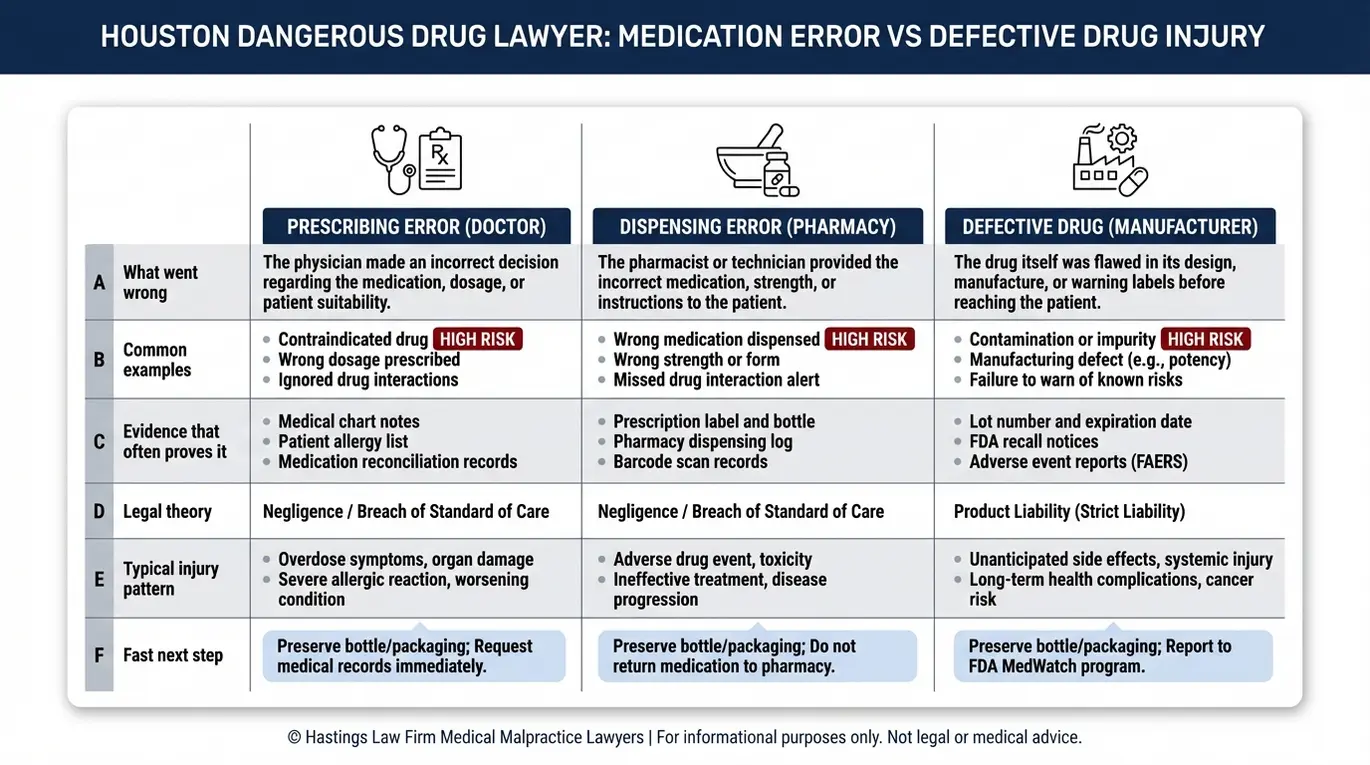
Prescription drug injuries typically stem from three primary sources: negligent prescribing by a physician, dispensing errors by a pharmacy, or inherent defects in the pharmaceutical product itself. Understanding which category applies to your situation is the first step toward identifying who may be held responsible.
An important distinction exists between a medical error and a product defect. A medical error involves a mistake made by a healthcare professional, such as a doctor prescribing the wrong dosage or a pharmacist filling a prescription incorrectly. A product defect involves defective drugs that were dangerous because of how they were designed, manufactured, or marketed. This distinction determines the legal theory behind your claim and which parties may be liable.
An adverse drug reaction (ADR), which is any harmful or unintended response to a medication at normal doses, can result from either type of failure. Our drug injury lawyers in Houston investigate these cases by tracing the injury back to its source. According to ECRI and the Institute for Safe Medication Practices (ISMP), medication errors remain among the most persistent and preventable hazards in healthcare.
The most common categories of drug injuries include:
- Prescribing errors: A physician prescribes a contraindicated drug, ignores known allergies, or orders an incorrect dosage. These are medical malpractice claims.
- Dispensing errors: A pharmacist provides the wrong medication, mislabels a bottle, or fails to flag harmful drug interactions. Look-alike/sound-alike medications, or LASA drugs (pharmaceuticals with similar names or packaging that lead to mix-ups), are a frequent contributor to these mistakes.
- Product defects: A drug reaches the market with manufacturing contamination, an unreasonably dangerous design, or inadequate warnings about known side effects. These failures often trigger product liability lawsuits against the manufacturer.
- Drug recalls: A medication is pulled from the market after reports of serious harm, but patients may have already suffered injuries before the recall was issued.
As prescription medication attorneys, we examine pharmacy logs, medical records, and manufacturer data to determine exactly where the breakdown occurred.
Overprescribing and Pill Mill Litigation
A specific form of prescribing negligence involves overprescribing, particularly with opioids and pain management drugs. A pill mill, or a clinic where doctors prescribe controlled substances in excessive quantities without legitimate medical justification, prioritizes volume over patient safety. These operations can cause addiction, organ damage, or death.
Hastings Law Firm has direct experience in this area. Founder Tommy Hastings has successfully held these practices accountable through litigation, focusing on cases where prescribing patterns fell below the standard of care. Proving these cases involves a thorough medical reconstruction to show that the clinic deviated from accepted medical standards.
Liability for Prescription Drug Injuries in Texas
Liability in drug injury cases may extend to the prescribing physician for negligence, the pharmacist for dispensing errors, or the pharmaceutical manufacturer for a defective design or marketing failure. Identifying all liable parties, including hospitals or drug manufacturers, is essential because in many cases, more than one party bears responsibility.
Physician liability arises when a doctor fails to meet the standard of care in prescribing medication. This includes prescribing a drug with a known contraindication, which is a factor that makes the drug unsafe for that particular patient. We review the physician’s records to determine whether they ignored medical history or failed to monitor for dangerous drug interactions.
Pharmacy liability applies when a pharmacist fills the wrong prescription, provides an incorrect dosage, or fails to flag a harmful interaction between medications. Pharmacists have an independent duty to verify prescriptions and warn patients of known risks. A dispensing error can be just as dangerous as a prescribing mistake.
Manufacturer liability is different because it often involves strict liability rather than a negligence standard. If a drug reaches consumers with manufacturing contamination, which is a defect introduced during production that changes the intended formulation, the manufacturer can be held liable even without proof of carelessness. The same applies when a company fails to adequately warn doctors and patients about known side effects. These are product liability claims, and they can extend to pharmaceutical companies and distributors.
The Hastings Law Firm Difference
Results matter, but what truly sets us apart is how we achieve them. Every verdict, every settlement, and every Houston courtroom victory comes from one guiding promise: To treat each client’s fight for justice as if it were our own.
This balance of skill, experience, and empathy reflects our core philosophy that justice should not only compensate the injured, but also make health care safer nationwide.

Why Dangerous Drugs Remain on the Market
Dangerous drugs often remain available because of the limitations in the FDA’s approval process and the financial incentives that drive pharmaceutical companies to bring products to market quickly.
The U.S. Food and Drug Administration (FDA) offers several expedited programs, including Breakthrough Therapy designation and the Accelerated Approval pathway, that allow drugs to reach patients faster. The Accelerated Approval pathway allows drugs to be approved based on surrogate endpoints rather than long-term safety and efficacy data. This can benefit patients with serious conditions, but it also means some drugs enter the market before their full risk profile is understood.
A black box warning, the FDA’s most serious safety label, is sometimes added only after a drug has been on the market for years. By the time the warning is issued, patients may have already suffered significant harm.
A dangerous drug attorney understands how these regulatory gaps create opportunities for harm and how to hold manufacturers accountable when they fail to disclose known risks. We thoroughly investigate drug manufacturers when evidence suggests they failed to meet safety standards.
Impact of the Prescription Drug User Fee Act
The Prescription Drug User Fee Act (PDUFA) is a federal law that allows pharmaceutical companies to pay fees directly to the FDA to fund the drug review process. This has helped speed up FDA approval but also raised concerns about potential conflicts of interest. When the agency responsible for drug safety relies on funding from the companies it regulates, questions about the independence of the review process often arise. This dynamic can affect how rigorously new drugs are evaluated and how quickly safety concerns are addressed.
Proving Your Pharmaceutical Injury Claim
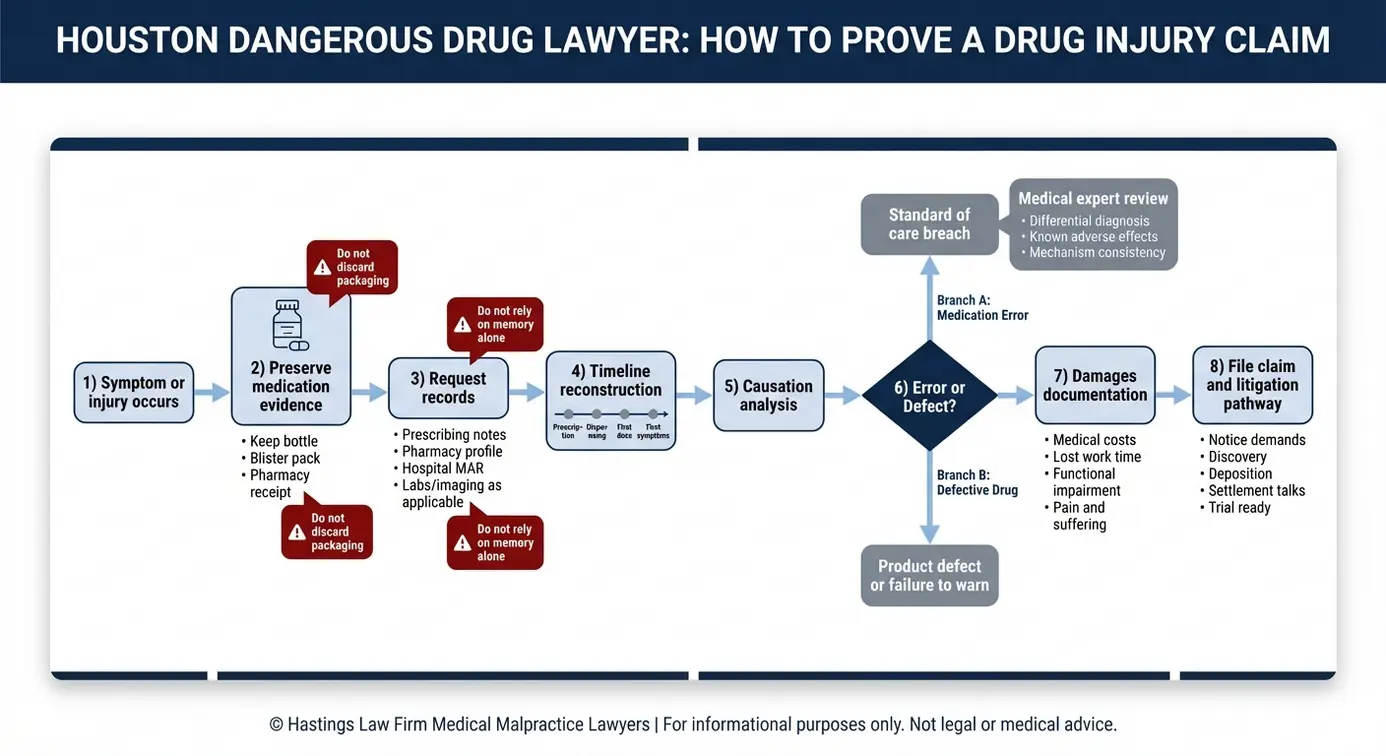
Proving a drug injury claim requires clear evidence connecting the medication to the specific injury, expert medical testimony establishing causation, and thorough documentation of financial and physical damages.
Building a strong case follows a structured process:
- Gather medical and pharmacy records. This includes prescription histories, physician notes, and pharmacy dispensing logs. These records form the factual foundation of your claim.
- Secure expert testimony. Under Texas Civil Practice and Remedies Code Chapter 74.351, medical malpractice claims require a qualified expert to provide a report. This report must establish that the standard of care was breached and that the breach caused your injury.
- Establish causation. Our trial lawyers must demonstrate that the drug, not a pre-existing condition, caused the specific harm. This involves a detailed analysis of medical timelines and clinical data.
- Document damages. Medical expenses, lost income, and records of physical and emotional impact support the full scope of your losses.
- Report to regulatory authorities. Filing a report through MedWatch, the FDA’s safety reporting system, creates an official record of the adverse event.
Our prescription drug injury lawyers handle each of these steps. Our in-house medical staff, including nurse practitioners and Board Certified Patient Advocates, review clinical records to identify exactly where the failure occurred.
Multi-District Litigation vs. Class Action Lawsuits
When a single prescription medication injures many people, legal cases are often consolidated for efficiency. The difference between the two main approaches is significant:
| Feature | Class Action Lawsuit | Multi-District Litigation (MDL) |
|---|---|---|
| Structure | One lawsuit represents all plaintiffs as a group | Individual lawsuits consolidated before one judge |
| Individual claims | One ruling applies equally to everyone | Each plaintiff retains their own claim |
| Settlement | Uniform settlement for the class | Settlements reflect each plaintiff’s specific damages |
| Common in drug cases? | Less common | More common for prescription drug injuries |
Most dangerous drug cases proceed as mass torts or MDLs. This means your case is managed efficiently alongside similar claims, but your individual circumstances are still considered when determining your settlement or verdict. This structure allows the court to handle high volumes of evidence while respecting the unique medical history of each patient.
Damages Recoverable in Houston RX Drug Injury Lawsuits
Patients harmed by prescription drugs in Texas may recover economic damages for medical bills and lost wages, as well as non-economic damages for pain, suffering, and physical impairment. The specific categories of drug injury compensation depend on the severity and long-term impact of the injury.
Economic damages cover the measurable financial losses caused by the injury:
- Past and future medical expenses, including surgeries, rehabilitation, and ongoing treatment
- Lost wages and diminished earning capacity if the injury affects your ability to work
- Out-of-pocket costs related to care or necessary home modifications. In severe cases requiring lifetime care, we calculate the long-term cost of nursing assistance to ensure your future needs are funded.
Non-economic damages address the less tangible but equally real harm you have experienced:
- Physical pain and suffering
- Mental anguish and emotional distress
- Loss of enjoyment of life and inability to participate in activities you once valued
- Physical impairment or disfigurement
A Houston prescription drug injury attorney will work to document both types of damages thoroughly. Undervaluing either category can significantly reduce the compensation available to you.
Punitive damages may also apply in cases where evidence shows gross negligence. Texas law caps punitive damages in most cases, but they can be a significant component of a wrongful death claim. These damages are designed to deter future misconduct, not just to compensate the injured patient. We pursue these when the evidence supports a claim of extreme disregard for safety.
Texas Statute of Limitations for Drug Injury Claims
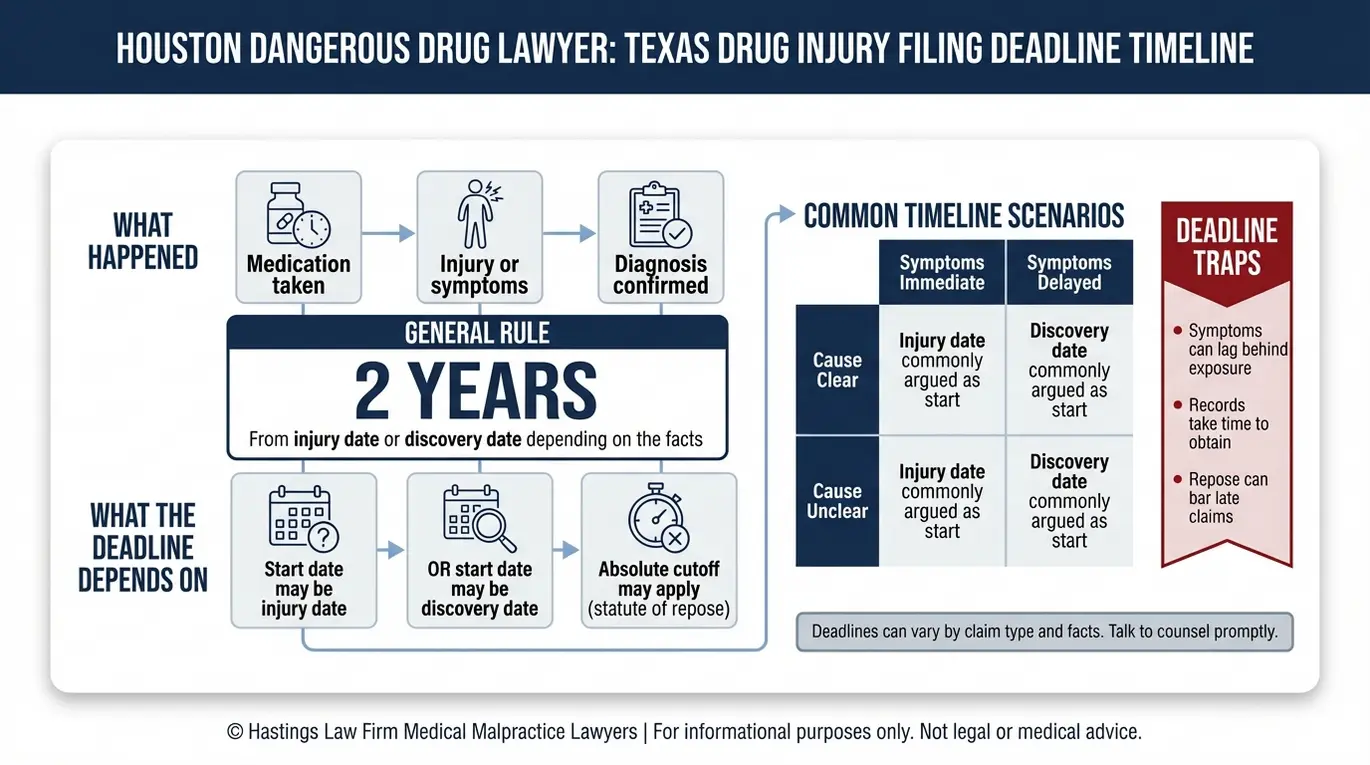
In Texas, the general statute of limitations for filing a drug injury lawsuit is two years from the date of the injury or the date the injury was discovered. This deadline is established under Texas Civil Practice and Remedies Code Chapter 16.
The discovery rule is especially relevant in pharmaceutical cases. Some drug injuries do not produce symptoms for months or years. If you developed cancer or organ damage that was later linked to a medication you took previously, the two-year clock may start from the date you learned the drug caused your condition.
Texas also imposes a statute of repose, which sets an absolute outer deadline for filing certain claims regardless of when the injury was discovered. These hard deadlines can eliminate your right to file even if you only recently connected your condition to a particular drug.
Consulting with an attorney early is one of the most important steps you can take. A delay in seeking legal guidance could mean losing your right to pursue a claim entirely. For a detailed review of the applicable statutes, refer to Texas Civil Practice and Remedies Code Chapter 16 (PDF).
Why Choose Hastings Law Firm for Drug Injury Litigation
Hastings Law Firm brings a unique combination of board-certified trial advocacy and in-house medical expertise to every pharmaceutical injury case. Unlike general practice firms, we focus exclusively on medical liability. Our dedicated trial lawyers understand the science behind these claims, and that singular focus gives our clients an advantage in complex litigation.
Founder Tommy Hastings is Board Certified in Personal Injury Trial Law by the Texas Board of Legal Specialization, a distinction held by fewer than 2% of Texas attorneys. This certification reflects a high level of experience and competence in trial law. He has represented numerous clients in cases involving defective and contaminated medication.
We are not a settlement mill. Every case is prepared from day one as if it will go to a jury. That trial-ready approach gives us a firm negotiation posture that insurance carriers recognize, often leading to more favorable results without the need for a trial.
As your Houston prescription drug injury lawyer, we work on a contingency fee basis. You pay no attorney fees or costs unless we secure a recovery for you.
Contact the Houston Dangerous Drug Attorneys at Hastings Law Firm Today for Help
A dangerous drug injury can leave you with serious health consequences, financial strain, and a deep sense of betrayal by the systems you trusted. You are not alone in this, and you do not have to figure it out on your own.
At Hastings Law Firm, our mission is to restore trust for clients who have been harmed by medical negligence and dangerous pharmaceutical products. Our team of attorneys, nurse practitioners, and patient advocates is ready to listen to your story, review your medical records, and help you understand whether you have a viable claim.
Time matters. Texas imposes strict filing deadlines on drug injury claims, and reaching out early helps preserve critical evidence.
Contact us today for a free, confidential case evaluation. There is no fee unless we win.
Frequently Asked Questions About Dangerous Drug Injury in Houston


This content was researched and written by the Hastings Law Firm editorial team, which includes attorneys, medical professionals, and experienced researchers. Our writing is informed by internal knowledge and practical experience, and we cross-check critical details against authoritative sources cited throughout. Every piece undergoes human-led fact-checking and legal review. Because legal and medical information can change, if you spot an error, please contact us. Learn more about our content standards and review process on our editorial policy page.

Tommy Hastings, founder of Hastings Law Firm, is a board-certified personal injury trial lawyer dedicated exclusively to healthcare injury cases. Since 2001, he has represented injured patients and families in litigation against major hospital systems, pharmaceutical companies, and negligent healthcare providers nationwide. He has handled numerous high-profile cases that have drawn national media attention and resulted in multi-million dollar recoveries. He draws on that experience in his writing, helping readers understand how these cases work and what options may be available to them.
