


Fort Worth Dangerous Drug Injury Lawyer
Written by: Hastings Law Firm | Reviewed by: Brady D. Williams | Updated: July 27, 2026
Medication related harm can leave people coping with unexpected side effects, worsening health, financial strain, and in the most severe situations fatal outcomes. Pharmaceutical injury claims often turn on whether the problem came from a defective drug, a prescribing decision, or a pharmacy dispensing error. Texas rules also shape how responsibility is evaluated when warnings were directed to a prescribing clinician rather than a patient. Clear documentation and careful review of what happened can be central to understanding accountability. If you or a loved one were harmed or worse due to dangerous drug injuries in Fort Worth, Texas, contact Hastings Law Firm for a free, confidential case review.
Trusted Medical Liability Attorneys for Pharmaceutical Injuries in Fort Worth
What You Should Know About Medication Side Effect Claims in Fort Worth:
- Recovery can depend on whether the harm is tied to a drug manufacturer product defect or a healthcare provider prescribing or dispensing error.
- Options can narrow when FDA approved labeling triggers a presumption that can shield manufacturers from certain warning based claims.
- Liability can shift away from a manufacturer when adequate warnings were provided to the prescribing physician under the learned intermediary doctrine.
- Compensation can include economic losses and non economic harms when a defective or negligently handled medication causes injury.
- Wrongful death claims can be available when a dangerous drug causes a fatal outcome and surviving family members can seek specified losses.
- Outcomes can vary between class actions and multi district litigation because individual injury history may carry less weight in a class action.
- Proof can hinge on causation because a recall alone does not automatically establish that the drug caused a specific injury.
- Preserved physical evidence can be critical because remaining pills and packaging may be needed for testing and verification.
- Accountability can turn on pharmacy records when the suspected harm involves wrong drug dispensing, incorrect dosage, or ignored interaction warnings.
- Filing options can be lost if time limits are missed because Texas law limits the time to bring a claim.

A Healthcare Focused Law Firm
When a medication causes harm instead of healing, the experience can shake your confidence in every prescription you take and every provider you trust. You may be dealing with unexpected side effects, a worsening condition, or a tragic loss. These situations raise difficult questions, and getting clear answers can feel impossible when you’re up against large pharmaceutical companies or hospital systems.
At Hastings Law Firm, we represent patients and families across Fort Worth who have been injured by dangerous drugs, defective medications, and prescription errors. As a Fort Worth dangerous drug injury lawyer team focused exclusively on medical liability, we bring in-house medical professionals and former defense attorneys together to investigate what went wrong and identify who should be held responsible. If you believe a medication harmed you or someone you love, we offer a free, confidential case evaluation to review what happened and explain your legal options.
Distinguishing Between Product Liability and Medical Malpractice in Pharmaceutical Cases
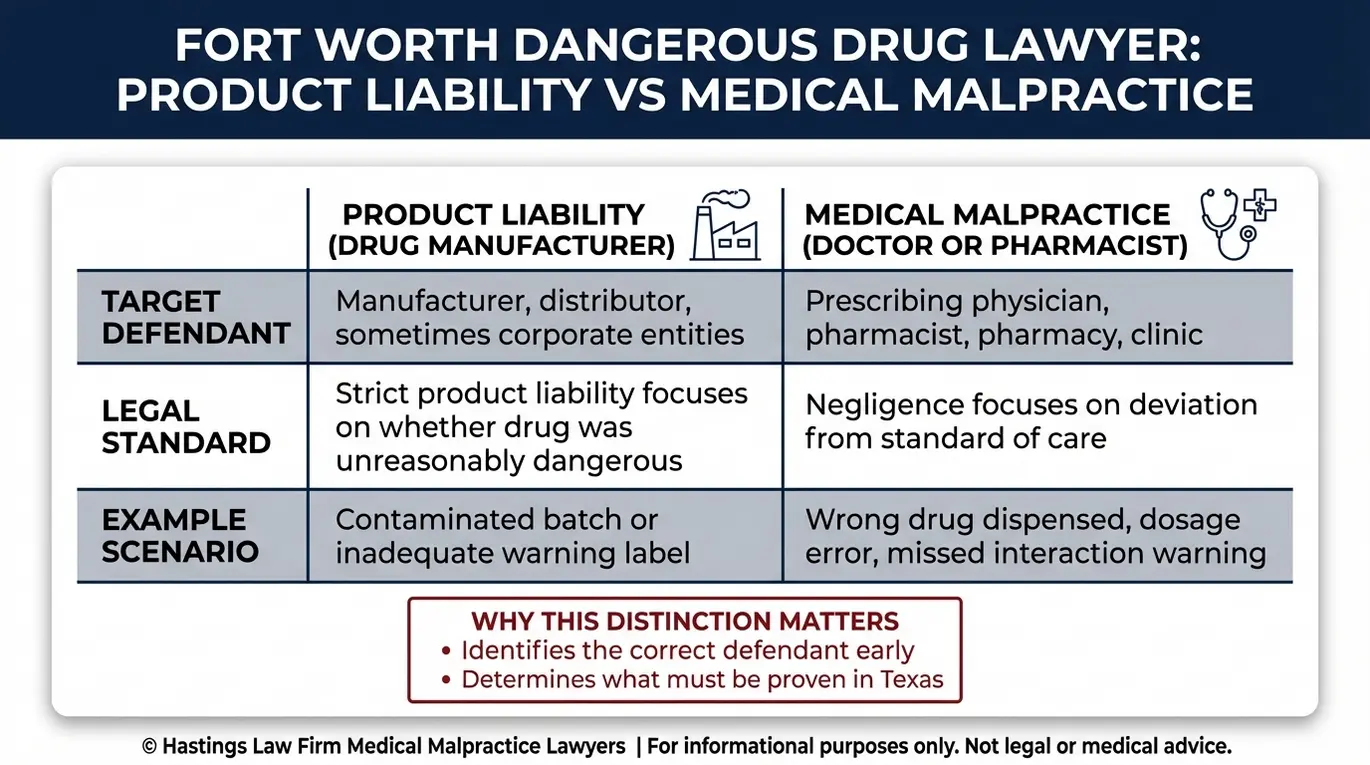
Pharmaceutical injury cases generally fall into one of two legal categories: product liability claims against the drug manufacturer, or medical malpractice claims against the healthcare provider who prescribed or dispensed the medication. In Texas, legal recovery for drug-related harm depends on pinpointing where the failure occurred. Understanding which theory applies to your situation is the first step toward building a viable case.
Product liability targets the company that designed, manufactured, or marketed the drug. Under Texas law, these claims can sometimes proceed under strict product liability, meaning you may not need to prove the manufacturer was careless. Instead, you must show the drug itself was unreasonably dangerous, whether because of a flaw in its formula, known as a design defect, contamination during production, or misleading labeling. The focus is on the product, not the provider’s behavior.
Medical malpractice, which includes pharmacy malpractice, targets the prescribing doctor, pharmacist, or other healthcare professional. These claims require proof that the provider deviated from the accepted standard of care, the level of treatment a reasonably competent professional would have provided in similar situations. A medication error, such as prescribing a drug to a patient with a known allergy, is one common example. Medical malpractice claims in Texas are governed by Civil Practice and Remedies Code Chapter 74, which sets specific procedural requirements including expert reports and pre-suit notice.
A prescription drug injury case may involve pharmaceutical negligence by a provider, a design defect, or both. As Fort Worth prescription drug injury attorneys, we evaluate the full chain of events to determine who bears liability and whether the claim should proceed against the drug manufacturer, the pharmacy, the prescribing physician, or multiple parties.
| Product Liability | Medical Malpractice | |
|---|---|---|
| Target Defendant | Drug manufacturer, distributor, or marketer | Prescribing doctor, pharmacist, or healthcare facility |
| Legal Standard | Strict liability (drug was unreasonably dangerous) or negligence | Negligence (provider deviated from the standard of care) |
| Example Scenario | A blood thinner causes internal bleeding due to an undisclosed risk the manufacturer knew about | A pharmacist dispenses the wrong dosage of a blood thinner, leading to an overdose |
Common Types of Defective Drug Claims in Texas
Defective drug claims in Texas generally fall into three categories: design defects, manufacturing defects, and marketing defects. Each focuses on a different point in the drug’s lifecycle where something went wrong.
- Design defects exist when the drug’s formula itself is inherently dangerous, even if the medication works as intended. Opioid painkillers are a well-known example of drugs where risks can outweigh the benefits for intended use. We must demonstrate that a safer alternative design was available or that the drug’s dangers made it unreasonably risky. In Texas, the “risk-utility” test requires us to prove the drug’s risks outweigh its utility and that a safer design was feasible.
- Manufacturing defects occur when something goes wrong during production, resulting in a contaminated or improperly formulated batch. A manufacturing defect, which can include contamination from foreign substances, incorrect ingredient ratios, or improper storage conditions, means the drug that reached the patient was different from what the manufacturer intended. These defects may affect only a specific lot or production run, and an FDA recall can sometimes confirm the problem. Because these defects often affect only a specific lot, securing the physical evidence of the pill or bottle is crucial for chemical testing.
- Marketing defects, or failure-to-warn claims where the manufacturer does not disclose known risks, are among the most common. These arise when the drug’s labeling or promotional materials fail to adequately disclose known side effects, dangerous drug interactions, or limitations on use. If a manufacturer knew or should have known about a risk and did not include it on the label, they denied patients and their doctors the information needed to make safe choices. Physicians rely on accurate labels to prescribe safely; when a manufacturer hides risks to protect profits, they strip doctors of the ability to practice informed medicine.
As a defective drug attorney team, we examine all three categories when evaluating a potential case.
Texas Civil Practice and Remedies Code Section 82.008
Texas law gives drug manufacturers a significant shield: the “FDA Presumption of Safety.” This statute establishes specific protections for manufacturers regarding FDA-approved labels. This law creates a legal hurdle for patients but does not block all pathways to recovery. Under Texas Civil Practice & Remedies Code §82.008, a manufacturer may argue that it cannot be held liable for failure-to-warn claims if the FDA approved its labeling and warnings at the time the drug was sold.
This defense is not absolute. We can overcome this presumption of safety by demonstrating that the manufacturer withheld safety data from the FDA, misrepresented clinical trial results, or engaged in fraud during the approval process. If the FDA’s approval was based on incomplete or manipulated information, the protection falls apart. Proving “fraud on the FDA” requires a detailed investigation into the manufacturer’s regulatory submissions and internal communications.
The Hastings Law Firm Difference
Results matter, but what truly sets us apart is how we achieve them. Every verdict, every settlement, and every Fort Worth courtroom victory comes from one guiding promise: To treat each client’s fight for justice as if it were our own.
This balance of skill, experience, and empathy reflects our core philosophy that justice should not only compensate the injured, but also make healthcare safer nationwide.

Pharmacy Negligence and Dispensing Errors
Pharmacy negligence refers to a preventable error that occurs at the point where medication is dispensed to the patient, such as filling a prescription with the wrong drug, providing an incorrect dosage, or failing to identify a dangerous drug interaction before the medication reaches the patient’s hands.
Wrong medication errors often involve what are called look-alike/sound-alike (LASA) medications, drugs with similar names or packaging that can easily be confused. For example, hydroxyzine and hydralazine have been mixed up repeatedly across U.S. pharmacies. When a pharmacist dispenses the wrong drug, the patient may experience a serious adverse reaction or miss treatment for the correct condition. Research compiled by the National Center for Biotechnology Information on Medication Dispensing Errors documents how frequently these errors occur.
Dosage errors are another common and dangerous form of prescription mistake. A dosage error, which can result from a misplaced decimal point or misread prescription, may mean the patient receives ten times the intended amount. These errors are particularly harmful in pediatric cases, where even small dosage variations can have severe consequences.
Failure to consult happens when a pharmacist ignores or overrides automated system warnings about potential drug interactions. Pharmacy software is designed to flag dangerous combinations, but when staff bypass those alerts due to time pressure or volume, the patient bears the risk.
If you suspect a dispensing error, a pharmacy error lawyer or Fort Worth prescription drug injury lawyer can investigate the pharmacy’s records, staffing logs, and internal protocols to determine whether negligence occurred.
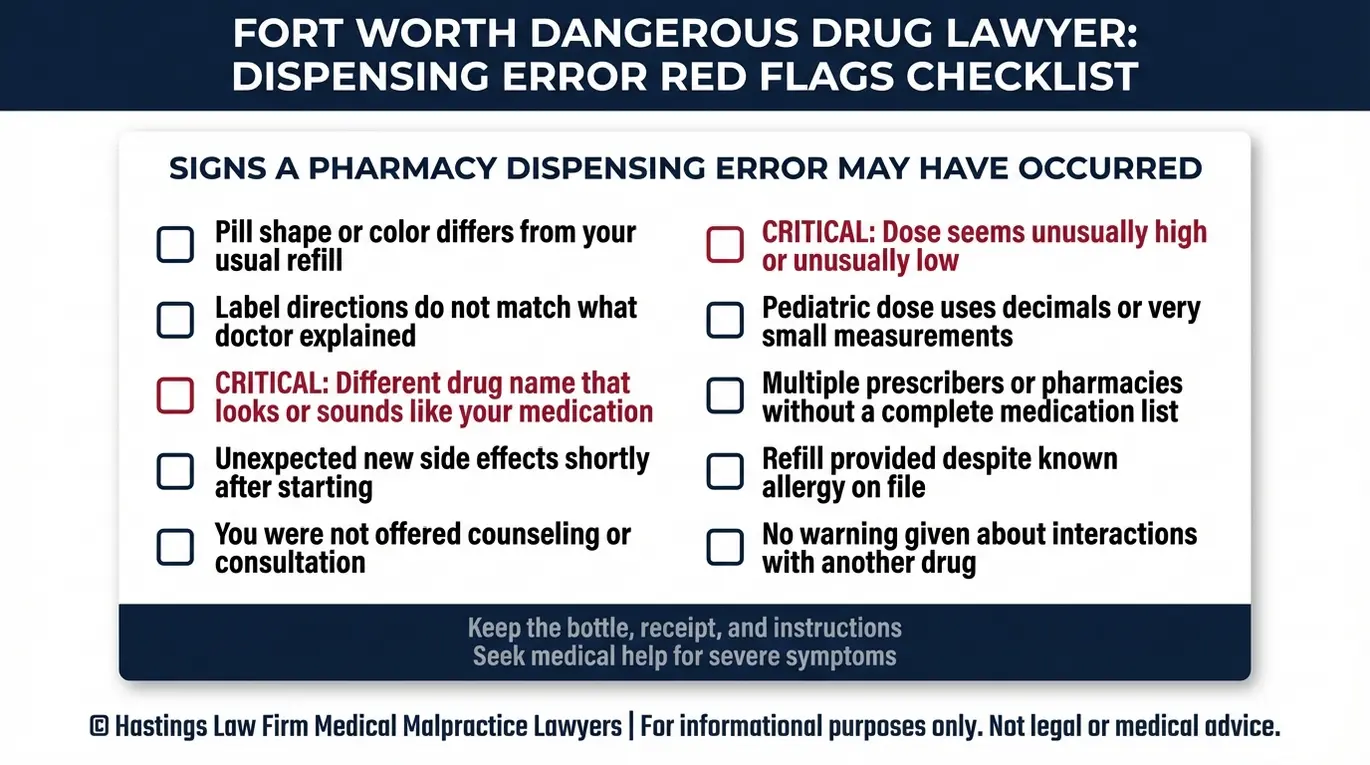
Signs of a possible dispensing error to watch for:
- The pills look different from your usual prescription (different shape, color, or markings)
- You experience new or unexpected symptoms after starting or refilling a medication
- The label instructions differ from what your doctor told you
- You received a different quantity than prescribed
- The pharmacy did not ask about your other medications or allergies before dispensing
Liability and The Learned Intermediary Doctrine
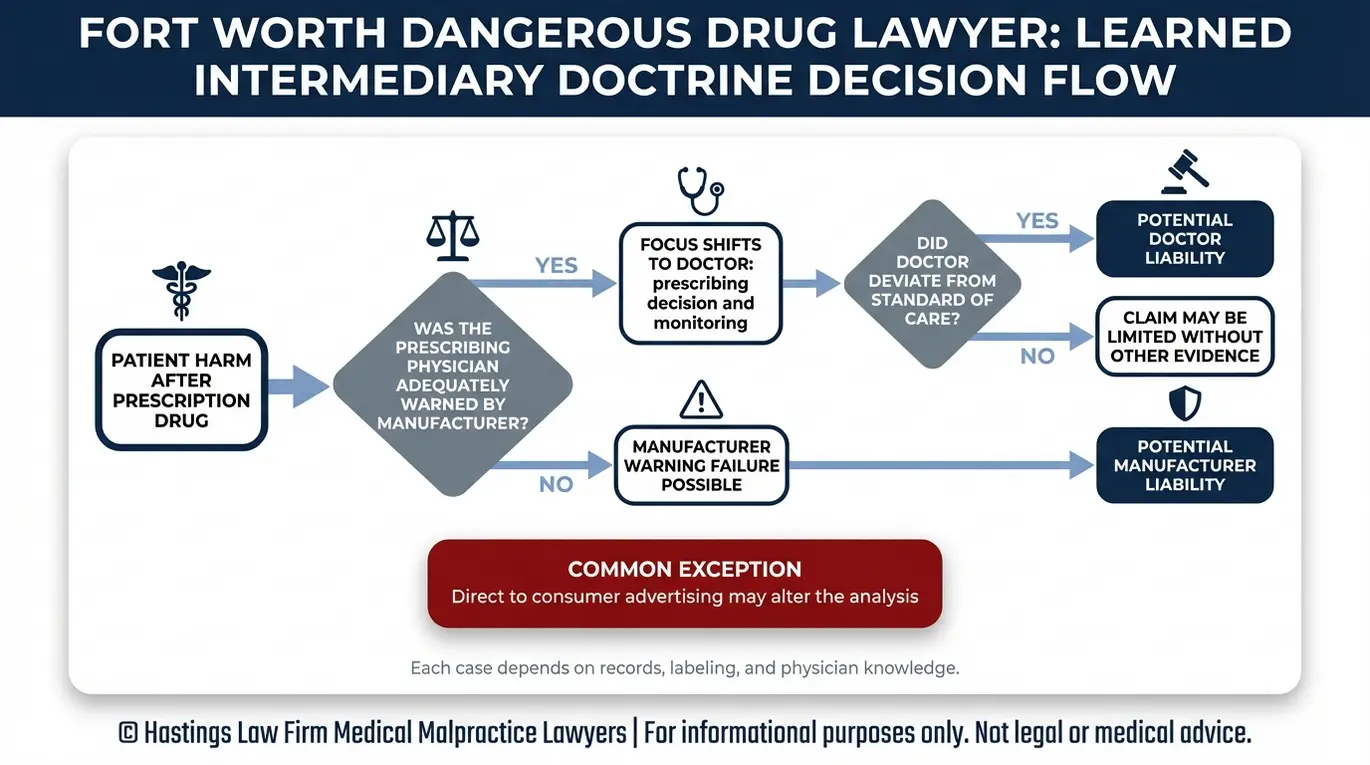
The Learned Intermediary Doctrine is a legal defense in Texas establishing that a drug manufacturer’s duty to warn about risks extends only to the prescribing physician, not directly to the patient. This doctrine helps determine whether the legal responsibility lies with the drug company or the prescribing doctor. The reasoning is that doctors act as learned intermediaries between the manufacturer and the patient, using their medical judgment to evaluate whether a drug is appropriate.
This means if a drug manufacturer provided adequate warnings to the prescribing doctor, and the doctor prescribed the medication anyway, the manufacturer may avoid liability. The responsibility shifts to the physician. A contraindication, a specific situation where a drug should not be used because of known risks, may have been clearly listed in the prescribing information. If the doctor ignored that contraindication, doctor negligence may be the cause of the injury rather than the pharmaceutical company’s product.
The same applies to drugs carrying a black box warning, which is the FDA’s most serious label alert reserved for medications with significant or life-threatening risks.
There is an important consideration regarding direct-to-consumer advertising. While courts in some other states have recognized an exception to the learned intermediary doctrine when a drug company markets directly to consumers, the Texas Supreme Court has declined to adopt that exception. In Texas, the doctrine generally applies even when a manufacturer advertises directly to patients. However, misleading direct-to-consumer advertising may still be relevant to other aspects of a pharmaceutical injury claim.
For a prescription drug injury lawyer in Fort Worth, this doctrine shapes case strategy. In many cases, building a strong claim means evaluating failure to warn arguments against the manufacturer and negligence claims against the provider. A drug liability attorney must determine where the breakdown in communication occurred and which party, or parties, failed in their duty to protect the patient.
Understanding Class Actions vs. Multi-District Litigation
While many drug injury cases are grouped together for efficiency, the key difference between Class Actions and Multi-District Litigation (MDL) is that MDLs preserve your individual lawsuit and value, whereas class actions split a single settlement among the group. This distinction helps you understand why your individual medical history remains central to an MDL claim.
- In a class action, one lawsuit represents an entire group of plaintiffs, and any settlement or verdict is divided among all members of the class. Individual circumstances, such as the severity of your injury, carry less weight. Class actions are rarely suitable for personal injury claims because injuries vary too widely between patients to be “certified” as a class. You may receive a small fraction of the total recovery.
- In an MDL, individual lawsuits are consolidated before a single federal judge for the pretrial phase, including discovery and key rulings. This streamlines the process and avoids conflicting decisions across courts. However, each plaintiff retains their own case. Your individual injuries, medical history, and damages are preserved, meaning your claim is valued based on what happened to you specifically.
In a Multi-District Litigation, pretrial proceedings are handled centrally to ensure consistency, but if your case does not settle during this phase, it can be remanded back to the original court for trial. This structure allows for mass efficiency while respecting the unique damages of each patient, such as individual wage loss or specific medical complications. Settlements in MDLs are typically negotiated on an individual basis or through structured grids that account for injury severity.
The Judicial Panel on Multidistrict Litigation maintains a current list of pending MDLs, which cover a broad range of pharmaceutical litigation categories. As a Fort Worth prescription drug injury lawyer team handling dangerous drug lawsuit claims, we track active MDLs and evaluate whether consolidation benefits our clients or whether filing independently in state court is the stronger approach.
Compensation for RX Drug Injury Victims
Patients harmed by a defective or negligently prescribed medication may recover both economic and non-economic damages under Texas law. Damages represent the legal attempt to make a person whole after an injury caused by another party’s actions. The specific types and amounts depend on the facts of the case and whether the conduct involved rises to the level of gross negligence.
Economic damages cover the financial losses you can document:
- Past and future medical expenses, including hospitalizations, surgeries, and rehabilitation
- Lost wages and diminished earning capacity if the injury affects your ability to work
- Out-of-pocket costs such as travel to medical appointments or home care needs
Calculating future costs is especially important in prescription drug injury cases. Some adverse drug events cause permanent organ damage, neurological harm, or chronic conditions that require lifelong care. Life care plans are essential for catastrophic injuries, accounting for inflation in medical costs over decades. This includes hospital bills, home modifications, and specialized transportation. A prescription drug injury lawyer Fort Worth residents trust works with medical experts and life-care planners to project these long-term needs accurately.
Non-economic damages address losses that do not come with a receipt:
- Physical pain and suffering
- Mental anguish and emotional distress
- Physical impairment or disfigurement
- Loss of enjoyment of life
Wrongful death claims carry their own provisions under Texas Civil Practice and Remedies Code Chapter 71. If a loved one died because of a dangerous drug, surviving family members may seek compensation for drug injury losses including loss of companionship, lost financial support, and funeral expenses. Punitive damages may apply in rare cases where the manufacturer or provider acted with gross negligence. These damages are designed to punish the wrongdoer and deter similar conduct.
How Our Legal Team Proves Your Case
We prove pharmaceutical negligence by combining medical expertise with litigation strategy from the earliest stage of investigation. Our approach starts with the clinical evidence and builds outward to establish exactly what went wrong and who is responsible.
Step 1: Record review by in-house medical professionals. Our team includes nurse practitioners and Board Certified Patient Advocates who analyze your medical records, pharmacy logs, and prescribing history. They identify whether an adverse drug event, harm caused by a medication at normal doses, occurred and look for signs of a drug interaction, which is a harmful reaction caused by combining medications. The U.S. Food and Drug Administration recommends that patients create and maintain a medication list, and we use these records alongside clinical data to reconstruct the medication timeline.
Step 2: Expert witness retention. We work with a national network of pharmacologists, toxicologists, and medical specialists who provide independent analysis and expert testimony. These experts evaluate whether the drug caused your injury, whether prescribing decisions met the standard of care, and whether the manufacturer’s warnings were adequate. Establishing causation is often a complex hurdle. We must show that the drug was the proximate cause of the injury, ruling out underlying health conditions. Our nursing staff plays a vital role in chronologically mapping your symptoms against the drug’s administration to build this link.
Step 3: Filing and discovery. Once we have validated the claim, we file suit and begin the discovery process to obtain internal documents from manufacturers, pharmacies, or healthcare providers. Our process for proving pharmaceutical negligence involves combining clinical findings with internal evidence. Our team includes former defense attorneys who previously represented hospitals and healthcare systems.
Our founder, Tommy Hastings, is board-certified in Personal Injury Trial Law, a distinction earned by less than 2% of Texas attorneys. Our leadership also includes a 2025 inductee into the American Board of Trial Advocates, which recognizes elite trial skills. This background gives us direct insight into the strategies the opposing side is likely to use, allowing us to prepare for and counter those arguments effectively. As a Fort Worth prescription drug injury lawyer team, we prepare every case as though it will go to trial.
Contact the Fort Worth Dangerous Drug Attorneys at Hastings Law Firm Today for Help
A medication you trusted caused harm, and that experience can leave you questioning every aspect of your care. We are here to help you understand your legal standing in Fort Worth. You deserve answers about what happened and clarity about what comes next.
Hastings Law Firm represents patients and families throughout Fort Worth and across Texas in dangerous drug, pharmacy error, and pharmaceutical liability cases. Our team of attorneys, nurses, and patient advocates is ready to review your situation and help you understand your legal options.
We work on a contingency fee basis, which means you pay no attorney fees or costs unless we recover compensation for you. Your initial free case review is completely confidential. Texas law limits the time you have to file a claim, so reaching out sooner gives us the best opportunity to preserve evidence and protect your rights. Contact Hastings Law Firm today to start your review.
Frequently Asked Questions About Dangerous Drug Injury in Fort Worth


This content was researched and written by the Hastings Law Firm editorial team, which includes attorneys, medical professionals, and experienced researchers. Our writing is informed by internal knowledge and practical experience, and we cross-check critical details against authoritative sources cited throughout. Every piece undergoes human-led fact-checking and legal review. Because legal and medical information can change, if you spot an error, please contact us. Learn more about our content standards and review process on our editorial policy page.

Brady D. Williams is a nationally recognized medical malpractice attorney who has spent his career handling high-stakes litigation for injured patients and families across the country. Licensed in both Texas and California, Brady draws on experience from hundreds of resolved medical cases to break down complex legal and medical topics for the people who need that information most. His writing reflects the same attention to detail and commitment to clarity that he brings to every case he handles.
