


Austin Dangerous Drug Injury Lawyer
Prescription drug injuries can leave people facing unexpected complications, financial strain, and lasting uncertainty about whether a medication was defective or a provider made a preventable error. These cases often turn on where responsibility lies, such as a manufacturer that failed to warn about known risks or a pharmacist or clinician who prescribed or dispensed the wrong drug or dose. The consequences can be severe, including prolonged hospitalization, permanent disability, or fatal outcomes. If you or a loved one were harmed or worse due to prescription drug injuries in Austin, Texas, contact Hastings Law Firm for a free, confidential case review.
Last Updated: July 27, 2026
Trusted Medical Liability Attorneys for Pharmaceutical Injuries in Austin
When a medication you trusted to help you causes serious harm, it can shake your confidence in the entire healthcare system. You may be dealing with unexpected medical complications, mounting bills, and real uncertainty about what went wrong and who is responsible. These are valid concerns, and you deserve clear answers.
At Hastings Law Firm, we focus exclusively on medical malpractice and pharmaceutical injury cases. Our founder, Tommy Hastings, is a board-certified trial lawyer who has dedicated his career to helping patients who have been harmed by medical negligence. As an Austin prescription drug injury lawyer team, we bring together experienced trial attorneys, in-house nursing staff, and former defense counsel to investigate what happened and identify who should be held accountable.
Our goal is to help you understand your legal options and protect your future, regardless of whether the injury stems from a defective drug or a provider’s error. If you or a loved one has been harmed by a dangerous medication, we offer a free, confidential case evaluation to review what happened and explain your next steps.

Distinguishing Between Defective Drugs and Medication Administration Errors
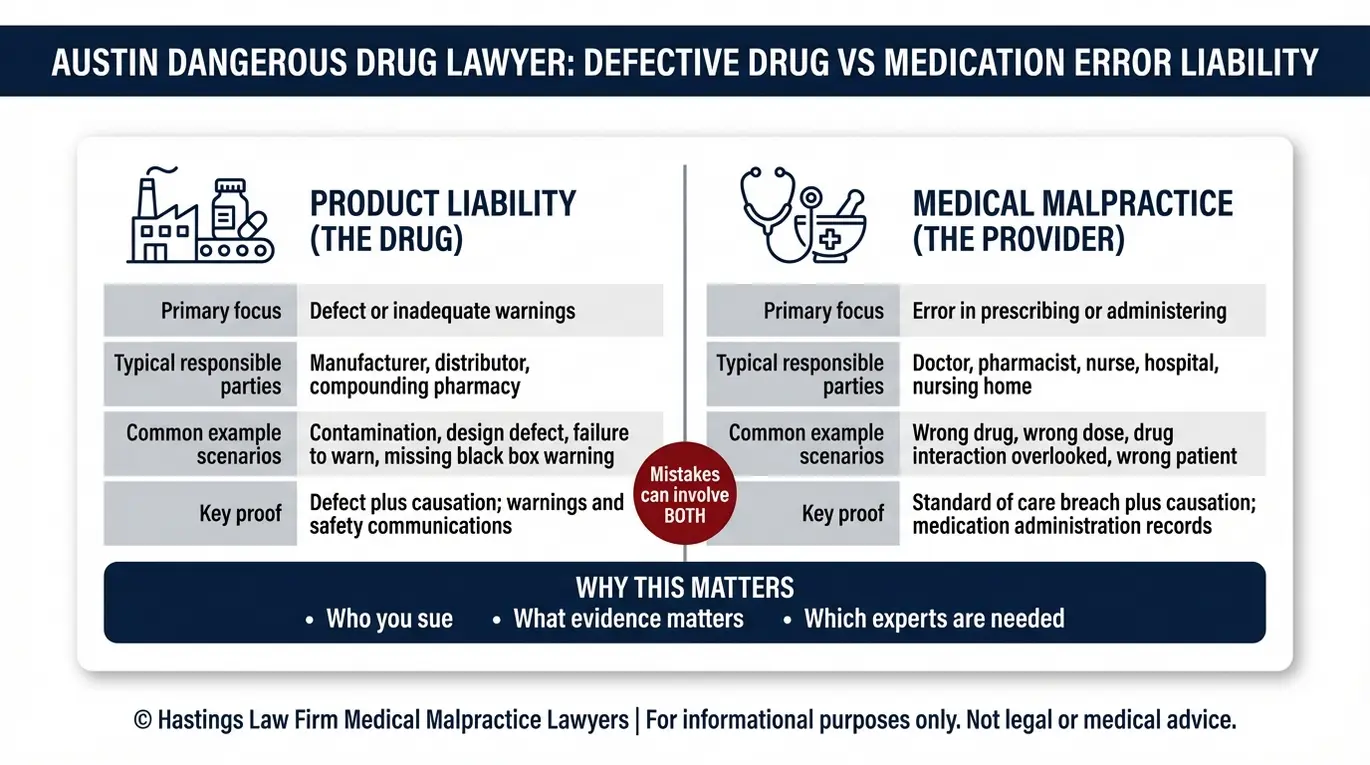
Liability in drug injury cases typically falls into two categories: product liability, where the drug itself is inherently dangerous or defectively manufactured, and medical malpractice, where a healthcare professional makes an error in prescribing or administering the medication. Understanding which category applies to your situation is the first step toward building a viable claim.
Product Liability: When the Drug Itself Is Dangerous
Product liability claims target the pharmaceutical manufacturer. These cases often involve a design defect, which is a flaw in the drug’s chemical formulation that poses unreasonable risks even when used as directed. They can also involve a manufacturing defect, an error where contamination or mistakes during production make a specific batch of medication harmful. A well-known example includes the Pharmatech Laboratories contamination cases that caused patient harm.
An Austin prescription drug injury lawyer evaluating your case will also look for failure to warn claims, where the manufacturer knew about dangerous side effects but did not adequately disclose them to doctors or patients.
Medical Malpractice: When the Provider Made the Error
Medical malpractice claims focus on pharmacist liability or the healthcare professional. This involves professional negligence, such as a doctor prescribing the wrong medication or a pharmacist dispensing an incorrect dosage. It can also include a “pill mill” operation that overprescribes controlled substances without legitimate medical justification. A drug injury attorney in Austin can help determine whether drug manufacturer negligence or a provider’s conduct fell below the accepted standard of care.
| Liability Type | Responsible Party | Example Scenario |
|---|---|---|
| Product Liability (Defective Drug) | Drug manufacturer or distributor | A blood thinner causes uncontrollable bleeding due to a design defect the manufacturer failed to disclose |
| Medical Malpractice (Provider Error) | Doctor, pharmacist, or hospital | A pharmacy dispenses the wrong dosage of a heart medication due to a labeling error |
We handle both types of claims. Our team understands the specific differences between suing a global pharmaceutical company and holding a local hospital or pharmacy accountable.
Pharmaceutical Liability and Failure to Warn
Drug manufacturers have a legal duty to warn doctors and consumers about known risks. A failure to warn occurs when a company is aware of dangerous side effects but does not disclose them to the public or healthcare providers. Some companies in the pharmaceutical industry also engage in off-label marketing, which is the promotion of a drug for uses not approved by the FDA, often without adequate safety data to support those uses.
The FDA requires the most serious warnings to appear in a black box warning, a bordered notice on the drug’s label that alerts prescribers to life-threatening risks. Patients may suffer serious injury when a manufacturer does not issue these warnings promptly after safety data becomes available.
Common Causes of Prescription Drug Injuries in Texas
Prescription drug injuries in Texas are frequently caused by dangerous drug interactions, improper dosing by nursing staff, pharmacy dispensing errors, or the use of recalled medications that were not properly removed from circulation. These failures happen more often than most people realize.
According to the Agency for Healthcare Research and Quality’s Patient Safety Network (PSNet), medication errors and adverse drug events remain one of the most common sources of preventable patient harm in the United States. In Texas, our Austin prescription drug injury lawyers see these errors and adverse side effects arise from several recurring scenarios. These events often lead to prolonged hospital stays or permanent disability.
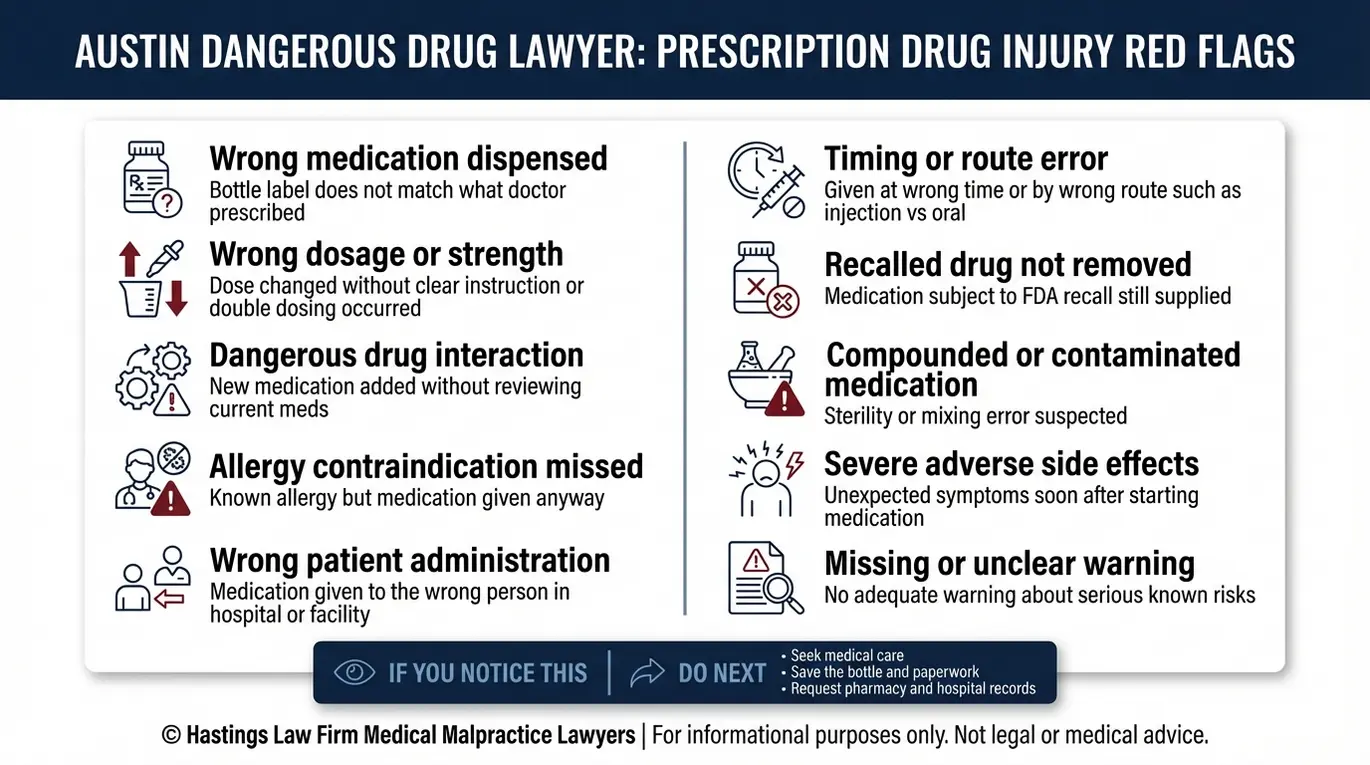
Red flags that may indicate a drug injury caused by negligence:
- A pharmacist dispensed the wrong medication, often because of similar-sounding drug names or illegible prescriptions, indicating pharmacy negligence
- A hospital or nursing facility administered medication to the wrong patient, at the wrong time, or through the wrong route, a sign of nursing home abuse & neglect
- A dosing error, a wrong dosage where the patient received a dangerously high or low amount of medication, occurred due to miscalculation or miscommunication between providers
- A drug-drug interaction, an adverse reaction caused when two or more medications conflict with each other, was not identified before prescribing
- A severe allergic reaction occurred because a known allergy was not reviewed in the patient’s chart
- A recalled medication was still being dispensed because the pharmacy or facility failed to remove it from inventory despite an FDA recall
- Contamination during the compounding process introduced harmful substances into the medication
If any of these situations sounds familiar, a drug injury law firm with medical expertise can review your records and help determine whether negligence occurred.
The Hastings Law Firm Difference
Results matter, but what truly sets us apart is how we achieve them. Every verdict, every settlement, and every Austin courtroom victory comes from one guiding promise: To treat each client’s fight for justice as if it were our own.
This balance of skill, experience, and empathy reflects our core philosophy that justice should not only compensate the injured, but also make health care safer nationwide.

Dangerous Drugs and Adverse Side Effects Subject to Litigation
Many lawsuits involve drugs that remain on the market despite known risks, including opioids, defective blood thinners, and contaminated compounding medications that cause severe physiological damage or death. An FDA recall, the removal or correction of a marketed product that poses a risk to health, is not always required for a drug to be the subject of litigation.
You can check for active and recent alerts through the U.S. Food and Drug Administration’s Drug Recalls page and the FDA’s Drug Recall Information for Consumers, Health Care Professionals, and Industry.
| Drug Category | Known Risk | Litigation Status |
|---|---|---|
| Opioid painkillers | Addiction, overdose, death | Active MDLs and individual lawsuits nationwide |
| Certain blood thinners | Uncontrollable internal bleeding | Ongoing litigation; some settlements reached |
| Contaminated compounded medications | Infection, organ damage, death | Individual lawsuits against compounding pharmacies |
| Specific diabetes and weight-loss drugs | Severe gastrointestinal injury | Emerging litigation with growing case filings |
A compounded medication, a drug custom-mixed by a compounding pharmacy rather than mass-produced by a manufacturer, carries unique contamination risks due to less regulatory oversight.
Most large-scale drug cases proceed as multi-district litigation (MDL) rather than class action lawsuits. In an MDL, cases are consolidated for pretrial proceedings but each person’s claim remains individual, preserving the full value of your specific injuries. As a prescription drug injury attorney team, we evaluate which legal path best protects your recovery. Each bad drug lawsuit we handle reveals patterns similar to cases involving dangerous medical devices.
Keep in mind that Texas imposes time limits on filing injury claims under the Texas Civil Practice and Remedies Code Chapter 16, so prompt evaluation is important.
Securing Compensation for Drug Injury Victims
Victims of prescription drug injuries may be entitled to recover economic damages for medical bills and lost wages, as well as non-economic damages for pain, suffering, and physical impairment caused by the medication. The type and amount of compensation depend on the severity of your injuries and the circumstances of the negligence.
Economic damages cover the financial losses you can document. This includes current and future medical expenses, rehabilitation costs for permanent organ damage or neurological injury, lost income from missed work, and reduced earning capacity if you can no longer perform your job. In serious drug injury cases, future care costs can be substantial, especially when ongoing treatment is required. We pursue compensatory damages under Texas tort law to ensure all your financial needs are met.
Non-economic damages address the personal toll that does not come with a receipt. These may include physical pain and suffering, mental anguish, disfigurement, physical impairment, and loss of consortium, which refers to the impact on your relationship with your spouse or family. In cases of wrongful death or severe injury, we handle settlement negotiation to cover these intangible losses.
Punitive damages may also be available in Texas when the conduct is especially egregious. If evidence shows that a drug manufacturer concealed safety data or that a provider acted with gross negligence, the court may award punitive damages to deter similar behavior in the future.
Our Austin dangerous drug lawyer team works with medical and economic experts to calculate the full scope of your losses, both current and projected. Tommy Hastings is board certified in personal injury trial law, an achievement held by less than 2% of attorneys in Texas.
How Our Austin Drug Injury Attorneys Build Your Case
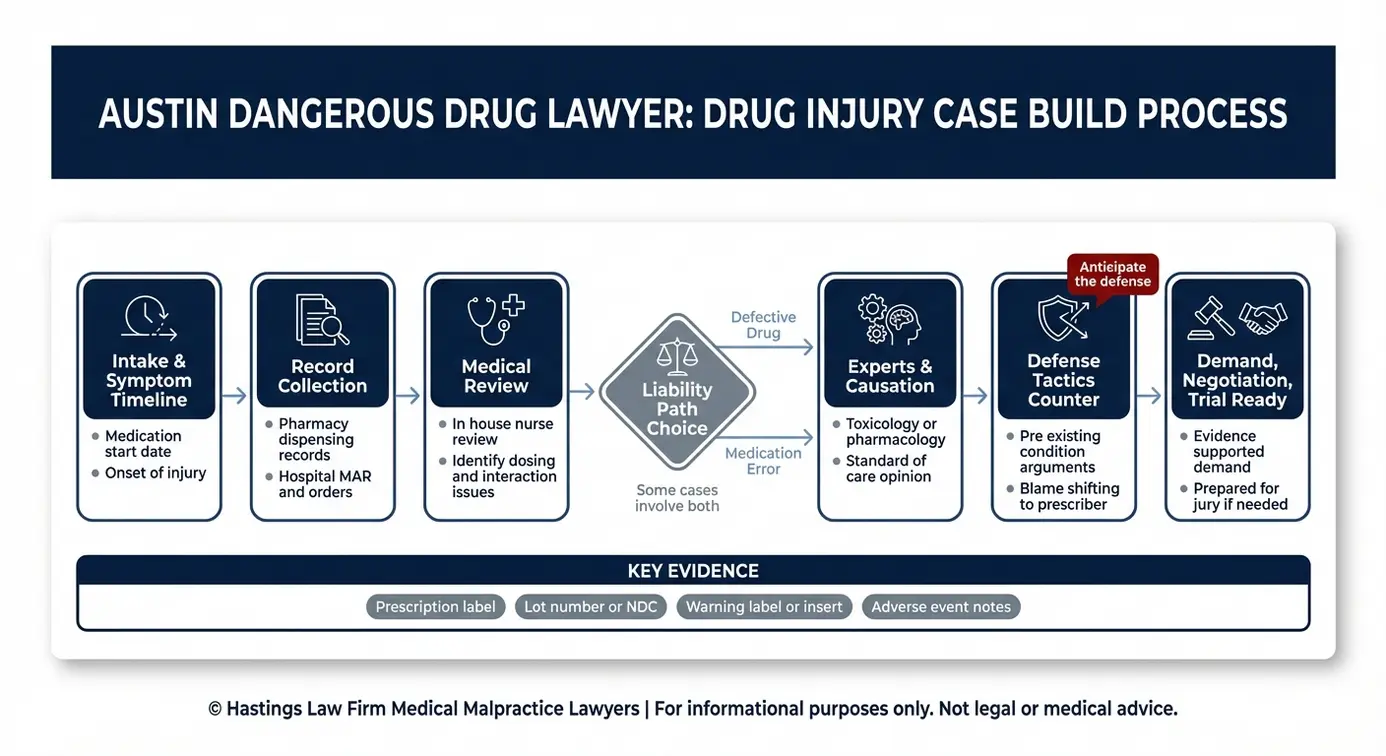
We build a winning case by securing expert testimony to establish the standard of care, analyzing pharmacy and hospital records for inconsistencies, and aggressively countering the defense strategies used by pharmaceutical corporations. Every case we accept is investigated and prepared as if it will go to trial.
Here is how our process works:
- Record collection and medical review: Our in-house nursing staff obtains and reviews your complete medical records, pharmacy logs, and prescribing history. They build a detailed timeline of drug administration to identify where the breakdown occurred.
- Expert analysis: We consult with qualified medical experts who can determine whether the drug caused your injury and whether the care you received met the accepted standard. We also reference data from the National Coordinating Council for Medication Error Reporting and Prevention (NCC MERP). This helps establish the prevalence of adverse drug events, which are injuries resulting from medication, to help meet the burden of proof.
- Evidence preservation: We act quickly to secure prescribing records, internal pharmacy communications, and manufacturing lot data before evidence is lost or altered.
- Case construction and litigation: Once we identify the liable parties, we prepare detailed demand packages or file suit. As an Austin personal injury lawyer team that includes a trial attorney, we prepare for court from day one, so we negotiate from a position of strength.
Understanding Defense Strategies Used by Pharmaceutical Corporations
Pharmaceutical companies and their legal teams often try to shift blame away from the drug or the manufacturer. Common tactics include arguing that the patient’s pre-existing condition caused the injury, that the prescribing doctor is solely at fault, or that the patient failed to follow instructions.
Our team includes former defense attorneys who understand these strategies because they used to deploy them. This insider perspective allows us to anticipate arguments about off-label marketing, the promotion of a drug for unapproved uses, and counter claims that the drug was not unreasonably dangerous or complied with drug safety regulations. We prepare our evidence and expert testimony to directly address these defenses before they gain traction.
Contact the Austin Dangerous Drug Attorneys at Hastings Law Firm Today for Help
If you or a loved one has suffered because of a medication error or a dangerous drug, you do not have to face the legal teams of hospitals and pharmaceutical companies on your own. The experienced attorneys at our Austin prescription drug injury law firm are ready to listen, review your situation, and help you understand your rights.
We offer a free, confidential case evaluation led by our in-house patient advocates. There is no obligation and no upfront cost. We work on a contingency fee basis, which means you pay no attorney fees or costs unless we secure a recovery for you.
You trusted the healthcare system to help you. Let us help you find the answers you deserve. Contact Hastings Law Firm today to take the first step.
Frequently Asked Questions About Dangerous Drug Injury in Austin


This content was researched and written by the Hastings Law Firm editorial team, which includes attorneys, medical professionals, and experienced researchers. Our writing is informed by internal knowledge and practical experience, and we cross-check critical details against authoritative sources cited throughout. Every piece undergoes human-led fact-checking and legal review. Because legal and medical information can change, if you spot an error, please contact us. Learn more about our content standards and review process on our editorial policy page.

Tommy Hastings, founder of Hastings Law Firm, is a board-certified personal injury trial lawyer dedicated exclusively to healthcare injury cases. Since 2001, he has represented injured patients and families in litigation against major hospital systems, pharmaceutical companies, and negligent healthcare providers nationwide. He has handled numerous high-profile cases that have drawn national media attention and resulted in multi-million dollar recoveries. He draws on that experience in his writing, helping readers understand how these cases work and what options may be available to them.
