


Houston Cerebral Palsy Lawyer
A cerebral palsy diagnosis can leave families searching for clear answers about what happened during labor and delivery. Some cases are unavoidable, but others are tied to preventable medical errors that lead to oxygen deprivation or brain trauma with lifelong consequences. Understanding warning signs, timely interventions, and how medical records reflect the course of care can help families make informed decisions about next steps. If your child suffered harm or worse due to preventable cerebral palsy from labor and delivery errors in Houston, Texas, contact Hastings Law Firm for a free, confidential case review.

Last Updated: July 27, 2026
Trusted Medical Attorneys for Preventable Birth Injuries in Houston
Learning that your child has cerebral palsy can feel like the ground has shifted beneath your family. If you suspect that a medical error during labor or delivery played a role, the uncertainty of not knowing what happened, or what to do next, can be overwhelming.
You deserve answers, and your child deserves a secure future.
Our Houston cerebral palsy lawyer team focuses exclusively on medical malpractice. We have the medical knowledge and trial experience to investigate what went wrong and hold the responsible parties accountable. Our in-house medical staff and nurse consultants review the clinical details that general practice firms often miss.
If your family is facing this situation, we can review what happened and explain your options in a free, confidential consultation.

Identifying Preventable Causes of Cerebral Palsy
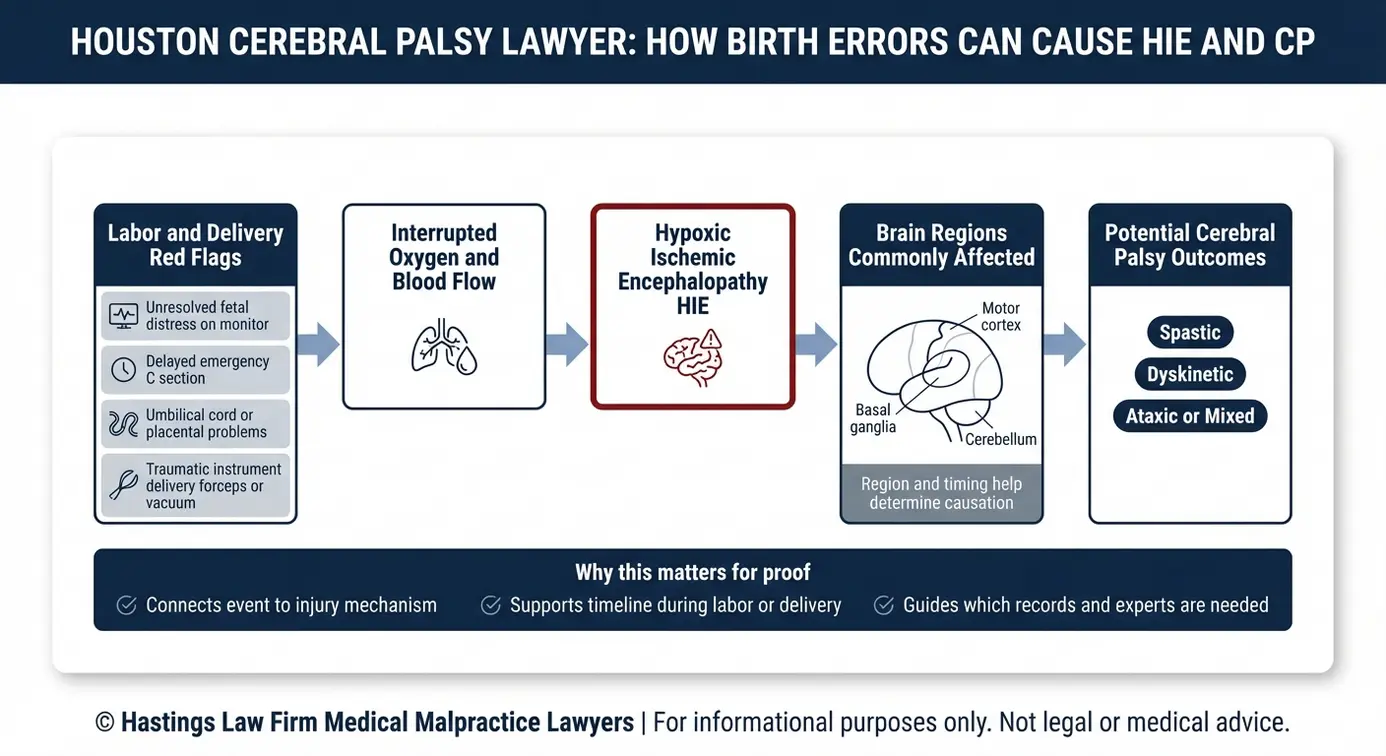
Preventable cerebral palsy is often caused by medical errors such as failure to monitor fetal distress, delayed C-sections, or improper use of delivery tools, resulting in oxygen deprivation or brain trauma during labor and delivery.
Not every case of cerebral palsy stems from medical negligence. Some causes are genetic or occur early in pregnancy and could not have been prevented. But when a birth injury results from a healthcare provider’s failure to follow accepted medical protocols, families have the right to seek accountability. Consulting a cerebral palsy lawyer in Houston allows families to determine if the injury was avoidable.
The connection between oxygen deprivation and brain damage is well established. Oxygen deprivation, or hypoxia, is a condition where a baby’s brain does not receive enough oxygen during labor or delivery. This can cause permanent injury to developing brain tissue. Even a few minutes of interrupted oxygen flow can be catastrophic.
A study published in the *Journal of Clinical Medicine* confirms that birth asphyxia is associated with increased risk of cerebral palsy, reinforcing the medical link between delivery complications and long-term neurological harm. Fetal distress, a condition where monitoring shows the baby is not tolerating labor well, is one of the most common warning signs that intervention is needed. When medical teams fail to recognize or respond to those warnings, the consequences can be severe.
Common medical errors linked to preventable cerebral palsy include:
- Failure to detect or respond to fetal distress on the monitor.
- Delay in performing an emergency C-section.
- Improper use of forceps or vacuum extraction.
- Failure to diagnose or treat maternal infections.
Conditions like birth asphyxia, hypoxic-ischemic encephalopathy (HIE), umbilical cord problems, and placental problems are all scenarios where timely medical action may have changed the outcome. A Houston cerebral palsy lawyer with medical expertise can distinguish between an unavoidable complication and a preventable error by examining clinical evidence in detail.
At Hastings Law Firm, our in-house nursing staff and medical consultants analyze fetal monitoring strips, delivery records, and hospital protocols to determine whether the care your child received met the accepted standard. That investigation is the foundation of every cerebral palsy case we handle.
Classifications of Cerebral Palsy and Their Link to Negligence
Cerebral palsy is classified into four main types—Spastic, Dyskinetic, Ataxic, and Mixed—which are determined by the specific area of the brain that sustained damage during development or birth.
Understanding which type of cerebral palsy a child has can tell us a great deal about what may have gone wrong during delivery. Each classification reflects damage to a different region of the brain, and certain patterns of injury are more consistent with birth trauma than with genetic causes. Cerebral palsy is a neurological disorder that permanently affects muscle tone, movement, and posture, but the severity and specific symptoms vary widely depending on the location of the injury.
Spastic cerebral palsy, the most common form, results from damage to the motor cortex or white matter of the brain. It causes stiff, tight muscles and difficulty with movement. Dyskinetic cerebral palsy, which involves involuntary, uncontrollable movements, is associated with damage to the basal ganglia, a deep brain structure that helps regulate motor control. This type of injury can result from prolonged oxygen deprivation during labor.
Ataxic cerebral palsy affects balance and coordination and is linked to damage in the cerebellum. Mixed cerebral palsy occurs when more than one area of the brain is injured, producing a combination of symptoms. For example, a child may exhibit both the stiff muscles of spastic CP and the involuntary movements of dyskinetic CP, suggesting widespread brain damage.
Research published in the *Journal of Child Neurology* outlines how clinicians and researchers use an algorithm for identifying and classifying cerebral palsy in young children, which also supports how the type and location of brain damage can point to its cause. When a cerebral palsy attorney investigates a potential birth injury case, the classification of the child’s condition is an important piece of the puzzle. Specific injury patterns, particularly those involving the basal ganglia or multiple brain regions, can help medical experts determine whether the brain damage is consistent with a traumatic delivery event or a prenatal cause unrelated to labor.
| Type of CP | Area of Brain Affected | Common Physical Symptoms | Potential Link to Birth Trauma |
|---|---|---|---|
| Spastic | Motor cortex / white matter | Stiff muscles, difficulty with voluntary movement | Consistent with oxygen deprivation during prolonged labor |
| Dyskinetic | Basal ganglia | Involuntary movements, difficulty holding posture | Strongly associated with acute oxygen loss at birth |
| Ataxic | Cerebellum | Poor balance, unsteady walking, tremors | Less commonly linked to birth trauma; may have other causes |
| Mixed | Multiple brain regions | Combination of spasticity, involuntary movement, balance issues | May indicate severe or prolonged oxygen deprivation affecting multiple areas |
The Hastings Law Firm Difference
Results matter, but what truly sets us apart is how we achieve them. Every verdict, every settlement, and every Houston courtroom victory comes from one guiding promise: To treat each client’s fight for justice as if it were our own.
This balance of skill, experience, and empathy reflects our core philosophy that justice should not only compensate the injured, but also make health care safer nationwide.

Recognizing Early Symptoms and Signs of Cerebral Palsy
Early signs of cerebral palsy often include missed developmental milestones such as failing to roll over, stiff or floppy muscle tone, and favoring one side of the body while crawling.
Cerebral palsy is not always diagnosed at birth. In many cases, symptoms emerge gradually as a child grows and begins to miss expected milestones. Parents are often the first to notice that something feels different, even before a formal diagnosis is made.
Between 3 and 6 months, babies who may have cerebral palsy can show unusual stiffness or floppiness when held. By 6 to 12 months, delays in sitting, crawling, or reaching for objects may become more apparent. According to Nicklaus Children’s Hospital, early detection of cerebral palsy is critical because it allows families to begin therapies that can improve long-term outcomes.
If you have noticed any of the following, consider discussing them with your child’s pediatrician:
- Unusually stiff or rigid muscles (hypertonia) or very floppy muscle tone (hypotonia)
- Head lag when picked up from a lying position
- Feeding difficulties or swallowing issues in infancy
- Favoring one hand or one side of the body before 12 months
- Failure to roll over, sit, or crawl within expected age ranges
- Seizures in infancy
- Difficulty tracking objects with the eyes
- Excessive irritability or arching of the back
Early diagnosis for cerebral palsy does more than guide therapy. It can also help establish the timeline for a potential birth injury claim. Medical records from the first months and years of life often contain the earliest clinical evidence of neurological damage.
Conditions Often Misdiagnosed as Cerebral Palsy
Some metabolic disorders and genetic conditions can produce symptoms that closely resemble cerebral palsy, leading to potential misdiagnosis. Metabolic disorders are conditions where the body cannot properly process certain nutrients. Genetic abnormalities identified through genetic testing, a type of lab analysis that examines DNA, may also explain a child’s symptoms. These issues can mimic cerebral palsy symptoms even when no birth injury occurred.
An accurate diagnosis matters for both medical treatment and legal accountability. If a child’s condition is genetic rather than caused by negligence, our firm must identify that distinction early. At Hastings Law Firm, our medical team works alongside neurologists and other specialists to confirm whether the clinical evidence supports a connection between the child’s diagnosis and events during delivery.

The Process of Filing a Birth Injury Lawsuit in Texas
Filing a birth injury lawsuit involves an initial investigation to gather medical records, obtaining an expert opinion to verify negligence, and filing a petition within the Texas statute of limitations.
Texas medical malpractice cases follow a specific legal process governed largely by Texas Civil Practice and Remedies Code, Chapter 74. Understanding these steps can reduce some of the uncertainty families feel about moving forward.
Step 1: Investigation and Medical Record Review The process begins with a thorough review of the mother’s and child’s medical records. We examine labor and delivery notes, fetal monitoring data, nursing logs, and any neonatal care documentation. Our in-house medical staff leads this review to identify potential breaches in the standard of care.
Step 2: Expert Report (Affidavit of Merit) Texas law requires that a qualified medical expert review the case and provide a written report, often called an affidavit of merit, confirming that negligence likely occurred. Under Chapter 74 of the Texas Civil Practice and Remedies Code, this report must be served within 120 days after the defendant files their original answer. Failing to meet this deadline can result in dismissal of the case.
Step 3: Filing the Lawsuit Once the expert report supports the claim, our Houston cerebral palsy lawyers file a formal petition in the appropriate Texas court. This initiates the litigation process.
Step 4: Discovery Both sides exchange documents, take depositions of medical providers, and retain additional experts. This phase is often the longest part of the case.
Step 5: Mediation and Negotiation Many medical malpractice cases are resolved through mediation, a structured negotiation process. Because we prepare every case as if it will go to trial, we negotiate from a position of strength.
Step 6: Trial If a fair resolution cannot be reached, we are prepared to present the case to a jury.
Statute of Limitations for Minors: In Texas, parents generally have two years from the date of injury to file a cerebral palsy lawsuit. Children may have additional time under the statute of limitations, but waiting can weaken the evidence. Medical records can be lost, and memories fade. The sooner families contact cerebral palsy attorneys, the stronger the investigation.
Cost: We handle birth injury cases on a contingency fee basis, meaning you pay no attorney fees or costs unless we secure a recovery for your family.

Establishing Liability and Proving Medical Negligence
To prove medical negligence, the plaintiff must demonstrate that a healthcare provider violated the accepted standard of care, the level of treatment a reasonably competent professional would have provided under similar circumstances, and that this violation directly caused the child’s cerebral palsy.
Medical malpractice cases are built on four essential elements:
- Duty: The healthcare provider had a professional obligation to care for the mother and baby.
- Dereliction (Breach): The provider failed to meet the accepted standard of care.
- Direct Cause: That failure directly caused injury to the child.
- Damages: The child suffered measurable harm as a result.
In a birth injury case, the patient’s family bears the burden of proof to show that the provider’s breach of duty was the primary reason for the injury. The most contested element is often causation. Defense teams frequently argue that the child’s condition was caused by genetics, a prenatal stroke, or other factors unrelated to labor. Overcoming these defenses requires a detailed, evidence-based reconstruction of the birth involving expert analysis.
As a cerebral palsy lawyer team with in-house medical staff, we reconstruct the timeline of labor and delivery using electronic fetal monitoring (EFM) strips. These are continuous recordings of the baby’s heart rate and the mother’s contractions. These strips can reveal patterns of distress that should have prompted immediate intervention. We also examine nursing notes, medication logs, and communication records between the care team.
Vacuum extraction, the use of a suction device applied to the baby’s head to assist delivery, is another area we closely evaluate. When used improperly, it can cause direct trauma to the brain. Our expert network includes board-certified obstetricians and neurologists who analyze these details to establish whether the standard of care was met.
Parties Who May Be Held Liable for Birth Injuries
Liability in a birth injury lawyer‘s investigation does not always rest solely with the delivering physician. Nursing staff who failed to escalate concerns, anesthesiologists who made medication errors, and the hospital itself may all share responsibility.
Hospitals can be held liable under theories of hospital negligence, such as inadequate staffing or failure to enforce safety protocols, and corporate negligence. Medical centers also face vicarious liability for the actions of their employees. A thorough legal strategy examines all parties involved to build the strongest possible case for the family.
Securing Compensation for Lifetime Care Costs
Compensation in cerebral palsy cases is designed to cover the lifetime cost of medical care, including physical therapy, assistive devices, home modifications, and lost future earning capacity.
A child with cerebral palsy may need daily care and medical support for decades. The financial burden on families is enormous, and a successful claim should account for every foreseeable expense. This is why damages in these cases are among the most carefully calculated in all medical malpractice litigation.
Economic damages cover measurable financial losses, both past and projected into the future:
- Past and future medical bills, including surgeries and specialist visits
- Physical, occupational, and speech therapy
- Wheelchairs, braces, and other assistive equipment
- Home and vehicle modifications for accessibility
- 24-hour in-home care or assisted living costs
- Lost future earning capacity
Non-economic damages address the personal toll of the injury:
- Pain and suffering
- Mental anguish experienced by the child and family
- Physical impairment and loss of quality of life
Texas caps non-economic damages in medical malpractice cases, but economic damages have no cap. Given that the lifetime cost of care for a child with cerebral palsy can reach millions of dollars, the economic component of the claim is often the largest.
Life care plans are central to calculating these costs. A Houston cerebral palsy lawyer works with life care planning experts who project the child’s medical, therapeutic, and support needs over an expected lifespan. These plans are thorough documents that account for inflation and changing medical needs as the child ages.
They serve as a roadmap for the child’s financial security, ensuring funds are available for ongoing therapy and specialized support. This detailed compensation strategy ensures that families can afford the care their child requires into adulthood. At Hastings Law Firm, our goal as your CP attorney team is to make sure your child’s future is financially protected for their entire life.
Why Choose Hastings Law Firm for Your Family
Hastings Law Firm offers a combination of board-certified trial experience and in-house medical expertise, ensuring that every clinical detail in your child’s case is analyzed to strengthen your family’s recovery.
Unlike firms that divide their attention across car accidents and other unrelated claims, we handle only medical malpractice cases. As a dedicated trial lawyer team, we spend every day working inside the medical-legal team environment. We understand hospital protocols and defense strategies because our team includes former defense attorneys and experienced hospital nurses who previously worked for the systems we now hold accountable.
Founder Tommy Hastings is board-certified in Personal Injury Trial Law by the Texas Board of Legal Specialization. His career is defined by securing significant recoveries for families, ensuring children with birth injuries have the resources for lifetime care. As a lawyer for cerebral palsy claims, he views patient safety and accountability as the core of his practice.
We know that families dealing with a cerebral palsy diagnosis carry an emotional weight that goes beyond the legal claim. Our team treats every client as a partner. We communicate openly, explain the process in plain language, and make sure you always know where your case stands. We believe that holding negligent providers accountable is how we help prevent the same mistake from happening to another family.
Hypothermia Therapy and Medical Intervention
Therapeutic hypothermia is a treatment commonly called cooling therapy involving the careful lowering of a newborn’s body temperature. It is the current standard of care for infants diagnosed with hypoxic-ischemic encephalopathy (HIE). It is used to slow brain damage caused by oxygen deprivation.
Cooling therapy must be initiated within approximately six hours of birth to be effective. If a medical team failed to recognize signs of HIE or delayed ordering brain cooling, that failure may represent negligence. We examine whether the therapy was indicated and whether mitigation of damage was possible if treatment had been timely.
Contact the Houston Birth Injury Attorneys at Hastings Law Firm Today for Help
If your child has been diagnosed with cerebral palsy and you believe something went wrong during labor or delivery, you are not alone in wanting answers. Our team provides a clear path forward for families seeking to understand their legal rights after a birth injury.
Hastings Law Firm is here to help you find those answers. Our team of attorneys, nurse consultants, and patient advocates will review your child’s medical records, identify whether negligence occurred, and explain your legal options clearly.
Time matters in these cases. Texas imposes strict deadlines for filing medical malpractice claims, and critical evidence can be lost with delay. Contact us today to schedule a free, confidential case evaluation with a patient advocate. You pay nothing unless we secure a recovery for your family.
Call Hastings Law Firm or reach out through our website to take the first step toward protecting your child’s future.
Frequently Asked Questions About Cerebral Palsy Malpractice in Houston


This content was researched and written by the Hastings Law Firm editorial team, which includes attorneys, medical professionals, and experienced researchers. Our writing is informed by internal knowledge and practical experience, and we cross-check critical details against authoritative sources cited throughout. Every piece undergoes human-led fact-checking and legal review. Because legal and medical information can change, if you spot an error, please contact us. Learn more about our content standards and review process on our editorial policy page.

Tommy Hastings, founder of Hastings Law Firm, is a board-certified personal injury trial lawyer dedicated exclusively to healthcare injury cases. Since 2001, he has represented injured patients and families in litigation against major hospital systems, pharmaceutical companies, and negligent healthcare providers nationwide. He has handled numerous high-profile cases that have drawn national media attention and resulted in multi-million dollar recoveries. He draws on that experience in his writing, helping readers understand how these cases work and what options may be available to them.
