


Arizona Telehealth Malpractice Lawyer
Telehealth can make care more convenient, but it can also create blind spots when symptoms are hard to assess through a screen. Virtual visits can lead to serious harm when a provider misses warning signs, prescribes medication without adequate review, or fails to direct a patient to in person evaluation when needed. Technology problems and automated triage tools can also contribute to communication breakdowns and delayed care. If you or a loved one were harmed or worse due to telehealth malpractice in Arizona, contact Hastings Law Firm for a free, confidential case review.

Last Updated: July 27, 2026
Trial-Ready Legal Representation for Virtual Care Negligence in Arizona
When something goes wrong during a telehealth appointment, it can feel deeply unsettling. You trusted a doctor to evaluate your symptoms and guide your care, but the screen between you may have created gaps that led to a missed diagnosis, a wrong prescription, or a delayed referral. If you or a loved one suffered harm after a virtual medical visit in Arizona, you are not alone, and you have legal options worth exploring.
Telehealth malpractice cases require an Arizona telehealth malpractice lawyer who understands both the medicine and the technology behind virtual care. Led by Tommy Hastings, a board-certified trial lawyer with over 20 years of experience, our firm focuses exclusively on medical negligence. We know how to trace what happened during a remote visit and determine whether the care you received fell below the accepted medical standard.
If you believe a virtual doctor’s error caused you harm, we can review what happened and explain your options during a free, confidential consultation.

Common Errors Committed by Virtual Doctors in Arizona
Telehealth malpractice most frequently occurs when a remote physician fails to recommend an in-person exam despite ambiguous symptoms, resulting in misdiagnosis. Virtual care errors occur when a remote provider fails to meet the accepted medical standard. Identifying these specific breaches often requires the oversight of an Arizona telehealth malpractice lawyer familiar with the nuances of remote care.
Diagnostic failures are among the most serious. Without palpation, the hands-on physical examination of the body, doctors cannot feel for abdominal tenderness, swollen lymph nodes, or irregular masses. Conditions like appendicitis, stroke, and heart attack can present with vague early symptoms that require a physical assessment to rule out.
When a virtual doctor relies solely on a patient’s verbal description or a brief video image, critical signs can go undetected. This can result in a failure to diagnose life-threatening conditions.
Prescription errors also occur when medications are issued without a thorough review of the patient’s medical history or without the lab work and physical testing the condition demands. Poor medication management, such as a doctor prescribing blood pressure medication without ordering baseline bloodwork, may miss a contraindicated condition entirely.
Triage negligence is another recurring concern. Tele-triage, the process of remotely assessing a patient’s urgency level, requires the provider to recognize red-flag symptoms and escalate care when needed. If a patient describes chest tightness or sudden vision changes on a video call and the physician does not direct them to an emergency room, that delay can have life-altering consequences. This often causes a delayed diagnosis that worsens the prognosis.
Common risk factors in virtual doctor negligence include:
- Relying on visual observation alone for conditions that require hands-on examination
- Prescribing medication without adequate diagnostic testing
- Failing to refer a patient for emergency or in-person evaluation when symptoms warrant it
- Inadequate follow-up after an initial virtual assessment
- Spending insufficient time evaluating a complex medical complaint
Asynchronous Care and Store-and-Forward Failures
Not all telehealth happens in real time. Asynchronous telehealth refers to medical consultations that occur without a live, simultaneous exchange between patient and provider. This model, known as store-and-forward care, introduces specific risks. One common form is store-and-forward telemedicine, where a patient submits photos, messages, or recorded data that a provider reviews later and responds with a diagnosis or treatment plan.
A patient who sends a photo of a skin lesion, for instance, may receive a diagnosis based solely on that image without any follow-up questions. If the provider misreads the image or fails to ask clarifying questions, the resulting delay in treatment can allow a treatable condition to progress.
Because there is no real-time conversation to catch inconsistencies or probe deeper, a communication breakdown is significantly more likely. The standard of care still requires the provider to recognize the limitations of what they are reviewing and escalate when the information is insufficient. Failing to do so may constitute negligence.
The Standard of Care in Arizona Telemedicine Cases
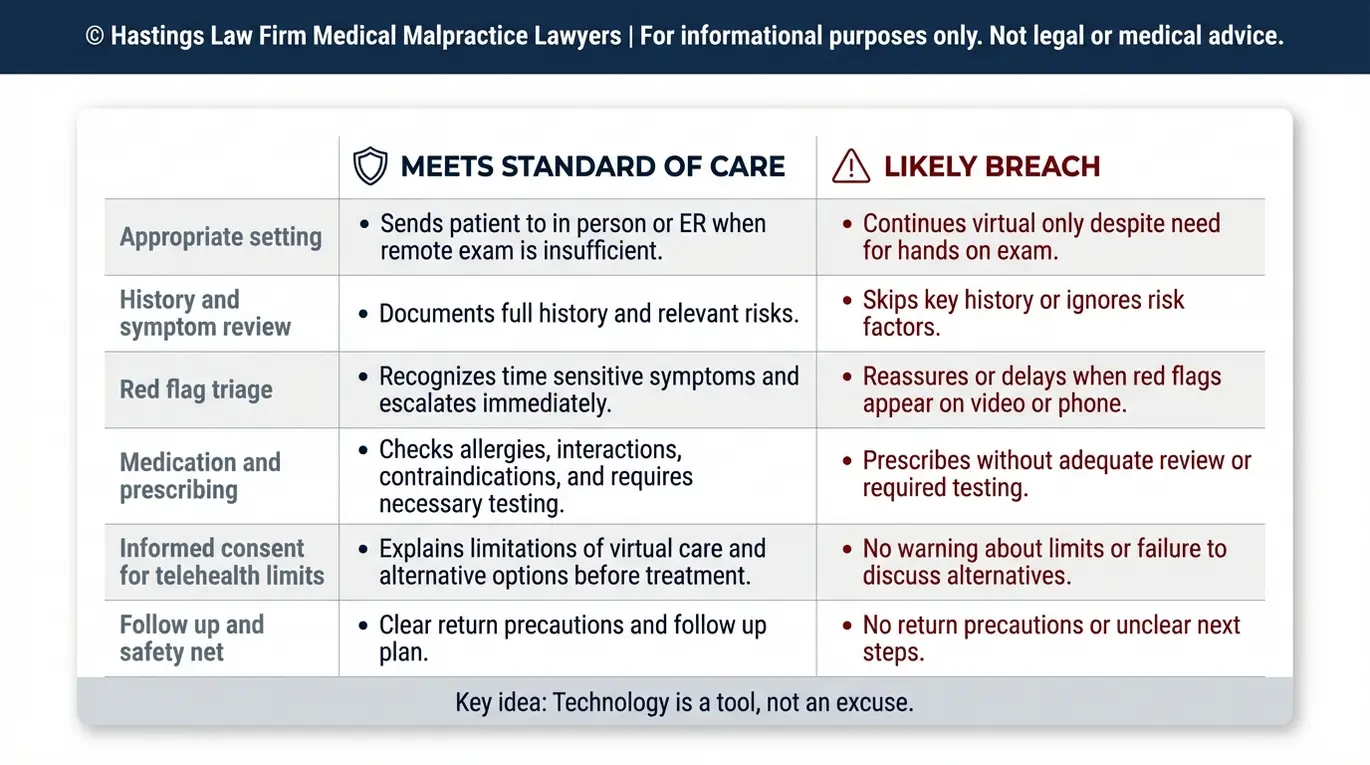
In Arizona, telehealth providers must adhere to the same standard of care as in-person physicians; the use of technology does not excuse a failure to diagnose or treat accurately. This is sometimes called the “same duty” rule: a doctor who chooses to treat a patient via video, phone, or messaging app is held to the same level of competence and diligence as one sitting across the exam table.
Technology is a tool, not a shield. The standard of care in telehealth dictates that if a provider cannot safely reach a diagnosis through a virtual visit, their duty of care requires them to direct the patient to an in-person facility. Ignoring that obligation, or proceeding with a diagnosis despite insufficient information, can constitute a breach of duty.
Arizona law recognizes telehealth as a legitimate method of delivering healthcare services. Under Arizona Revised Statutes § 20-1057.13, insurers are required to cover telehealth services on the same terms as in-person care, reinforcing the legitimacy of virtual care delivery. The Arizona State Board of Psychologist Examiners’ Telemedicine & Telepractice Statutes & Rules further outline regulatory expectations for remote providers. These frameworks reinforce that licensure and practice standards are not relaxed simply because the encounter is virtual.
Informed consent also carries added weight in telemedicine. Before beginning treatment, a provider should explain the inherent limitations of a virtual visit, including what the technology can and cannot assess. If a patient was never told that a video call might miss certain physical findings, that omission may become part of a malpractice claim. We evaluate whether informed consent was properly obtained as part of every telehealth case we investigate.
The Hastings Law Firm Difference
Results matter, but what truly sets us apart is how we achieve them. Every verdict, every settlement, and every Arizona courtroom victory comes from one guiding promise: To treat each client’s fight for justice as if it were our own.
This balance of skill, experience, and empathy reflects our core philosophy that justice should not only compensate the injured, but also make health care safer nationwide.

Cross-State Jurisdiction and Licensing Issues
Jurisdiction in telehealth cases typically defaults to where the patient was located during the appointment, but cases involving out-of-state doctors often require navigating complex federal and state licensing regulations. This is one of the more confusing aspects of cross-state licensing, and it is a key reason to work with an Arizona telehealth malpractice lawyer who understands these issues.
The central question is simple: where do you file your claim? If you were physically located in Arizona during the virtual visit, Arizona courts generally have authority over the case, even if the treating physician was sitting in another state. The doctor directed their medical services to an Arizona patient, and that creates a legal connection to Arizona’s jurisdiction.
The Interstate Medical Licensure Compact allows physicians to obtain licenses in multiple states through a streamlined process. While this compact makes it easier for doctors to practice across state lines, it does not eliminate their obligation to follow each state’s standard of care. A physician licensed through the compact who treats an Arizona patient is still subject to Arizona’s medical malpractice laws.
When evaluating a cross-state telehealth claim, we look at several factors:
- Where the patient was physically located at the time of the virtual appointment
- Where the treating physician was licensed and located
- Whether the telehealth platform operated as an intermediary with its own obligations
- Which state’s malpractice laws and statute of limitations apply
- Whether a supervising physician in Arizona bore responsibility for the remote provider’s decisions
Liability for Technical Failures and AI Triage
While doctors are liable for their medical decisions, telehealth platforms may be independently liable if their software, AI triage systems, or connection failures directly contributed to the patient’s injury. Telemedicine negligence extends beyond the physician when technology fails.
Consider what happens when a video call drops mid-consultation. If a connection failure causes a communication breakdown while a patient is describing chest pain, the platform’s infrastructure may be at fault. The question becomes whether technical glitches prevented the doctor from gathering information that would have changed the clinical outcome.
AI triage chatbots, automated symptom checkers that assess a patient’s reported symptoms and assign a risk level, add another layer of potential liability. A study published in PubMed Central comparing diagnostic and triage accuracy of AI symptom checkers, ChatGPT, and physicians found meaningful differences in diagnostic performance.
If an automated system incorrectly assesses a patient as “low risk,” proving causation, that the platform’s error directly led to the injury, becomes central to the case. Remote patient monitoring (RPM), the use of connected devices to transmit patient health data like blood pressure to a provider, can also fail. If a device malfunctions, that technical breakdown may amount to telehealth platform liability, separate from any error by the physician.
Proving Negligence Using Digital Evidence and Metadata
Proving a telehealth claim requires securing digital footprints such as session metadata, chat logs, and electronic health record audit trails that show exactly how long the doctor spent reviewing the patient’s file. Our team includes board-certified patient advocates and former hospital nurses who analyze these records from an insider’s perspective.
Unlike a traditional office visit, virtual care creates a data trail that can be extraordinarily detailed. Telehealth session metadata, the automatically generated records of a virtual appointment’s technical details, can reveal how long the consultation lasted and when the provider logged in. If metadata shows a doctor spent only two minutes on a call involving complex symptoms, that evidence can directly support a claim of inadequate evaluation.
Electronic health record (EHR) audit trails are equally important. An EHR audit trail is a timestamped log showing every action taken within a patient’s digital medical record, including when it was opened, what was viewed, and what was modified. These records can show whether a doctor actually reviewed your medical history before prescribing or whether they bypassed that step entirely.
An Arizona telehealth malpractice lawyer experienced in these cases knows how to identify and preserve this evidence before it is overwritten or deleted. Key digital evidence we work to secure includes:
| Evidence Type | What It Shows |
|---|---|
| Session metadata (duration, timestamps) | How long the appointment lasted and whether the full session occurred |
| Chat and message logs | What the patient reported and how the provider responded |
| EHR audit trail | Whether the doctor reviewed medical history, labs, or prior records |
| Video or audio recordings | The substance of the clinical interaction, if recorded |
| Platform activity logs | Connection stability, technical errors, and system notifications |
| Prescription and order timestamps | When medications or referrals were issued relative to the consultation |
Expert testimony from qualified medical professionals ties this digital evidence to the standard of care. Our team examines these records to establish proximate cause, showing that the provider’s actions directly led to the injury.

Recovering Damages for Telehealth Injuries in Arizona
Victims of telehealth malpractice are entitled to economic damages for medical bills and lost wages, as well as non-economic damages for pain, suffering, and loss of quality of life. Patients harmed by medical errors deserve a complete review of their financial and personal losses to understand the true impact on their future.
Economic damages cover the measurable financial losses tied to the injury. These include past and future medical expenses, rehabilitation costs, lost income, and reduced earning capacity. If a missed telehealth diagnosis led to a condition that now requires ongoing treatment, those projected costs are part of your claim.
Non-economic damages address the less tangible but equally real consequences: chronic pain, emotional distress, loss of enjoyment of daily activities, and the impact on personal relationships. These damages are assessed based on the severity and permanence of the injury.
In the most tragic cases, where a failure to diagnose or a delayed referral during a virtual visit contributed to a patient’s death, surviving family members may pursue a wrongful death claim. Data from the National Practitioner Data Bank (NPDB) tracks adverse action reports and malpractice payments nationally. This reflects the scope of harm caused by medical negligence.
As an Arizona telehealth malpractice lawyer, we calculate the full extent of each client’s losses. We build the case to support recovery of every category of damages and compensation the evidence warrants.
Contact the Arizona Healthcare Malpractice Attorneys at Hastings Law Firm Today for Help
A virtual appointment should not come with lower standards of care. Do not let a virtual doctor’s negligence define your future. If a telehealth provider’s error caused you or a loved one harm, whether through a rushed video consultation, a missed diagnosis, or a technical failure, you deserve answers and a clear path forward.
At Hastings Law Firm, we believe in restoring trust and enforcing accountability. Since founding our firm in 2005, we have committed our entire practice to helping patients recover from medical malpractice litigation. Our attorneys, in-house nurses, and former defense counsel prepare every case from day one as if it will go to a jury.
We understand the medical and technical details that make telehealth cases different, and we know how to build them effectively. We represent clients throughout Arizona on a contingency fee basis. This means you pay no attorney fees or costs unless we recover compensation for you.
Contact us today for a free, confidential case evaluation. We can review what happened during your virtual visit and help you understand your legal options.
Frequently Asked Questions About Telehealth Malpractice in Arizona


This content was researched and written by the Hastings Law Firm editorial team, which includes attorneys, medical professionals, and experienced researchers. Our writing is informed by internal knowledge and practical experience, and we cross-check critical details against authoritative sources cited throughout. Every piece undergoes human-led fact-checking and legal review. Because legal and medical information can change, if you spot an error, please contact us. Learn more about our content standards and review process on our editorial policy page.

Tommy Hastings, founder of Hastings Law Firm, is a board-certified personal injury trial lawyer dedicated exclusively to healthcare injury cases. Since 2001, he has represented injured patients and families in litigation against major hospital systems, pharmaceutical companies, and negligent healthcare providers nationwide. He has handled numerous high-profile cases that have drawn national media attention and resulted in multi-million dollar recoveries. He draws on that experience in his writing, helping readers understand how these cases work and what options may be available to them.
