


Texas Subgaleal Hemorrhage Lawyer
Written by: Hastings Law Firm | Reviewed by: Tommy Hastings | Updated: July 27, 2026
A subgaleal hemorrhage in a newborn can be a fast moving emergency that leaves families searching for clear answers about delivery decisions and newborn monitoring. The condition involves internal bleeding beneath the scalp that can progress quickly and lead to shock, permanent brain injury, or worse when it is not recognized and treated promptly. Some cases arise from unavoidable complications, while others may be tied to preventable errors involving vacuum extraction, forceps, or delayed cesarean delivery. If you or a loved one were harmed or worse due to subgaleal hemorrhage birth injuries in Texas, contact Hastings Law Firm for a free, confidential case review.

Top Rated Birth Injury Attorneys Representing Families Across Texas
What You Should Know About Infant Scalp Hemorrhage Claims in Texas:
- Life altering outcomes can follow when subgaleal hemorrhage is not recognized and treated quickly, including shock, permanent brain injury, and death.
- Liability disputes can turn on whether delivery decisions fell below the accepted standard of care, since not every complicated delivery is negligent.
- Severe injury risk can rise with improper use of vacuum extractors or forceps, especially when excessive force or repeated detachments occur.
- Options can narrow if legal time limits are missed in Texas, including limits that can apply even when the injured patient is a minor.
- Recovery can be shaped by damage limits in Texas, since non economic damages in medical malpractice cases are subject to statutory caps.
- Long term financial needs can be central to damages, since projected lifetime care may include ongoing rehabilitation and specialized support.
- Accountability can extend beyond the delivery room, since failures in postpartum monitoring may be treated as an independent breach.
- Key evidence can be found in labor and delivery records and NICU documentation, since those records may show device use details and monitoring gaps.

A Healthcare Focused Law Firm
Learning that your newborn has suffered a subgaleal hemorrhage is devastating. You trusted your medical team to keep your baby safe, and now you’re looking for answers about what went wrong and what comes next.
At Hastings Law Firm, we focus exclusively on medical malpractice cases, including birth injuries caused by preventable medical errors. Our team includes in-house nurse consultants and former defense attorneys who know how hospitals and their insurers respond to these claims. As a Texas subgaleal hemorrhage lawyer, founder Tommy Hastings has spent over two decades holding negligent providers accountable and securing the resources families need to move forward.
If your child was diagnosed with a subgaleal hemorrhage after delivery, we can review what happened and explain your legal options. Contact us for a free, confidential case evaluation.
Subgaleal Hemorrhage in Newborn Claims in Texas
A subgaleal hemorrhage claim in Texas is a specific type of medical malpractice lawsuit filed when a newborn suffers life-threatening bleeding between the skull and scalp due to negligent delivery tactics. Unlike a minor birth-related bruise, this condition can rapidly become a medical emergency.
To understand why a subgaleal hemorrhage claim carries such weight, it helps to know what sets this injury apart:
- Subgaleal hemorrhage (SGH): Bleeding that occurs in the subgaleal space, the loose tissue layer between the skull’s outer membrane and the scalp. Because this space has few boundaries, blood can spread across the entire head, and a newborn can lose a dangerous volume of blood very quickly.
- Cephalohematoma: A more common and typically less serious condition where blood collects between the skull bone and its covering, but remains confined to a small area. A cephalohematoma usually resolves on its own.
The critical difference is severity. SGH can lead to neonatal trauma, hypovolemic shock (a dangerous drop in blood volume), and even death if not recognized and treated immediately. According to a study on neonatal subgaleal hemorrhage diagnosis and management published in PMC, this condition carries a mortality rate that demands urgent clinical attention.
Not every subgaleal hematoma results from negligence. Some deliveries are genuinely complicated. A birth injury becomes a legal claim when the medical team’s actions fell below the accepted standard of care, causing or worsening the hemorrhage. Texas subgaleal hemorrhage attorneys evaluate this distinction by analyzing delivery records, device usage logs, and the clinical decisions made before, during, and after birth, as governed by Texas Civil Practice and Remedies Code, Chapter 74.
Physiological Mechanism of Subgaleal Hemorrhage
The subgaleal space, the layer of connective tissue between the skull’s periosteum and the scalp’s muscular layer, is a potential space that can expand significantly. Small blood vessels called emissary veins pass through the skull and connect the veins inside the brain to the veins in the scalp.
During a vacuum-assisted delivery, the suction force can shear or rupture these emissary veins. When that happens, blood flows freely into the subgaleal space. Because the space extends from the orbital ridges at the front of the skull to the nape of the neck, a newborn can lose enough blood to develop hypovolemic shock, a life-threatening condition where the body does not have enough circulating blood to deliver oxygen to its organs.
This is what makes SGH so dangerous: the bleeding is internal, it can be difficult to detect initially, and by the time visible swelling appears, the baby may already be in distress.

Common Causes of Subgaleal Hemorrhage Injuries
The most common cause of subgaleal hemorrhage is the improper use of instrumental delivery devices, specifically vacuum extractors and forceps, during difficult labor. When these tools are applied incorrectly or used beyond safe limits, the forces placed on a newborn’s head can rupture the delicate vessels beneath the scalp.
Vacuum Extraction Errors
A vacuum extractor, a device that uses suction to help guide the baby through the birth canal during a vacuum-assisted delivery, must be applied with precision. Research published by the National Library of Medicine on vacuum cup placement and its association with subgaleal hemorrhage confirms that improper cup positioning significantly increases the risk of SGH. Specific errors include excessive traction, applying the cup for too long, and repeated “pop-offs,” which occur when the vacuum cup detaches from the baby’s head during extraction. Each detachment increases the shearing force on the scalp and emissary veins.
Forceps Trauma
Forceps deliveries carry their own risks. Improper placement or excessive force can compress the skull and damage the scalp tissue, leading to hemorrhage in the subgaleal space.
Failure to Proceed to C-Section
In many cases we review, the underlying issue is that operative vaginal deliveries were attempted when a cesarean section was the safer option. Prolonged labor, abnormal fetal positioning, or signs of fetal distress can all indicate that continued vaginal delivery poses too great a risk.
A subgaleal hemorrhage lawyer in Texas will evaluate whether the standard of care required a different delivery approach, including whether warning signs were present that should have prompted an earlier change in plan.
Liability indicators we examine include:
- Number of vacuum attempts and documented pop-offs
- Total duration of vacuum or forceps application
- Fetal heart rate patterns before and during extraction
- Whether the care team documented indications for a C-section and chose not to proceed
- Timing of the decision to use operative delivery instruments
The Hastings Law Firm Difference
Results matter, but what truly sets us apart is how we achieve them. Every verdict, every settlement, and every Texas courtroom victory comes from one guiding promise: To treat each client’s fight for justice as if it were our own.
This balance of skill, experience, and empathy reflects our core philosophy that justice should not only compensate the injured, but also make healthcare safer nationwide.

Long Term Effects of Subgaleal Hemorrhage Injuries
If not treated immediately, subgaleal hemorrhage can lead to massive blood loss, shock, and permanent brain damage, including cerebral palsy and developmental delays. The severity of these outcomes often depends on how quickly the bleeding was identified and how rapidly treatment began.
The progression follows a pattern clinicians sometimes describe as a “domino effect.” Uncontrolled bleeding causes hypovolemic shock, a condition where the body loses so much blood that it cannot maintain adequate oxygen delivery. When the brain is deprived of oxygen, even briefly, permanent brain injury can follow.
| Stage | Condition | Potential Consequences |
|---|---|---|
| Immediate | Hypovolemic shock, seizures | Organ failure, emergency transfusion |
| Short-term | Brain oxygen deprivation | Cognitive impairment, motor deficits |
| Long-term | Permanent brain injury | Cerebral palsy, hydrocephalus (excess fluid in the brain), developmental delays, need for lifelong care |
Research from the National Institutes of Health on brain recovery after hemorrhage shows that the extent of recovery depends heavily on the speed of intervention and the severity of the initial bleed.
For families seeking legal help for subgaleal hemorrhage injuries, understanding these long-term effects is essential. Under Texas Civil Practice and Remedies Code, Chapter 74, claims must account not just for what has already happened, but for the projected lifetime of care the child will need.
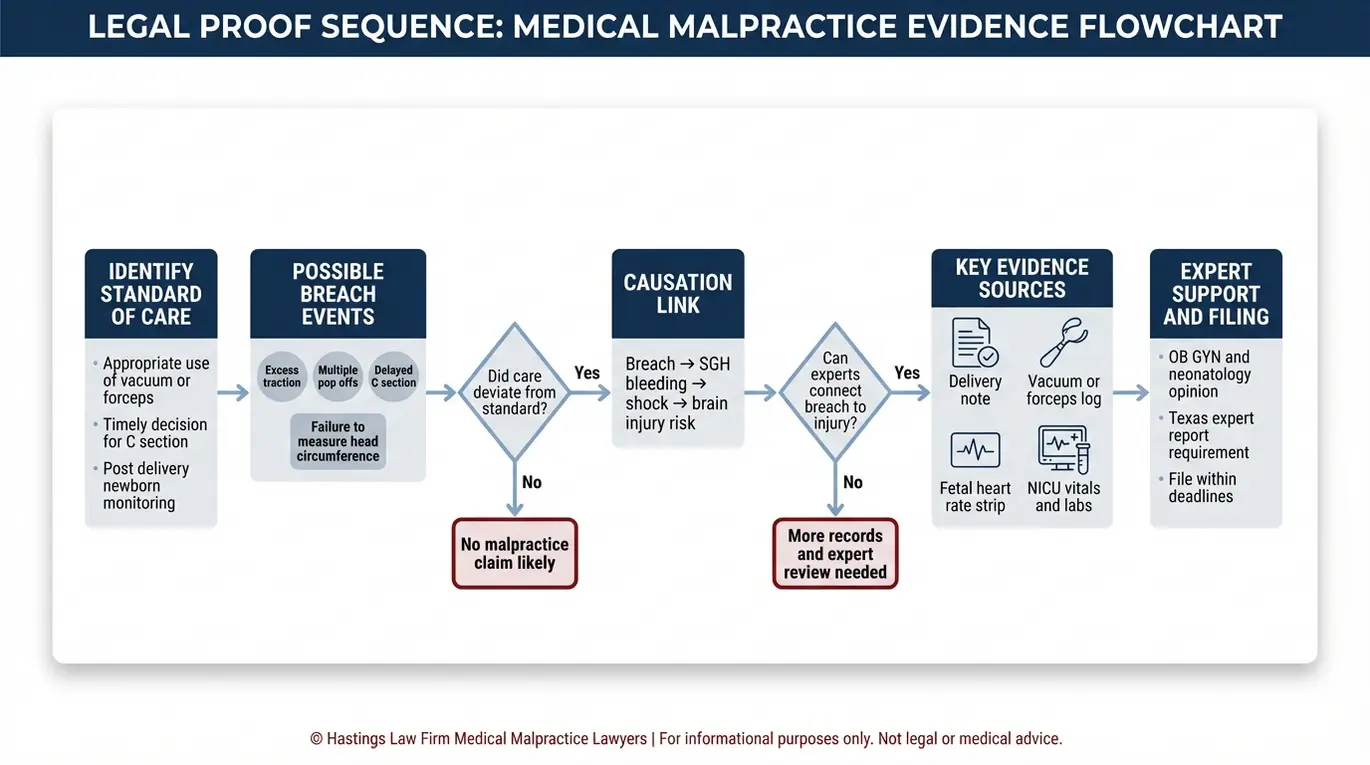
Proving Liability in Subgaleal Hemorrhage Medical Malpractice Injury Cases
Liability is proven by demonstrating that the attending physician or medical staff deviated from the accepted standard of care during delivery or failed to monitor the infant after birth. The standard of care refers to the level of treatment a reasonably competent medical professional would have provided under similar circumstances.
Breach of Duty
The first step is establishing what a prudent physician would have done given the specific conditions of the delivery. If the baby was in an unfavorable position, or if labor had stalled, the standard of care may have required a cesarean section rather than instrumental delivery. Our medical team, which includes nurse consultants and board-certified patient advocates, reconstructs the clinical timeline to identify where decisions diverged from accepted practice.
Causation
It is not enough to show that a mistake occurred. A Texas birth injury attorney must also prove that the specific error, whether it was vacuum misuse, excessive force, or a delayed C-section, directly caused the subgaleal hemorrhage. This requires expert testimony from qualified neonatologists or maternal-fetal medicine specialists who can connect the clinical evidence to the injury.
Failure to Monitor
Liability can also extend to nursing staff and postpartum teams. Newborn monitoring after an operative delivery is important. If the care team failed to track the baby’s head circumference, missed early signs of swelling, or did not act on declining vital signs, that failure may constitute an independent breach.
Medical records obtained through channels like the Texas Department of State Health Services Open Records Policy can reveal gaps in postpartum documentation.
Mistake vs. Actionable Negligence
Not every medical mistake or poor outcome in the delivery room constitutes actionable negligence. Negligence in a medical setting occurs when a provider fails to meet the accepted standard of care. Childbirth carries inherent risks, and not all complications are preventable.
The legal distinction turns on whether the medical team followed accepted protocols or whether their actions fell below the standard that the medical community recognizes as appropriate. A known risk that was properly managed and communicated is different from a preventable error that was caused by deviation from established guidelines. We investigate that distinction in every case we evaluate.
Compensation for Subgaleal Hemorrhage Damages
Compensation typically includes coverage for past and future medical bills, long-term rehabilitation costs, pain and suffering, and loss of future earning capacity for the child. Because subgaleal hemorrhage injuries can require decades of specialized care, the financial stakes in these cases are significant.
Economic damages cover the measurable financial losses:
- NICU hospitalization and emergency treatment
- Future surgeries, including any procedures related to hydrocephalus or seizure management
- Physical, occupational, and speech therapy
- 24-hour nursing or attendant care
- Adaptive equipment and home modifications
- Loss of future earning capacity
Non-economic damages address the less tangible but equally real harms, including pain, suffering, physical impairment, disfigurement, and loss of enjoyment of life. In Texas, non-economic damages in medical malpractice cases are subject to statutory caps, though economic damages are not capped.
The Life Care Plan
A Texas subgaleal hemorrhage lawyer will work with medical and financial experts to develop a Life Care Plan. This document projects every anticipated expense across the child’s full life expectancy, from therapies and medications to housing modifications and vocational support. The Life Care Plan is often the foundation of the damages calculation, helping to ensure the child’s long-term financial security through a settlement or verdict.
Steps to Take After a Subgaleal Hemorrhage Injury
Parents should ensure their child is receiving specialized NICU care, request a copy of all medical records immediately, and contact a specialized birth injury attorney before discussing the event with hospital risk managers.
- Prioritize your baby’s medical treatment. Make sure the care team is monitoring head circumference, which is the routine measurement used to detect ongoing bleeding or swelling beneath the scalp. Ask questions and document what you are told.
- Request complete medical records. Ask for copies of labor and delivery records, fetal monitoring strips, nursing notes, and all NICU documentation. Do this as soon as possible.
- Do not sign anything from the hospital’s risk management team. Hospitals may present settlement documents or release forms early in the process. Have an attorney review any paperwork before you agree to anything.
- Contact a birth injury attorney for a case evaluation. Early legal involvement ensures a thorough investigation and helps preserve evidence, including electronic fetal monitoring data and device logs, that can be critical to your case.

The Statute of Limitations for Subgaleal Hemorrhage Injury Cases
In Texas, the statute of limitations for medical malpractice is generally two years from the date of the injury, but specific exceptions exist for minors that may extend the filing deadline.
The General Rule: Under Texas law, most medical malpractice claims must be filed within two years. For birth injuries, the clock typically starts on the date of delivery.
The Minor Exception: Because the injured patient is a child, Texas tolling provisions can extend the filing period. Generally, the statute of limitations for a minor’s own claims does not begin to run until the child reaches age 18, potentially allowing claims to be brought until age 20. However, the parents’ separate claims for medical expenses and related costs are subject to the standard two-year deadline.
The Statute of Repose: Texas imposes an absolute 10-year outer limit on medical malpractice claims. Regardless of tolling, no claim can be filed more than 10 years after the act of negligence.
Do not wait. While strict legal deadlines apply, evidence degrades and memories fade. Contacting lawyers for subgaleal hemorrhage cases early gives your legal team the best opportunity to build a strong case.
Why You Need an Experienced Subgaleal Hemorrhage Injury Lawyer
These cases involve complex neonatal medicine and well-funded hospital defense teams. You need a firm with the financial resources and medical expertise to fight for fair value for your child’s future.
Subgaleal hemorrhage cases are among the most resource-intensive claims in medical malpractice. They require testimony from neonatologists, biomechanical experts, and life care planners. Depositions, medical reconstructions, and expert fees can reach hundreds of thousands of dollars before a case ever reaches a courtroom. Hastings Law Firm fronts all of these costs on a contingency fee basis. We operate on a no win, no fee policy: you pay nothing unless we recover compensation for your family.
Our team includes former defense attorneys who spent years representing hospitals and insurers. That experience gives us direct insight into the strategies the other side will use, and it allows us to build cases that anticipate those arguments from the start. Combined with our in-house nursing staff, who review every page of your medical records with clinical precision, this is the kind of medical expertise that changes outcomes.
As a Texas subgaleal hemorrhage lawyer, Tommy Hastings has built a career on translating complex medical evidence into clear, persuasive cases. Board certified in personal injury trial law by the Texas Board of Legal Specialization, a distinction held by fewer than 2% of Texas attorneys, Tommy is a dedicated trial lawyer who prepares every case as if it will go to a jury. That trial-ready approach is why defense teams and insurance carriers take our cases seriously. We offer a free evaluation to help you understand your legal options.
Contact the Texas Birth Injury Attorneys at Hastings Law Firm Today for Help
If your child was diagnosed with a subgaleal hemorrhage after delivery, you deserve to know what happened and why. At Hastings Law Firm, we exist to help families find those answers and to secure the financial resources needed to provide for a child’s lifetime of care.
Our evaluation is free and completely confidential. We will review your medical records, consult with qualified experts, and give you an honest assessment of whether negligence contributed to your baby’s injury. There are no fees unless we win your case.
You are not going up against the hospital alone. Our entire team, attorneys, nurse consultants, and patient advocates, is here to stand with your family. Call Hastings Law Firm today or complete our online form to schedule your free consultation.
Frequently Asked Questions About Subgaleal Hemorrhage in Texas


This content was researched and written by the Hastings Law Firm editorial team, which includes attorneys, medical professionals, and experienced researchers. Our writing is informed by internal knowledge and practical experience, and we cross-check critical details against authoritative sources cited throughout. Every piece undergoes human-led fact-checking and legal review. Because legal and medical information can change, if you spot an error, please contact us. Learn more about our content standards and review process on our editorial policy page.

Tommy Hastings, founder of Hastings Law Firm, is a board-certified personal injury trial lawyer dedicated exclusively to healthcare injury cases. Since 2001, he has represented injured patients and families in litigation against major hospital systems, pharmaceutical companies, and negligent healthcare providers nationwide. He has handled numerous high-profile cases that have drawn national media attention and resulted in multi-million dollar recoveries. He draws on that experience in his writing, helping readers understand how these cases work and what options may be available to them.
