


Arizona Subgaleal Hemorrhage Lawyer
Written by: Hastings Law Firm | Reviewed by: Tommy Hastings | Updated: July 27, 2026
A subgaleal hemorrhage after an instrumental delivery can leave families facing sudden medical crisis and lasting uncertainty about what went wrong. This type of birth trauma involves hidden bleeding beneath the scalp that can progress quickly and lead to shock, seizures, brain damage, or worse if it is not recognized and treated promptly. Concerns often focus on vacuum or forceps use, newborn monitoring, and whether warning signs were missed. If you or a loved one were harmed or worse due to subgaleal hemorrhage birth injury in Arizona, contact Hastings Law Firm for a free, confidential case review.

Top Rated Birth Injury Representation for Arizona Families
What You Should Know About Infant Scalp Hemorrhage Claims in Arizona:
- The risk of severe neurological harm can rise quickly when a subgaleal hemorrhage is not recognized and treated promptly.
- Concerns about preventability often center on vacuum or forceps misuse, including excessive force or prolonged traction.
- The chance to intervene can narrow rapidly when newborn monitoring is incomplete after an instrumental delivery.
- Liability disputes can turn on whether the obstetrician or nursing staff deviated from the accepted standard of care and caused the injury.
- Recovery for long term injuries can involve both financial losses and non financial harms tied to lifelong care needs.
- Options can be permanently limited if Arizona time limits are missed, especially when a public hospital or state employee is involved.
- Proof issues can grow over time because key records can be lost or overwritten and staff memories can fade.
- Case evaluation can depend heavily on objective records such as fetal monitoring strips, vacuum device logs, nursing notes, and NICU records.

A Healthcare Focused Law Firm
When your newborn has been diagnosed with a subgaleal hemorrhage after an instrumental delivery, the fear and confusion can be overwhelming. You may sense that something went wrong during the birth, but the medical team’s explanations feel incomplete or dismissive. That instinct deserves to be heard.
At Hastings Law Firm, we focus exclusively on medical malpractice. Our legal team includes in-house nurse consultants and former defense attorneys who understand how hospitals document delivery room events. Our founder, Tommy Hastings, is board-certified in personal injury trial law, a distinction held by fewer than 2% of attorneys in Texas. As an experienced Arizona subgaleal hemorrhage lawyer team, we know how to uncover the truth in these cases.
If your child was harmed during delivery, we welcome the chance to review what happened and explain your legal options in a free, confidential consultation.
Understanding Subgaleal Hemorrhage and Birth Trauma
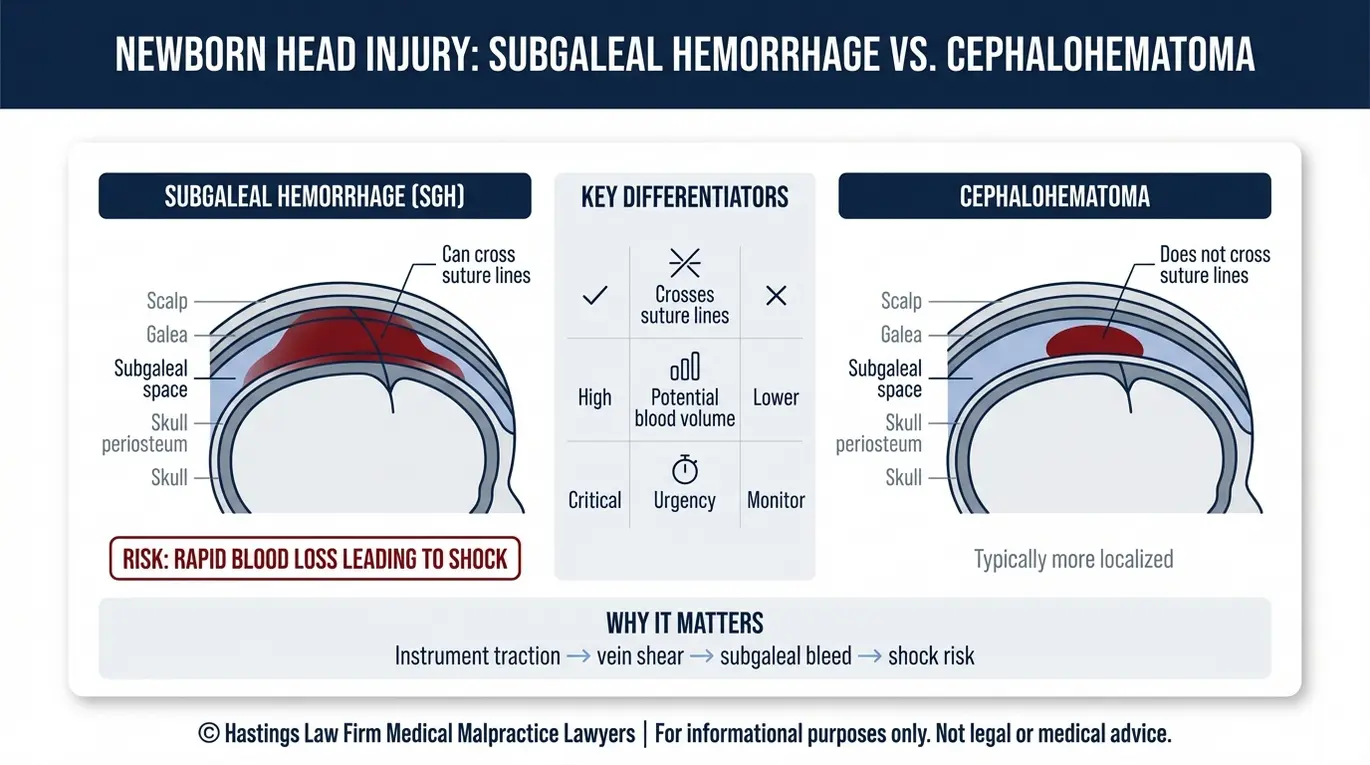
A subgaleal hemorrhage is a serious and potentially life-threatening condition in which blood collects in the loose connective tissue between the skull’s periosteum (the membrane covering the bone) and the scalp’s galea (a tough layer of tissue beneath the skin). This space is uniquely dangerous because it is not confined by the skull’s bony boundaries, meaning it can hold a massive volume of blood, sometimes exceeding the newborn’s entire blood supply.
That capacity for hidden blood loss is what makes a subgaleal hemorrhage, sometimes called a subgaleal hematoma, a severe form of birth trauma critical to detect early.
Key anatomical and clinical details include:
- The subgaleal space spans the entire surface of the skull, from the orbits of the eyes to the nape of the neck. Unlike bleeding that stays in one small pocket, blood here spreads freely.
- Hypovolemic shock, a dangerous drop in blood volume that starves organs of oxygen, can develop rapidly if the hemorrhage is not identified and treated.
- Seizures and brain damage may result from the combination of blood loss, low blood pressure, and reduced oxygen delivery to the infant’s brain.
Distinguishing subgaleal hemorrhage from a cephalohematoma helps families understand the specific risks. A cephalohematoma is a collection of blood that sits between the skull bone and the periosteum. It is limited by the skull’s suture lines, meaning it cannot spread beyond one bone plate. A subgaleal hemorrhage, by contrast, crosses suture lines freely.
According to research published in PubMed Central on neonatal subgaleal hemorrhage diagnosis and management, this condition is most commonly associated with traumatic vacuum or forceps extraction. When the hemorrhage is not recognized quickly, the risk of neonatal brain hemorrhage, intracranial hemorrhage, hydrocephalus, and lasting neurological harm increases significantly.
Vacuum and Forceps Misuse as Primary Causes
The leading cause of subgaleal hemorrhage is vacuum or forceps misuse during delivery, especially when safety limits on force and duration are exceeded.
The injury happens through a specific mechanism. During a vacuum-assisted delivery or forceps delivery, traction applied to the baby’s head creates shearing forces on the emissary veins. These are small blood vessels that connect the scalp’s surface blood supply to the deeper venous system.
When these veins tear, blood flows into the subgaleal space. The more force applied, or the longer the traction continues, the greater the risk of catastrophic bleeding.
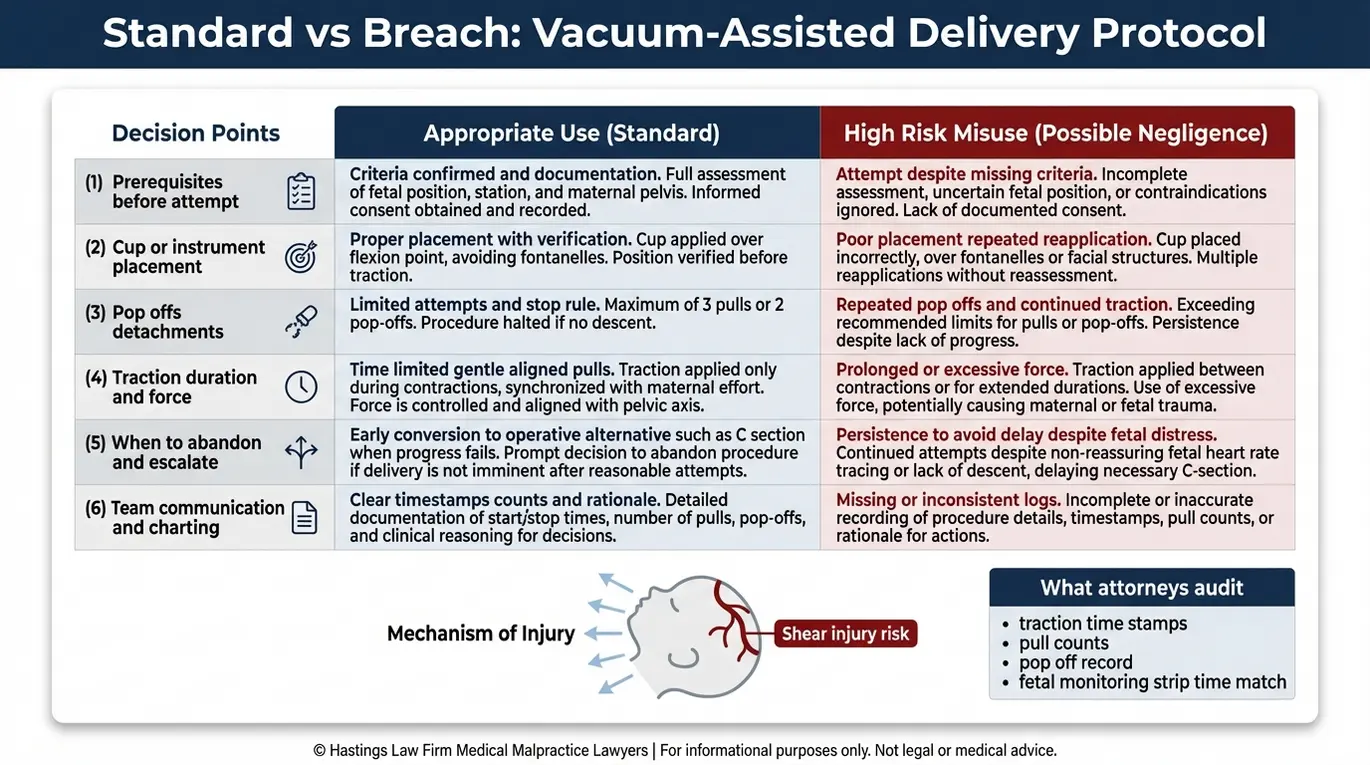
One of the most important safety concepts in vacuum extraction is the “pop-off,” which refers to the moment the vacuum cup detaches from the baby’s scalp. A pop-off signals that the cup is losing its seal, often because of excessive traction, improper placement, or both.
| Standard of Care | Potential Negligence |
|---|---|
| Vacuum applied with proper cup placement over the flexion point | Cup placed off-center or over suture lines, increasing shear force |
| No more than 2 to 3 pop-offs before abandoning the attempt | Repeated pop-offs beyond accepted limits without switching to cesarean delivery |
| Total traction time limited (generally under 20 minutes) | Prolonged traction beyond safe time limits |
| Clear criteria met before attempting instrumental delivery | Instrument used despite incomplete cervical dilation or unengaged fetal head |
| Escalation to C-section when progress stalls | Continued instrument use during prolonged labor despite fetal distress signs |
The ACOG Practice Bulletin Number 219 on Operative Vaginal Birth outlines these parameters clearly. Research on vacuum cup placement precision and its association with subgaleal hemorrhage has also confirmed that incorrect positioning of the cup dramatically increases the risk of this injury.
In some cases, prolonged labor places pressure on the delivering physician to speed the process. When that pressure leads to aggressive or repeated instrument use rather than a timely decision to perform a C-section, the result can be a preventable delivery error with devastating consequences.
The Hastings Law Firm Difference
Results matter, but what truly sets us apart is how we achieve them. Every verdict, every settlement, and every Arizona courtroom victory comes from one guiding promise: To treat each client’s fight for justice as if it were our own.
This balance of skill, experience, and empathy reflects our core philosophy that justice should not only compensate the injured, but also make healthcare safer nationwide.

Recognizing Symptoms and Monitoring Failures
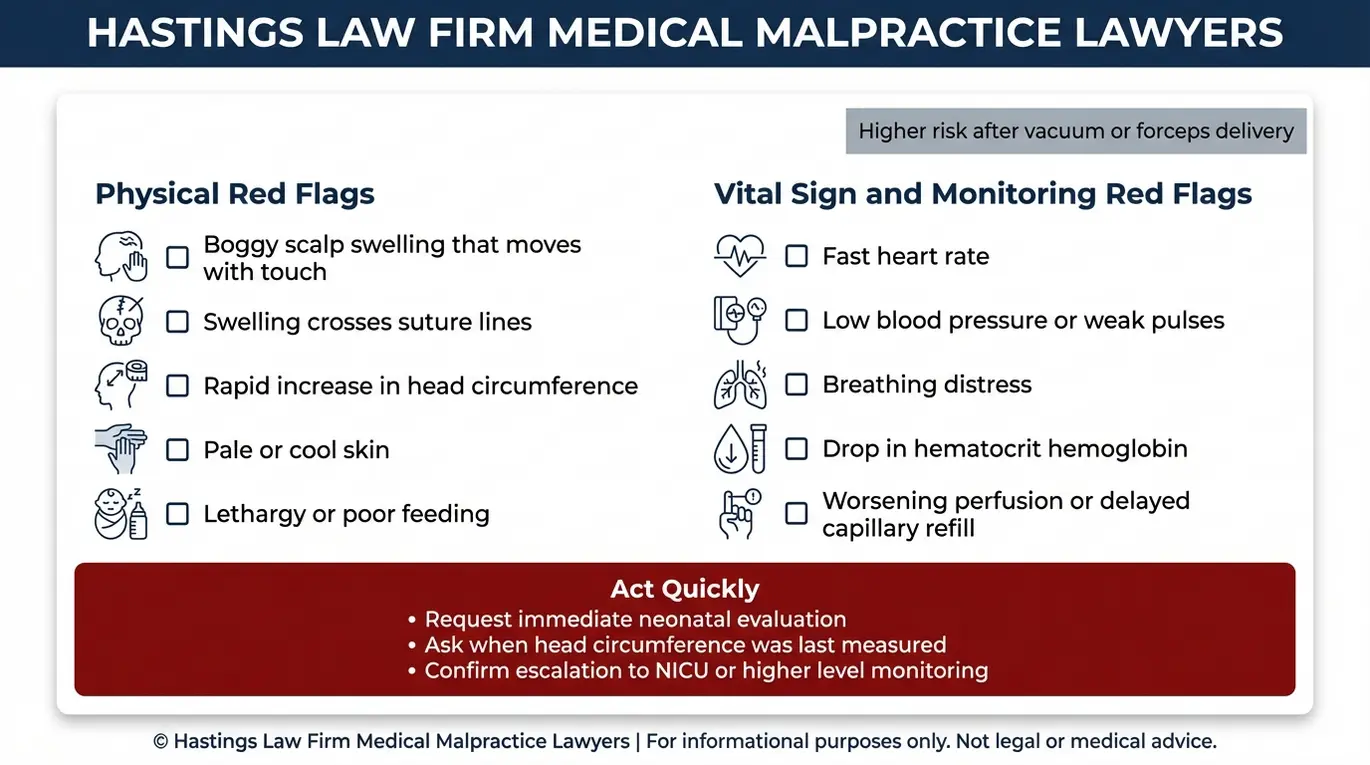
Symptoms of subgaleal hemorrhage include a boggy, fluctuating scalp swelling that crosses suture lines (the fibrous joints between the bones of a newborn’s skull), a steadily increasing head circumference, pale skin, rapid heart rate, and signs of hypovolemic shock, a condition where the body loses so much blood that the heart cannot pump enough to sustain organ function.
Clinical warning signs include:
- Scalp swelling that feels soft and fluid-filled, and that shifts when the baby’s head position changes (fluid wave sign)
- Swelling that extends beyond the borders of a single skull bone, crossing cranial suture lines
- Pallor (pale or grayish skin) and increasing lethargy
- Tachycardia (abnormally fast heart rate) that does not resolve
- A measurable increase in head circumference over serial checks
- Declining hemoglobin or hematocrit on blood work
- Signs of poor perfusion: cool extremities, weak pulses, low urine output
Proper newborn monitoring after any vacuum-assisted or forceps delivery requires nursing staff to measure the infant’s head circumference at regular intervals and closely monitor vital signs. These serial measurements are reliable indicators of bleeding beneath the scalp.
When monitoring failures happen, the window for intervention narrows rapidly. If staff does not recognize the expanding hemorrhage before the infant progresses to shock, the resulting oxygen deprivation can lead to lasting neurological complications, including cerebral palsy and developmental delays. This type of failure, sometimes called a failure to rescue, can form the basis of a medical malpractice claim when the signs were present but not acted upon.
Proving Liability and The Standard of Care
Proving liability requires showing that the obstetrician or nursing staff deviated from the accepted medical standard of care, and that this deviation directly caused the hemorrhage and the injuries that followed.
Medical experts measure the standard of care by what a reasonably competent physician or nurse would have done under the same circumstances. In the context of instrumental deliveries, this includes recognizing when to abandon a vacuum attempt, monitoring the infant closely after delivery, and escalating care at the first sign of hemorrhage.
Building this case depends on a detailed review of medical records and raw clinical data. We examine:
- Fetal monitoring strips to assess the baby’s heart rate patterns before and during the delivery
- Vacuum device logs that record suction pressure levels, the number of pop-offs, and the total duration of traction
- Nursing notes and vital sign records documenting head circumference measurements, or the absence of them
- NICU admission records showing the infant’s condition at the time bleeding was finally identified
- Delivery room documentation including the time of each vacuum application and the decision-making timeline
Our team includes in-house nurse consultants who know how to read these records and identify gaps or inconsistencies in the charting. We also analyze head circumference trending, which is the sequential tracking of the baby’s head size over time to detect abnormal expansion.
Former defense attorneys on our staff understand how hospitals prepare their defense. This helps us anticipate their arguments and build a stronger case. An experienced birth injury lawyer uses this evidence to prove causation.
To establish medical negligence, we work with our national network of board-certified obstetric experts and neonatology experts. These specialists review the full clinical picture and provide opinions on whether the care provided fell below what the medical community requires. Their independent analysis is the foundation of every case we bring forward.
Compensation and Damages for Long-Term Injuries
Compensation in subgaleal hemorrhage cases covers both the immediate financial burden and the long-term costs of caring for a child who may face a lifetime of medical needs.
Economic damages account for the measurable financial losses your family has already experienced and those projected into the future. These typically include:
- NICU and hospitalization costs from the initial emergency treatment
- Ongoing therapies such as physical therapy, occupational therapy, and speech therapy
- Adaptive equipment including wheelchairs, communication devices, and home modifications
- Round-the-clock care if the child suffered brain damage requiring constant supervision
- Loss of earning capacity, which reflects the income the child will never be able to earn as an adult due to their injuries
Non-economic damages address the harm that does not carry a price tag but is no less real. These include the child’s physical pain and suffering, emotional distress, and the loss of enjoyment of life that comes with a severe disability.
In cases where a child does not survive, families may pursue wrongful death damages to hold the responsible parties accountable.
Calculating these figures accurately requires more than adding up current medical bills. We work with life care planners and forensic economists who project the full lifetime cost of the injury. They factor in inflation, the child’s expected lifespan, and the specific level of care needed at each stage of life. This thorough approach is necessary for securing a settlement that protects your child’s future.
Hastings Law Firm handles these cases on a contingency-fee basis, meaning you pay no attorney fees unless we recover compensation on your behalf.
Arizona Statute of Limitations and Legal Deadlines
In Arizona, the statute of limitations for medical malpractice claims is generally two years from the date the injury occurred or was discovered. For birth injuries, this timeline has specific implications for both the parents’ claims and the child’s individual claim.
Under Arizona Revised Statutes Section 12-542, the two-year window applies to the parents directly. However, Arizona law allows for the tolling of statute periods for minors. This means the child’s own claim is preserved because the statute is paused until the child turns 18, at which point the two-year statute of limitations begins to run, giving the child until age 20 to file. An Arizona subgaleal hemorrhage lawyer can help you determine which filing deadlines apply to your family’s specific situation.
Even with tolling protections, waiting carries serious risks. Fetal monitoring strips can be overwritten or lost. Nursing staff rotate, transfer, or leave the profession, and their memories of specific deliveries fade. Hospital policies may be revised, making it harder to prove what protocols were in place at the time of the birth.
If the injury occurred at a public hospital or involved a state employee, Arizona imposes a significantly shorter claims deadline of just 180 days to file a notice of claim. This notice is a formal document required to notify the government of your intent to sue. Missing this window can permanently bar the case.
The safest path is to seek a legal consultation as soon as possible so that evidence can be preserved and deadlines can be identified before they pass.
Auditing Hospital Protocols for Instrument Use
One of the less visible but important parts of our investigation involves auditing hospital protocols for operative vaginal delivery. This is the clinical term for any delivery assisted by a vacuum extractor or forceps. Hospitals should maintain written guidelines that govern how and when these instruments may be used.
These protocols specify acceptable ranges for vacuum extractor negative pressure and traction time. In practice, we find that these protocols vary widely from facility to facility. Some hospitals have detailed, evidence-based policies, while others have vague or outdated guidelines.
Our team reviews the hospital’s written policies and compares them against national standards from organizations like ACOG. We then examine the medical records to determine whether the protocols were actually followed during your child’s birth. Gaps between what the policy requires and what the records show can be powerful evidence of a systemic failure.
Contact the Arizona Birth Injury Attorneys at Hastings Law Firm Today for Help
If your child suffered a subgaleal hemorrhage during delivery, you deserve honest answers about what happened and why. At Hastings Law Firm, our mission is to restore the trust that was broken and hold negligent providers accountable so that no other family endures the same experience.
Our team of medical malpractice attorneys, in-house nurse consultants, and national medical experts is prepared to review your child’s records and determine whether the care they received fell below the standard. We handle birth injury cases across Arizona from our Phoenix office, and every consultation is free and confidential.
We work on a contingency-fee basis, so there is no cost to your family unless we secure a recovery. If you are looking for an Arizona subgaleal hemorrhage lawyer who will treat your family with respect and prepare your case as if it is going to trial, we are here to help.
Call us today or request a free case evaluation online to take the first step.
Frequently Asked Questions About Subgaleal Hemorrhage in Arizona


This content was researched and written by the Hastings Law Firm editorial team, which includes attorneys, medical professionals, and experienced researchers. Our writing is informed by internal knowledge and practical experience, and we cross-check critical details against authoritative sources cited throughout. Every piece undergoes human-led fact-checking and legal review. Because legal and medical information can change, if you spot an error, please contact us. Learn more about our content standards and review process on our editorial policy page.

Tommy Hastings, founder of Hastings Law Firm, is a board-certified personal injury trial lawyer dedicated exclusively to healthcare injury cases. Since 2001, he has represented injured patients and families in litigation against major hospital systems, pharmaceutical companies, and negligent healthcare providers nationwide. He has handled numerous high-profile cases that have drawn national media attention and resulted in multi-million dollar recoveries. He draws on that experience in his writing, helping readers understand how these cases work and what options may be available to them.
