


Arizona Radiologist Malpractice Lawyer
Written by: Hastings Law Firm | Reviewed by: Tommy Hastings | Updated: July 27, 2026
Radiology errors can happen when imaging findings are missed, misread, or not communicated in time, and the result can be delayed treatment and a worse outcome. These cases often involve complex questions about what the scan showed, how it was interpreted, and whether workload pressures or communication breakdowns played a role. Some claims also arise from interventional radiology procedures where complications can cause severe injury. If you or a loved one were harmed or worse due to radiology errors in Arizona, contact Hastings Law Firm for a free, confidential case review.
Expert Legal Representation for Imaging Errors in Arizona
What You Should Know About Medical Imaging Error Claims in Arizona:
- A missed or misread imaging finding can lead to delayed treatment and a worsened medical outcome.
- Responsibility can be harder to pinpoint when images are read through teleradiology and the radiologist never examines the patient.
- A claim can turn on whether a competent radiologist would have detected the abnormality under similar circumstances.
- A communication breakdown can be central when a critical finding is identified but not relayed quickly enough for timely intervention.
- Error risk can rise under heavy reading volume pressure, even though the standard of care does not change with workload.
- Severe injuries can occur during interventional radiology procedures, including vascular damage or stroke.
- Recovery in Arizona can include economic losses and non economic harms tied to additional treatment and reduced quality of life.
- Available compensation is not capped in Arizona medical malpractice cases.
- Options can be affected by timing limits that may start when an injury is discovered rather than when it occurred.
- Key evidence can depend on imaging films, radiology reports, and medical records reviewed by a qualified radiology expert.

A Healthcare Focused Law Firm
A misread scan, a critical oversight where a radiologist fails to correctly identify or interpret imaging findings, can have severe consequences. A condition that should have been caught early may go undetected for weeks or months, allowing it to progress beyond the point where treatment is most effective. If you or a loved one was harmed by a diagnostic error involving medical imaging, you may have questions about what went wrong and what your options are.
Diagnostic error cases are medically and legally complex. Many involve teleradiology, a practice where images are read remotely by radiologists who may never meet or examine the patient. Identifying where the error occurred, and who is responsible, requires both medical knowledge and legal experience focused on this area of law.
As an Arizona radiologist malpractice lawyer, Hastings Law Firm represents patients and families affected by radiology errors across the state. Our team includes in-house medical professionals and former defense attorneys who understand how these cases are built, investigated, and prepared for trial. If something was missed on your imaging, we can review what happened and explain your options in a free, confidential consultation.
Common Types of Radiological Errors and Misdiagnoses
Radiology malpractice occurs when a radiologist deviates from the standard of care by failing to identify, misinterpreting, or failing to communicate critical findings in medical imaging, resulting in patient harm. A radiologist malpractice lawyer in Arizona understands that these errors can take several forms, and recognizing the distinction between them is often central to building a case.
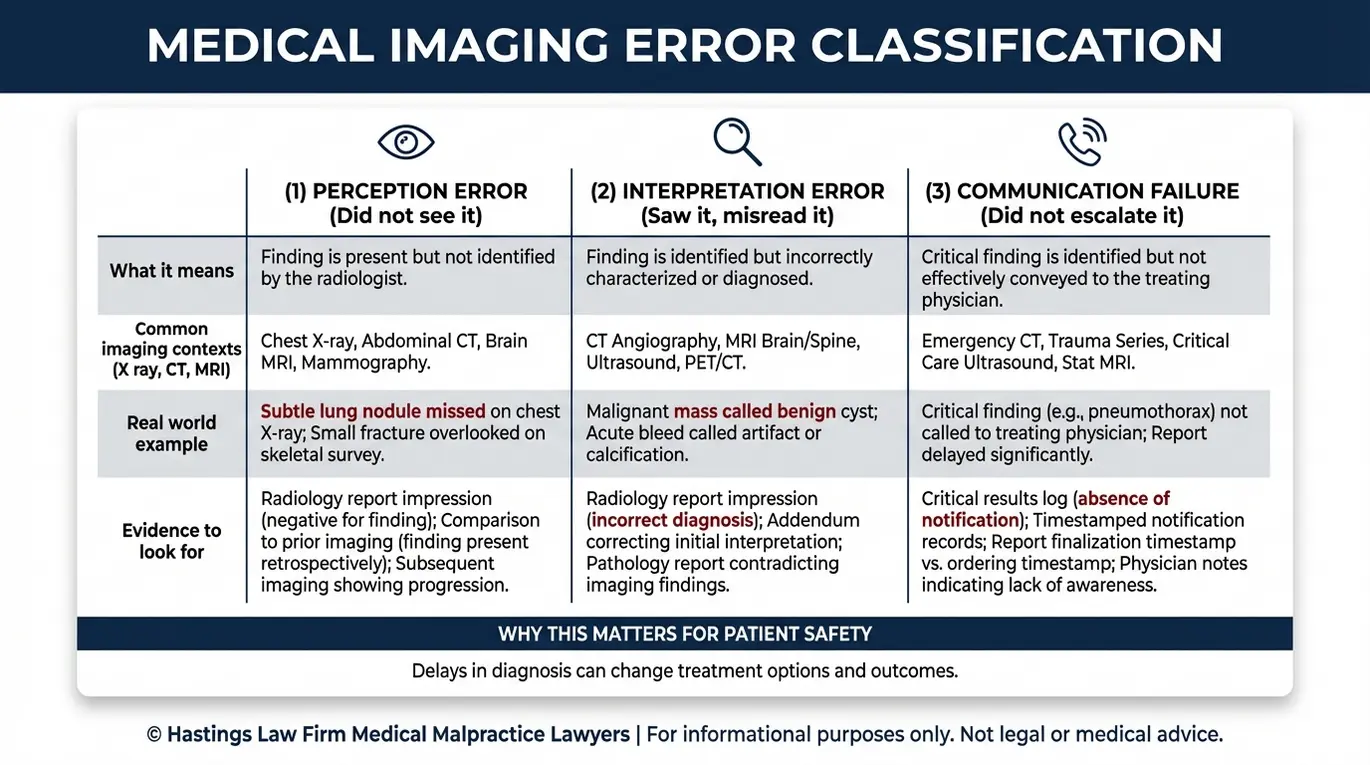
A perception error, an instance where an abnormality is clearly visible on the scan but the radiologist fails to see it, is a frequent cause of litigation. An interpretation error, where the radiologist notices the finding but incorrectly dismisses it as benign (not harmful) when it is actually pathological (meaning it is caused by disease), represents a different type of failure. Communication failures, or communication errors, represent a third category, where the radiologist correctly identifies a critical issue, such as a tumor or active bleed, but does not alert the treating physician quickly enough for timely intervention.
According to research published by Patient Safety Journal on characteristics and trends of medical diagnostic errors, diagnostic errors remain one of the most common and harmful categories of medical mistakes in the United States. Radiology errors, including misread scans and a missed diagnosis, account for a significant portion of these cases.
| Error Type | What Happens | Example |
|---|---|---|
| Perception Error | Abnormality is visible but not detected | A lung nodule on a chest X-ray is overlooked |
| Interpretation Error | Finding is seen but misclassified | A mass on a CT scan is labeled benign when it is malignant |
| Communication Failure | Finding is correctly identified but not reported promptly | A brain bleed on an MRI is noted in the report but the ordering physician is not notified urgently |
The Danger of Volume Pressure and Assembly-Line Medicine
One factor that contributes to radiology errors is volume pressure, where corporate radiology groups or hospital systems require radiologists to read an extremely high number of imaging studies per shift. When a radiologist is expected to interpret dozens of scans per hour, the risk of processing errors increases significantly.
This environment also creates conditions for what is known as satisfaction of search, a cognitive bias where a radiologist identifies one abnormality on a scan and stops looking, missing a second or third finding. We will examine whether workload conditions played a role in the missed diagnosis, because the standard of care does not lower just because a practice is understaffed or overloaded. Radiologists must maintain the same standard of care regardless of their workload.
Proving Negligence and The Standard of Care
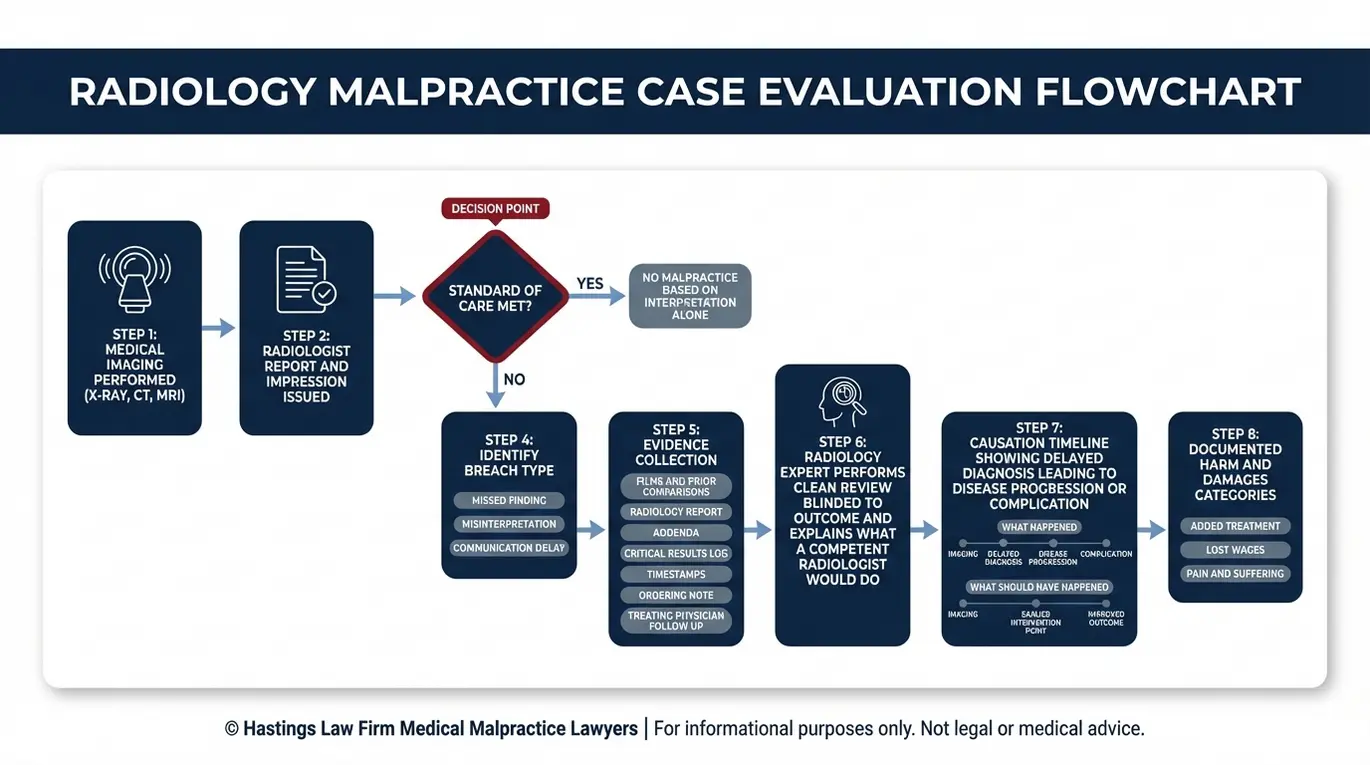
Proving a claim requires demonstrating that a competent radiologist under similar circumstances would have detected the abnormality and that this failure directly caused the patient’s injury or progression of disease. Under A.R.S. § 12-563, Arizona law requires the injured party to establish specific elements of proof to move forward with a medical malpractice claim. Our firm is led by Tommy Hastings, a board-certified trial attorney with over two decades of experience in medical negligence law, who helps clients manage these statutes.
The impression, the radiologist’s summary conclusion in an imaging report, is often the first thing we examine. If that impression failed to note a visible abnormality, or if critical results communication, the process of urgently notifying the treating physician about dangerous findings, did not happen in a timely way, those gaps can form the foundation of a negligence claim.
Here is what must be established:
- Duty and Breach: The radiologist had a professional obligation to the patient and made a specific error in reading or reporting the imaging.
- Causation: The missed or delayed diagnosis directly led to a worsened medical outcome, such as cancer spreading to a later stage before treatment began.
- Damages: The patient suffered real, measurable harm as a result, including additional treatment, pain, lost income, or loss of life.
- Expert Validation: A qualified radiology expert reviews the original films in a “clean” blind read to determine whether the error would be apparent to a competent peer and provides expert testimony regarding the failure.
This expert review is essential. Our team reviews your medical records and works with a national network of radiology specialists who can objectively assess whether the standard of care was met. Being proactive about your health, including asking questions during medical appointments as recommended by the National Institute on Aging, can also help you identify concerns earlier.
Interventional Radiology and Surgical Complications
Not all radiology malpractice involves reading scans. Interventional radiology (IR), a subspecialty where physicians perform minimally invasive procedures guided by imaging, often uses fluoroscopy, a technology providing real-time X-ray video during a procedure. These cases involve catheterizations, biopsies, stent placements, and similar treatments.
When errors occur during interventional radiology procedures, the injuries can be severe, including vascular damage, organ perforation, or stroke. Medical malpractice claims involving these specialized procedures require the same proof of negligence, but the analysis focuses on procedural technique and whether delayed treatment of a complication worsened the outcome. These procedures use medical imaging to guide the physician in real-time.
The Hastings Law Firm Difference
Results matter, but what truly sets us apart is how we achieve them. Every verdict, every settlement, and every Arizona courtroom victory comes from one guiding promise: To treat each client’s fight for justice as if it were our own.
This balance of skill, experience, and empathy reflects our core philosophy that justice should not only compensate the injured, but also make healthcare safer nationwide.

Recoverable Damages for Diagnostic Errors in Arizona
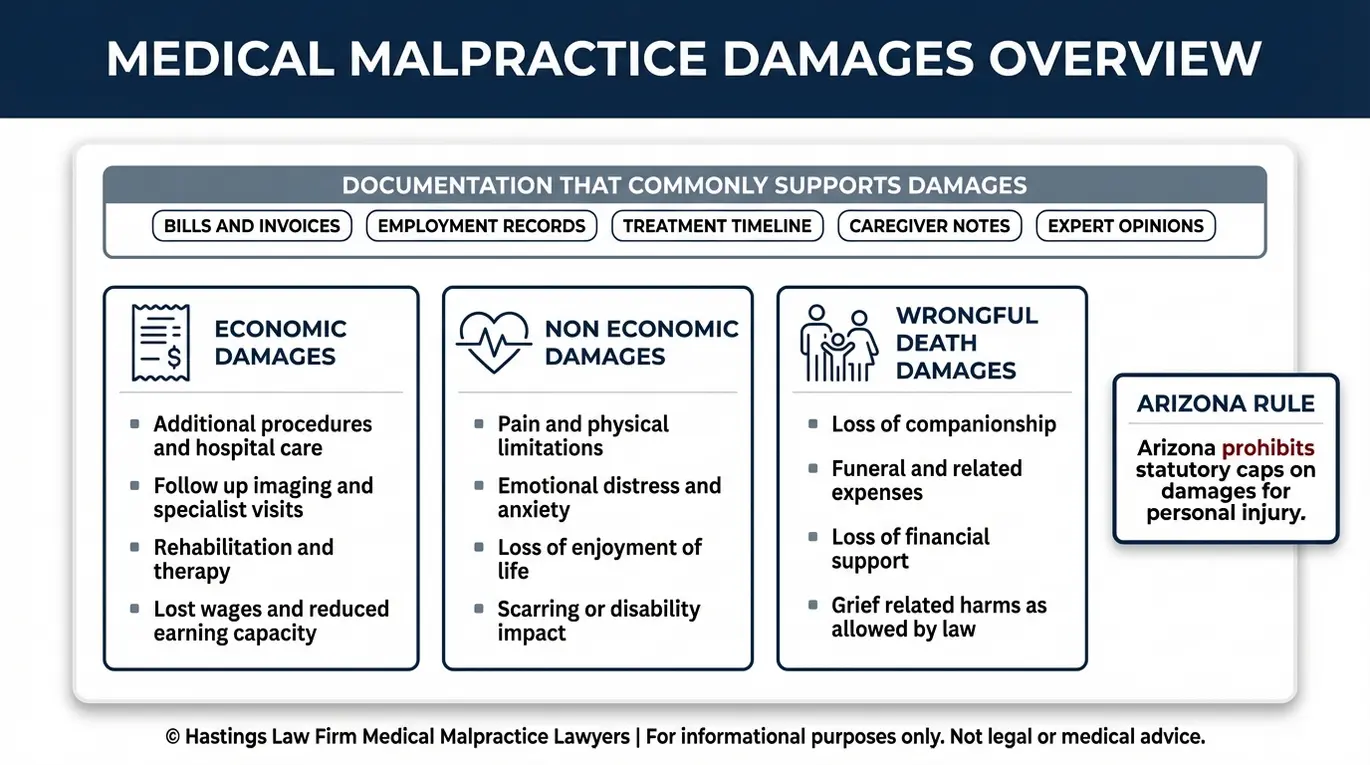
Victims of radiology errors in Arizona may recover economic damages for medical bills and lost wages, as well as non-economic damages for pain, suffering, and loss of quality of life. The Arizona Constitution, Article 2, Section 31, protects the right to recover damages for personal injuries, and Arizona does not impose a cap on these damages in medical malpractice cases.
Economic damages cover the financial cost of the error: additional surgeries, more aggressive treatment plans like chemotherapy, rehabilitation, and income lost during recovery or delayed treatment. These funds help address the non-economic damages of physical pain, emotional distress, and diminished quality of life that often follow a delayed or missed diagnosis.
In cases where a radiology error contributed to a patient’s death, families may pursue a wrongful death claim. An Arizona Radiologist Malpractice Lawyer can help identify the full scope of recoverable losses based on the specific circumstances of your case.
Contact the Arizona Doctor Malpractice Attorneys at Hastings Law Firm Today for Help
A missed finding on a scan can change the course of someone’s life. At Hastings Law Firm, our mission is to restore trust for patients and families who have been let down by the healthcare system, and to hold negligent providers accountable so the same mistakes are not repeated.
Our team of attorneys, nurse consultants, and medical staff will review your records, consult with qualified radiology experts, and give you an honest assessment of your case. We handle these cases on a contingency fee basis, which means you pay no attorney fees or costs unless we secure a recovery on your behalf.
If you believe a radiology error caused harm to you or someone you love, contact us for a free, confidential case evaluation. Let us help you find the answers you deserve.
Frequently Asked Questions About Radiologist Malpractice in Arizona


This content was researched and written by the Hastings Law Firm editorial team, which includes attorneys, medical professionals, and experienced researchers. Our writing is informed by internal knowledge and practical experience, and we cross-check critical details against authoritative sources cited throughout. Every piece undergoes human-led fact-checking and legal review. Because legal and medical information can change, if you spot an error, please contact us. Learn more about our content standards and review process on our editorial policy page.

Tommy Hastings, founder of Hastings Law Firm, is a board-certified personal injury trial lawyer dedicated exclusively to healthcare injury cases. Since 2001, he has represented injured patients and families in litigation against major hospital systems, pharmaceutical companies, and negligent healthcare providers nationwide. He has handled numerous high-profile cases that have drawn national media attention and resulted in multi-million dollar recoveries. He draws on that experience in his writing, helping readers understand how these cases work and what options may be available to them.
