


Texas Pulmonary Embolism Malpractice Lawyer
Written by: Hastings Law Firm | Reviewed by: Gabe Sassin | Updated: July 27, 2026
A missed pulmonary embolism can turn a treatable emergency into life threatening harm, especially when warning signs or known risk factors are overlooked. This topic often involves emergency room discharge without appropriate testing, misread imaging, or a breakdown in risk assessment and prevention for hospitalized patients. When accepted protocols are not followed, patients can suffer severe complications, including fatal outcomes, and families may be left searching for clear answers about what went wrong. If you or a loved one were harmed or worse due to a failure to diagnose a pulmonary embolism in Texas, contact Hastings Law Firm for a free, confidential case review.
Trusted Texas Medical Attorneys for Failure to Diagnose Pulmonary Embolism Claims
What You Should Know About Failure to Diagnose Pulmonary Embolism Claims in Texas:
- Outcomes can be catastrophic when a pulmonary embolism is missed, since the condition is described as life threatening and can be fatal without timely treatment.
- Liability can turn on whether warning signs were dismissed and the patient was discharged without confirmatory testing.
- Recovery can depend on whether risk factors were assessed and acted on, since tools like the Caprini Score are described as central to prevention decisions.
- Options can narrow when prevention measures are not provided for high risk patients, including anticoagulants or mechanical compression.
- Disputes often focus on whether diagnostic testing was ordered and interpreted correctly, including CT pulmonary angiography and D dimer testing.
- Separate responsibility may arise when nursing staff do not escalate worsening symptoms through the chain of command.
- Compensation can be limited for non economic damages in Texas, while economic damages are described as not capped.
- Wrongful death claims may be available when a pulmonary embolism is fatal, including losses tied to companionship, mental anguish, funeral expenses, and lost financial support.
- Defenses can reduce accountability when hospitals claim the clot was an inherent surgical risk or that symptoms were atypical.
- Case viability can be affected by missed filing deadlines in Texas, since strict time limits and rare exceptions are described.

A Healthcare Focused Law Firm
A pulmonary embolism, caused by a pulmonary embolus (a blood clot that blocks an artery in the lungs), is one of the most preventable causes of death in hospitals and emergency rooms. When doctors miss the warning signs or fail to act on known risk factors, the consequences can be devastating. Venous thromboembolism (VTE), the broader condition that includes both blood clots in the legs and those that travel to the lungs, is a well-documented medical emergency with clear diagnostic and treatment protocols. When those protocols are ignored, it may be medical malpractice.
If you or someone you love suffered serious harm or death because a blood clot went undiagnosed or untreated, a Texas Pulmonary Embolism Malpractice Lawyer at Hastings Law Firm can review your medical records and explain your legal options. Contact us for a free, confidential case evaluation.
Failure to Diagnose a Pulmonary Embolism
A failure to diagnose occurs when a physician overlooks standard clinical warning signs of a pulmonary embolism, such as chest pain or shortness of breath, and discharges the patient without ordering confirmatory tests like a CT angiogram or D-dimer blood test.
Doctors must employ differential diagnosis, a systematic method used when a patient presents with symptoms that could point to several conditions. This process involves listing possible causes and testing to rule them out. When someone arrives at an emergency room with sudden chest pain, difficulty breathing, or a persistent cough, a pulmonary embolism should remain on the list of possible causes until testing rules it out. This “rule out” principle is important because PE symptoms mimic other less severe conditions. Ignoring this step places the patient at significant risk and violates the accepted standard of care.
Too often, we see cases where that process breaks down. A patient’s symptoms get attributed to a panic attack, pneumonia, or a pulled muscle, and they are sent home without imaging or bloodwork to check for clots. A study in the National Library of Medicine on common reasons for malpractice lawsuits involving pulmonary embolism and deep vein thrombosis notes that emergency misdiagnosis is a frequent problem. These errors, often involving emergency room error, are leading triggers for PE-related malpractice claims.
The missed opportunities in these cases tend to follow a pattern:
- Failing to order a D-dimer test, a simple blood test that detects clot fragments in the bloodstream
- Not following up with CT pulmonary angiography when initial symptoms suggest a clot
- Discharging a patient with known risk factors without any VTE screening
- Misinterpreting test results or imaging studies
- Ignoring worsening symptoms during observation
Each of these gaps represents a point where the correct diagnosis could have been made and treatment started. As a pulmonary embolism lawyer in Texas, we work with medical experts to reconstruct the clinical timeline and identify exactly where the standard of care was not met.
What Is a Pulmonary Embolism and Deep Vein Thrombosis?
A pulmonary embolism (PE) is a life-threatening blockage in one of the pulmonary arteries in the lungs, usually caused by a pulmonary embolus, or blood clot, that travels from the legs, a condition known as deep vein thrombosis (DVT). Deep vein thrombosis (DVT) refers to a clot that forms in the deep veins, usually in the legs. Together, DVT and PE fall under the umbrella of venous thromboembolism (VTE), and according to MedlinePlus, PE can be fatal if not treated quickly.
The process typically starts in the deep veins of the lower legs or thighs. When a person is immobile for extended periods, whether from surgery, hospitalization, or prolonged bed rest, blood flow in the legs slows significantly. Blood begins to pool in the veins because of reduced venous return, and this stagnation creates the conditions for a clot to form.
If that clot breaks free, blood clot migration carries it through the circulatory system toward the heart and into the pulmonary arteries. Once lodged in the lungs, the clot restricts blood flow and oxygen exchange. This puts immediate strain on the heart, which must work harder to push blood past the blockage. In severe cases, a large PE can cause the heart to fail entirely.
The reason this matters from a legal perspective is that doctors have well-established tools to identify patients at risk for DVT and PE, and proven methods to prevent clots from forming in the first place.

The Hastings Law Firm Difference
Results matter, but what truly sets us apart is how we achieve them. Every verdict, every settlement, and every Texas courtroom victory comes from one guiding promise: To treat each client’s fight for justice as if it were our own.
This balance of skill, experience, and empathy reflects our core philosophy that justice should not only compensate the injured, but also make healthcare safer nationwide.

Recognizing Risk Factors and the Caprini Score
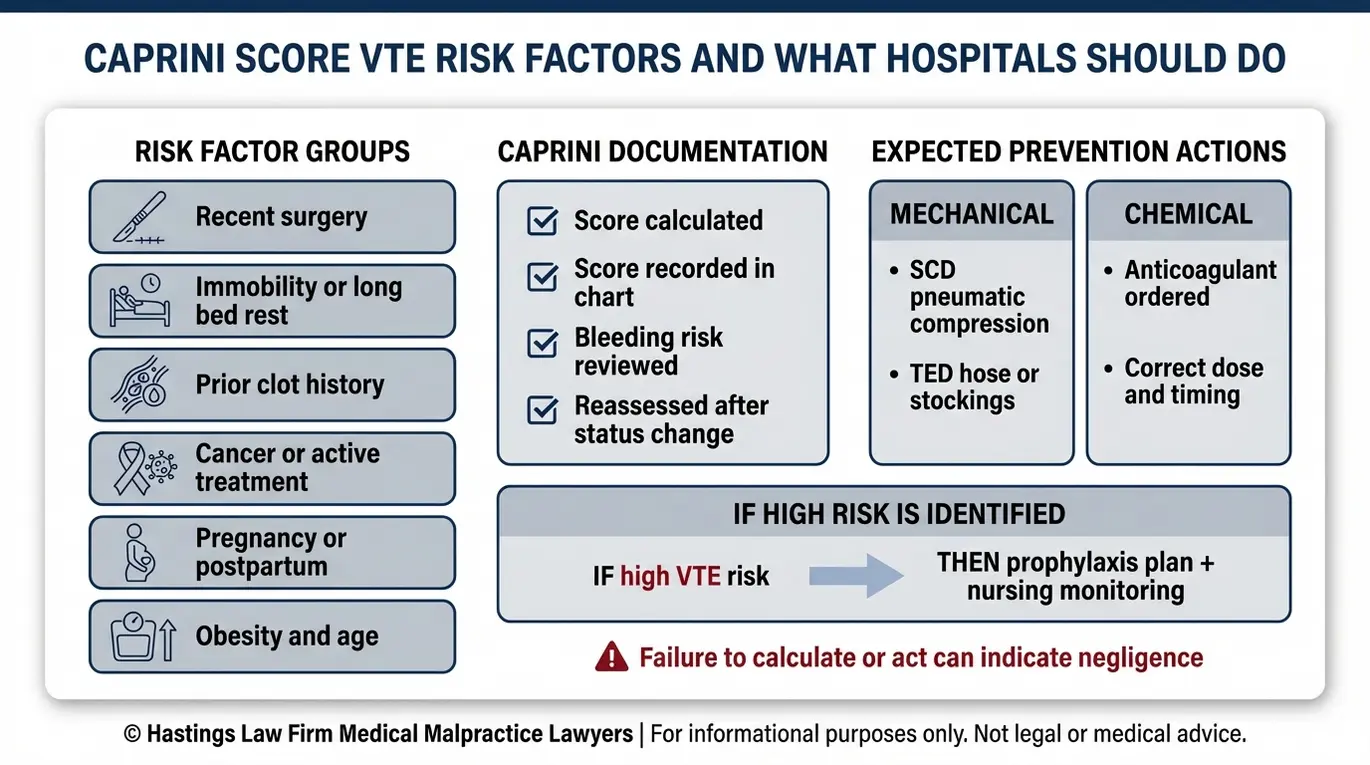
Doctors use risk assessment tools, such as the Caprini Score, to calculate a patient’s likelihood of developing blood clots based on factors like recent surgery, obesity, age, and immobility. The Caprini Score is a standardized medical tool used to assess blood clot risk. When a hospital fails to perform this assessment or ignores a high score, it can be strong evidence of negligence.
Medical staff should use the Caprini VTE Risk Assessment, a scoring system that assigns point values to specific risk factors, to place the patient into a risk category that determines what preventive measures are required. Hospitals are expected to calculate this score for surgical patients and many other admitted patients as part of the standard of care. A high Caprini score obligates the medical team to provide prophylaxis, either through blood-thinning medications or mechanical compression devices.
The Centers for Disease Control and Prevention (CDC) reports that VTE affects hundreds of thousands of Americans each year, making risk assessment a critical part of hospital care. Common risk factors include:
| Risk Factor | Why It Increases Clot Risk |
|---|---|
| Postoperative recovery (especially hip or knee) | Tissue damage and immobility activate clotting |
| Prolonged hospital stay or bed rest | Reduced blood flow causes venous stasis, the slowing or pooling of blood in the veins |
| Obesity | Increased pressure on veins in the pelvis and legs |
| Cancer or chemotherapy | Cancer cells and treatments can promote clot formation |
| Pregnancy or recent childbirth | Hormonal changes increase blood clotting factors |
| Hypertension | Associated with vascular damage and clot risk |
| Age over 60 | Vein function declines with age |
When a patient has multiple risk factors and the medical team does not act, we examine whether the Caprini assessment was completed, documented, and followed. That gap between what should have been done and what actually happened is often where the malpractice lies.
Proving Malpractice in Pulmonary Embolism Cases
Malpractice is proven by demonstrating that the medical provider deviated from the accepted standard of care, either by failing to assess risk, failing to prescribe anticoagulants, or failing to interpret diagnostic tests accurately, and that this deviation directly resulted in injury or death. The standard of care is the level of care a reasonably competent healthcare professional would provide under similar circumstances.
VTE prophylaxis refers to the preventive use of mechanical compression and anticoagulant medications for patients at elevated risk. A study published in PubMed Central comparing chemical and mechanical prophylaxis of venous thromboembolism confirms that both methods are effective and widely recognized as necessary interventions. When a hospital fails to use either approach for a high-risk patient, that omission can form the basis of a negligence claim.
As a Texas PE malpractice attorney, our team examines several categories of potential liability to identify all liable providers:
- Failure to prevent: Not prescribing anticoagulants such as Heparin or Warfarin, or failing to use mechanical devices like pneumatic compression devices (SCDs) or TED hose (compression stockings) for at-risk patients
- Failure to diagnose: Not ordering CT pulmonary angiography (CTPA), the gold-standard imaging test for detecting blood clots in the lungs, when symptoms warranted it
- Failure to treat after diagnosis: This involves administering incorrect dosages of blood thinners. It can also include not considering a vena cava filter when anticoagulants were contraindicated
- Nursing failures: Nurses who observe warning signs must escalate concerns through the nursing chain-of-command. Failing to advocate for the patient when a doctor misses a clot can create separate liability
Our in-house medical staff includes nurse practitioners and board-certified patient advocates who previously worked in the hospital systems they now challenge. They review clinical records to determine whether prevention protocols were followed, whether nursing staff escalated appropriately, and whether the treating physicians met the standard of care. Former defense attorneys on our team help us anticipate how hospitals and their insurers will try to justify these failures.

Compensation for Pulmonary Embolism Injuries in Texas
Patients and families harmed by PE malpractice in Texas can recover economic damages for medical bills and lost wages, as well as non-economic damages for pain, suffering, and physical impairment, subject to state-imposed caps. Non-economic damages refer to intangible losses such as physical pain and emotional trauma.
Economic damages cover the financial losses that result from the injury. These include:
- Past and future medical bills, including hospitalization, surgeries, and ongoing treatment
- Lost income and reduced earning capacity
- Rehabilitation and long-term care costs
Non-economic damages address the personal toll of the injury, including physical pain, emotional suffering, loss of enjoyment of life, and physical impairment. Under the Texas Civil Practice and Remedies Code, Chapter 74, non-economic damages are capped at $250,000 against all physicians and individual healthcare providers combined and $250,000 per healthcare institution, up to $500,000 total for institutions. There is no cap on economic damages.
Many pulmonary embolism cases are fatal. In wrongful death claims, surviving family members can seek compensation for losses like companionship and mental anguish. Families can also recover funeral expenses and the financial support the deceased would have provided, ensuring future financial security. As malpractice lawyers for pulmonary embolism cases, we work to document the full scope of each family’s loss so that no category of damages is overlooked.
Contact the Texas Healthcare Malpractice Attorneys at Hastings Law Firm Today for Help
If a pulmonary embolism was missed, misdiagnosed, or left untreated, you deserve to know whether the medical care you or your loved one received met the standard. Time limits apply to medical malpractice claims in Texas, so early action helps preserve important evidence and protect your right to file.
Hastings Law Firm focuses exclusively on medical malpractice. Our team includes former defense attorneys and in-house medical staff who understand the internal protocols hospitals use to assess risk. As a Texas Pulmonary Embolism Malpractice Lawyer, Tommy Hastings and his team prepare every case as if it is going to trial. This trial-ready approach puts our clients in the strongest possible position during negotiations or in the courtroom.
Tommy Hastings is board-certified in Personal Injury Trial Law by the Texas Board of Legal Specialization, a distinction held by less than 2% of attorneys in the state. There is no fee unless we recover compensation for you. Contact us today for a free, confidential case evaluation, and let us help you find the answers you deserve.
Frequently Asked Questions About Pulmonary Embolism Malpractice in Texas


This content was researched and written by the Hastings Law Firm editorial team, which includes attorneys, medical professionals, and experienced researchers. Our writing is informed by internal knowledge and practical experience, and we cross-check critical details against authoritative sources cited throughout. Every piece undergoes human-led fact-checking and legal review. Because legal and medical information can change, if you spot an error, please contact us. Learn more about our content standards and review process on our editorial policy page.

Gabe Sassin has focused exclusively on medical malpractice law since 2007. After spending more than a decade as a malpractice defense attorney, he knows exactly how the other side works. He has seen firsthand how healthcare providers, insurers, corporate defendants, and their legal teams think, prepare, and build their defense against claims. That knowledge works for the people who need it most today, injured patients and their families. His unique experience shapes everything he writes, giving readers a look at how these cases actually work from someone who has handled them from both sides.
