


Houston Prostate Surgery Error Lawyer
Prostate surgery demands careful technique, especially during nerve sparing approaches meant to protect sexual function and bladder control. When errors occur during robotic prostatectomy or related procedures, the results can be permanent and deeply disruptive, including lasting incontinence, sexual dysfunction, and life threatening infection from missed bowel injury. Distinguishing an expected complication from a preventable mistake often depends on what happened in the operating room and what was documented afterward. If you or a loved one were harmed or worse due to prostate surgery errors in Houston, Texas, contact Hastings Law Firm for a free, confidential case review.

Last Updated: July 27, 2026
Trusted Houston Medical Attorneys for Negligent Urological Procedures
Prostate surgery is one of the most technically demanding procedures in urology, particularly when it involves the nerve-sparing technique, a method designed to preserve the neurovascular bundles that control erectile function and bladder control. When a surgeon fails to perform this procedure with the precision it requires, the consequences can permanently alter a patient’s quality of life.
If you or a loved one experienced unexpected complications after prostate surgery, you may be wondering whether what happened was truly unavoidable. That uncertainty is understandable, and you deserve clear answers. As a Houston prostate surgery error lawyer team that focuses exclusively on medical malpractice, we can review your medical records, consult with qualified urological experts, and explain whether you may have a case. Contact Hastings Law Firm for a free, confidential evaluation.

Common Errors During Robotic Prostatectomy and Surgery
Surgical errors during prostate procedures often involve the misuse of robotic equipment, accidental cutting of nerves, or perforation of the bowel during the operation. These are not simply “bad outcomes.” They can represent clear departures from the standard of care that every surgeon is expected to follow.
Robotic prostatectomy, a form of laparoscopic surgery performed using systems like the Da Vinci system, a sophisticated remote-controlled manipulator, has become widespread in Houston. Data from Robotic Surgery Statistics published by Market.us Media confirms the adoption of robotic-assisted procedures continues to grow rapidly. But the technology is only as safe as the surgeon controlling it. Operating the Da Vinci system requires specialized training, and insufficient experience can lead to mechanical errors such as wrong-site surgery, tears, thermal burns to surrounding tissue, or uncontrolled movements of the robotic arm.
One scenario that increases risk is what surgeons refer to as a “complicated gut,” where a patient has intra-abdominal adhesions, or scar tissue from prior abdominal surgeries. A surgeon who fails to account for these adhesions may inadvertently damage the bowel during entry or dissection. The Prostate Surgery Patient Guide from Northwestern Medicine outlines standard expectations, and deviations from those expectations often signal a problem.
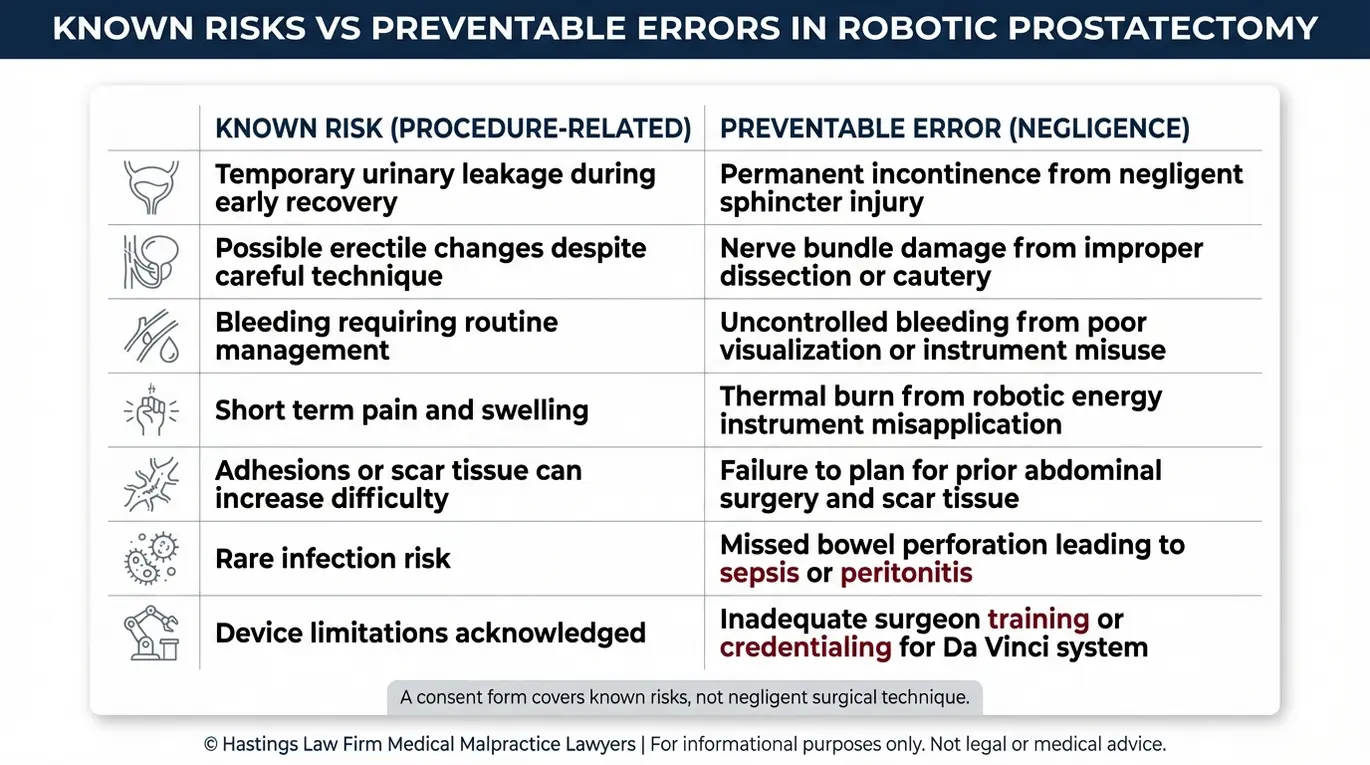
Not every complication is malpractice. But there is a clear line between a known risk and a preventable error. A lawyer for prostate surgery errors can help you understand which side of that line your experience falls on.
| Known Surgical Risk | Preventable Error / Negligence |
|---|---|
| Temporary urinary incontinence during recovery | Permanent incontinence caused by cutting the external urethral sphincter |
| Minor bleeding controlled during surgery | Uncontrolled hemorrhage from improper use of robotic instruments |
| Temporary erectile difficulty after nerve-sparing surgery | Permanent impotence from severing neurovascular bundles without justification |
| Small risk of infection with proper post-op care | Sepsis from an undetected bowel perforation left unrepaired at closing |
| Scar tissue formation at the surgical site | Retained foreign object, such as a surgical sponge or clip, left inside the body |
Under the Texas Civil Practice and Remedies Code, Section 74.301, patients who suffer harm from surgical negligence may be entitled to recover damages. If your prostate surgery malpractice attorney can demonstrate a breach, the law provides a path toward accountability.
Severe Complications Following Prostate Procedures
The most severe complications include permanent erectile dysfunction, urinary incontinence due to sphincter damage, and life-threatening sepsis caused by undiagnosed bowel perforations. These severe complications reshape daily life far beyond the operating room.
Nerve damage is a devastating result of a negligent prostatectomy. The surgeon has a duty to identify and preserve the neurovascular bundles responsible for sexual function. When those nerves are carelessly severed or damaged, the patient may face permanent impotence and a profound loss of intimacy. For an attorney for prostate surgery complications, documenting the surgeon’s operative technique is a central part of building the case.
Bowel perforation, or rectal injury, is a serious form of organ damage that occurs when the surgeon nicks or cuts the rectal wall during dissection. Research published by PubMed Central on the incidence of rectal injury after radical prostatectomy confirms this complication demands immediate identification. Responsible surgical practice requires “running the bowel,” meaning the surgeon visually inspects the area for damage before closing. Failure to detect a perforation can lead to peritonitis, which is an infection of the abdominal lining, and sepsis.
Permanent incontinence differs from the temporary recovery issues many patients experience. When the external urethral sphincter, the muscle responsible for voluntary bladder control, is negligently cut or damaged, the result can be lifelong dependence on pads or additional corrective procedures.
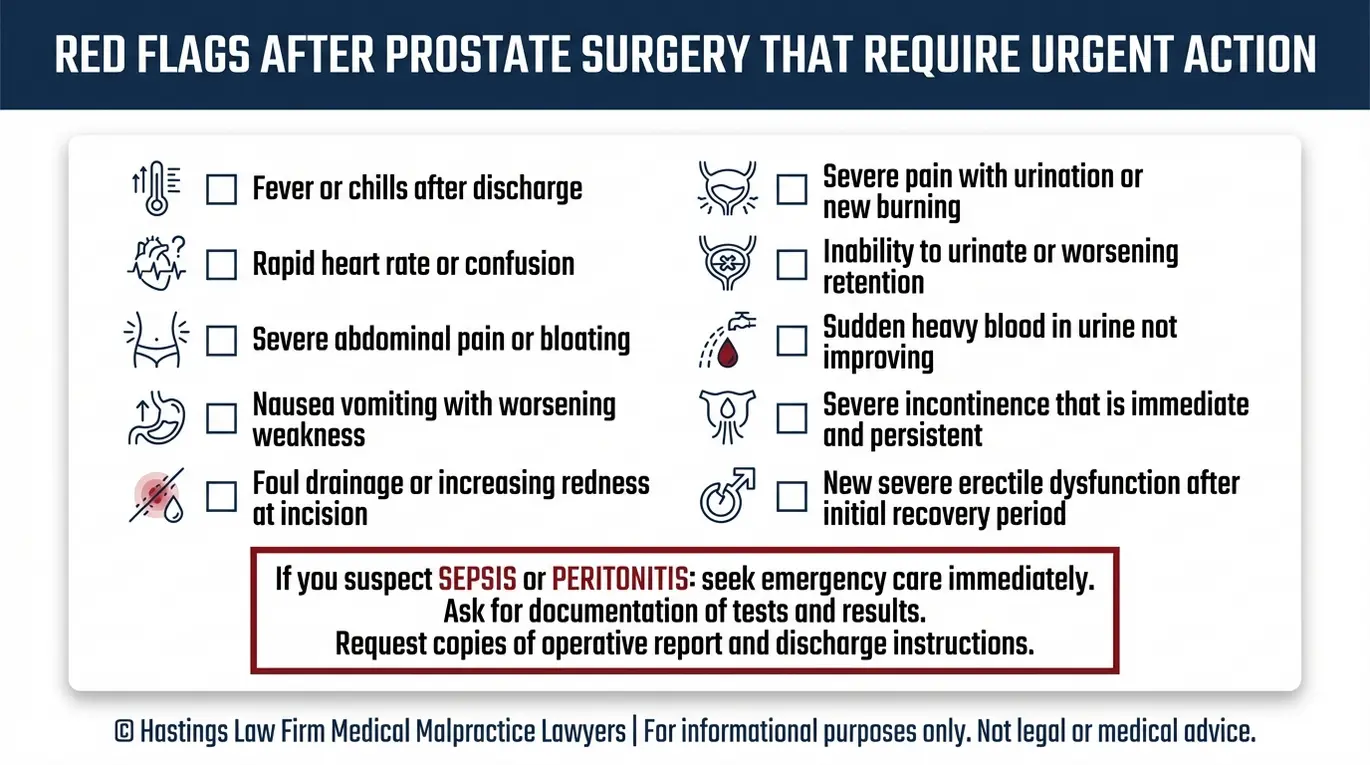
Signs that may point to surgical negligence include:
- Immediate, severe incontinence with no improvement over time
- High fever, abdominal pain, or signs of sepsis within days of discharge
- A need for emergency corrective surgery to repair operative damage
- Permanent sexual dysfunction following a procedure where nerves should have been spared
As a Houston surgical error lawyer team, we examine surgical logs, post-operative notes, and imaging to determine whether these complications were avoidable.
The Hastings Law Firm Difference
Results matter, but what truly sets us apart is how we achieve them. Every verdict, every settlement, and every Houston courtroom victory comes from one guiding promise: To treat each client’s fight for justice as if it were our own.
This balance of skill, experience, and empathy reflects our core philosophy that justice should not only compensate the injured, but also make health care safer nationwide.

Proving Negligence in Texas Prostate Surgery Cases
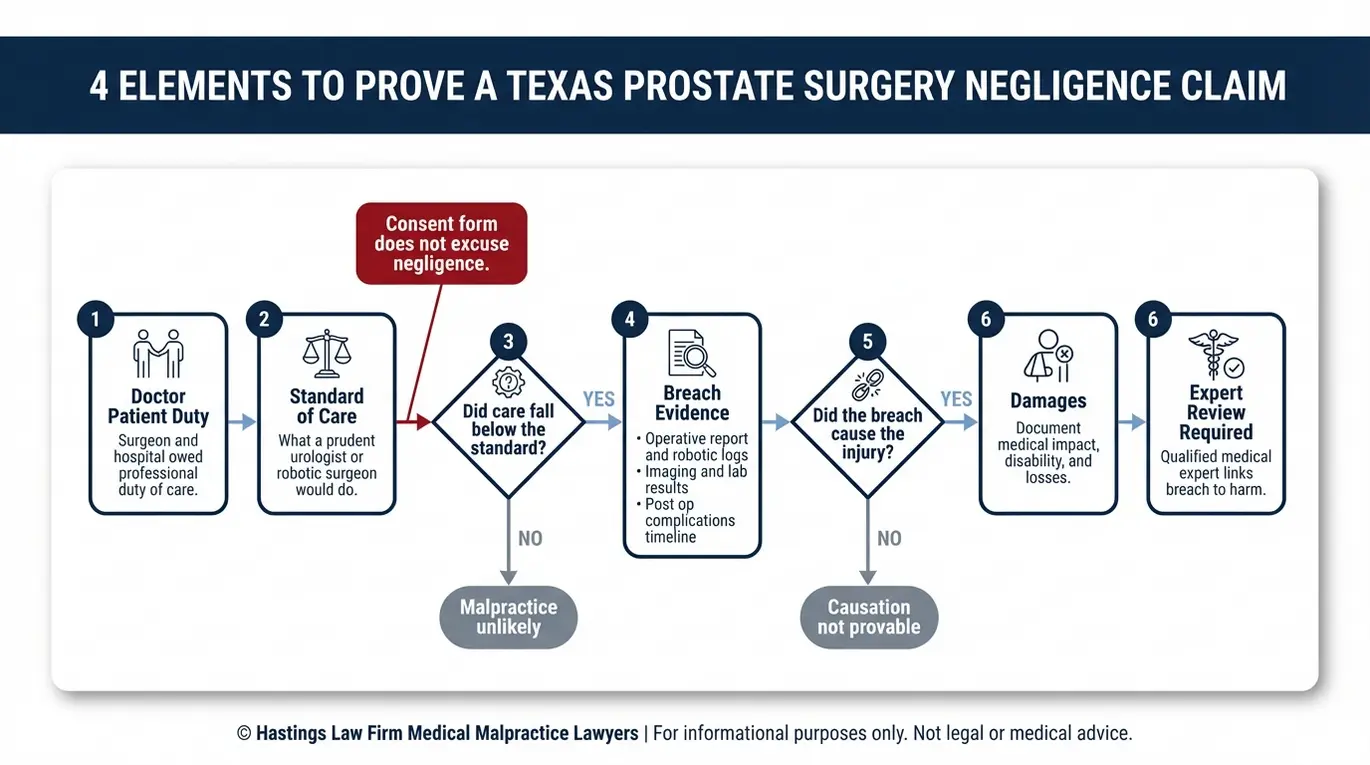
To prove negligence in Texas, a plaintiff must show that the surgeon breached the accepted standard of care, directly causing an injury that would not have occurred under a prudent surgeon’s care. This requires more than showing a bad result; it requires demonstrating that the surgeon’s decisions or technique fell below what a competent urologist would have done in the same situation.
Under Texas Civil Practice and Remedies Code, Chapter 74, medical malpractice claims must be supported by a qualified expert report early in the litigation. This mandatory report must outline how the healthcare provider failed to meet the standard of care. A board-certified urologist or robotic surgeon reviews the operative records and testifies as an expert witness about where the surgeon deviated from their duty. At Hastings Law Firm, we work with a national network of urological specialists who provide an objective medical review of whether the standard was met.
One defense that hospitals frequently raise is informed consent. They argue that because the patient signed a form acknowledging surgical risks, the surgeon cannot be held liable. But a consent form is not a blanket shield for negligence.
Surgeons must still account for complexities like intra-abdominal adhesions, or scar tissue from prior surgeries, which can complicate the field. If a surgeon perforated the bowel and failed to identify it, or if a retained foreign object, such as a surgical sponge or instrument, was left inside the body, no consent form excuses that conduct. Signing a form acknowledges known risks. It does not authorize substandard care.
Our prostate surgery error lawyer team examines every piece of available evidence: robotic system logs, operative reports, anesthesia records, and post-discharge documentation. This level of investigation is how we identify every liable party and determine validity for a medical malpractice lawsuit.
Recovering Compensation for Long Term Impairment
Patients harmed by surgical negligence may recover economic damages for medical bills and lost wages, as well as non-economic damages for physical pain, mental anguish, pain and suffering, and loss of enjoyment of life. Economic damages represent the measurable financial losses resulting from an injury. These can include medical bills, ongoing treatment, and lost earning capacity if the injury affects your ability to work. A qualified Houston prostate surgery error lawyer can help ensure your compensation reflects these long-term financial and medical needs.
To calculate the lifetime financial impact, we work with life-care planners who project the full cost of future medical needs, therapies, and adaptive equipment. This methodology ensures that any recovery accounts for the long road ahead, not just the bills already received. Non-economic damages address the emotional toll of impotence, the strain on personal relationships, and the daily frustration of managing a condition that should never have occurred.
Why Choose Our Houston Medical Malpractice Team
Hastings Law Firm is not a general injury practice. We do not handle car accidents, slip-and-falls, or product recalls. Every case we take involves medical malpractice, and every member of our team is a dedicated medical malpractice specialist focused on holding healthcare providers accountable.
Our founder, Tommy Hastings, is board certified in Personal Injury Trial Law by the Texas Board of Legal Specialization, a distinction held by fewer than 2% of Texas attorneys. Our legal team includes former defense attorneys who previously represented hospitals, which gives us direct insight into how the other side builds its case. We prepare every matter from day one as though it will go to a jury.
We handle cases on a contingency fee basis. You pay no attorney fees and no costs unless we secure a recovery on your behalf.
Contact the Houston Surgical Error Attorneys at Hastings Law Firm Today for Help
If you or a loved one suffered a serious, unexpected injury during prostate surgery, you do not have to accept it as “just a complication.” You deserve to know what happened and whether it could have been prevented.
Hastings Law Firm offers a free, confidential case evaluation led by our medical-legal team. This team includes in-house medical staff and nurse practitioners who assist in case evaluation and record analysis to identify breaches in care. We will review your records, consult with qualified experts, and give you an honest assessment of your options. There is no fee unless we win your case.
Call us today or reach out online. We are here to listen, and we are ready to help.
Frequently Asked Questions About Prostate Surgery Error in Houston


This content was researched and written by the Hastings Law Firm editorial team, which includes attorneys, medical professionals, and experienced researchers. Our writing is informed by internal knowledge and practical experience, and we cross-check critical details against authoritative sources cited throughout. Every piece undergoes human-led fact-checking and legal review. Because legal and medical information can change, if you spot an error, please contact us. Learn more about our content standards and review process on our editorial policy page.

Tommy Hastings, founder of Hastings Law Firm, is a board-certified personal injury trial lawyer dedicated exclusively to healthcare injury cases. Since 2001, he has represented injured patients and families in litigation against major hospital systems, pharmaceutical companies, and negligent healthcare providers nationwide. He has handled numerous high-profile cases that have drawn national media attention and resulted in multi-million dollar recoveries. He draws on that experience in his writing, helping readers understand how these cases work and what options may be available to them.
