


Texas Pneumothorax From Medical Procedure Lawyer
Written by: Hastings Law Firm | Reviewed by: Brady D. Williams | Updated: July 27, 2026
A collapsed lung after a medical procedure can be painful, frightening, and medically urgent, especially when it follows care that was supposed to help. Some pneumothorax events are known risks of certain interventions, but others may be tied to preventable errors such as poor technique, missed warning signs, or delayed treatment. Understanding what happened can matter for health outcomes and for accountability when standards were not met. If you or a loved one were harmed or worse due to pneumothorax from a medical procedure in Texas, contact Hastings Law Firm for a free, confidential case review.

Trusted Texas Medical Attorneys for Collapsed Lung Malpractice Claims
What You Should Know About Collapsed Lung From Medical Procedure Claims in Texas:
- Long term harm can follow when a pneumothorax is not recognized and treated promptly after a procedure.
- Life threatening emergencies can occur when pressure builds in the chest and shifts the heart and other organs.
- Liability can turn on whether the collapsed lung was an unavoidable complication or a preventable breach of the standard of care.
- Recovery options can be affected when informed consent did not adequately address the risk of pneumothorax before the procedure.
- Hospital responsibility can be disputed when the provider is an independent contractor rather than an employee.
- Accountability can extend beyond the operator when resident supervision is inadequate during high risk procedures.
- Compensation can include economic losses such as additional surgeries and lost wages.
- Recovery for pain suffering and physical impairment can be limited by statutory caps in Texas.
- Severe outcomes can include fatal cardiac arrest or irreversible brain injury when pneumothorax complications escalate.
- Case evaluation can depend on records such as imaging results oxygen readings and supervision logs.

A Healthcare Focused Law Firm
A pneumothorax, commonly known as a collapsed lung, can be a frightening and painful experience, especially when it happens because of a medical procedure you trusted would help you. If you or a loved one suffered a collapsed lung during or after a medical intervention, you may be wondering whether what happened was simply an unavoidable risk or the result of a preventable error.
That distinction matters, and you deserve a clear answer. As a Texas pneumothorax from medical procedure lawyer, our team at Hastings Law Firm focuses exclusively on medical malpractice. Our in-house medical staff and former defense attorneys know how to examine what went wrong and why. We can review your records, explain your options, and help you understand whether you have a case, all at no cost unless we recover for you.
Understanding Iatrogenic Pneumothorax
Iatrogenic pneumothorax is a collapsed lung caused by an accidental puncture or injury during a medical procedure, allowing air to leak into the pleural space and putting pressure on the lung. This condition occurs when air is trapped between the lung and the chest wall, preventing normal expansion.
The word “iatrogenic” means the injury was caused by medical treatment rather than occurring on its own. Spontaneous pneumothorax can happen without any outside cause. An iatrogenic pneumothorax, by contrast, results directly from something a healthcare provider did during a procedure, which may sometimes involve medical negligence.
When air enters the pleural space, the thin gap between the two layers of tissue (called the pleura) that line the lungs and chest wall, it prevents the lung from expanding fully. According to the National Center for Biotechnology Information (NCBI), this can rapidly compromise breathing and reduce the amount of oxygen reaching the bloodstream, creating an urgent and potentially life-threatening situation.

Medical Procedures Commonly Linked to Lung Collapse
High-risk procedures for iatrogenic pneumothorax include central line placements, thoracentesis, lung biopsies, and mechanical ventilation, where needle or instrument proximity to the lung creates a risk of puncture. These procedures often require precise instrument placement near sensitive lung tissue to avoid accidents. When medical teams do not follow proper protocols during these procedures, the consequences can be severe.
Here are the most common procedures associated with this injury:
- Central venous catheterization (CVC): This involves placing a catheter into a large vein, often near the neck or chest. During insertion, a needle can puncture the apex of the lung if the provider uses poor technique or fails to confirm placement. A systematic review and meta-analysis published by JAMA Internal Medicine documents significant complication rates associated with these catheters.
- Thoracentesis: This is a procedure to drain fluid from around the lungs, often to treat pleural effusion, an abnormal buildup of fluid in the pleural space. The risk of lung puncture increases when ultrasound guidance is not used or is used incorrectly.
- Lung biopsy: Needle aspiration of lung tissue can inadvertently damage the visceral pleura, the membrane directly covering the lung, allowing air to escape.
- Mechanical ventilation: Incorrect pressure settings on a ventilator can cause barotrauma, a type of ventilator-induced lung injury where excessive pressure ruptures the tiny air sacs in the lungs, often occurring during procedures requiring anesthesia and intubation.
Each of these procedures has established safety protocols. A Texas pneumothorax from medical procedure lawyer can help determine whether those protocols were followed in your case.
The Hastings Law Firm Difference
Results matter, but what truly sets us apart is how we achieve them. Every verdict, every settlement, and every Texas courtroom victory comes from one guiding promise: To treat each client’s fight for justice as if it were our own.
This balance of skill, experience, and empathy reflects our core philosophy that justice should not only compensate the injured, but also make healthcare safer nationwide.

Recognizing the Signs of a Pneumothorax Post-Procedure
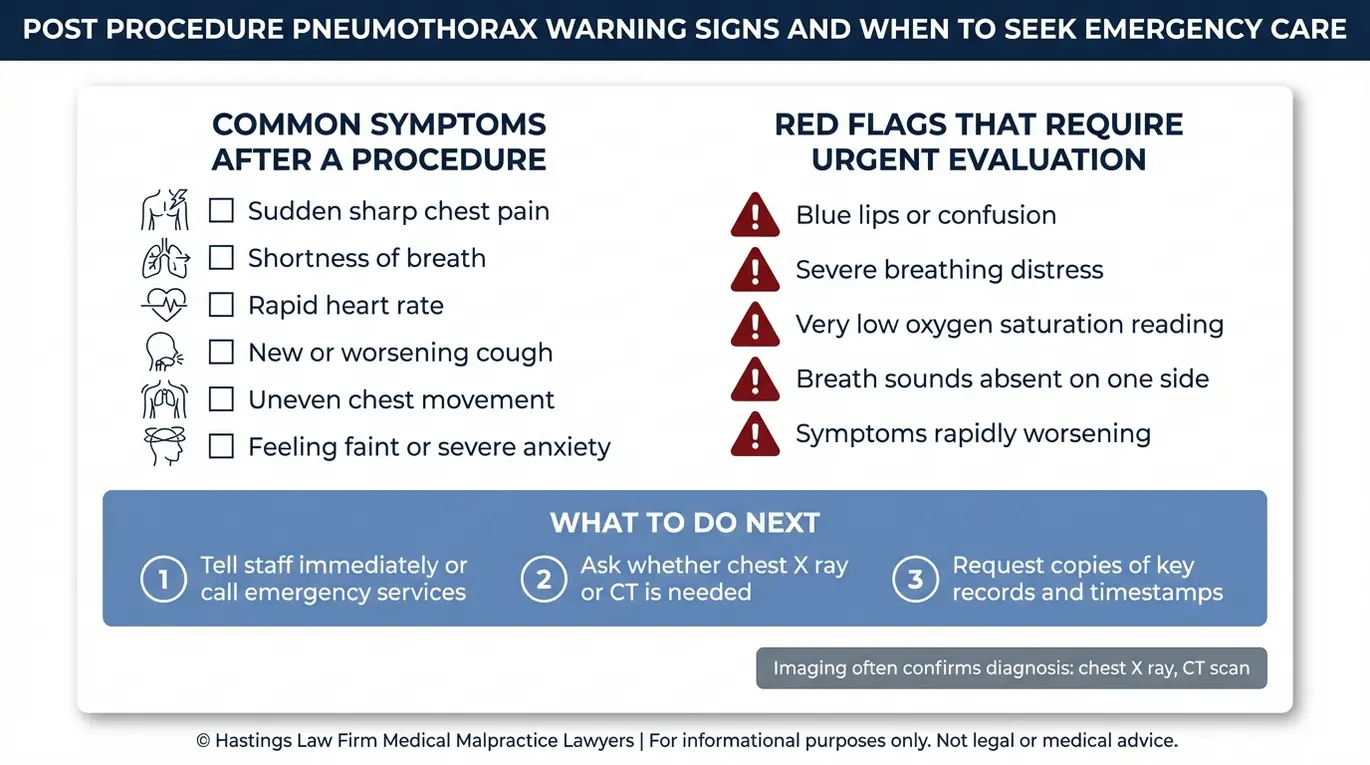
Symptoms of a collapsed lung often include sudden sharp chest pain, rapid heart rate, and difficulty breathing, which require immediate diagnostic imaging like a chest X-ray to prevent life-threatening hypoxia. A collapsed lung prevents oxygen from entering the blood normally, making rapid diagnosis critical to preventing permanent injury.
Some symptoms develop within minutes of a procedure, while others may appear hours later. One of the most dangerous forms is tension pneumothorax (a life-threatening build-up of pressure), a condition where trapped air continues to build pressure and begins shifting the heart and other organs out of position. This is a medical emergency.
According to MedlinePlus, the following signs after a medical procedure should prompt immediate medical attention:
- Sudden shortness of breath or respiratory distress
- Sharp or stabbing chest pain on the affected side
- Rapid heart rate
- Low oxygen saturation readings
- Absent or diminished breath sounds on one side of the chest
- Bluish discoloration of the skin (cyanosis)
If these symptoms are not recognized and treated quickly, the patient’s oxygen and carbon dioxide levels can reach critical thresholds. A delayed diagnosis of pneumothorax after a known high-risk procedure may itself represent a failure in the standard of care. Quick recognition is important to avoid hypoxia (dangerously low oxygen levels).
Proving Malpractice: Was It a Known Risk or Negligence?
Proving malpractice requires demonstrating that the pneumothorax resulted from a breach of the standard of care—such as poor technique or failure to use ultrasound guidance—rather than being an unavoidable complication of the procedure. The standard of care is the level of care and skill that a prudent healthcare professional would provide in a similar situation.
Not every collapsed lung after a medical procedure is malpractice. Pneumothorax is a known, documented risk of several interventions. The critical legal question is whether the provider’s actions fell below what a reasonably competent professional would have done under the same circumstances.
There are generally three paths to establishing liability:
Negligent technique or failure to follow protocols. If a provider skipped ultrasound guidance, an imaging method used to steer needles safely, during a thoracentesis, used improper needle placement during a central line insertion, or set ventilator pressures outside safe parameters (barotrauma, or ventilator-induced lung injury), those deviations from accepted practice can form the basis of a claim. The Texas Administrative Code, Title 25 sets forth health services standards that inform facility-level obligations.
Delayed diagnosis or treatment. Even when a pneumothorax occurs as a known complication, the medical team has a duty to identify and treat it promptly. Failure to order post-procedure imaging or to act on declining oxygen levels can constitute separate negligence.
Lack of informed consent. If a provider did not adequately explain the risk of pneumothorax before the procedure, the patient may not have been given the information needed to make a meaningful decision about their care.
A Texas pneumothorax from medical procedure lawyer at Hastings Law Firm works with qualified medical experts to reconstruct the timeline, analyze the technique used, and determine where the breach of duty occurred.
Teaching Hospital Risks and Resident Supervision
In teaching hospital settings, procedures are sometimes performed by residents or medical students who are still in training. Residents are doctors who have graduated medical school and are receiving specialized training, while attendings are the supervising senior physicians responsible for patient safety. This is a normal part of medical education, but it comes with specific responsibilities.
An attending physician must provide adequate resident supervision, and the level of oversight should match the trainee’s experience and the complexity of the procedure. When resident involvement in a high-risk procedure occurs without proper oversight and a pneumothorax results, supervision failures may extend liability to both the supervising physician and the hospital. We examine credentialing records, supervision logs, and institutional policies to evaluate whether appropriate safeguards were in place.

Recovering Damages for Medical Error Pneumothorax Cases
Victims of negligent medical procedures can recover compensation for economic losses like additional surgeries and lost wages, as well as non-economic damages for pain, suffering, and physical impairment. Compensation aims to address both measurable financial losses and the significant quality-of-life impacts of a serious medical error.
Economic damages cover the measurable financial impact of the injury. This includes medical bills for emergency treatment such as chest tube insertion (also called tube thoracostomy, a procedure where a tube is placed between the ribs to drain air or fluid), extended hospital stays, follow-up imaging, and any additional surgeries. Lost wages from missed work during recovery are also recoverable.
Non-economic damages address the pain and suffering from the collapse itself, the anxiety of a medical emergency, breathing difficulties during recovery, and lasting physical impairment. Just as in cases involving wrong site surgery or other severe errors, under Texas Civil Practice and Remedies Code § 74.301, non-economic damages in medical malpractice cases are subject to statutory caps.
In cases where a pneumothorax leads to fatal cardiac arrest or irreversible brain injury, surviving family members may be able to pursue a wrongful death claim.
Contact the Texas Healthcare Malpractice Attorneys at Hastings Law Firm Today for Help
If a medical procedure left you or a loved one with a collapsed lung, you do not have to accept it as “just a complication” without getting answers. You deserve to know what happened and whether it could have been prevented.
At Hastings Law Firm, founded by Tommy Hastings, a board-certified trial lawyer, our legal and medical team works together to review your records and identify where the standard of care may have been breached. Our team includes former hospital nurses and former defense attorneys who previously worked for the systems they now challenge. These insights allow us to evaluate your situation from every angle and anticipate defense tactics.
There is no cost to speak with a Texas pneumothorax from medical procedure lawyer on our team. We work on a contingency fee basis, meaning you pay nothing unless we secure a recovery for you. Contact us today for a free, confidential case evaluation. Let us help you find the answers you deserve.
Frequently Asked Questions About Pneumothorax From Medical Procedure in Texas


This content was researched and written by the Hastings Law Firm editorial team, which includes attorneys, medical professionals, and experienced researchers. Our writing is informed by internal knowledge and practical experience, and we cross-check critical details against authoritative sources cited throughout. Every piece undergoes human-led fact-checking and legal review. Because legal and medical information can change, if you spot an error, please contact us. Learn more about our content standards and review process on our editorial policy page.

Brady D. Williams is a nationally recognized medical malpractice attorney who has spent his career handling high-stakes litigation for injured patients and families across the country. Licensed in both Texas and California, Brady draws on experience from hundreds of resolved medical cases to break down complex legal and medical topics for the people who need that information most. His writing reflects the same attention to detail and commitment to clarity that he brings to every case he handles.
