


Arizona Pneumothorax From Medical Procedure Lawyer
Written by: Hastings Law Firm | Reviewed by: Tommy Hastings | Updated: July 27, 2026
A collapsed lung after a medical procedure can be frightening and painful, especially when it follows care that was supposed to help. Pneumothorax can happen as a known complication, but it can also result from preventable errors such as poor technique, inadequate imaging guidance, or delayed recognition of warning signs. The consequences can escalate quickly when symptoms are missed or treatment is delayed, including life threatening complications. If you or a loved one were harmed or worse due to pneumothorax from a medical procedure in Arizona, contact Hastings Law Firm for a free, confidential case review.

Trusted Arizona Medical Attorneys for Collapsed Lung Claims
What You Should Know About Collapsed Lung From Medical Procedure Claims in Arizona:
- Life threatening complications can develop when a pneumothorax is not recognized and treated promptly after a procedure.
- Accountability can turn on whether the injury was preventable rather than an unavoidable known risk of the procedure.
- Recovery options can be limited if legal time limits are missed, including shorter requirements tied to public hospitals.
- Liability can extend beyond one clinician when supervision, staffing, equipment, or delayed diagnosis contributed to the harm.
- Compensation can include economic losses and non economic harms such as pain, suffering, and emotional distress.
- Wrongful death claims may be available when a pneumothorax leads to fatal cardiac arrest or organ failure.
- Disputes often focus on whether accepted technique and precautions were followed, such as imaging guidance and post procedure monitoring.
- Financial recovery can be reduced when comparative negligence is alleged based on failure to follow post procedure instructions.

A Healthcare Focused Law Firm
A collapsed lung after a medical procedure can leave you in pain, confused, and searching for answers. If a doctor or hospital caused your pneumothorax, a condition where air leaks into the space around your lung and causes it to collapse, you deserve to know whether what happened was preventable. When a collapsed lung results directly from a medical procedure rather than an underlying condition, it is called an iatrogenic pneumothorax, meaning the injury was caused by medical intervention itself.
At Hastings Law Firm, our team of attorneys, nurse consultants, and former defense lawyers focuses exclusively on medical malpractice. We understand both the medical science behind these injuries and the legal standards that apply in Arizona. If you or a loved one suffered a collapsed lung during or after a procedure, an experienced Arizona pneumothorax from medical procedure lawyer at our firm can review your records and explain your options at no cost and no obligation.
Common Medical Procedures That Cause Pneumothorax
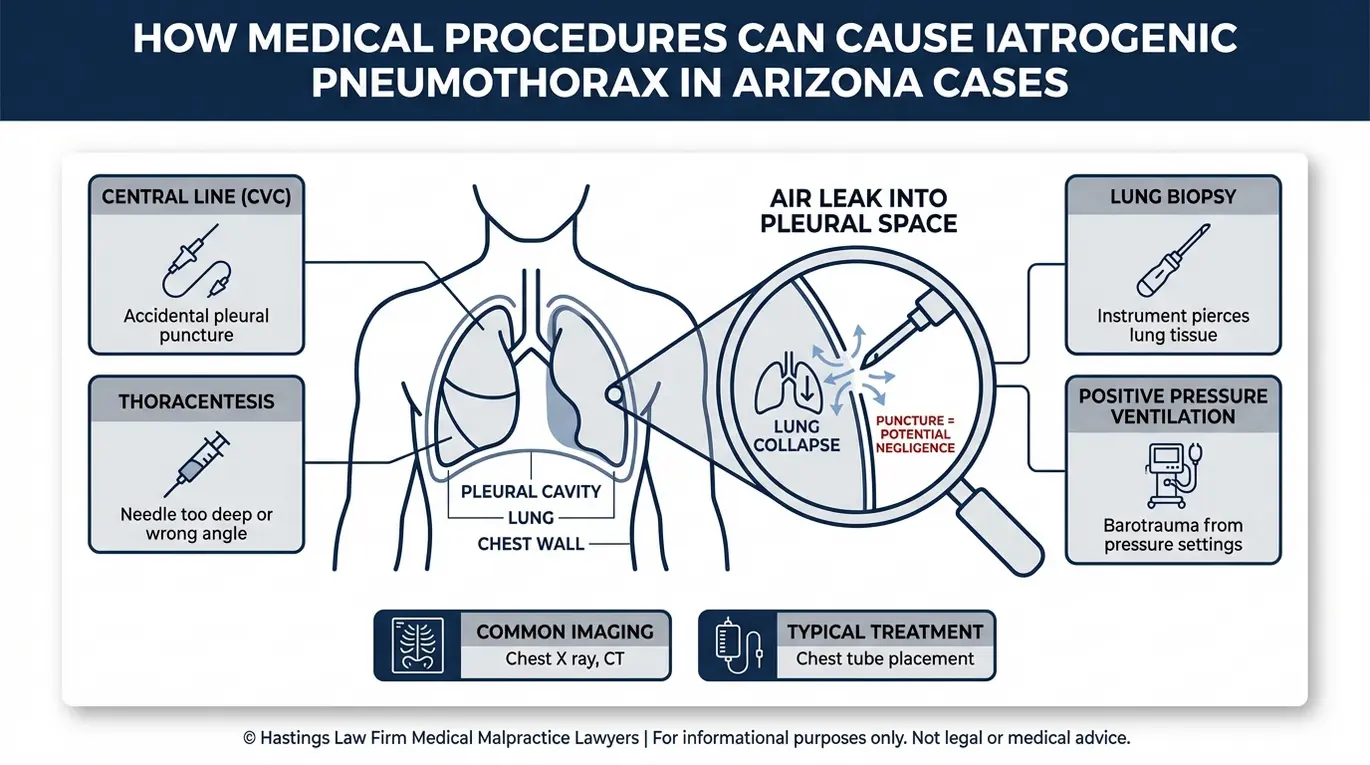
Iatrogenic pneumothorax occurs when a medical instrument accidentally punctures the lung or its lining, causing air to leak into the pleural space, the thin gap between the lung and the chest wall. Once air enters that space, pressure builds and the lung partially or fully collapses.
Several invasive procedures carry a recognized risk of this injury. But a recognized risk does not automatically excuse a preventable error. The question in every case is whether the physician followed accepted technique and took appropriate precautions. Here are the procedures most commonly associated with iatrogenic pneumothorax and how errors occur during each:
- Central venous catheter (CVC) placement: A CVC, also called a central line, is a catheter inserted into a large vein near the neck or chest. A needle advanced too far or at the wrong angle can puncture the lung. Research published by the JAMA Network on complication rates of central venous catheters confirms catheter insertion remains a significant source of iatrogenic injury.
- Lung biopsy: During a biopsy, a needle is inserted through the chest wall to collect tissue. If the needle overshoots or the patient is poorly positioned, it can breach the pleural cavity and cause a collapse.
- Thoracentesis: This procedure drains excess fluid from around the lungs using a needle. An improperly guided insertion can puncture the lung itself rather than reaching only the fluid.
- Positive pressure ventilation: Mechanical ventilators push air into the lungs under pressure. If pressure settings are too high or not adjusted for the patient’s lung condition, the force can rupture lung tissue.
The distinction between a “known risk” and negligence is critical. Every procedure carries some degree of risk, and patients may sign consent forms acknowledging that. However, consent to a risk does not mean consent to substandard care. When a collapsed lung results from poor technique, inadequate imaging guidance, or a failure to respond quickly after the puncture, that is a different situation entirely, and one our collapsed lung attorney is equipped to investigate.
Recognizing Symptoms and Immediate Health Risks
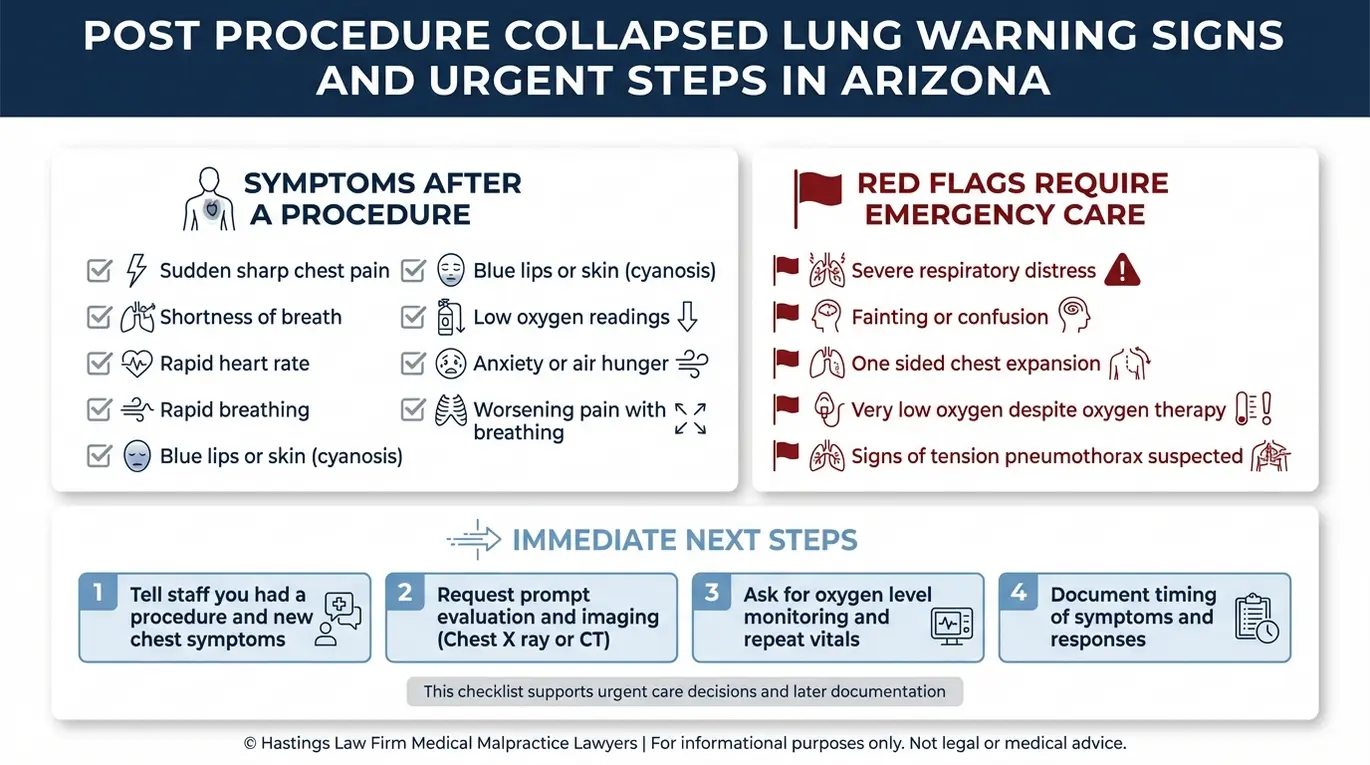
Symptoms of a collapsed lung typically include sudden sharp chest pain, shortness of breath, rapid heart rate, and cyanosis (a bluish discoloration of the skin caused by low oxygen) immediately following a procedure.
If you or a loved one experienced any of the following during or shortly after a medical procedure, it may indicate a pneumothorax:
- Sudden, stabbing chest pain on the side of the procedure
- Respiratory distress or a feeling of being unable to get enough air
- Tachycardia (elevated heart rate)
- Dropping oxygen levels or rising carbon dioxide levels on monitoring equipment
- Cyanosis (bluish tint to the lips, fingertips, or skin)
The most dangerous progression is a tension pneumothorax, a life-threatening emergency where trapped air continues to build pressure, pushing the heart and major blood vessels to the opposite side of the chest. Osmosis describes this condition as one that can cause cardiovascular collapse within minutes if not treated. A review published by PubMed Central on pneumothorax diagnosis and treatment confirms that rapid identification through chest X-ray or CT scan is the standard expectation after any high-risk procedure.
When medical staff fail to recognize these symptoms promptly or delay diagnostic imaging, the injury can worsen dramatically. A delayed diagnosis may itself be evidence of negligence. Under ARS § 12-542, Arizona generally allows two years to file a medical malpractice claim from the date the injury occurred or was discovered. And if a public hospital was involved, the timeline may be much shorter; a Notice of Claim with Maricopa County, for example, must be filed within 180 days. Speaking with a medical malpractice lawyer for pneumothorax early protects your ability to take legal action.
The Hastings Law Firm Difference
Results matter, but what truly sets us apart is how we achieve them. Every verdict, every settlement, and every Arizona courtroom victory comes from one guiding promise: To treat each client’s fight for justice as if it were our own.
This balance of skill, experience, and empathy reflects our core philosophy that justice should not only compensate the injured, but also make healthcare safer nationwide.

Proving Negligence: Standard of Care vs. Known Risk
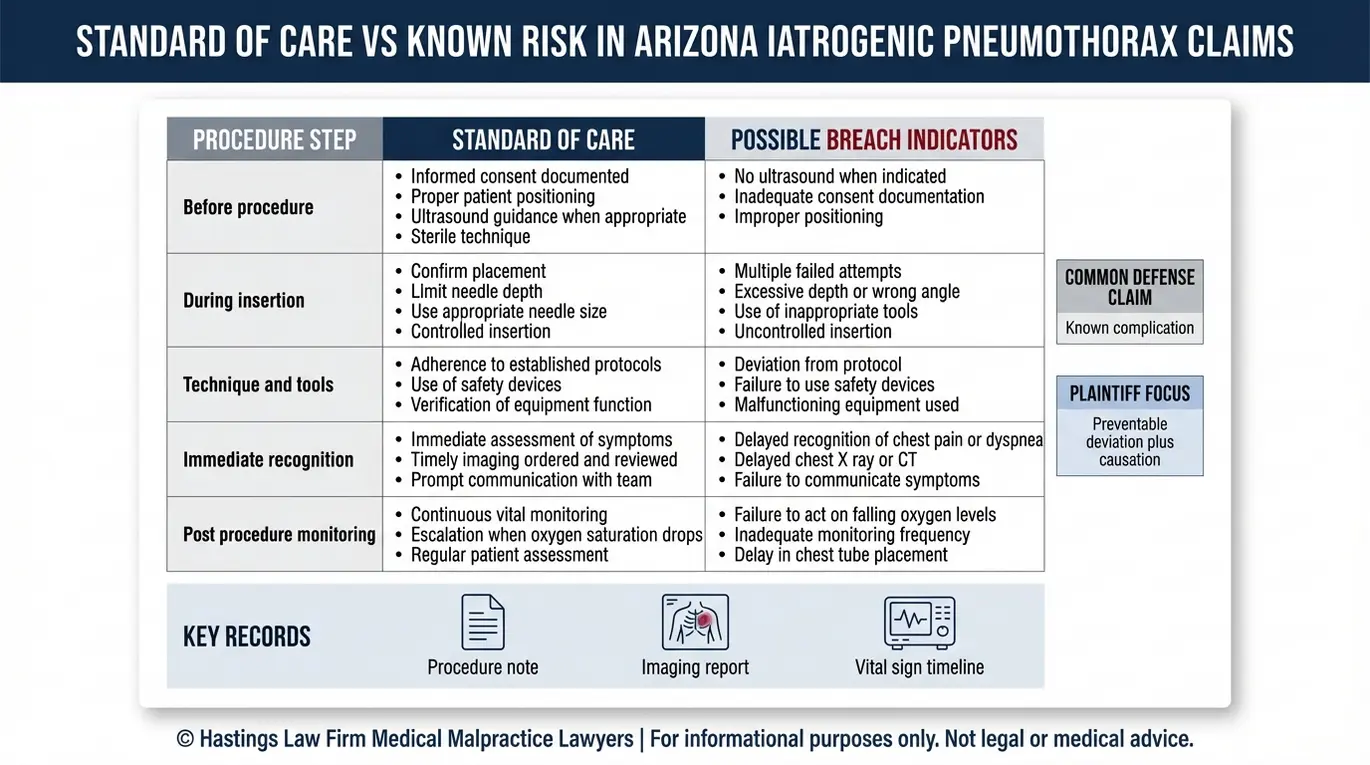
To prove negligence, a patient must demonstrate that the physician deviated from the accepted standard of care and that this deviation directly caused the lung collapse, rather than the pneumothorax being a recognized complication that occurred despite proper technique.
The duty of care requires the level of treatment a reasonably competent physician in the same specialty would have provided under similar circumstances. For invasive procedures near the chest, this typically includes proper patient positioning, correct needle angle and depth, real-time imaging guidance when indicated, and close post-procedure monitoring.
The most common defense in these cases is predictable: “Pneumothorax is a known risk of the procedure.” And that is sometimes true. But a known risk does not shield a provider who used poor technique, skipped safety steps, or failed to catch the collapse quickly.
Our Arizona medical malpractice attorney team examines specific evidence to determine whether the standard was met and established causation. For central line placement, one of the most important factors is whether the physician used ultrasound guidance, a real-time imaging method that allows the doctor to visualize the vein and surrounding structures during insertion. The doctor may instead have relied on the older landmark technique, which involves using external body landmarks to estimate needle placement without visual confirmation. A systematic review and meta-analysis published on PubMed comparing ultrasound guidance and landmark technique found that ultrasound-guided insertion significantly reduces complication rates, including pneumothorax.
We also look at the post-procedure response through thorough expert review. A delay in ordering imaging, ignoring symptoms, or failing to place a chest tube promptly can each represent a separate breach. Our in-house nursing staff and national network of medical experts review every record and timeline to determine where the care fell short.
The Role of Teaching Hospitals and Residents
Iatrogenic injuries can occur more frequently in teaching hospitals where resident physicians, doctors still in post-graduate training, perform procedures under supervision. In these facilities, student doctors gain hands-on experience under the watch of senior physicians who are responsible for their actions.
A resident may have less experience with needle placement or ventilator management, and the supervising physician has a legal duty to provide adequate oversight. When a resident’s inexperience contributes to a collapsed lung, liability may extend to both the resident and the attending physician. We evaluate staffing records, training logs, and supervision protocols to determine whether the teaching environment contributed to the error.
Liability for Iatrogenic Pneumothorax in Arizona
Liability may extend beyond the individual doctor to include the hospital, supervising physicians, or other medical staff if there was a failure to supervise, maintain equipment, or diagnose the injury in a timely manner.
The technical cause of this iatrogenic injury involves air leaking into the pleural space after a puncture. The surgeon or anesthesiologist who performed the procedure may bear direct responsibility for a technical error, such as advancing a needle too far or selecting an improper insertion site. But hospitals can also be liable under principles of vicarious liability when their employees cause harm during the course of their duties. If faulty equipment contributed to the puncture, or if staffing decisions left an inexperienced provider unsupervised, the institution may share responsibility. Cases involving systemic failures often fall under hospital negligence.
Radiologists and other specialists can face liability as well. If a post-procedure chest X-ray showed signs of a pneumothorax and the reading physician missed it, that delayed diagnosis may have allowed the injury to progress. As a pneumothorax injury lawyer, we trace every step of care to identify each responsible party, because accountability often involves more than one provider.
Compensation for Victims of Medical Procedure Collapsed Lungs
An experienced Arizona pneumothorax from medical procedure lawyer knows that patients who suffer a collapsed lung due to medical negligence may recover economic damages for medical bills and lost wages, as well as non-economic damages for pain, suffering, and the emotional impact of the error. Arizona’s constitution protects the right to a jury trial and to full and fair compensation for injuries. The Arizona Constitution preserves these rights without a cap on non-economic damages in most medical malpractice cases.
Recoverable damages in a pneumothorax case may include:
- Medical expenses: ICU stays, emergency imaging, chest tube placement (also called tube thoracostomy, a procedure where a tube is inserted between the ribs to drain air or fluid), corrective surgeries, and follow-up care.
- Lost income: Wages lost during recovery, as well as reduced future earning capacity if the injury caused lasting limitations.
- Pain and suffering: The physical pain of the collapse and chest tube insertion, along with ongoing respiratory discomfort.
- Emotional distress: Anxiety, fear of future medical procedures, and symptoms of PTSD that can follow a traumatic medical event.
- Wrongful death: If the pneumothorax led to fatal cardiac arrest or organ failure, surviving family members may pursue a claim.
- Litigation economics: Coverage for the financial impact associated with pursuing justice and rehabilitation.
Litigation Costs and Case Viability
Hastings Law Firm advances all costs and operates on a contingency fee basis, meaning you pay no attorney fees or expenses unless we recover compensation on your behalf. A contingency fee arrangement means legal costs are tied to the success of the claim, allowing patients to seek justice without upfront financial risk. This removes the financial barrier that often prevents injured patients from holding negligent providers accountable.
Contact the Arizona Healthcare Malpractice Attorneys at Hastings Law Firm Today for Help
You should not have to carry the burden of a preventable injury alone. If you or a loved one suffered a collapsed lung during a medical procedure, our team at Hastings Law Firm is ready to listen, review your medical records, and give you honest answers about whether you have a case.
Hastings Law Firm is led by board-certified trial attorney Tommy Hastings, who is board-certified in Personal Injury Trial Law by the Texas Board of Legal Specialization, a distinction held by less than 2% of attorneys. Our firm uses a trial-ready philosophy, preparing every case from day one as if it will go before a jury to ensure the best possible posture for our clients. Tommy has dedicated his career of over 20 years to holding healthcare providers accountable and making the system safer for every patient.
Our Arizona office in Phoenix gives us direct access to local courts, and our in-house medical staff can begin evaluating your records immediately. There is no fee unless we win, and your initial consultation is completely confidential. Contact our Arizona pneumothorax attorney team today to take the first step toward understanding what happened and what comes next.
Frequently Asked Questions About Pneumothorax From Medical Procedure in Arizona


This content was researched and written by the Hastings Law Firm editorial team, which includes attorneys, medical professionals, and experienced researchers. Our writing is informed by internal knowledge and practical experience, and we cross-check critical details against authoritative sources cited throughout. Every piece undergoes human-led fact-checking and legal review. Because legal and medical information can change, if you spot an error, please contact us. Learn more about our content standards and review process on our editorial policy page.

Tommy Hastings, founder of Hastings Law Firm, is a board-certified personal injury trial lawyer dedicated exclusively to healthcare injury cases. Since 2001, he has represented injured patients and families in litigation against major hospital systems, pharmaceutical companies, and negligent healthcare providers nationwide. He has handled numerous high-profile cases that have drawn national media attention and resulted in multi-million dollar recoveries. He draws on that experience in his writing, helping readers understand how these cases work and what options may be available to them.
