


Texas Physical Therapist Malpractice Lawyer
Written by: Hastings Law Firm | Reviewed by: Gabe Sassin | Updated: July 27, 2026
Physical therapy is meant to support recovery, but careless treatment can cause new injuries or make existing problems worse. When that happens, it can be hard to tell whether symptoms are normal soreness or a preventable error. Common concerns include unsafe transfers, inadequate monitoring, inappropriate techniques, and failures to adjust care when symptoms worsen. Claims often turn on proving that therapy caused measurable harm rather than the natural course of a prior condition, and responsibility may extend beyond one provider to a clinic. If you or a loved one were harmed or worse due to physical therapist negligence in Texas, contact Hastings Law Firm for a free, confidential case review.

Trusted Legal Representation for Physical Therapy Negligence in Texas
What You Should Know About PT Rehab Negligence Claims in Texas:
- Recovery can be set back by physical therapy errors that cause a new injury or measurably worsen an existing condition.
- Accountability can extend beyond one therapist when supervision failures or clinic level safety problems contribute to harm.
- Options can expand beyond negligence when professional boundaries are crossed, since sexual misconduct may create civil claims and criminal exposure.
- Disputes can focus on causation when pain is blamed on a pre existing condition rather than negligent treatment.
- Compensation can include economic losses such as medical expenses and lost wages as well as non economic harms such as pain and emotional distress.
- Recovery for non economic damages can be limited in Texas medical malpractice claims, while economic damages are not capped.
- Liability can involve equipment issues when a clinic fails to maintain items used for safe transfers, and some situations may also implicate product liability.
- Clarity can depend on detailed treatment documentation, since medical records, imaging, and session notes may show when the clinical trajectory changed.

A Healthcare Focused Law Firm
Physical therapy is supposed to help you heal. When a therapist’s carelessness causes a new injury or makes an existing one worse, the confusion and frustration that follow can feel overwhelming. You trusted a licensed professional to guide your recovery, and that trust was broken.
These cases are medically and legally complex. Founded by board-certified trial lawyer Tommy Hastings, our firm includes attorneys, in-house nurses, and medical consultants who focus exclusively on medical malpractice litigation. This clinical depth allows us to handle the specific challenges of rehabilitation claims.
If you or a loved one was harmed during physical therapy, a Texas physical therapist malpractice lawyer at our firm can review what happened and explain your options. The consultation is free, and you pay nothing unless we recover compensation on your behalf.
Recognizing Negligence in Physical Therapy Treatment
Physical therapist negligence occurs when a provider deviates from the accepted standard of care, resulting in patient injury through actions like improper supervision, inappropriate treatment, incorrect exercise technique, or failure to monitor a patient’s limits. The standard of care for physical therapists refers to the level of treatment a reasonably competent PT would provide under similar circumstances, including proper patient assessment, continuous monitoring, and safeguarding against foreseeable harm.
A physical therapist is expected to evaluate your condition thoroughly, design an appropriate treatment plan, track your progress at every session, and adjust the approach when something is not working. When any of those steps are skipped or handled carelessly, a breach of duty may occur. A skilled PT malpractice attorney can help you seek justice. According to a scoping review of adverse events related to physiotherapy practice published in PubMed Central, preventable injuries in rehabilitation settings are well-documented and span a range of clinical errors.
Distinguishing between normal discomfort during recovery and an injury caused by a therapist’s error is a vital part of these cases. Soreness after a session can be normal. But sharp, sudden pain during a transfer, a burn from improperly applied equipment, or a joint that is significantly worse after treatment may point to something else entirely.
Here are some red flags that may indicate negligence rather than normal recovery:
- A therapist pushes a joint beyond safe limits during passive range of motion (PROM), the technique of manually moving a patient’s limb without the patient actively engaging the muscles
- Burns result from electrical stimulation (e-stim), a modality that sends electrical impulses to muscles, or from heat packs left on too long without monitoring
- A patient is dropped during a transfer or falls due to lack of proper spotting or support
- Treatment is applied without reviewing updated imaging or medical records
- The therapist fails to modify exercises after the patient reports worsening symptoms
- No individualized assessment is performed before beginning treatment, contrary to guidelines established by the American Physical Therapy Association’s documentation standards
If any of these situations sound familiar, speaking with a Texas physical therapist malpractice lawyer can help clarify whether what you experienced was a preventable error. Our team includes in-house medical staff who can review your records and assess whether the care you received fell below acceptable standards.
Liability for Sexual Misconduct in Therapy Settings
Physical therapy requires close physical contact, which creates a professional obligation to maintain professional boundaries, the limits that define appropriate and ethical patient interaction. Therapeutic touch, meaning physical contact performed solely for a legitimate clinical purpose, has well-defined limits. When a therapist crosses those professional boundaries, the claim may involve what the law calls an intentional tort, which is a deliberate harmful act rather than simple carelessness.
Sexual misconduct in a therapy setting can include inappropriate touching disguised as treatment, comments about a patient’s body unrelated to care, or any contact that exceeds the scope of the prescribed treatment plan. These acts may give rise to both criminal charges and civil claims against the therapist and the facility that employed them. Because the clinic has a duty to vet, train, and supervise its staff, facility liability may apply even when the misconduct was committed by a single provider.

Distinguishing Malpractice from Pre-Existing Conditions
Defense attorneys often argue that a patient’s pain is due to their original injury rather than therapy errors, requiring a lawyer to prove that the therapist’s actions actively aggravated the condition or caused a distinct new injury. This makes causation, the legal requirement to prove the therapist’s actions directly caused the harm, one of the most contested issues in negligence in rehabilitation cases. This factor often determines whether these claims are successful.
Aggravation of injury, a recognized legal theory in Texas, applies when a therapist’s actions take a pre-existing condition, meaning an injury or illness that existed before therapy began, and make it measurably worse. You do not have to prove the therapist caused a brand-new injury from scratch. If the evidence shows your condition deteriorated beyond what would be expected under proper care, that can support a valid claim.
The challenge is that rehabilitation patients arrive already in pain. Defense teams will point to that baseline and argue everything the patient is experiencing was inevitable. Overcoming this argument requires qualified expert testimony from medical professionals who can analyze the clinical timeline and distinguish between the natural progression of an injury and harm caused by negligent treatment.
As a physical therapist malpractice lawyer in Texas, our team works with rehabilitation medicine experts and reviews medical records and treatment logs session by session. We compare the documented treatment plan against what was actually performed, examine imaging taken before and after therapy, and identify the specific point where the patient’s trajectory changed. This evidence-driven approach allows us to establish proximate cause, the direct link between the therapist’s conduct and the worsened outcome.
The Hastings Law Firm Difference
Results matter, but what truly sets us apart is how we achieve them. Every verdict, every settlement, and every Texas courtroom victory comes from one guiding promise: To treat each client’s fight for justice as if it were our own.
This balance of skill, experience, and empathy reflects our core philosophy that justice should not only compensate the injured, but also make healthcare safer nationwide.

Establishing Liability Under Texas Medical Laws
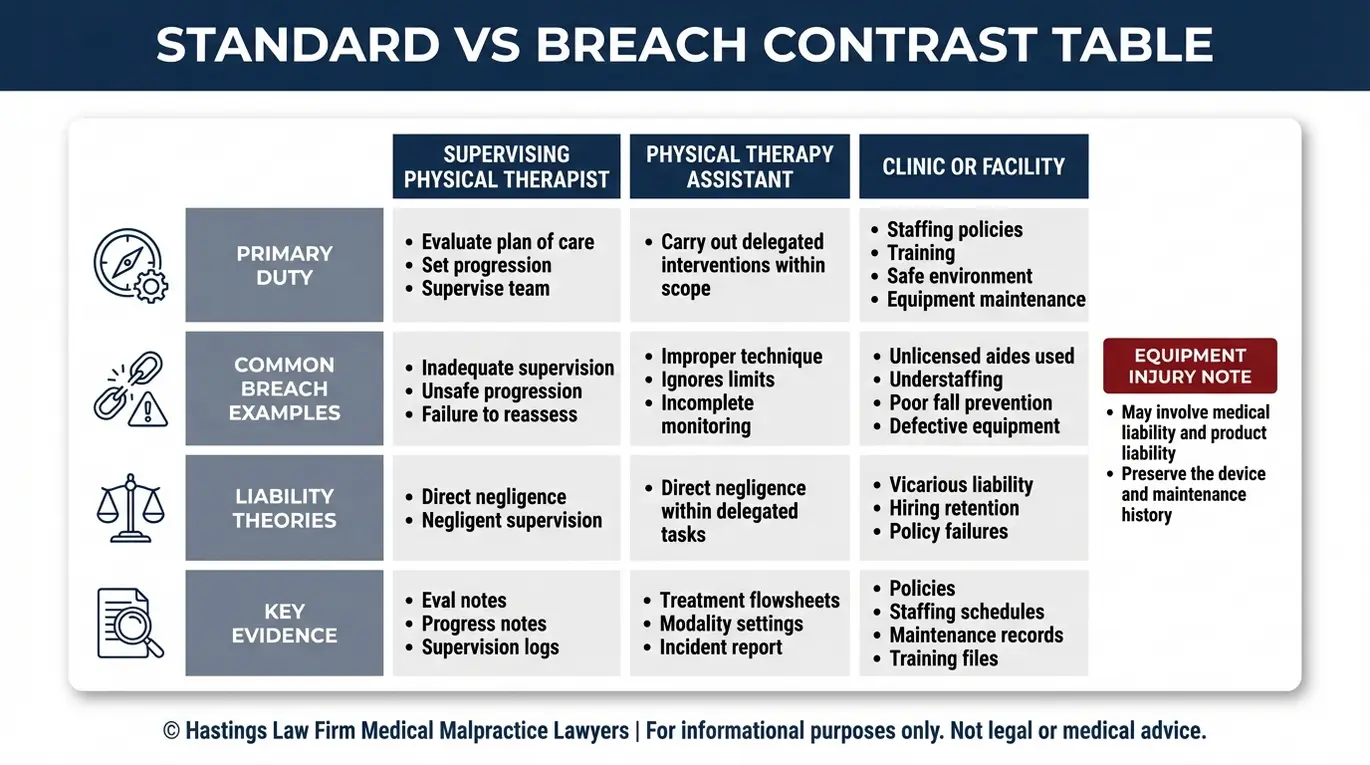
When suing a physical therapist, proving liability in Texas requires identifying exactly who was responsible for the negligent care, whether that is the supervising physical therapist, a physical therapy assistant (PTA), a person trained and licensed to provide therapy under the direct oversight of a PT, or the facility itself. Texas law treats medical liability claims involving physical therapy under Chapter 74 of the Texas Civil Practice and Remedies Code. This statute imposes specific procedural requirements, including the filing of an expert report by a qualified expert witness within 120 days of the defendant’s answer.
The supervising PT carries legal responsibility for the care delivered by assistants and aides working under their direction. According to the Executive Council of Physical Therapy and Occupational Therapy Examiners (ECPTOTE) supervision guidelines, Texas has strict rules governing how closely a PTA must be supervised. If a clinic allows unlicensed or underqualified staff to perform hands-on treatment, or if a PT fails to properly direct an assistant’s work, both the therapist and the facility may face liability.
Facility-level claims also arise when clinics fail to maintain equipment. For example, if a patient is injured because a gait belt, a strap used to safely assist patients during walking or transfer exercises, was worn or defective, the claim may involve both medical malpractice and product liability depending on whether the fault lies with the manufacturer or the clinic’s failure to inspect and replace equipment.
| Potentially Liable Party | Basis for Liability | Common Examples |
|---|---|---|
| Supervising Physical Therapist | Direct negligence or failure to supervise | Improper technique, failure to review patient history, inadequate oversight of PTA |
| Physical Therapy Assistant (PTA) | Negligent treatment under PT direction | Applying excessive force, ignoring patient distress, performing procedures beyond scope |
| Facility / Clinic | Vicarious liability, institutional negligence | Hiring unqualified staff, failing to maintain equipment, inadequate safety protocols |
A Texas physical therapist malpractice lawyer at Hastings Law Firm evaluates all potential defendants to build the strongest possible claim. Our former defense attorneys understand how hospitals and clinics structure their liability arguments, which gives us a strategic advantage in identifying every responsible party.
Compensation Available for Physical Therapy Injuries
Victims of physical therapy negligence may recover economic damages for medical bills and lost wages, as well as non-economic damages for pain, suffering, and physical impairment resulting from the error. Economic damages cover the measurable financial losses tied to the injury: medical expenses, corrective surgeries, additional rehabilitation costs, prescription medications, and lost wages from missed work. If the injury results in long-term disability, future medical care and diminished earning capacity may also be included.
Non-economic damages address the personal toll of the injury. These include physical pain, emotional distress, and the loss of enjoyment of activities that the patient could perform before the negligent treatment. Under the Texas Civil Practice and Remedies Code § 74.301, non-economic damages in medical malpractice cases are capped at $250,000 against all individual health care providers and $500,000 total against all health care institutions. Economic damages, however, have no statutory cap.
Because of these caps, building a thorough claim for damages for PT injuries is essential. A Texas physical therapist malpractice lawyer at our firm works with medical and financial experts to document every cost, both current and projected, so that full compensation for rehab negligence is accounted for.
Contact the Texas Healthcare Malpractice Attorneys at Hastings Law Firm Today for Help
If a physical therapist compromised your recovery instead of supporting it, you deserve a clear understanding of what went wrong and what options you have. Our team of attorneys, nurse consultants, and medical experts focuses exclusively on medical negligence claims. We have the clinical knowledge and litigation experience to hold the right parties accountable.
We charge no fees unless we recover compensation for you. Every case begins with a free, confidential evaluation where a patient advocate listens to your story, reviews the details, and helps determine whether the care you received fell below the standard you were owed.
You do not have to figure this out alone. Contact Hastings Law Firm today and let our family help yours take the first step toward answers and recovery.
Frequently Asked Questions About Physical Therapist Malpractice in Texas


This content was researched and written by the Hastings Law Firm editorial team, which includes attorneys, medical professionals, and experienced researchers. Our writing is informed by internal knowledge and practical experience, and we cross-check critical details against authoritative sources cited throughout. Every piece undergoes human-led fact-checking and legal review. Because legal and medical information can change, if you spot an error, please contact us. Learn more about our content standards and review process on our editorial policy page.

Gabe Sassin has focused exclusively on medical malpractice law since 2007. After spending more than a decade as a malpractice defense attorney, he knows exactly how the other side works. He has seen firsthand how healthcare providers, insurers, corporate defendants, and their legal teams think, prepare, and build their defense against claims. That knowledge works for the people who need it most today, injured patients and their families. His unique experience shapes everything he writes, giving readers a look at how these cases actually work from someone who has handled them from both sides.
