


Houston Nursing Home Sexual Abuse Lawyer
Sexual abuse in a nursing home or assisted living facility can leave an older resident with physical injuries, lasting emotional trauma, and a profound loss of dignity. Warning signs can be physical or behavioral, and many residents cannot self report due to cognitive or physical limitations, which can delay protection. Accountability often turns on whether a facility failed to provide reasonable safeguards, supervision, and reporting when concerns arose. If you or a loved one were harmed or worse due to nursing home sexual abuse in Houston, Texas, contact Hastings Law Firm for a free, confidential case review.
Last Updated: July 27, 2026
Compassionate Legal Advocacy for Victims of Elder Sexual Abuse in Houston
Discovering that a loved one may have been sexually abused in a nursing home is a deeply distressing experience. You may be feeling shocked, angry, and unsure of what to do next. These feelings are valid, and you are not alone in facing this.
Sexual abuse in long-term care facilities is far more common than most families realize, and residents who suffer this kind of harm deserve swift protection and accountability. As a Houston nursing home sexual abuse lawyer, the team at Hastings Law Firm brings focused experience in holding negligent facilities responsible. Under the leadership of founder Tommy Hastings, who is board-certified in Personal Injury Trial Law, our in-house medical staff including Board Certified Patient Advocates and attorneys who formerly defended hospitals understand how these cases are built. We prepare every one as if it will go before a jury.
If you believe your loved one has been harmed, we can review what happened and explain your legal options in a free, confidential consultation.

Recognizing Signs of Sexual Abuse in Assisted Living Facilities
Signs of sexual abuse in the elderly include unexplained bruising around the genital or breast area, torn or bloody undergarments, sudden contraction of sexually transmitted infections (STIs), and extreme behavioral changes such as withdrawal or panic when specific staff members enter the room. These changes are clinical indicators that a physical or mental boundary may have been crossed.
Because this type of abuse is severely underreported, especially among vulnerable seniors who cannot speak for themselves, family members are often the first and only line of defense.
Physical Red Flags
Certain physical indicators should prompt immediate concern and medical evaluation:
- Unexplained bruising, scratches, or bleeding around the thighs, genitals, or breasts
- Perineal trauma, meaning injury to the genital or anal area, with no documented medical explanation
- New or unexplained sexually transmitted infections (STIs), meaning diseases passed from one person to another through sexual contact
- Difficulty walking or sitting that was not present before
- Torn, stained, or bloody clothing or bedding
Behavioral Red Flags
Emotional and psychological changes in long-term care settings can be just as telling as physical signs, often manifesting as crying or visible panic:
- Sudden withdrawal, depression, or refusal to communicate
- Flinching, crying, or visible panic around certain caregivers
- Regression in cognitive function or new episodes of self-harm
- Unexplained changes in sleep patterns or appetite
- Resistance to routine care such as bathing or dressing
Why Many Residents Cannot Self-Report
Many nursing home residents live with dementia, Alzheimer’s disease, or significant physical limitations. These conditions can make it impossible for them to describe what happened, identify who harmed them, or even understand that what occurred was abuse. Some residents may lack the verbal ability to report an incident at all.
This silence does not mean nothing happened, but it can lead to deep emotional trauma for the patient. It means families must remain watchful and act quickly when something seems wrong.
If you notice any of these signs, reporting to Adult Protective Services (Texas Department of Family and Protective Services) is an important first step. Speaking with experienced sexual abuse attorneys in Houston can also help you understand what legal protections are available.

Forms of Sexual Exploitation and Assault in Nursing Homes
Sexual abuse in nursing homes encompasses any non-consensual sexual contact, meaning sexual interaction that occurs without the willing agreement of the victim, including unwanted touching, coerced nudity, rape, sodomy, and taking explicit photographs of residents. These acts may be committed by staff members, other residents, or even outside visitors, all while the facility bears responsibility for the safety of everyone in its care. These definitions help legal teams identify specific violations of patient rights.
The legal definition of this abuse extends beyond physical assault. Voyeurism involves secretly watching or recording a resident in private moments and is a recognized form of sexual abuse. So is any act where a resident is forced or manipulated into sexual activity through threats, intimidation, or exploitation of their dependence on a caregiver. In severe cases, these actions may suggest gross negligence by the facility.
The Power Dynamic and Resident Vulnerability
Nursing home residents rely on staff for activities of daily living (ADLs), the basic tasks of self-care like bathing, dressing, eating, and toileting. This dependency creates an inherent power imbalance within the care facility. A caregiver who controls access to food, hygiene, or comfort holds enormous influence over a resident’s daily experience, often causing significant emotional distress.
When that power is exploited, residents may be coerced into silence or compliance. This is especially true for individuals who lack the capacity to consent, meaning they cannot legally or cognitively agree to sexual contact due to conditions like Alzheimer’s or advanced dementia. In long-term care facilities, the responsibility to protect these residents from harm falls squarely on the institution. A nursing home abuse lawyer can help determine whether that duty was met or whether the facility’s failures allowed the abuse to occur.
The Hastings Law Firm Difference
Results matter, but what truly sets us apart is how we achieve them. Every verdict, every settlement, and every Houston courtroom victory comes from one guiding promise: To treat each client’s fight for justice as if it were our own.
This balance of skill, experience, and empathy reflects our core philosophy that justice should not only compensate the injured, but also make health care safer nationwide.

Establishing Liability Against Houston Care Facilities
A nursing home can be held liable for sexual abuse when it failed to implement reasonable safety measures, such as conducting rigorous background checks, providing adequate supervision, or responding swiftly to prior complaints of misconduct. The abuser may be one individual, but the legal focus of a civil claim often centers on holding the facility accountable for the institutional negligence that allowed the abuse to happen.
As a Houston nursing home sexual abuse lawyer, we evaluate whether neglect can lead to liability by examining the facility’s policies and practices. Common failures we examine include:
- Negligent hiring: Failing to screen employees for prior criminal offenses, including sex crimes, before granting them unsupervised access to residents
- Negligent supervision: Maintaining unsafe staffing levels, sometimes called understaffing, where too few caregivers are responsible for too many residents, leaving individuals isolated and unprotected
- Failure to act on warnings: Ignoring complaints from residents, family members, or other staff about concerning behavior, including resident-to-resident sexual abuse, which refers to abusive sexual contact between individuals living in the same facility
- Failure to report: Not involving law enforcement or state agencies when abuse allegations surface
Publicly available data, such as inspection records on Medicare.gov’s Care Compare tool for Focused Care of Center, can reveal patterns of deficiency citations and staffing concerns. These records often become important evidence in building a negligence claim against a facility and the corporate entities that control its operations.

Civil Lawsuits vs Criminal Charges in Elder Abuse Cases
A criminal case focuses on punishing the perpetrator with jail time and is pursued by the state and law enforcement to seek justice, while a civil lawsuit is filed by the family to secure financial compensation from the facility for the physical and emotional damages, such as medical bills, caused by its negligence. These are two separate legal processes, and they can run at the same time.
Families do not need to wait for a criminal conviction, or even criminal charges, before filing a civil suit. The burden of proof in a civil case is lower than in a criminal proceeding. A lawyer for nursing home sexual assault can help your family move forward with a claim while any criminal investigation is still underway.
| Feature | Criminal Case | Civil Lawsuit |
|---|---|---|
| Who files | The state (district attorney) | The resident’s family or legal representative |
| Goal | Punishment (jail, probation) | Financial compensation for damages |
| Burden of proof | Beyond a reasonable doubt | Preponderance of the evidence (more likely than not) |
| Target | The individual perpetrator | The facility, its corporate owner, and/or the individual |
| Outcome | Conviction or acquittal | Monetary judgment or settlement |
The civil lawsuit often targets the nursing home corporation rather than just the individual abuser, because the facility carries insurance coverage and bears legal responsibility for the safety of its residents. Resources like the Texas Pattern Jury Charges (Texas Tech University School of Law Library) outline how Texas juries evaluate negligence and damages in these cases.
Recoverable Damages for Victims of Institutional Sexual Assault
Victims of nursing home sexual abuse may recover economic damages for medical treatment and therapy, non-economic damages for pain, suffering, and mental anguish, and potentially punitive damages designed to punish the facility for gross negligence. Secure recoverable compensation can help provide for the future care and safety of your loved one.
Economic damages cover the measurable financial costs that result from the abuse. These can include emergency medical care, ongoing psychological counseling, the cost of relocating the resident to a safe facility, and any other out-of-pocket expenses tied to the incident.
Non-economic damages address the harm that does not come with a receipt. This includes compensation for physical pain and suffering, emotional distress, the severe violation of dignity and personal autonomy, and post-traumatic stress. As a Houston sexual abuse attorney, we work closely with medical and psychological experts to document the full scope of this harm.
Punitive damages, referred to in Texas as “exemplary damages,” may be awarded when the evidence shows the facility acted with malice or gross negligence. These damages go beyond compensation for patients and are intended to penalize the facility to deter similar conduct in the future. Texas law sets specific thresholds for when exemplary damages apply, and proving them requires clear and convincing evidence, a higher standard than what is needed for compensatory damages.
Immediate Steps to Protect Your Loved One in Houston
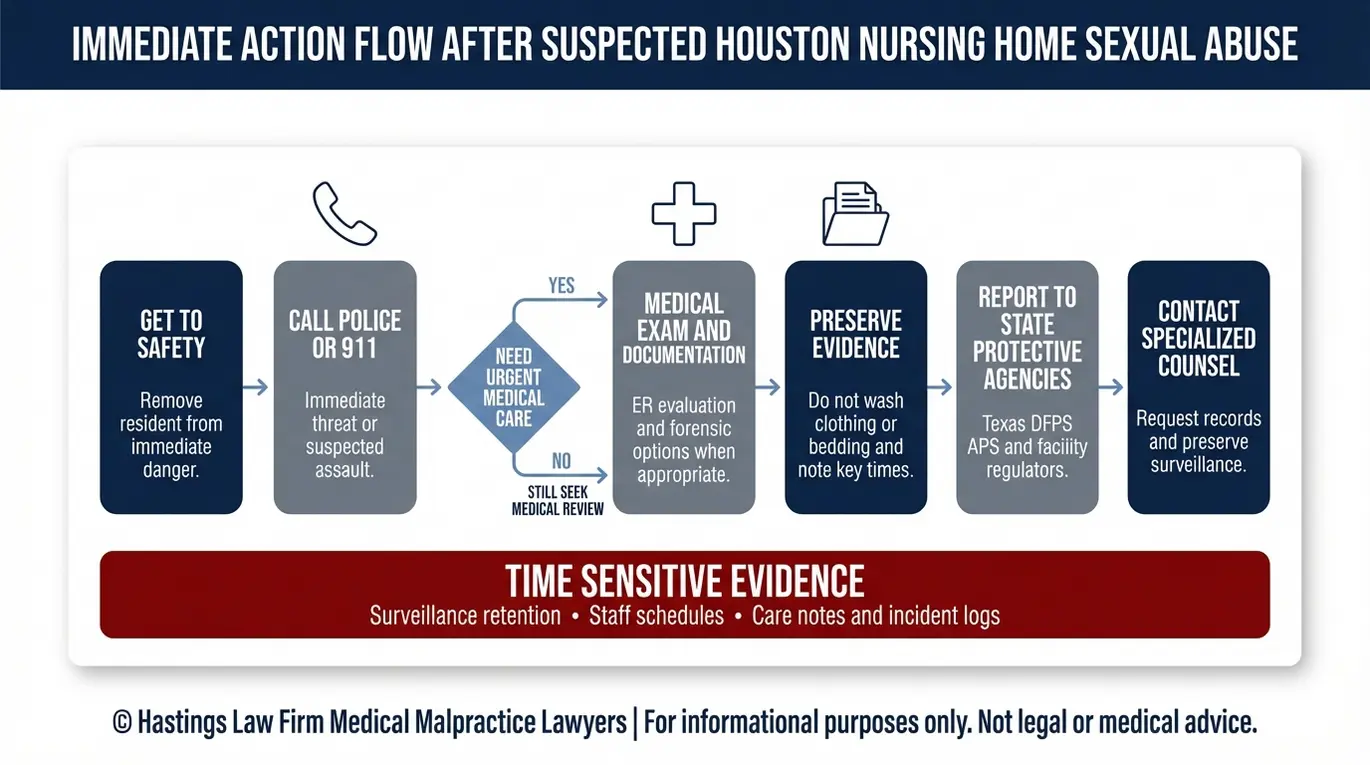
If you suspect sexual abuse, immediately remove the resident from the facility to a safe location, take them to a hospital for a forensic exam, report the incident to the local police and the Texas Department of Family and Protective Services, and contact a specialized attorney to preserve evidence. Below is a step-by-step guide for the first critical hours:
- Call 911 or local police. Your loved one’s immediate safety comes first. Contact law enforcement to file a police report regarding the suspected abuse and ensure the resident is removed from any ongoing danger.
- Seek a medical examination. Take your loved one to a hospital for a forensic exam. Ask about a Sexual Assault Nurse Examiner (SANE), a specially trained nurse who conducts a sexual assault forensic examination, a specialized process to document injuries and collect physical evidence.
- Report to the state. File a report with the Texas Department of Family and Protective Services through Adult Protective Services. Texas law requires that allegations of abuse in care facilities be investigated by state authorities.
- Contact an attorney experienced in these cases. An attorney can act quickly to preserve evidence such as surveillance footage, employment records, and internal incident reports before they are altered or destroyed. Facilities are not always forthcoming with this information, and early legal involvement helps protect your family’s rights.
Do not confront the facility or the suspected abuser directly. Let law enforcement and your legal team handle the investigation while you focus on your loved one’s safety and well-being.
Contact the Houston Nursing Home Attorneys at Hastings Law Firm Today for Help
No family should have to face this alone. If someone you love has been sexually abused in a Houston nursing home, the attorneys at Hastings Law Firm are here to listen, investigate, and hold the responsible parties accountable.
Our team includes in-house medical professionals, former defense attorneys, and board-certified trial lawyers who understand the sensitivity these cases demand. We prepare every case with rigor as we would for a jury trial, because that level of preparation is what it takes to secure a fair outcome.
Time matters. Surveillance footage can be overwritten, records can be altered, and memories fade. The sooner you reach out, the more evidence we can preserve.
Contact a Houston nursing home sexual abuse lawyer at Hastings Law Firm for a free, confidential case evaluation. We operate on a contingency fee basis, meaning you pay nothing unless we recover compensation on your behalf.
Frequently Asked Questions About Nursing Home Sexual Abuse in Houston


This content was researched and written by the Hastings Law Firm editorial team, which includes attorneys, medical professionals, and experienced researchers. Our writing is informed by internal knowledge and practical experience, and we cross-check critical details against authoritative sources cited throughout. Every piece undergoes human-led fact-checking and legal review. Because legal and medical information can change, if you spot an error, please contact us. Learn more about our content standards and review process on our editorial policy page.

Tommy Hastings, founder of Hastings Law Firm, is a board-certified personal injury trial lawyer dedicated exclusively to healthcare injury cases. Since 2001, he has represented injured patients and families in litigation against major hospital systems, pharmaceutical companies, and negligent healthcare providers nationwide. He has handled numerous high-profile cases that have drawn national media attention and resulted in multi-million dollar recoveries. He draws on that experience in his writing, helping readers understand how these cases work and what options may be available to them.
