


Texas Patient Fall in Hospital Lawyer
A hospital fall can leave a family facing sudden injuries, added medical needs, and lasting loss of independence that did not exist before admission. Many inpatient falls are preventable and may reflect breakdowns in basic safety practices such as monitoring, risk screening, and timely assistance. Texas law also treats some hospital fall claims as medical malpractice rather than ordinary premises negligence, which can affect what must be proven and what limits may apply. If you or a loved one were harmed or worse due to a patient fall in a hospital in Texas, contact Hastings Law Firm for a free, confidential case review.
Last Updated: September 20, 2026
Trusted Texas Medical Attorneys for Hospital Fall Negligence Claims
If a loved one falls while in the hospital, you likely have many questions. How did this happen? Wasn’t the staff supposed to be watching? You trusted the facility to keep your family member safe. Now you are dealing with a serious injury that did not exist before they were admitted.
It is natural to question why the hospital staff did not prevent the fall. Hospital falls are among the most preventable events in medicine. When they happen, it often points to breakdowns in basic patient safety.
As a Texas patient fall in hospital lawyer, we focus exclusively on medical malpractice. Our team includes in-house nurses and former defense attorneys who understand the internal systems hospitals use to defend these claims. If your loved one was injured in a fall during their hospital stay, we can review what happened and explain your legal options at no cost to you.

Hospital Liability: Distinguishing Malpractice from Ordinary Negligence
In Texas, a hospital fall is considered medical malpractice (under Chapter 74) if the fall resulted from a failure in medical judgment, such as inadequate nursing assessment or failure to implement fall protocols, rather than a simple slip-and-fall hazard like a wet floor. Choosing the correct legal path is critical because medical negligence claims have different evidence rules than standard slip-and-fall cases. This distinction changes how your medical negligence case is filed, what evidence is required, and what legal hurdles you must clear.
Texas law treats these two types of claims very differently. A “health care liability claim,” governed by Texas Civil Practice and Remedies Code Chapter 74, applies when the injury involves medical judgment or patient care. Standard premises liability covers non-medical hazards that could affect anyone on the property, such as a broken handrail in a stairwell.
For a patient who falls from a hospital bed or during a nurse-assisted transfer, the claim almost always falls under Chapter 74. This means you must prove the hospital breached the standard of care. This is the level of treatment a reasonably competent medical professional would have provided under similar circumstances. Simply showing that the fall occurred is not enough to prove a breach of the duty of care.
A lawyer for hospital falls must demonstrate that the medical staff failed to follow fall prevention protocols. These are the standard precautions hospitals are required to use for at-risk patients. These include risk screenings, bed alarm activation, and mobility assistance plans.
| Factor | Medical Malpractice (Chapter 74) | Premises Liability |
|---|---|---|
| Cause of Fall | Failure in nursing care, assessment, or medical protocols | Environmental hazard (wet floor, broken equipment) |
| Who Is Affected | Patients receiving medical care | Visitors, vendors, or non-patients |
| Legal Standard | Breach of the medical standard of care | Failure to maintain safe property conditions |
| Expert Report Required | Yes, within 120 days of the defendant’s original answer | No |
| Damages Cap | Non-economic damages capped under Chapter 74 | No statutory cap on non-economic damages |
Choosing the right legal category is the first step we take. Filing the wrong type of claim can lead to the court dismissing your case.
Claims Against Government-Run Hospitals
If the fall happened at a public or county hospital, a rule called sovereign immunity may limit the facility’s liability. Sovereign immunity is a legal rule that protects government facilities from most lawsuits unless they meet specific requirements. Understanding these rules is essential when dealing with public health systems.
Texas law requires special notice requirements before you can file a lawsuit against government-run Texas hospitals. The deadlines for that notice are often much shorter than the standard statute of limitations. If you miss these deadlines, you may lose your right to seek compensation forever. Talking to a lawyer early is the best way to protect your rights in cases involving public facilities.

Common Causes of Inpatient Falls: Where Safety Failures Occur
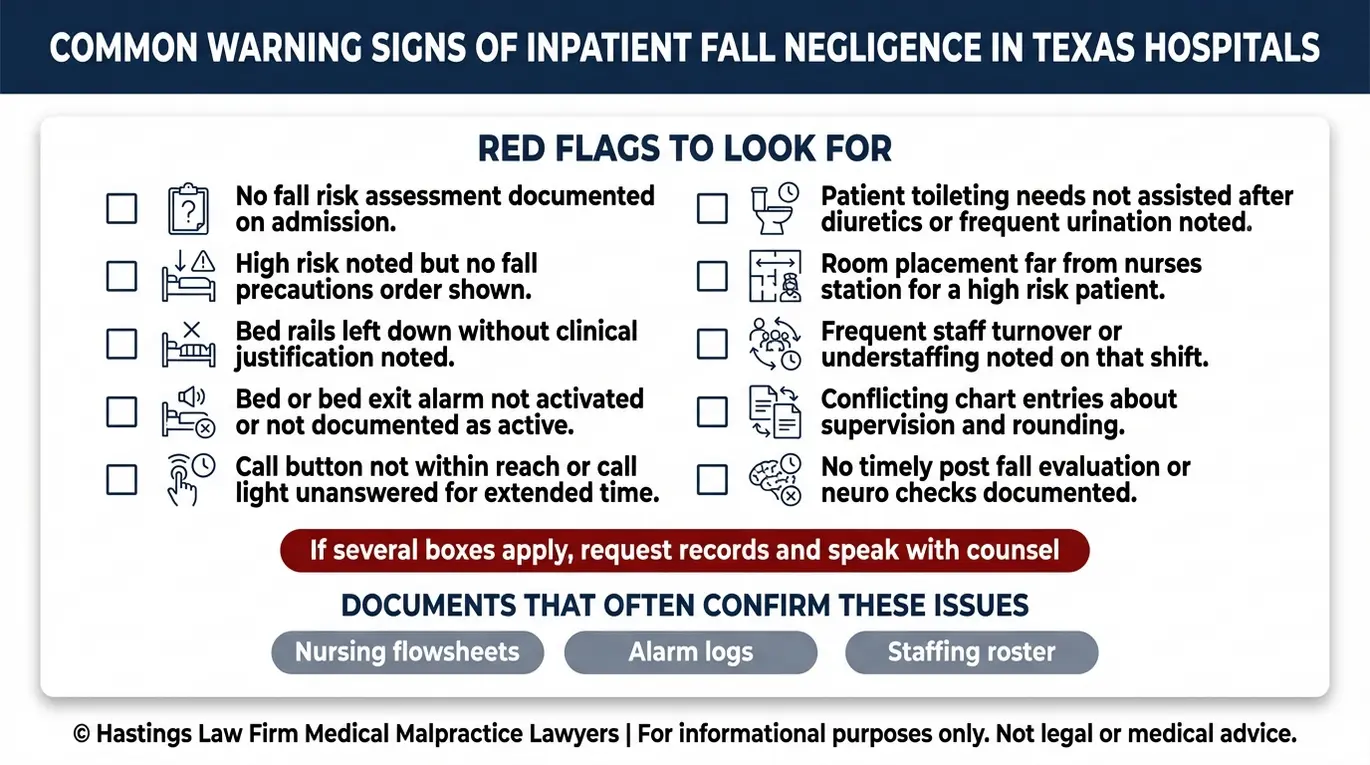
Inpatient falls are frequently caused by systemic failures such as understaffing, failure to activate bed alarms, neglecting fall risk assessments, or delayed responses to patient call buttons. These are not random accidents. They follow recognizable patterns that point to institutional breakdowns in patient monitoring and safety.
The CDC’s STEADI (Stopping Elderly Accidents, Deaths & Injuries) initiative identifies hospital falls among older adults as a major preventable health threat. In Texas medical malpractice cases, evidence-based guidelines help show what a hospital should have done to prevent a fall. When hospitals fail to follow these practices, patients pay the price.
Here are some of the most common safety failures we see in these cases:
- Failure to complete a fall risk assessment: Every patient should be screened at admission using a validated tool like the Morse Fall Scale. This is a scoring system that rates a patient’s fall risk based on factors like history of falling, mental status, and use of mobility aids. When this step is skipped, high-risk patients go unprotected.
- Bed exit alarms not activated: Staff must activate bed exit alarms for at-risk patients. A bed exit alarm is a sensor placed on the bed or mattress that alerts nursing staff when a patient attempts to get up without help. If the alarm is never set, no one may know the patient is moving until it is too late.
- Bed rails left down or improperly positioned: For patients identified as fall risks, raised side rails are a basic safety measure. Leaving them down allows a patient to try to leave the bed without help.
- Broken or inaccessible call buttons: If a patient cannot reach their call button, they may try to get up on their own. This often leads to falls when they wait for help that never arrives.
- Understaffing and nurse fatigue: When a hospital floor has too few nurses, response times drop. A patient may wait a long time for help after pressing their call light. Low nurse-to-patient ratios and overworked staff are common factors in these fall cases.
- Inadequate supervision during transfers: Moving a patient from a bed to a wheelchair requires hands-on assistance. Rushing this process or assigning it to untrained staff creates unnecessary risk for the patient.
An experienced lawyer will examine each of these areas to determine whether the hospital met its duty of care.
Toileting and Diuretics: A High-Risk Scenario
Toileting-related falls often happen because of a lack of supervision during a patient’s most vulnerable moments. This risk grows when patients take diuretics. These medications increase urine output and create a frequent, urgent need to toilet.
When a patient on diuretics presses the call light and no one responds, the patient may try to go alone rather than risk an accident in bed. The medical team has a responsibility to anticipate this need. If the care plan does not account for the risk of medication and limited mobility, that is a failure in planning.
The Hastings Law Firm Difference
Results matter, but what truly sets us apart is how we achieve them. Every verdict, every settlement, and every Texas courtroom victory comes from one guiding promise: To treat each client’s fight for justice as if it were our own.
This balance of skill, experience, and empathy reflects our core philosophy that justice should not only compensate the injured, but also make health care safer nationwide.

The Physical Toll: Injuries Resulting from Hospital Negligence
Hospital falls often result in catastrophic injuries such as hip fractures, subdural hematomas (bleeding between the brain and its outer covering), and spinal damage. A hospital fall can lead to long-term health problems that require expensive medical care for years. For elderly patients, these injuries can lead to massive long-term care costs and permanently reduce independence.
Hip and pelvis fractures are among the most devastating outcomes. These breaks often set off a chain of complications for elderly patients. Immobility can lead to blood clots, pneumonia, and rapid muscle loss. A study published in PubMed Central on hip fracture-related mortality trends documents the high death rates associated with these fractures in older adults.
Traumatic brain injuries present a dangerous threat. A subdural hematoma, which is a brain bleed caused by the head striking a hard surface, can develop slowly and go undetected for days. This risk is higher for patients taking blood-thinners, where a minor head impact can lead to life-threatening bleeding.
| Injury | Long-Term Consequence |
|---|---|
| Hip or pelvis fracture | Loss of mobility, extended rehabilitation, increased mortality risk within one year |
| Subdural hematoma (TBI) | Cognitive decline, permanent neurological damage, or death |
| Spinal cord injury | Partial or complete paralysis, chronic pain, lifelong care needs |
| Soft tissue and joint damage | Chronic pain, reduced range of motion, repeat surgeries |
When a fall leads to a patient’s death, the family may have a wrongful death claim. A lawyer for patient injuries can evaluate whether the fall and the care failures were the proximate cause of the death. Proximate cause is the legal term for the primary event that directly results in an injury or loss.
Proving Negligence: How We Investigate Your Case
We prove negligence by securing the audit trail of the call light system, analyzing staffing logs for shortages, and working with medical experts to establish that the hospital’s failure to follow safety protocols directly caused the injury. We investigate and prepare every case we accept as if it were going to trial to ensure we are ready to present the facts to a jury.
Here is the process our team follows as your hospital fall injury attorney:
- Preserve and secure critical evidence. We send immediate demands to the hospital to secure all data for evidence collection. Securing this evidence allows us to see exactly what the medical staff was doing when the fall occurred. Digital records provide a footprint of staff activity. We also request the call light system audit trail to see when a patient called for help and how long they waited.
- Analyze staffing records and assignment sheets. We review staffing logs to see how many patients were assigned to each nurse when the fall happened. If the floor was short-staffed, it points to a systemic failure rather than a single mistake.
- Engage qualified medical experts. Through our national network, we use physicians and nursing specialists whose expert opinions can evaluate whether the hospital met the standard of care. Under Texas Civil Practice and Remedies Code Chapter 74, an expert report is required within 120 days of the defendant’s original answer.
- Interview witnesses. Roommates and visiting family members may have seen gaps in supervision. Their firsthand accounts can provide powerful evidence of unanswered call lights or the circumstances of the fall.
- Build the causation timeline. Our in-house nurses create a timeline to connect the hospital’s failures to the injury. At this stage, the medical and legal analysis comes together to show that the fall could have been prevented.
Room Placement and Visibility
Where a high-risk patient is placed on the floor matters. Hospitals must consider how easily staff can see and reach a patient when deciding where to place them. Positioning patients with a documented fall risk closer to the nurses’ station allows for faster response times. If a patient was assigned to a room far from help, that room distance may have contributed to the injury.

Damages and Compensation for Fall Victims
Patients injured by hospital falls in Texas may recover economic damages for additional medical bills and lost wages, as well as non-economic damages for physical pain, mental anguish, and physical impairment. These damages help families pay for the medical care the patient now requires because of the injury.
Economic damages pay for the measurable financial costs caused by the fall. These include corrective surgeries, rehabilitation, in-home nursing care, and income lost during recovery. For elderly patients who require long-term care, these costs can be very high.
Non-economic damages cover losses that do not have a set price but change your life forever. Pain and suffering, emotional distress, and loss of independence all fall into this category. Texas law does cap non-economic damages in medical malpractice cases. A lawyer can help you understand how those limits apply to your case.
The Centers for Medicare & Medicaid Services (CMS) classifies certain preventable hospital falls as “Never Events.” These are events that should not happen in a safe healthcare setting. When CMS labels an injury this way, Medicare may refuse to pay the hospital for treating that injury. This classification can help your case and potential settlement by showing that even the government views these falls as preventable.
Contact the Texas Hospital Malpractice Attorneys at Hastings Law Firm Today for Help
Hospital falls leave families with injuries, unanswered questions, and medical bills that should never have existed. If you believe your loved one’s fall could have been prevented with proper care, you deserve to know what happened and whether the hospital can be held accountable.
Tommy Hastings is board-certified in Personal Injury Trial Law by the Texas Board of Legal Specialization, an honor held by fewer than 2% of Texas attorneys. Our firm has spent decades holding medical facilities accountable for safety failures. Texas law limits the time you have to file a medical malpractice claim, so it is important to act quickly.
Our team of attorneys, in-house nurses, and board-certified patient advocates is ready to review your case. We offer a free case evaluation to help you understand your options. You pay no fees unless we recover compensation on your behalf. Call Hastings Law Firm today to get the answers and accountability your family deserves.
Frequently Asked Questions About Patient Fall in Hospital in Texas


This content was researched and written by the Hastings Law Firm editorial team, which includes attorneys, medical professionals, and experienced researchers. Our writing is informed by internal knowledge and practical experience, and we cross-check critical details against authoritative sources cited throughout. Every piece undergoes human-led fact-checking and legal review. Because legal and medical information can change, if you spot an error, please contact us. Learn more about our content standards and review process on our editorial policy page.

Gabe Sassin has focused exclusively on medical malpractice law since 2007. After spending more than a decade as a malpractice defense attorney, he knows exactly how the other side works. He has seen firsthand how healthcare providers, insurers, corporate defendants, and their legal teams think, prepare, and build their defense against claims. That knowledge works for the people who need it most today, injured patients and their families. His unique experience shapes everything he writes, giving readers a look at how these cases actually work from someone who has handled them from both sides.
