


Arizona Pain Management Center Malpractice Lawyer
Written by: Hastings Law Firm | Reviewed by: Tommy Hastings | Updated: July 27, 2026
Pain management care is meant to reduce suffering, but preventable mistakes at a pain clinic can leave patients with new injuries, worsening symptoms, and lasting uncertainty. In Arizona, negligence claims often turn on whether a provider or facility fell below the accepted standard of care and whether that lapse caused measurable harm. These cases can involve disputes about known procedure risks, medication oversight, and whether a patient condition would have worsened anyway. If you or a loved one were harmed or worse due to pain management center malpractice in Arizona, contact Hastings Law Firm for a free, confidential case review.

Top Rated Representation for Pain Clinic Negligence in Arizona
What You Should Know About Pain Clinic Negligence Claims in Arizona:
- Serious harm can follow pain clinic negligence, including nerve damage, spinal cord injury, and infections.
- Recovery can be limited or lost if a medical injury claim is not brought within the applicable Arizona time limit.
- Options may remain open when an injury is not immediately linked to a medical error, because Arizona recognizes a discovery based start to the filing period.
- Facility accountability can expand who may be responsible, since Arizona recognizes vicarious liability for staff negligence and systemic clinic failures.
- Disputes over causation can be central, because defendants often argue worsening pain reflects an underlying condition rather than a new injury from an error.
- Medication related injuries can be a major driver of claims, especially when multiple drugs are prescribed without adequate oversight and dangerous interactions occur.
- Some procedure outcomes can create a presumption of negligence, such as wrong site injections or retained foreign objects.
- Compensation can include economic and non economic losses, and Arizona law does not impose a cap on malpractice damages awarded by a jury.
- Insurance reimbursement claims can reduce net recovery, because subrogation liens may apply when health insurance paid for injury related care.
- A claim may not move forward without qualified medical expert support in Arizona, because expert testimony is required to establish the standard of care.

A Healthcare Focused Law Firm
When you trust a pain management provider to help you feel better, and something goes wrong instead, the experience can leave you feeling confused and unsure of what to do next. You may be dealing with new or worsening symptoms, struggling to get clear answers, and wondering whether what happened to you was avoidable. Those feelings are valid, and you are not alone.
An experienced Arizona pain management center malpractice lawyer can help you understand whether your injury resulted from a preventable medical error. At Hastings Law Firm, our team of attorneys, nurse consultants, and former defense counsel focuses exclusively on medical malpractice. The firm was founded by Tommy Hastings, a board-certified trial lawyer who has dedicated his career to medical malpractice cases. We can review what happened, explain your legal options, and help you decide on a path forward. Contact us for a free, confidential case evaluation.
Defining Negligence in Arizona Pain Management Centers
Medical negligence in a pain management setting occurs when a physician, nurse, or facility deviates from the accepted standard of care, directly causing injury or worsening the patient’s condition through errors like improper injections or medication mismanagement. Establishing medical negligence requires specific legal criteria. The standard of care refers to the level of treatment a reasonably competent pain management professional would provide under similar circumstances.
In this specialty, that includes protocols like monitoring vital signs during procedural sedation, which is the use of medications to sedate a patient during a procedure. It also includes maintaining sterile technique and reviewing a full medical history before prescribing medication.
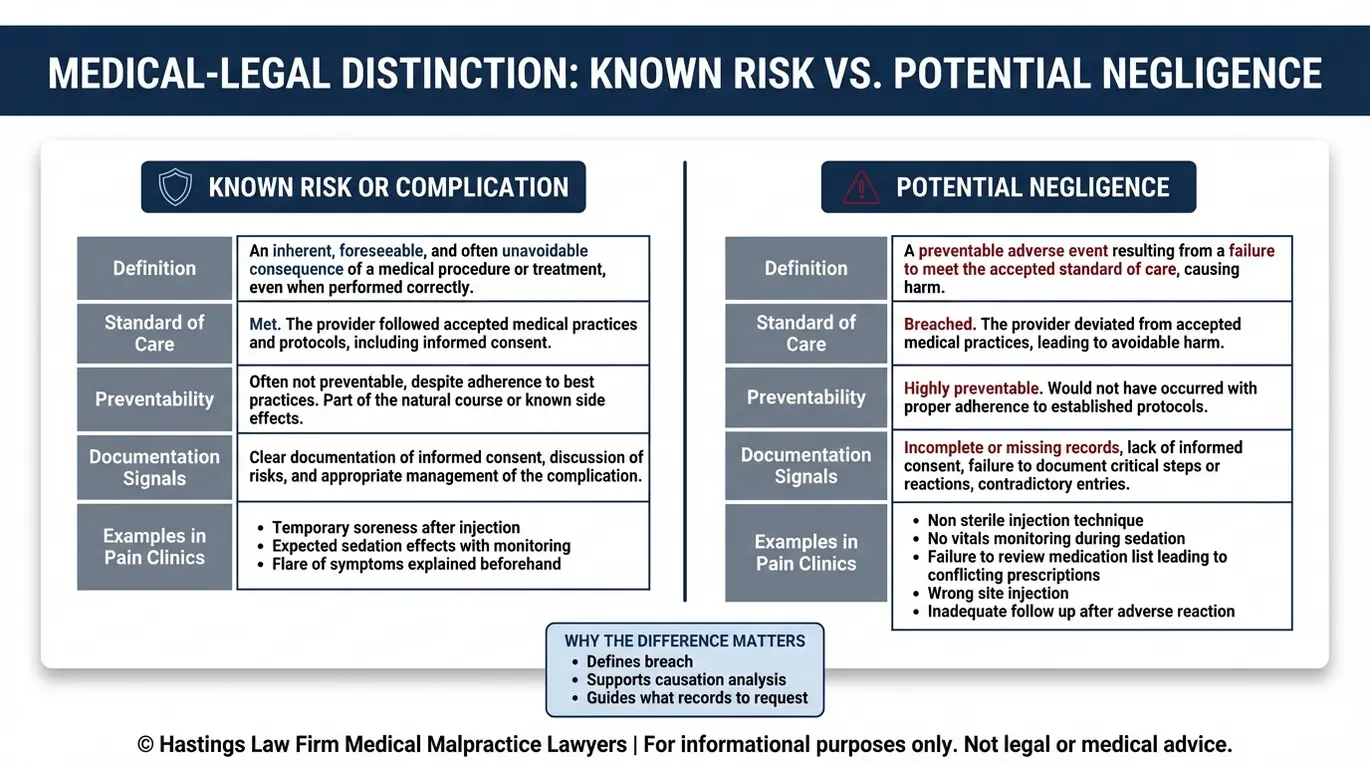
Not every bad outcome after a pain management procedure is malpractice. Some procedures carry known risks, and a complication can occur even when everything is done correctly. The legal question is whether the provider’s actions fell below the accepted standard and whether that failure caused your injury. A known complication, like temporary soreness after an injection, is different from a preventable Arizona pain management error, like nerve damage caused by incorrect needle placement.
A pain clinic negligence lawyer evaluates these details carefully because the distinction between a recognized risk and a genuine breach of the standard of care is often where these cases are won or lost.
Common types of pain management errors include:
- Injection errors: Incorrect needle placement during epidural steroid injections (ESIs) or facet joint injections.
- Medication mismanagement: Prescribing opioids without proper monitoring, failing to check for drug interactions, or operating what amounts to a pill mill, a clinic that prescribes controlled substances without legitimate medical justification.
- Inadequate monitoring: Failing to track patient vitals during or after sedation procedures.
- Sterile technique failures: Using contaminated equipment or failing to follow proper sterilization protocols, leading to infections.
- Failure to obtain informed consent: Not explaining the risks and alternatives before performing a procedure.
Arizona law also recognizes the concept of vicarious liability, meaning the pain management facility itself can be held responsible for the negligent actions of its staff. If a clinic’s systemic failures, such as inadequate staffing, poor training, or unsafe protocols, contributed to a patient’s injury, the institution may share liability alongside the individual provider. A pain management malpractice attorney examines both the provider’s conduct and the facility’s operational practices to identify every responsible party.
Pain Management Treatment Related Injuries
Pain management involves procedures that carry real physical risks when performed incorrectly. An Arizona pain management error can result in injuries that are distinct to this specialty and can significantly affect a patient’s quality of life. These specific complications often require detailed medical evaluation to prove negligence.
Nerve damage is one of the most serious outcomes. A misplaced needle during an epidural steroid injection (ESI), which delivers anti-inflammatory medication into the epidural space around the spinal nerves, or a facet joint injection, can compress or sever a nerve. This can lead to chronic pain, numbness, or loss of function in the affected area. Spinal cord injury can occur during procedures performed near the spine, with consequences ranging from localized weakness to partial paralysis.
Infections are another significant risk. When sterile protocols are not followed during injections or implant procedures, bacteria can be introduced into the body. Spinal infections in particular can become life-threatening if not promptly diagnosed and treated. Patients may also suffer injuries from improperly implanted devices, failed pain pumps, or reactions to medications administered without adequate screening.
Proving Liability in Pain Clinic Cases
To prove liability, a plaintiff must demonstrate four elements: a duty of care existed, the provider breached that duty, the breach directly caused a specific injury, and the injury resulted in compensable damages. In Arizona malpractice law, establishing a breach of duty is essential. An experienced malpractice lawyer in Phoenix understands that these elements of negligence form the foundation of every medical negligence case, including claims against pain management providers.
Here is a breakdown of each element:
- Duty of care: A doctor-patient relationship existed, creating a legal obligation to treat the patient according to accepted medical standards. This relationship establishes a fiduciary responsibility where patient safety must come first.
- Breach of duty: The provider’s actions fell below the standard of care, such as failing to review a patient’s medication history before prescribing a new opioid. A breach is a failure to act as a competent professional would.
- Causation: The breach directly caused the patient’s injury, rather than the injury being a result of the underlying chronic pain condition. For example, if a patient had back pain and an injection caused leg paralysis, we must prove the paralysis is distinct from the history of back pain.
- Damages: The patient suffered real, measurable harm, whether physical, financial, or emotional.
Defense attorneys often contest causation when you sue a pain management doctor. They frequently argue that the patient’s pain or worsening condition is simply a progression of their pre-existing chronic pain. Overcoming this argument requires detailed medical evidence and qualified expert analysis showing that the provider’s specific error, not the underlying condition, caused the new or worsened injury.
One area of particular concern in pain clinic cases is polypharmacy, which is the practice of prescribing multiple medications simultaneously. When a provider combines conflicting medications such as opioids and benzodiazepines without proper oversight, the risk of dangerous drug interactions increases significantly.
Dosages are often measured in morphine milligram equivalents (MME), a standardized unit used to compare the potency of different opioids. Prescribing above recommended MME thresholds without documented justification can be strong evidence of a breach.
National overdose data tracked through CDC WONDER underscores the scope of opioid-related harm across the country. An Arizona medical negligence attorney can use prescribing records and pharmacy data to establish whether a clinic’s practices fell outside accepted guidelines.
Res Ipsa Loquitur in Procedure Cases
In some situations, the injury itself is evidence of negligence. The legal doctrine of res ipsa loquitur, a Latin phrase meaning “the thing speaks for itself,” applies when an injury could not have occurred without some form of negligence. This legal doctrine simplifies cases where the error is obvious to a layperson.
In pain management cases, res ipsa loquitur may apply when a provider performs a wrong-site injection, delivering medication to the incorrect area of the spine, or when a procedure results in a dural puncture. This is an accidental puncture of the membrane surrounding the spinal cord that causes spinal fluid to leak. A retained foreign object, such as a broken needle tip, is another example. These outcomes fall outside the range of expected results and can create a presumption of negligence that the defense must rebut.
The Hastings Law Firm Difference
Results matter, but what truly sets us apart is how we achieve them. Every verdict, every settlement, and every Arizona courtroom victory comes from one guiding promise: To treat each client’s fight for justice as if it were our own.
This balance of skill, experience, and empathy reflects our core philosophy that justice should not only compensate the injured, but also make healthcare safer nationwide.

Arizona Statute of Limitations for Medical Injury Claims
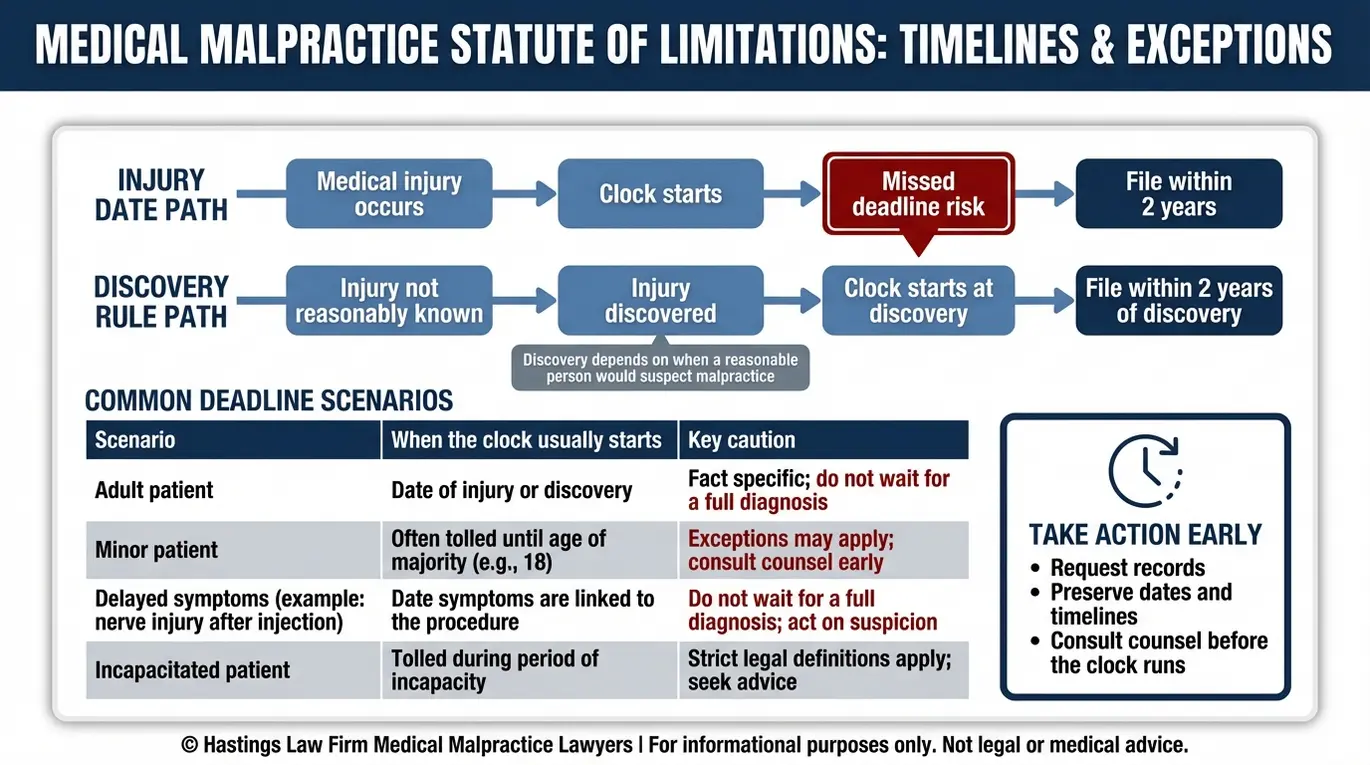
In Arizona, the standard statute of limitations for medical malpractice claims is two years from the date the injury occurred or two years from the date the injury was discovered, though specific exceptions apply for minors. Missing this time limit to file almost always means losing the right to pursue a claim, regardless of how strong the evidence may be.
The two-year filing deadline is established under A.R.S. § 12-542. For many patients, the clock starts on the date of the procedure or treatment that caused the injury. But pain management injuries are not always immediately apparent. Nerve damage from an injection may develop gradually, or a patient may not realize that a pain pump malfunction caused their worsening symptoms until months later.
The discovery rule helps when an injury is not immediately obvious. Under this rule, the statute of limitations begins when the patient knew, or reasonably should have known, that their injury was caused by medical error. This exception exists to protect patients who had no way of connecting their symptoms to a provider’s mistake at the time it happened.
Arizona also requires patients to support their claim with a preliminary expert opinion affidavit under A.R.S. § 12-2603, which must be filed early in the litigation process. This is one reason consulting with an attorney promptly is so important; your legal team needs time to investigate, obtain records, and secure expert review before any Arizona pain management lawsuit deadline passes.
| Category | Filing Deadline | Key Details |
|---|---|---|
| Adults (standard) | 2 years from the date of injury | Governed by A.R.S. § 12-542 |
| Discovery rule | 2 years from the date the injury was discovered | Applies when harm is not immediately apparent |
| Minors | Varies; the statute may be tolled until the minor reaches 18 | Specific rules apply depending on the child’s age |
The Litigation Process for Pain Management Claims
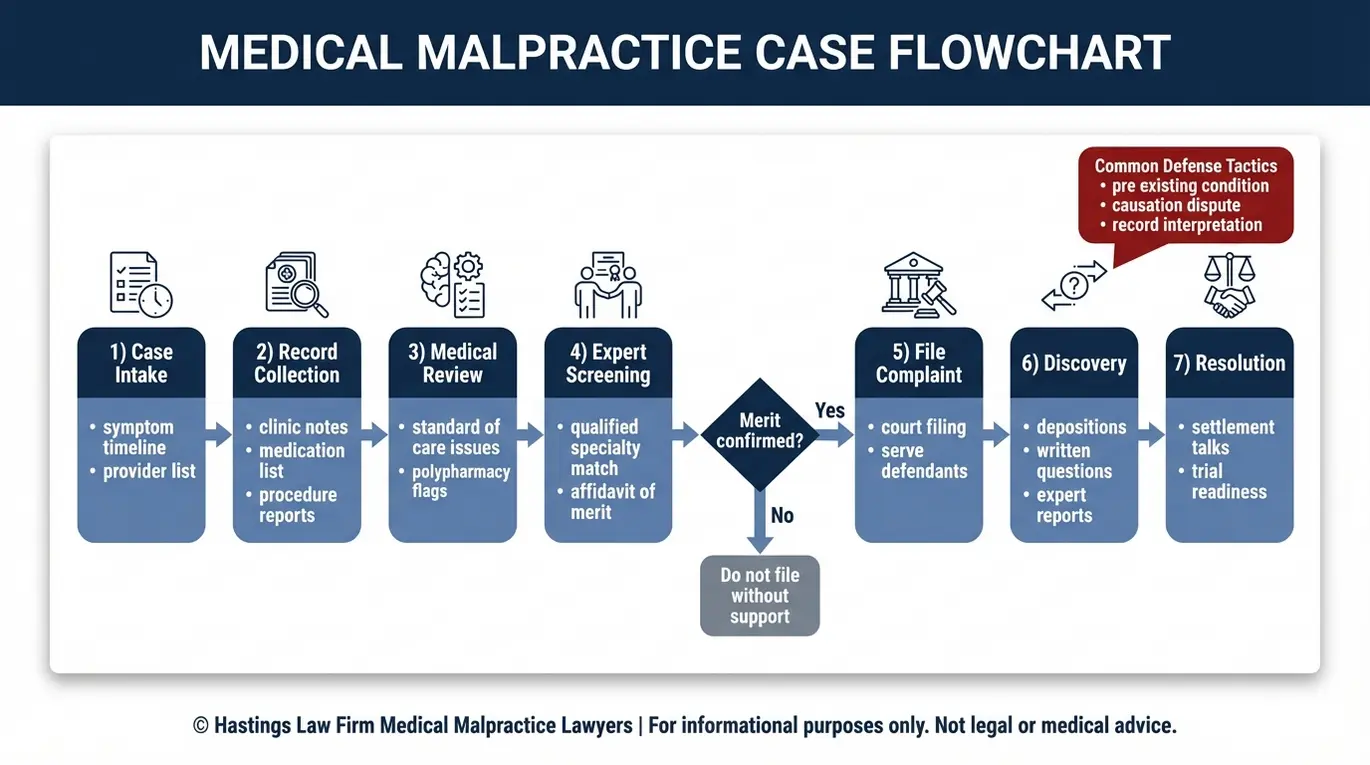
The medical malpractice legal process begins with a comprehensive investigation and affidavit of merit, followed by filing the complaint, a discovery phase where evidence is exchanged, and concluding with settlement negotiations or a jury trial. Here is how the process typically unfolds:
- Investigation and expert review: Our medical team, which includes in-house nurse consultants and board-certified patient advocates, gathers all relevant medical records, imaging, and clinical notes. We perform a thorough investigation of medical records to find inconsistencies. We then work with medical experts to determine whether the standard of care was breached and to secure the required affidavit.
- Filing the complaint: Once the investigation supports a malpractice claim, we submit a formal complaint to the court. This document outlines the facts of the case, identifies the defendants, and states the legal basis for the claim.
- Discovery: Both sides exchange evidence during this discovery phase. This gathering includes written questions, requests for documents, and depositions, where the nursing staff and other witnesses provide sworn testimony. These sworn interviews lock the defendants into their stories, preventing them from changing their defense strategy at trial. Our former defense attorneys know exactly what to look for because they once conducted these same depositions from the other side.
- Settlement negotiation or trial: Many malpractice cases resolve through negotiated settlement once the evidence is fully developed. However, we prepare every case from day one as though it will go before a jury. This trial-ready approach signals to insurance carriers that we will not accept less than fair value for our clients.
Calculating Damages for Chronic Pain Injuries
Damages in Arizona malpractice cases cover economic losses like medical bills and lost wages, as well as non-economic damages for pain and suffering, with no constitutional cap on the amount a jury can award. Arizona’s Constitution, under Article 2, Section 31, specifically prohibits the legislature from placing a cap on malpractice damages Arizona juries can award. That means a jury has the full authority to award compensation that reflects the true scope of the harm.
Understanding the two main categories of damages is essential for anyone considering a claim:
| Economic Damages | Non-Economic Damages |
|---|---|
| Past and future medical expenses | Physical pain and suffering |
| Corrective surgeries or procedures | Emotional distress and mental anguish |
| Lost wages and diminished earning capacity | Loss of enjoyment of life |
| Rehabilitation and physical therapy | Loss of consortium (impact on relationships) |
| Prescription medication costs | Permanent disability or disfigurement |
Economic damages are calculated based on documented financial losses. If a pain management error caused nerve damage that now requires corrective surgery, those surgical costs are included. This also covers follow-up care, physical therapy, and any time missed from work.
Seeking compensation for future medical expenses ensures these needs are met. Future medical costs are especially important in chronic pain cases because the effects of a botched procedure can require ongoing treatment for years. Inflation and rising healthcare costs must be factored into these life care plans to ensure the settlement lasts a lifetime.
Non-economic damages address the ways an injury affects your daily life beyond your bank account. Chronic pain that worsens because of a provider’s negligence can limit your ability to work, care for your family, or enjoy activities you once valued. Arizona juries are permitted to value the loss of hobbies, family time, and independence. These losses are real, and Arizona law recognizes them fully.
One financial detail many patients do not anticipate is subrogation. If your health insurance paid for treatment related to the injury, your insurer may hold a subrogation lien, which is a legal right to be reimbursed from your settlement. Our team accounts for these obligations during settlement negotiations to protect your recovery. In wrongful death cases, surviving family members may also pursue compensation for funeral expenses and lost financial support.
The Role of Medical Experts in Pain Management Litigation
Expert testimony is legally required in Arizona to establish the standard of care. A qualified pain management expert witness must testify that the defendant’s actions fell below accepted medical practices and that the deviation caused the patient’s injury. Without this testimony, a malpractice case cannot move forward.
Arizona law requires that the testifying expert practice in the same specialty as the defendant. If your case involves a botched spinal cord stimulator (SCS) or a malfunctioning intrathecal pain pump, the expert must have relevant experience with these procedures. An SCS is a device surgically placed to deliver electrical impulses that interrupt pain signals.
Finding qualified experts willing to testify against peers in the medical community can be difficult. Hastings Law Firm maintains a national network of top-tier medical experts across specialties, including pain management, anesthesiology, and interventional radiology. Our in-house medical staff works alongside these experts to analyze records, build a clear narrative for a jury, and support the affidavit of merit.
Contact the Arizona Healthcare Malpractice Attorneys at Hastings Law Firm Today for Help
You trusted a medical professional to manage your pain, and if that trust was broken by a preventable error, you deserve honest answers about what happened and what comes next. Holding negligent providers accountable is not just about your recovery; it can help prevent the same thing from happening to someone else.
Hastings Law Firm is an Arizona pain management malpractice law firm built for cases like yours. Our team of attorneys, nurse consultants, and former defense counsel focuses exclusively on medical malpractice, and we have the medical knowledge and trial experience to handle complex pain management claims.
We work on a contingency fee basis, which means you pay no attorney fees or costs unless we secure a recovery for you. If you or a loved one has been harmed by negligent care at a pain clinic, reach out to us for a free, confidential case evaluation. Let us help you find the answers you deserve.
Frequently Asked Questions About Pain Management Center Malpractice in Arizona


This content was researched and written by the Hastings Law Firm editorial team, which includes attorneys, medical professionals, and experienced researchers. Our writing is informed by internal knowledge and practical experience, and we cross-check critical details against authoritative sources cited throughout. Every piece undergoes human-led fact-checking and legal review. Because legal and medical information can change, if you spot an error, please contact us. Learn more about our content standards and review process on our editorial policy page.

Tommy Hastings, founder of Hastings Law Firm, is a board-certified personal injury trial lawyer dedicated exclusively to healthcare injury cases. Since 2001, he has represented injured patients and families in litigation against major hospital systems, pharmaceutical companies, and negligent healthcare providers nationwide. He has handled numerous high-profile cases that have drawn national media attention and resulted in multi-million dollar recoveries. He draws on that experience in his writing, helping readers understand how these cases work and what options may be available to them.
