


Fort Worth Over Prescribing of Medication Lawyer
Written by: Hastings Law Firm | Reviewed by: Brady D. Williams | Updated: July 27, 2026
Negligent prescribing can turn medical care into a source of addiction, overdose, or lasting harm, especially when opioids are given without careful review of history, dosing guidance, and ongoing monitoring. These situations often involve missed warning signs, unsafe dose escalation, or dangerous drug combinations, and the impact can extend to families who relied on a provider to act responsibly. Accountability may involve more than one party, including prescribers, pharmacies, hospitals, or manufacturers. If you or a loved one were harmed or worse due to over prescribing of medication in Fort Worth, Texas, contact Hastings Law Firm for a free, confidential case review.
Trusted Medical Attorneys in Fort Worth for Negligent Prescribing
What You Should Know About Excessive Medication Negligence Claims in Fort Worth:
- Long term harm can follow when prescribing decisions ignore patient history, dosage guidance, or monitoring.
- Severe outcomes can occur when opioids are prescribed in ways that create dependency, toxicity, or overdose.
- Responsibility can extend beyond the prescriber when a pharmacy fills a prescription that presents clear safety red flags.
- Institutional accountability can matter when a hospital allows a high risk physician to practice without proper vetting.
- Options against drug manufacturers can be limited when warnings were provided to the prescribing doctor rather than directly to the patient.
- Recovery can be reduced when non compliance or misuse defenses shift focus away from the prescriber conduct.
- Compensation can include financial losses and personal suffering tied to negligent prescribing injuries.
- Non economic recovery can be limited in Texas, while reimbursement for documented financial losses is treated differently.
- Punitive damages may be available when conduct is described as extreme recklessness or tied to pill mill practices.
- Case outcomes can depend on whether prescription records, monitoring program data, and lab results show ignored warning signs.

A Healthcare Focused Law Firm
When a doctor’s prescribing habits cause addiction, overdose, or lasting physical harm, the damage reaches far beyond the initial prescription. Patients and families dealing with the fallout of negligent prescribing often feel a deep sense of betrayal. You trusted a medical professional to help you heal, and instead, that relationship may have led to dependency on opioid analgesics, a class of powerful painkillers that carry serious risks including respiratory depression, a dangerous slowing of breathing that can be fatal in high doses.
If you or someone you love has been harmed by a physician’s negligent prescribing, you are not wrong for questioning what happened. Hastings Law Firm focuses exclusively on medical malpractice, and our team includes in-house medical professionals who understand both the clinical and legal sides of these cases. A Fort Worth over prescribing of medication lawyer at our firm can review your situation in a free, confidential consultation and help you understand your options.
How Over Prescribing Occurs in Hospitals and Private Practices
Over-prescribing occurs when a physician disregards patient history, ignores dosage guidelines, or fails to monitor a patient’s medication usage. The consequences can include addiction, organ toxicity, or fatal overdose. Understanding the distinction between medical necessity and negligence is important when reviewing a doctor’s actions. There is an important distinction between a known side effect of a properly prescribed drug and a preventable adverse drug event caused by negligence.
Every medication carries some risk. But when a doctor prescribes opioids to a patient with a history of substance abuse, that is not a side effect. It is a prescription error if they increase dosages beyond safe morphine milligram equivalents (MME), which is a measurement used to compare opioid potency.
Some cases involve individual physicians who fail to exercise proper judgment. Others involve what are commonly known as pill mills, clinics that operate primarily to distribute large quantities of controlled substances with little to no legitimate medical oversight. In pill mill operations, patients may be cycled through brief appointments and handed prescriptions with minimal examination. Both scenarios can give rise to a claim, and a Fort Worth over prescribing of medication lawyer can help determine which applies.
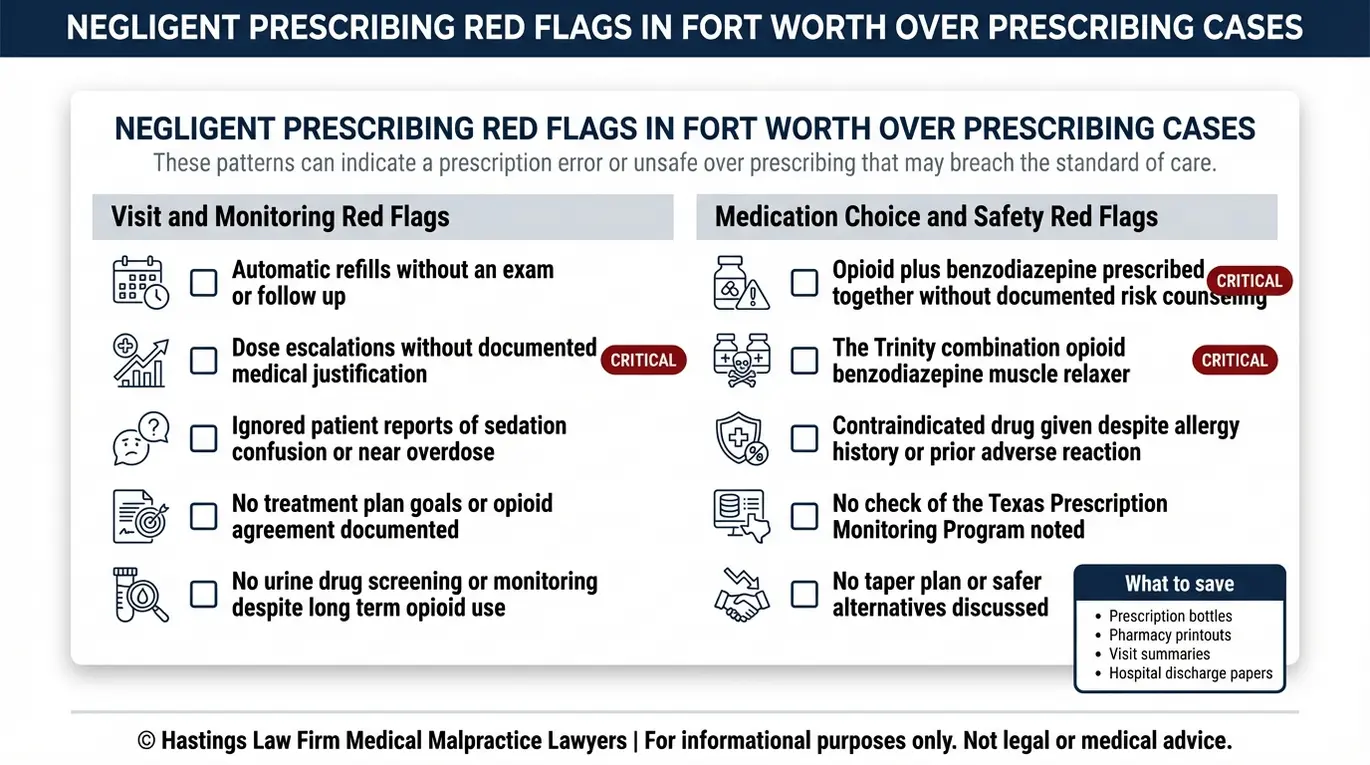
Recognizing the warning signs of negligent prescribing is a necessary step:
- Prescribing opioids or other controlled substances without reviewing the patient’s full medical history
- Ignoring patient complaints about side effects or signs of dependency
- Issuing automatic refills without follow-up examinations or dosage errors going unaddressed
- Prescribing contraindicated drugs or combinations known to cause dangerous drug interactions
- Failing to order appropriate lab work or monitoring for long-term medication use
- Rapidly escalating dosages without documented clinical justification
If any of these patterns look familiar, a medication error may have occurred, and it may be worth having your records reviewed by an over prescribing attorney.
Liability for Dangerous Drug Habits and Overdose
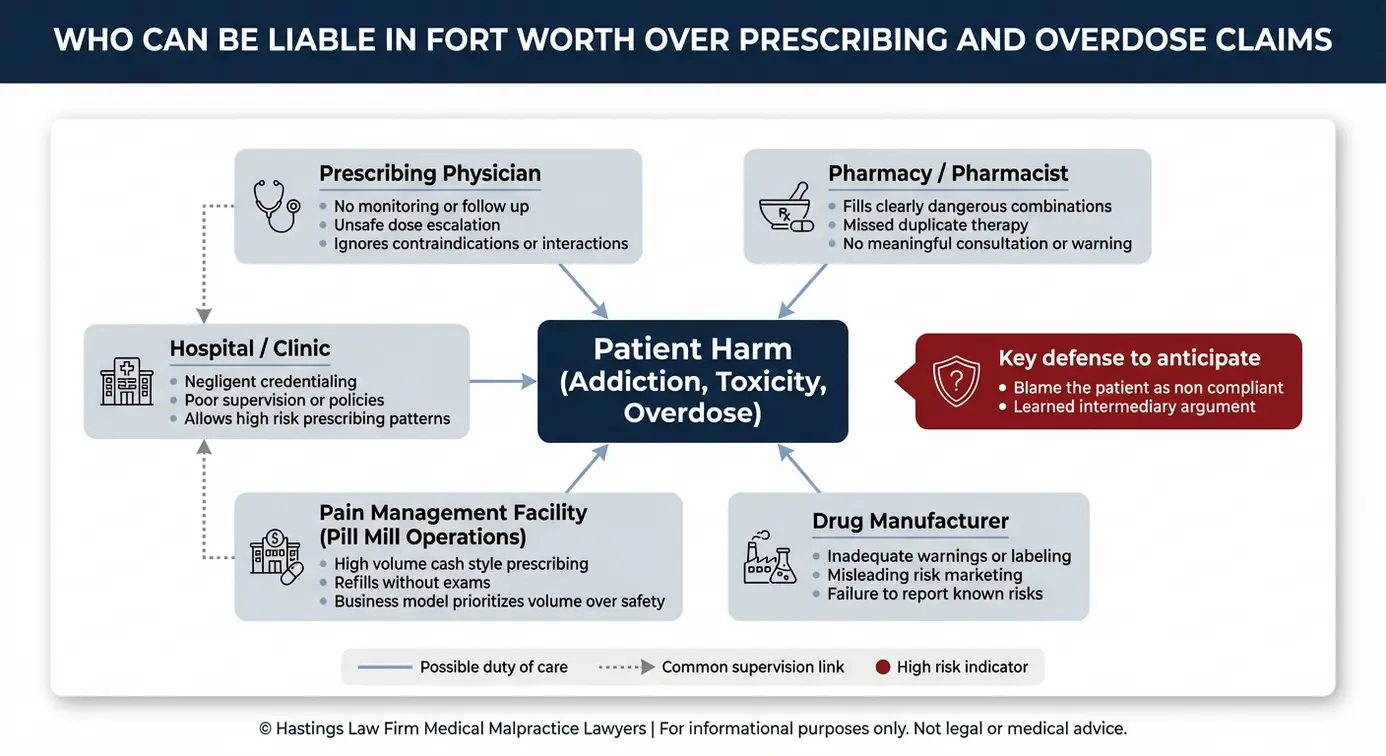
Liability in over-prescribing cases may extend beyond the prescribing physician to include the pharmacy that filled the dangerous order, the hospital that failed to supervise the doctor, or even pharmaceutical companies. Identifying every responsible party is essential to building a strong case. Our team includes former defense attorneys and experienced nurses who previously worked for the hospital systems they now challenge. A medication error attorney can assist in identifying every responsible party.
Physician liability often centers on a breach of duty, specifically the failure to check a patient’s prescription history before writing a new script. Texas operates the Texas Prescription Monitoring Program (Texas State Board of Pharmacy), a PMP database designed to flag patients who may be receiving dangerous quantities of controlled substances from multiple providers. A physician who fails to consult this tool before prescribing may have breached the duty of care owed to the patient.
Pharmacy liability can arise when a pharmacist fills a prescription that should have raised red flags. One well-known example is the “Holy Trinity” drug combination, the simultaneous prescribing of an opioid, a benzodiazepine, and a muscle relaxant. This combination carries a high risk of fatal respiratory depression, and a pharmacist has a professional obligation to question or refuse to fill prescriptions that present obvious dangers.
Hospital liability may apply when a healthcare facility grants privileges to a physician with a known history of malpractice complaints or disciplinary actions. This concept, known as negligent credentialing, holds hospitals accountable for failing to properly vet the physicians they allow to practice under their roof. Research published by the University of Arkansas at Little Rock Law Review examines how negligent credentialing claims allow injured patients to hold institutions directly responsible.
| Potentially Liable Party | Basis for Liability | Key Evidence |
|---|---|---|
| Prescribing Physician | Failure to monitor, ignoring PMP data, unsafe dosages | Prescription records, PMP reports, patient charts |
| Pharmacy / Pharmacist | Filling dangerous combinations without intervention | Dispensing logs, “Holy Trinity” prescriptions |
| Hospital / Clinic | Negligent credentialing of a high-risk physician | Credentialing files, prior complaints, disciplinary history |
| Drug Manufacturer | Failure to adequately warn of risks | FDA filings, marketing materials, drug labeling |
A Fort Worth over prescribing of medication lawyer at Hastings Law Firm works with our in-house medical staff to trace the full chain of negligence across every party involved.
The Learned Intermediary Doctrine and Pharmaceutical Liability
Pharmaceutical companies sometimes avoid liability by relying on the learned intermediary doctrine. Under this legal theory, the drug manufacturer argues that its duty to warn runs to the prescribing doctor, not directly to the patient. If the manufacturer provided adequate warnings through the FDA-approved drug label and black box warnings, they may claim the doctor is responsible. Black box warnings are the strongest safety alerts the FDA can require for drugs with serious or life-threatening risks.
This defense is not absolute. If the manufacturer promoted off-label uses, downplayed known risks of dangerous drugs, or distributed defective drugs with inadequate labeling, the company can still be held liable. An experienced lawyer for over prescribing will investigate the manufacturer’s conduct alongside the prescriber’s to determine where accountability truly lies.
The Hastings Law Firm Difference
Results matter, but what truly sets us apart is how we achieve them. Every verdict, every settlement, and every Fort Worth courtroom victory comes from one guiding promise: To treat each client’s fight for justice as if it were our own.
This balance of skill, experience, and empathy reflects our core philosophy that justice should not only compensate the injured, but also make healthcare safer nationwide.

Proving Causation and Negligence in Texas Courts
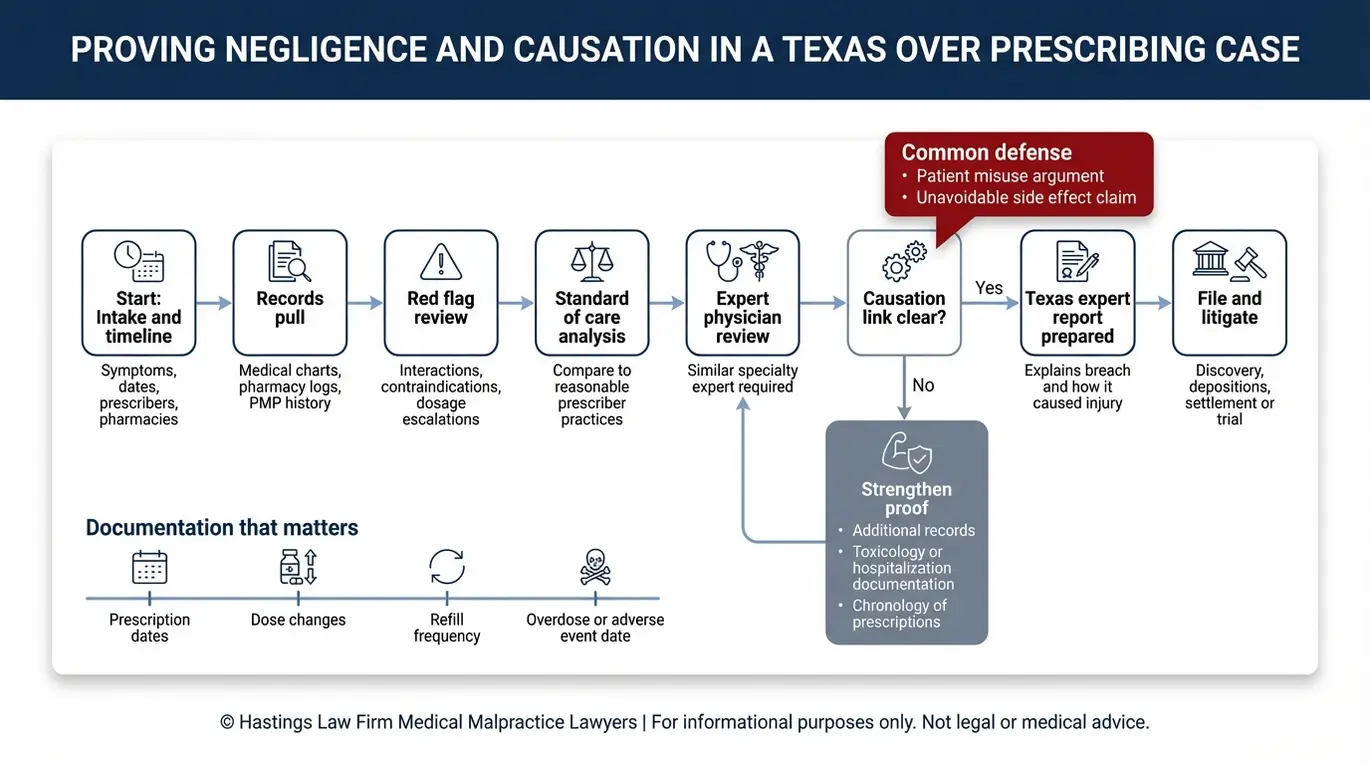
Proving negligence requires clear evidence that the doctor breached the accepted standard of care, such as violating established prescribing guidelines, and that this breach directly caused the patient’s injury or addiction. Under Texas medical malpractice law, cases follow a structured legal framework, and your legal team must satisfy each element to move the case forward with the help of a Fort Worth over prescribing lawyer.
Here is how we approach the process:
- Investigation and record collection: We gather pharmacy dispensing records, the physician’s chart notes, and the full audit trail of prescriptions. We also obtain urine drug screen (UDS) results, which are laboratory tests that detect what substances were actually present in a patient’s system. A thorough investigation often reveals that a doctor ignored these critical test results or continued prescribing despite clear signs of misuse.
- Expert review and report: Under the Texas Civil Practice and Remedies Code Chapter 74, a medical malpractice claim in Texas requires a qualified expert report. This report must come from a qualified health care provider practicing in the same or similar specialty and must detail how the standard of care was breached and how that breach caused harm. A medication error lawyer will ensure this document meets all statutory requirements and effectively counters any challenges from the defense.
- Litigation and overcoming defenses: Defense attorneys frequently argue that the patient bears responsibility, claiming “non-compliance” or “misuse” of the medication. The distinction between physical dependence, a predictable physiological response to prolonged opioid use, and addiction, a behavioral disorder involving compulsive use despite harm, is often central to these cases. We use the medical records and expert testimony to demonstrate causation, showing that the physician’s conduct, not the patient’s behavior, was the proximate cause of injury.
Data from the CDC’s Provisional Drug Overdose Death Counts underscores the scope of this crisis across the country, and Texas is no exception. An adverse drug event resulting from negligent prescribing is not a personal failing. It is a medical injury, and it deserves the same serious legal response as any other form of malpractice. An experienced over prescribing attorney can help you seek justice.
Potential Damages for Victims of Medication Errors
Patients harmed by over-prescribing may recover compensation that reflects both the financial toll and the personal suffering caused by negligent care. Texas law recognizes several categories of recoverable damages, and an over prescribing of medication attorney can help identify which apply to your circumstances, including cases of wrongful death.
| Economic Damages | Non-Economic Damages |
|---|---|
| Rehabilitation and detox program costs | Physical pain and suffering |
| Hospital bills from overdose treatment | Emotional distress and mental anguish |
| Lost wages and diminished earning capacity | Loss of consortium (damage to family relationships) |
| Ongoing medical care and therapy expenses | Loss of enjoyment of life |
Under Texas Civil Practice and Remedies Code § 74.301, non-economic damages in medical malpractice cases are subject to statutory caps. Economic damages, however, are not capped and are calculated based on actual financial losses. These damages are strictly calculated based on bills and receipts, ensuring you are reimbursed for every dollar spent on recovery.
In cases involving pill mills or extreme recklessness, punitive damages may also be available. As a specialized Fort Worth over prescribing lawyer, Tommy Hastings applies decades of experience to hold these operations accountable and ensure safety standards are followed. Tommy Hastings is a board-certified trial lawyer who has dedicated his career to enforcing accountability for patients. These damages send a powerful message to the medical community that patient safety must always come before profit.
Contact the Fort Worth Healthcare Malpractice Attorneys at Hastings Law Firm Today for Help
Hastings Law Firm was founded on a simple principle: patients who have been harmed by negligent medical care deserve answers, accountability, and fair compensation. Our firm is led by board-certified trial lawyer Tommy Hastings, who has over 20 years of experience in complex medical litigation. Our team of over prescribing attorneys, former defense lawyers, and in-house medical staff is built to handle exactly these cases.
Texas imposes strict time limits on medical malpractice claims, so acting promptly protects your right to seek justice. If you or a loved one has been injured by negligent prescribing, contact a Fort Worth over prescribing of medication lawyer at Hastings Law Firm for a free, confidential case evaluation. You pay no fees unless we recover compensation on your behalf.
Frequently Asked Questions About Over Prescribing of Medication in Fort Worth


This content was researched and written by the Hastings Law Firm editorial team, which includes attorneys, medical professionals, and experienced researchers. Our writing is informed by internal knowledge and practical experience, and we cross-check critical details against authoritative sources cited throughout. Every piece undergoes human-led fact-checking and legal review. Because legal and medical information can change, if you spot an error, please contact us. Learn more about our content standards and review process on our editorial policy page.

Brady D. Williams is a nationally recognized medical malpractice attorney who has spent his career handling high-stakes litigation for injured patients and families across the country. Licensed in both Texas and California, Brady draws on experience from hundreds of resolved medical cases to break down complex legal and medical topics for the people who need that information most. His writing reflects the same attention to detail and commitment to clarity that he brings to every case he handles.
