


Austin Over Prescribing of Medication Lawyer
Negligent prescribing can turn legitimate treatment into a life altering crisis when excessive dosing, ignored contraindications, or continued refills occur despite warning signs. Harm can build over time through dependency, organ damage, and other severe outcomes, especially when monitoring and follow up care are missing. Responsibility may involve more than one provider when pharmacists, nurses, or hospitals fail to catch unsafe orders or system alerts. If you or a loved one were harmed or worse due to over prescribing of medication in Austin, Texas, contact Hastings Law Firm for a free, confidential case review.

Last Updated: July 27, 2026
Trusted Medical Attorneys in Austin for Negligent Prescribing
When a doctor prescribes too much medication, or keeps prescribing long after warning signs appear, the consequences can be devastating. What may have started as treatment for legitimate pain can spiral into dependency, organ damage, or worse. If you or a loved one has been harmed by negligent prescribing from a pill mill or through gradual titration, you deserve answers. A pill mill is a clinic that prescribes controlled substances without medical justification. Gradual titration is a steady dose escalation without adequate monitoring.
As an Austin over prescribing of medication lawyer, Hastings Law Firm focuses exclusively on medical malpractice. Our team includes former defense lawyers and experienced hospital nurses who understand how healthcare systems defend these claims. We evaluate the medical history and prescribing patterns to determine if a provider failed to meet the standard of care.

Identifying Negligence in Over Prescribing Cases
Over-prescribing negligence occurs when a physician exceeds the standard of care by authorizing excessive dosages, ignoring contraindications (conditions or factors that make a particular medication potentially harmful for a patient), or continuing a medication regimen that leads to addiction or organ damage. This is not the same as experiencing a known side effect listed on a drug’s label. Negligence means a reasonably competent doctor, facing the same circumstances, would not have prescribed the medication the way yours was prescribed.
The National Coordinating Council for Medication Error Reporting and Prevention (NCCMERP), a coalition of healthcare organizations focused on medication safety, helps establish the baseline standards for safe prescribing. When a provider’s conduct falls below those standards and a patient is harmed, the provider may be liable for medical malpractice. The scope of this problem is significant. Data from the CDC’s SUDORS Dashboard on Fatal Drug Overdose continues to show the deadly toll of prescription drug misuse across the country.
Common over-prescribing scenarios include long-term opioid regimens that go unchecked, benzodiazepine toxicity in elderly patients, and incorrect dosage calculations in pediatric care. In each of these situations, the prescribing physician had a duty to monitor the patient and adjust or discontinue the medication when dangerous side effects emerged.
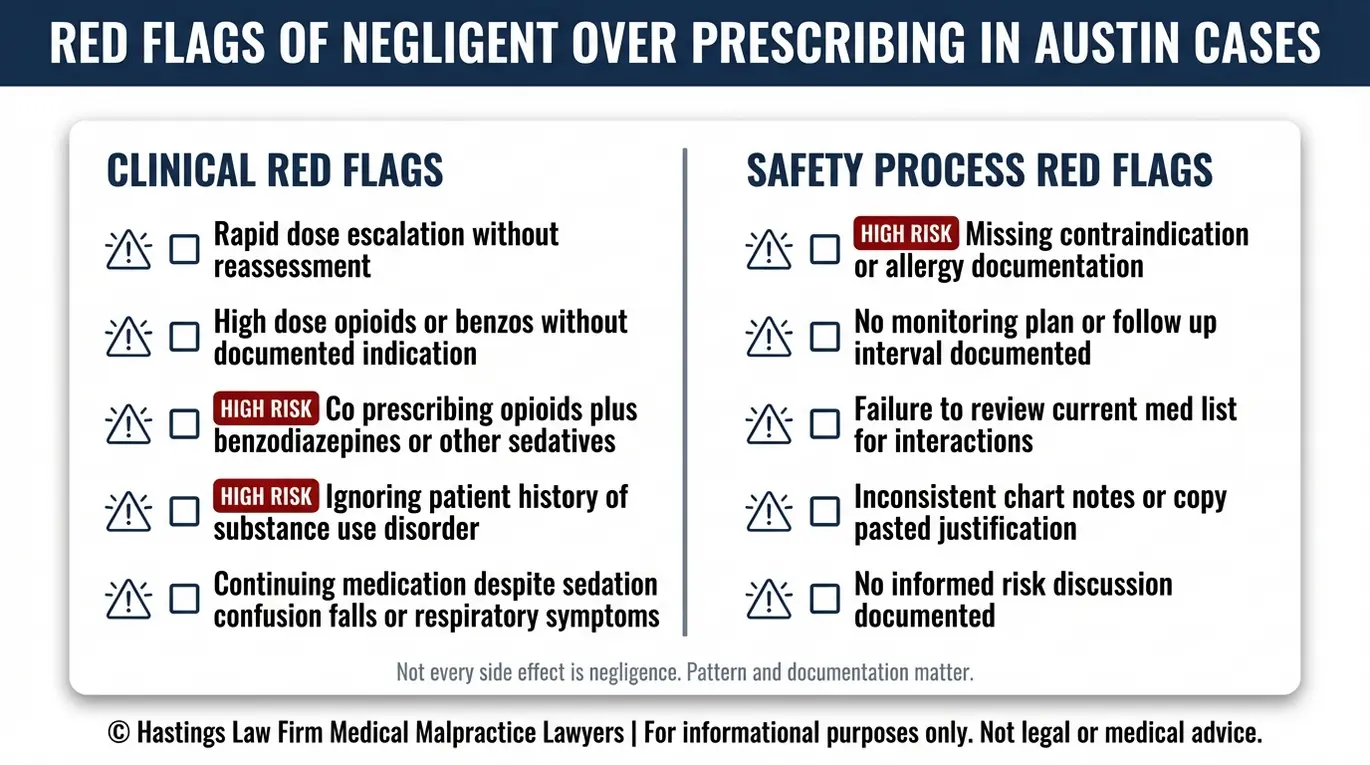
Red Flags of Over-Prescribing:
- Prescribing high doses of controlled substances without reviewing the patient’s medication history
- Rapid dosage increases without documented medical justification
- Ignoring signs of dependency, tolerance, or adverse reactions
- Failing to order routine lab work or follow-up appointments to monitor organ function
- Continuing prescriptions despite documented contraindications in the patient’s chart
- Documentation errors or missing records that should reflect clinical decision-making
If any of these patterns appear in your medical records, they may indicate a failure to monitor or a breach of the standard of care. A qualified medication error lawyer can help determine if these failures constitute malpractice.
Medical Malpractice vs. Pharmaceutical Liability
Medical malpractice involves different legal principles than pharmaceutical liability. Medical malpractice involves a healthcare provider’s decision, such as prescribing the wrong medication or an incorrect dosage. Pharmaceutical liability, on the other hand, involves a drug that is inherently dangerous due to defects in its design, manufacturing, or labeling.
For example, if a drug manufacturer fails to include an FDA boxed warning (also called a “Black Box Warning,” the strongest safety warning the FDA requires on a drug’s label) about a life-threatening risk, the manufacturer may bear responsibility. The same applies if a physician engages in off-label prescribing, which means using a drug for a purpose or population not approved by FDA regulations, without informing the patient of the added risks. Our team evaluates each potential source of liability from the start to ensure all responsible parties are identified.
Liability and The Chain of Responsibility in Medication Errors
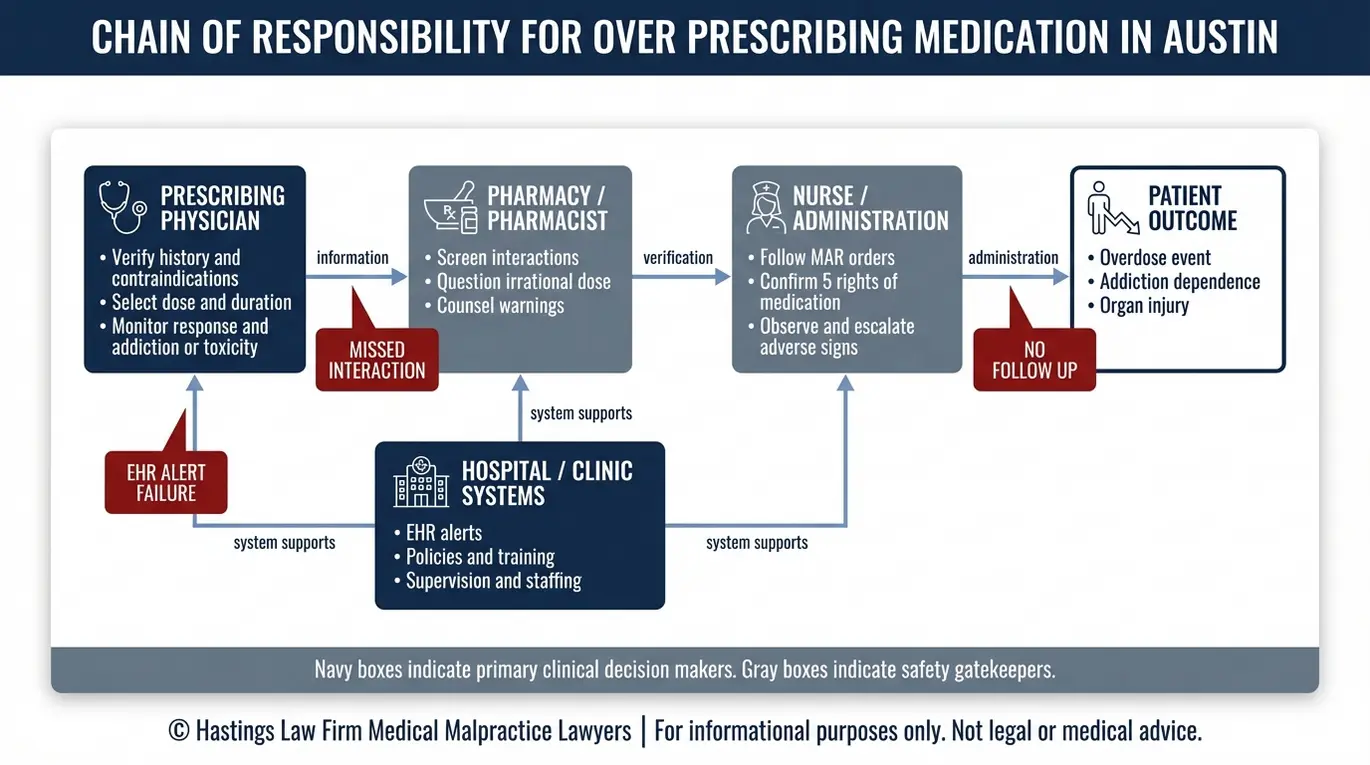
Liability for over-prescribing often extends beyond the prescribing doctor. Pharmacists who fill clearly dangerous orders, nurses who administer incorrect doses, and hospitals with inadequate safety protocols may all share responsibility for a patient’s injuries. The chain of responsibility describes how each provider must act to prevent errors.
Each healthcare provider involved in the medication process has specific legal duties. When a pharmacist receives a prescription, they hold what is known as corresponding responsibility, a legal obligation under federal DEA regulations and Texas pharmacy law to independently verify that a prescription is legitimate and safe before dispensing it, a key aspect of pharmacist liability. Hospitals also have a duty to maintain functioning clinical decision support (CDS) alerts, the automated warnings built into electronic health record systems that flag dangerous drug interactions or irrational dosages. When these alerts are overridden without justification, or when systems fail entirely, the institution itself may be liable for hospital negligence. Research published on the NCBI Bookshelf on Medical Error Reduction and Prevention highlights how systemic breakdowns across the prescribing chain contribute to preventable medication errors.
| Provider | Primary Duty | Common Failures |
|---|---|---|
| Physician | Prescribing: verify patient history, select appropriate drug and dosage, monitor for adverse reactions and addiction | Ignoring contraindications, failing to adjust doses, no follow-up monitoring |
| Pharmacist | Dispensing: confirm prescription validity, screen for lethal interactions, flag irrational dosages | Filling a clearly excessive order without contacting the prescriber |
| Nurse | Administering: verify correct patient, drug, dose, route, and time before giving medication | Administering without checking the order against patient records or allergy alerts |
Our team examines the full chain of drug administration to identify every party whose actions, or inaction, contributed to the harm.
The Hastings Law Firm Difference
Results matter, but what truly sets us apart is how we achieve them. Every verdict, every settlement, and every Austin courtroom victory comes from one guiding promise: To treat each client’s fight for justice as if it were our own.
This balance of skill, experience, and empathy reflects our core philosophy that justice should not only compensate the injured, but also make health care safer nationwide.

Recovering Damages for Over Prescribing Injuries
Patients harmed by medication errors in Texas may be entitled to fair compensation for prescription errors, including economic damages for medical bills and rehabilitation costs, as well as non-economic damages for physical pain, mental anguish, and loss of enjoyment of life. Damages are the legal term for the financial and personal losses caused by an injury.
Economic damages cover the measurable financial toll of the injury. This can include emergency care, hospitalization, and the cost of medication-assisted treatment (MAT), a combination of medications and therapy used to treat substance use disorders. It also includes future lost wages if cognitive impairment or physical dependence prevents you from returning to work. Withdrawal is the body’s physiological adaptation to a drug, which produces painful symptoms when the drug is stopped. In the most tragic outcomes, families may also pursue claims for wrongful death.
Non-economic damages account for the suffering that does not come with a receipt. The emotional weight of an addiction that started with a legitimate prescription. The physical pain of organ failure caused by years of unchecked medication use. The disruption to your daily life and relationships.
Texas does cap non-economic damages in medical malpractice claims. These caps can limit the amount recoverable for pain and suffering, but they do not eliminate the claim, and they do not apply to economic losses like medical expenses and lost income. Our Austin office can explain how these caps may affect your specific situation and build a case designed to pursue every dollar of compensation available under the law.

Why Choose Hastings Law Firm for Drug Litigation
Hastings Law Firm is a trial-focused practice that handles medical malpractice cases exclusively, bringing board-certified expertise and a record of significant results to every medication negligence case we accept.
- Exclusive medical malpractice focus. We do not divide our attention among unrelated practice areas. Every attorney, nurse consultant, and staff member works on medical negligence cases.
- Trial-ready from day one. We prepare every case as if it will go to a jury trial from the first day of our investigation. That level of preparation strengthens our position whether the case settles or goes to trial.
- Expertise in complex prescribing cases. Our founder, Tommy R. Hastings, is Board Certified in Personal Injury Trial Law by the Texas Board of Legal Specialization and has over two decades of experience. He is also a member of the American Board of Trial Advocates (ABOTA), an invitation-only group for elite trial lawyers.
- No fee unless we win. We work on a contingency fee basis, so you pay nothing unless we recover compensation on your behalf.
Contact the Austin Healthcare Malpractice Attorneys at Hastings Law Firm Today for Help
Over-prescribing is not simply a medical mistake. It is a violation of the trust you placed in a healthcare provider to protect your health, not compromise it. When that trust is broken and the consequences are life-altering, you have every right to seek answers and accountability.
If you or a loved one has suffered because of negligent prescribing in Austin, Hastings Law Firm is here to help you understand what happened. We offer support to those facing the consequences of medical errors. Our team of medical malpractice attorneys and in-house medical professionals will review your records, identify the responsible parties, and explain your legal options with honesty and clarity.
The consultation is a confidential case evaluation and comes with no obligation. You pay no attorney fees or costs unless we recover compensation for you. Reach out to our Austin office today to schedule your risk-free case evaluation.
Frequently Asked Questions About Over Prescribing of Medication in Austin


This content was researched and written by the Hastings Law Firm editorial team, which includes attorneys, medical professionals, and experienced researchers. Our writing is informed by internal knowledge and practical experience, and we cross-check critical details against authoritative sources cited throughout. Every piece undergoes human-led fact-checking and legal review. Because legal and medical information can change, if you spot an error, please contact us. Learn more about our content standards and review process on our editorial policy page.

Gabe Sassin has focused exclusively on medical malpractice law since 2007. After spending more than a decade as a malpractice defense attorney, he knows exactly how the other side works. He has seen firsthand how healthcare providers, insurers, corporate defendants, and their legal teams think, prepare, and build their defense against claims. That knowledge works for the people who need it most today, injured patients and their families. His unique experience shapes everything he writes, giving readers a look at how these cases actually work from someone who has handled them from both sides.
