


Houston Organ Puncture or Perforation Lawyer
An organ puncture or perforation during surgery can turn a planned procedure into a serious medical crisis. These injuries may be missed in the operating room and only become clear later when pain and infection worsen. The consequences can be severe, including emergency treatment, additional surgery, long recovery, and in extreme cases fatal outcomes. Disputes often focus on whether the harm was an unavoidable complication or a preventable error that fell below the standard of care. If you or a loved one were harmed or worse due to organ puncture or perforation in Houston, Texas, contact Hastings Law Firm for a free, confidential case review.

Last Updated: July 27, 2026
Trusted Houston Medical Attorneys for Surgical Negligence
When a routine surgery leaves you or a loved one with an unexpected internal injury, the confusion and fear can be overwhelming. You trusted a medical team to perform a procedure safely, and now you may be dealing with a painful complication that should never have happened. An organ puncture or perforation during surgery can lead to life-threatening infections, additional surgeries, and a long, uncertain recovery.
At Hastings Law Firm, we are a nationally recognized plaintiff trial firm focused exclusively on medical malpractice. Our team of attorneys, in-house nurse consultants, and former defense lawyers understands both the medicine and the law behind these cases. If you believe a surgical error caused your injury, a Houston organ puncture or perforation lawyer at our firm can review your medical records and explain your legal options at no cost and no obligation.

Understanding Organ Perforation as Medical Malpractice
An organ perforation becomes medical malpractice when the surgeon deviates from the standard of care, either by causing the injury through negligence or by failing to recognize and repair the puncture immediately during the procedure.
Identifying medical malpractice involves determining if a healthcare provider deviated from the standard of care. Understanding the distinction requires knowing how these injuries occur. An organ perforation, sometimes called an organ puncture, is an unintended hole or tear in a vital organ or internal structure during a surgical procedure. When this injury is caused by medical treatment itself, it is an iatrogenic perforation, a complication directly resulting from a healthcare provider’s actions.
Hospitals and defense attorneys often label these injuries as “known complications,” suggesting they are an unavoidable risk of the procedure. While it is true that some surgeries carry inherent risks, the law draws a clear line between an accepted complication and a preventable error caused by negligence.
The standard of care, the level of treatment a reasonably competent surgeon would provide under similar circumstances, establishes a duty of care requiring precision, proper technique, and careful inspection before closing. The distinction matters because:
- A known complication is a risk that exists even when the surgeon follows every appropriate step. It is disclosed to the patient beforehand and occurs despite proper care.
- A negligent error occurs when the surgeon fails to exercise the skill, caution, or attentiveness that the standard of care demands, such as using excessive force, failing to identify anatomy correctly, or closing the patient without checking for damage.
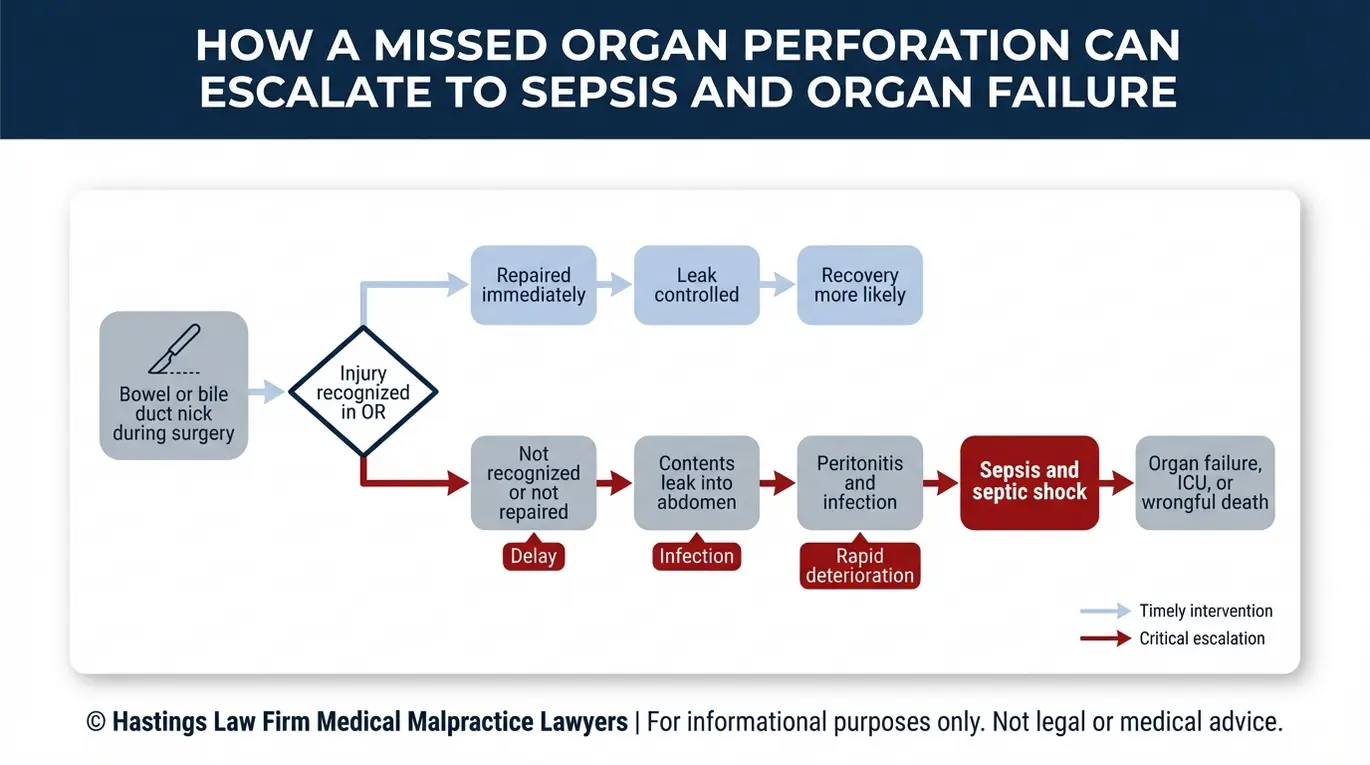
One of the most dangerous aspects of these injuries is their hidden nature. A surgeon may nick an organ like the bowel during the procedure and close the surgical site without inspecting for damage. The patient is sent to recovery with no awareness that anything went wrong. Days later, as contents leak internally, the situation becomes a medical emergency.
Under Texas Civil Practice and Remedies Code, Chapter 74, medical malpractice claims in Texas require the injured party to demonstrate that the provider breached the applicable standard of care. An organ perforation attorney in Houston can evaluate whether the surgeon’s actions crossed that legal threshold.

Common Surgical Errors Leading to Internal Injuries
Most organ perforations occur during abdominal surgeries, particularly laparoscopic procedures where visibility is limited, leading to accidental nicks of the bowel, bladder, or blood vessels.
Many internal injuries occur during abdominal operations where the surgical field is difficult to see. Laparoscopic surgery, a minimally invasive technique often called “keyhole” surgery, uses small incisions and a camera to guide instruments inside the body. While this approach generally offers shorter recovery times, it also reduces the surgeon’s direct line of sight.
Instruments are inserted through narrow ports, and the surgical field is viewed on a monitor rather than with the naked eye. This limited visibility increases the risk of an instrument accidentally puncturing a nearby organ.
Beyond technique, equipment malfunction can also cause surgical errors. Robotic surgical systems and powered instruments can behave unpredictably. A malfunction during a delicate procedure, whether from defective equipment or improper calibration, can cause thermal burns, unintended cuts, or excessive tissue damage that the surgeon may not detect in real time.
Certain procedures carry a higher risk for organ puncture injuries, including:
- Laparoscopic cholecystectomy (gallbladder removal): This is one of the most common sources of bile duct injury, a serious complication where the duct connecting the liver to the small intestine is accidentally cut, clipped, or burned. A meta-analysis published in BJS Open examined risk factors for bile duct injuries during cholecystectomy and confirmed that surgeon experience, anatomical misidentification, and intraoperative technique are significant contributors to these injuries.
- Gynecological procedures: Surgeries involving the uterus, ovaries, or fallopian tubes can result in bowel or bladder perforation, especially during adhesion removal.
- Hernia repair: Both open and laparoscopic hernia repairs involve working near the intestines, where a misplaced instrument or staple can cause a bowel perforation.
- Colorectal and bariatric surgeries: These complex abdominal operations involve dissection near multiple internal organs and blood vessels, raising the stakes for undetected nicks.
Houston organ puncture lawyers at Hastings Law Firm work closely with surgical specialists to determine exactly how and why an injury occurred.
The Hastings Law Firm Difference
Results matter, but what truly sets us apart is how we achieve them. Every verdict, every settlement, and every Houston courtroom victory comes from one guiding promise: To treat each client’s fight for justice as if it were our own.
This balance of skill, experience, and empathy reflects our core philosophy that justice should not only compensate the injured, but also make health care safer nationwide.

The Devastating Consequences of Untreated Perforations
If a puncture is not immediately identified, leakage of gastric contents, bile, or fecal matter into the abdominal cavity can lead to sepsis and peritonitis, rapidly progressing to organ failure or wrongful death.
These internal injuries require immediate medical intervention to prevent infection and long-term damage. The timeline from a missed perforation to a life-threatening emergency can be very short.
When the contents of the stomach, intestines, or liver bile ducts spill into the sterile abdominal cavity, the body’s response is swift and severe. Peritonitis, an infection and inflammation of the membrane lining the abdominal cavity, can develop within hours. Without emergency intervention, the infection spreads into the bloodstream.
Once the infection becomes systemic, it can trigger sepsis, which The Third International Consensus Definitions for Sepsis and Septic Shock (Sepsis-3) defines as a life-threatening organ dysfunction caused by a dysregulated host response to infection. Septic shock, the most severe stage, involves a dangerous drop in blood pressure that can lead to multiple organ failure and death.
The following table illustrates how initial symptoms can escalate into serious medical consequences when a perforation goes undetected:
| Early Warning Signs | Potential Consequences if Untreated |
|---|---|
| Increasing abdominal pain after surgery | Peritonitis (abdominal infection) |
| Fever and elevated heart rate | Sepsis and septic shock |
| Abdominal rigidity or distension | Internal bleeding or abscess formation |
| Nausea, vomiting, inability to pass gas | Bowel obstruction or tissue death |
| Sudden drop in blood pressure | Multi-organ failure or wrongful death |
For patients who survive, the long-term consequences can be permanent. Many require a colostomy, a surgical procedure that diverts part of the colon through an opening in the abdomen into an external bag to collect waste. Others face multiple revision surgeries, chronic pain, nutritional complications, and permanent disability that fundamentally changes their daily life.
An organ puncture lawyer can help determine whether earlier detection of the injury would have prevented this cascade of harm.
Does Signing a Consent Form Prevent You From Suing
No. A signed consent form acknowledges the known risks of a procedure, but it does not grant the surgeon permission to perform the surgery negligently or to act below the medical standard of care.
A consent form is a clinical disclosure, not a legal waiver of your right to safe medical treatment. Patients often have this misconception after a surgical injury. Many people believe that because they signed a document listing “perforation” as a possible risk, they have given up their legal rights to seek compensation. That is not how the law works.
Under Texas Civil Practice and Remedies Code, Chapter 74, informed consent relates to the disclosure of risks, not a waiver of the right to competent care or a shield against the use of medical records to prove fault. A consent form covers complications that may occur even when the surgeon does everything correctly. It does not protect a surgeon who used improper technique, failed to identify critical anatomy, or neglected to inspect the surgical site for damage before closing.
While a perforation can happen during a complex procedure, failing to detect it, failing to repair it, or causing it through carelessness is not a risk the patient agreed to accept. A perforation injury attorney can help clarify whether the injury was truly unavoidable or whether it resulted from a breach of the standard of care.
Proving Causation in Latent Injury Cases
Delayed diagnosis is a significant challenge in perforation cases, especially when symptoms are not discovered until days after the surgery. Proving fault in these cases requires an expert review to link the injury to the original surgery.
These cases often involve occult bowel perforations, which are hidden or delayed perforations that do not produce obvious symptoms right away. In some cases, the perforation itself results from electrocautery, the use of an electrically heated instrument to cut tissue or stop bleeding. A thermal injury from electrocautery may weaken the tissue during surgery, but the bowel wall does not fully break down until hours or days later. By then, the patient has been discharged, and the onset of symptoms may initially be attributed to normal post-surgical discomfort.
Proving causation in these cases requires medical experts who can connect the timing of the original surgery to the delayed injury. Our team examines operative reports, nursing notes, post-discharge records, and imaging studies to establish whether the perforation originated during the procedure, even if it was not apparent until later.
How We Investigate and Litigate Surgical Negligence
We build a case by securing the operative report immediately, working with independent medical experts to review the surgical technique, and calculating the total lifetime cost of the injury.
As a Houston surgical injury lawyer team, we treat every case as trial-ready from day one. Our investigation process works as follows:
- Step 1: Immediate Record Retrieval. We move quickly to obtain the complete, unedited surgical and medical records, including operative reports, anesthesia logs, nursing notes, and any equipment documentation. Early retrieval helps preserve evidence before records can be altered or lost.
- Step 2: Independent Expert Review. Through our national network of qualified medical experts, we have the surgical records reviewed by specialists in the same field as the operating surgeon. These independent reviewers assess whether the technique used met the standard of care and whether the perforation was preventable or should have been detected sooner.
- Step 3: Full Damage Valuation. We calculate the complete damages and financial impact of the injury, not just current medical expenses, but future surgeries, ongoing care needs, lost income, reduced earning capacity, and the physical pain and emotional suffering the patient has endured. Our in-house nurse consultants and patient advocates help ensure nothing is overlooked.
This structured approach allows us to present a clear, evidence-driven case, whether we are negotiating a fair resolution or presenting the facts to a jury.

Contact the Houston Surgical Error Attorneys at Hastings Law Firm Today for Help
Surgical organ perforations are often preventable. Legal guidance helps families understand their rights when a medical error causes life-altering harm.
When a surgeon’s error leaves you or someone you love facing sepsis, emergency surgery, or a permanent colostomy, the financial and emotional toll should not fall on your family. Hastings Law Firm has spent nearly two decades holding negligent medical providers accountable. Our team includes former defense attorneys and nurses who understand how hospitals build their cases. We are led by Tommy Hastings, who is Board Certified in Personal Injury Trial Law by the Texas Board of Legal Specialization.
We are here to listen, to review what happened, and to give you honest answers about your legal options. There is no fee unless we recover compensation for you. Call Hastings Law Firm or contact us online for a free, confidential case evaluation. Let us help you find the answers you deserve.
Frequently Asked Questions About Organ Puncture or Perforation in Houston


This content was researched and written by the Hastings Law Firm editorial team, which includes attorneys, medical professionals, and experienced researchers. Our writing is informed by internal knowledge and practical experience, and we cross-check critical details against authoritative sources cited throughout. Every piece undergoes human-led fact-checking and legal review. Because legal and medical information can change, if you spot an error, please contact us. Learn more about our content standards and review process on our editorial policy page.

Tommy Hastings, founder of Hastings Law Firm, is a board-certified personal injury trial lawyer dedicated exclusively to healthcare injury cases. Since 2001, he has represented injured patients and families in litigation against major hospital systems, pharmaceutical companies, and negligent healthcare providers nationwide. He has handled numerous high-profile cases that have drawn national media attention and resulted in multi-million dollar recoveries. He draws on that experience in his writing, helping readers understand how these cases work and what options may be available to them.
