


Austin Nursing Home Supervision Lawyer
Nursing home supervision failures can leave older adults exposed to preventable harm when staff do not monitor residents according to their assessed needs and individualized care plans. Breakdowns tied to understaffing, missed safety checks, unmonitored exits, and poor hiring or training can lead to serious injuries, rapid health decline, or worse. Families may also face confusing facility narratives that label incidents as unavoidable even when warning signs were present. If you or a loved one were harmed or worse due to nursing home supervision failures in Austin, Texas, contact Hastings Law Firm for a free, confidential case review.
Last Updated: July 27, 2026
Protecting Austin Seniors from Negligent Oversight
When a loved one is placed in a nursing home, families trust that trained staff will keep them safe. Learning that your parent or grandparent was injured because no one was watching is a deeply painful experience. It raises serious questions about what went wrong and who is responsible.
Nursing home supervision failures are not minor oversights. They can lead to devastating injuries, from broken bones to life-threatening complications. If your family is dealing with this kind of harm, you deserve clear answers and honest guidance about your legal options.
As an Austin nursing home supervision lawyer, Hastings Law Firm focuses exclusively on medical malpractice and negligence cases. Our team includes in-house medical professionals who know how to review facility records and identify where care broke down. Our founder, Tommy Hastings, is Board Certified in Personal Injury Trial Law by the Texas Board of Legal Specialization, a credential held by fewer than 2% of Texas attorneys. If your loved one was hurt because of inadequate monitoring, we can review what happened and explain your options in a free, confidential consultation.

What Constitutes Negligent Supervision in Texas Nursing Homes
Negligent supervision occurs when a facility fails to monitor residents according to their assessed needs, resulting in preventable harm such as falls, wandering, or peer-to-peer aggression. Under Texas law, supervision is not simply about having someone nearby. It requires the active implementation of an individualized care plan, the written set of protocols tailored to each resident’s specific medical and safety needs.
Every resident admitted to a long-term care facility must receive a fall risk assessment, an evaluation that identifies how likely a resident is to fall and what precautions are needed to prevent it. Once those risks are identified, the facility is legally required to follow through. That means maintaining toileting schedules, activating bed alarms, monitoring exits for residents prone to wandering, and ensuring adequate staffing to carry out these measures. 26 Tex. Admin. Code § 554.1001 establishes the standard of care and nursing services standards that Texas facilities must meet.
Understaffing is one of the most common reasons supervision breaks down. When a facility does not schedule enough nurses or aides for the number of residents on a given shift, even the most diligent staff cannot monitor everyone who needs help. An Austin nursing home supervision lawyer will examine whether staffing levels violated nursing home resident rights or were inadequate relative to the resident population and their care needs.
Supervision failures also extend to how a facility manages its employees. Hiring staff without proper background checks, failing to train aides on safety equipment, or ignoring complaints about an employee’s conduct can be forms of negligent supervision. If concerns arise about a specific facility, families can report them through Adult Protective Services (APS) Investigations and Services at the Texas Department of Family and Protective Services.
Common supervision failures include:
- Failing to respond to call lights within a reasonable time
- Not implementing fall prevention measures identified in the care plan
- Leaving exit doors unmonitored for residents with dementia
- Assigning too few staff members to high-acuity units, which house residents requiring intensive medical care
- Failing to conduct required welfare checks or room rounds
- Hiring or retaining staff without completing background screenings
If your family suspects that a loved one was harmed because of any of these failures, Austin nursing home supervision attorneys at Hastings Law Firm can help evaluate the situation and determine whether negligence occurred.
Common Injuries Resulting from Lack of Supervision
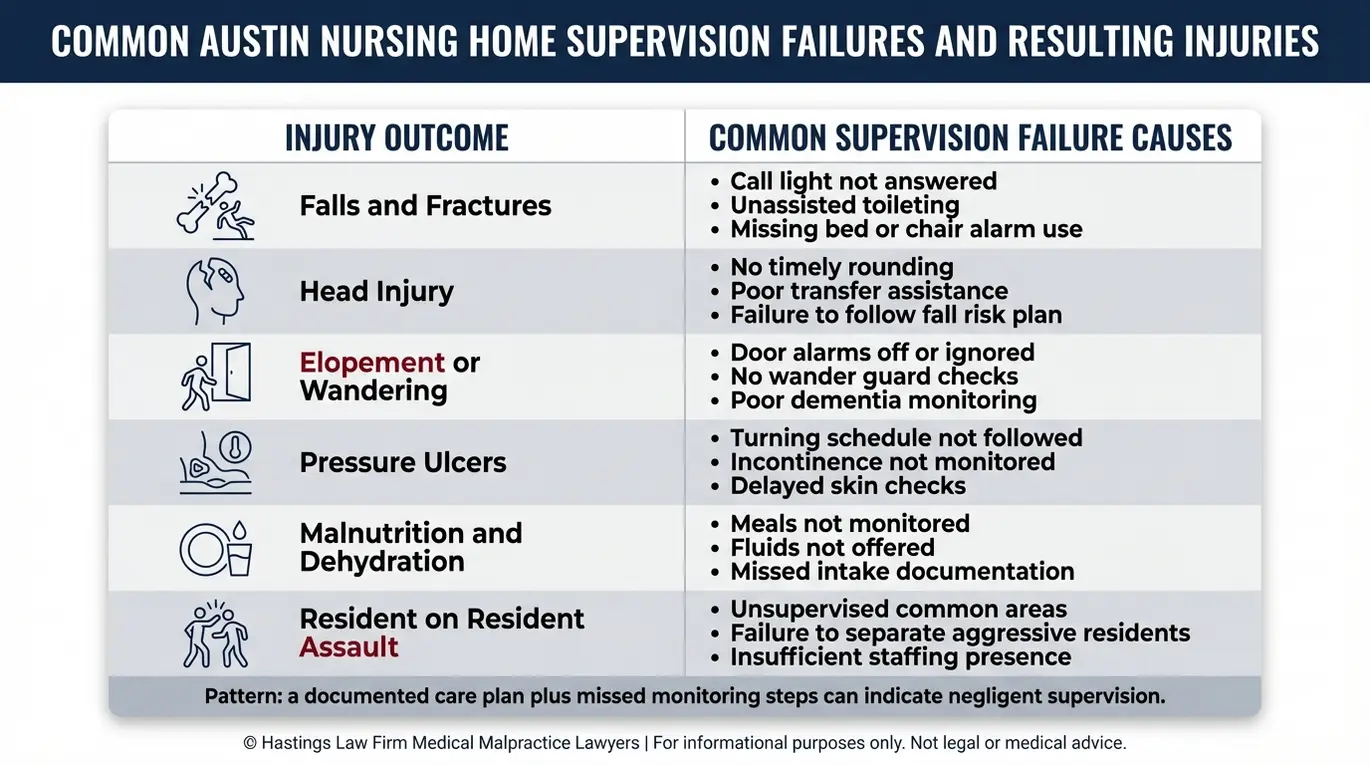
The most frequent outcomes of inadequate supervision include traumatic falls resulting in hip fractures, elopement where residents wander off-premises, and unmonitored resident-on-resident assaults. Each of these injuries is tied directly to a specific breakdown in the facility’s duty to monitor and protect.
Falls and fractures are the leading cause of serious injury in nursing homes. Many occur when a resident who needs help getting to the bathroom presses a call light and no one responds in time. Rather than wait, the resident attempts to stand or walk alone and falls. Hip fractures, head injuries, and spinal damage are common results, and for elderly patients, these injuries can trigger a rapid decline in overall health.
Elopement, the term used when a resident wanders away from the facility unnoticed, poses extreme danger for individuals with dementia or cognitive impairment. Without functioning door alarms and attentive staff, a confused resident can walk into traffic, exposure to extreme weather, or other hazardous situations. These incidents are preventable when monitoring systems are in place and actually used.
Bedsores, also called pressure ulcers, develop when immobile residents are not repositioned on a regular schedule. According to a systematic review published by PubMed Central on repositioning for pressure injury prevention in adults, consistent turning and repositioning is a standard preventive measure. When staff fail to follow scheduled toileting, the routine practice of assisting residents to the bathroom at set intervals, and turning protocols, tissue begins to break down. Advanced pressure ulcers can become infected and, in severe cases, lead to sepsis and death.
Resident-on-resident aggression happens when common areas or shared rooms go unmonitored. Residents with behavioral conditions may become physically violent toward others. Without adequate staff presence, these incidents go unchecked. The Medicare nursing home checklist highlights the importance of evaluating a facility’s safety environment before and during a loved one’s stay.
A direct connection exists between specific supervision failures and the injuries they cause:
| Injury | Supervision Failure |
|---|---|
| Hip fractures and head trauma from falls | Unanswered call lights; no fall prevention measures in place |
| Elopement injuries or death | Unmonitored exits; disabled or absent door alarms |
| Pressure ulcers (bedsores) | Failure to follow turning and repositioning schedules |
| Resident-on-resident assault injuries | Unmonitored common areas; no behavioral risk separation |
| Malnutrition and dehydration | Missed meal assistance; failure to track intake |
| Wrongful death in nursing homes | Cumulative or acute supervision breakdowns left unaddressed |
An Austin nursing home supervision lawyer can review the circumstances of your loved one’s injury to determine whether inadequate monitoring was a contributing factor.
The Hastings Law Firm Difference
Results matter, but what truly sets us apart is how we achieve them. Every verdict, every settlement, and every Austin courtroom victory comes from one guiding promise: To treat each client’s fight for justice as if it were our own.
This balance of skill, experience, and empathy reflects our core philosophy that justice should not only compensate the injured, but also make health care safer nationwide.

Liability and Accountability for Supervision Failures
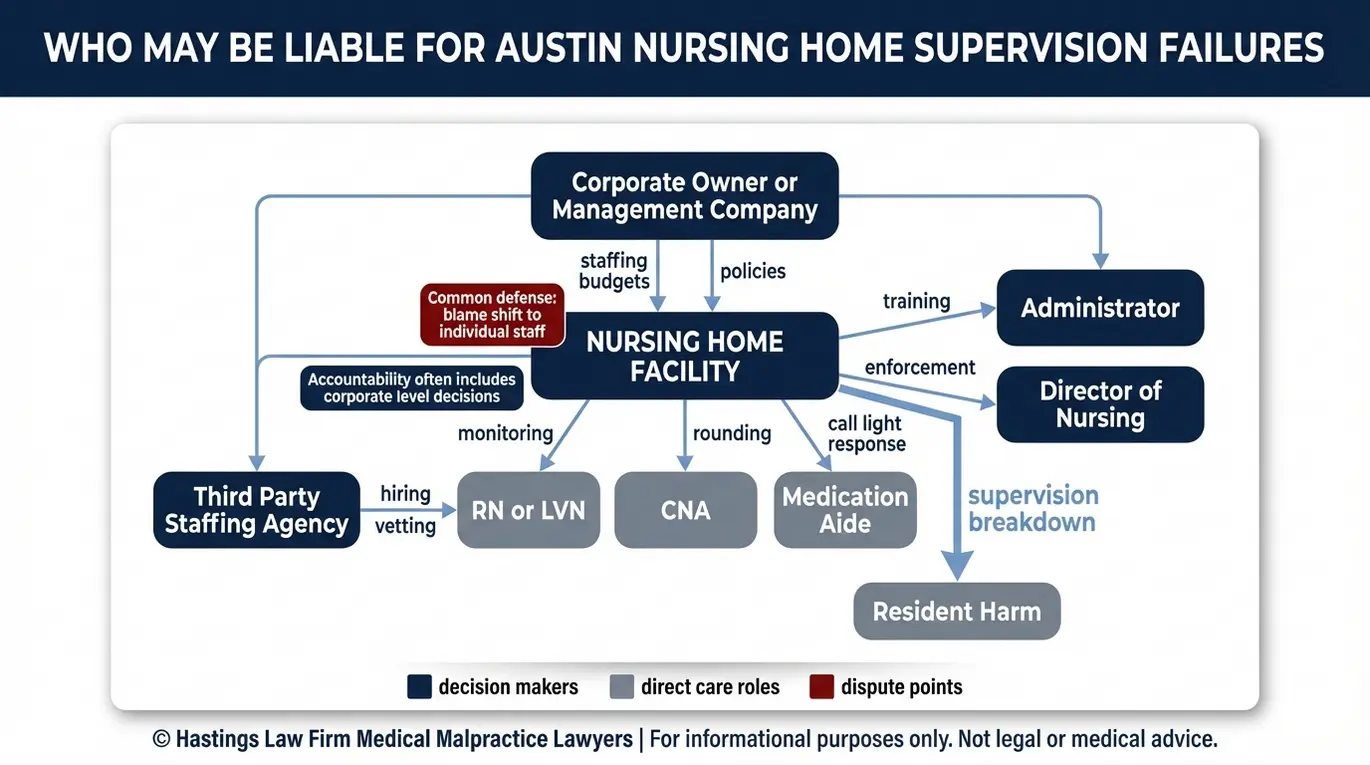
Liability for supervision failures often extends beyond the individual nurse to the facility’s corporate management, third-party staffing agencies, and administrators who ignored safety protocols. Understanding who is responsible is critical to building an effective case.
Corporate ownership groups that set staffing budgets and operational policies can be held liable when their decisions result in unsafe conditions. If a corporate entity establishes staffing ratios that fall below what is needed to safely monitor residents, the organization itself may bear responsibility. Federal and state nursing home laws, including the Nursing Home Reform Act (OBRA), set baseline standards that all long-term care facilities receiving Medicare or Medicaid funds must follow.
Third-party staffing agencies that supply temporary nurses or aides can also face liability. When an agency provides unqualified or improperly vetted workers, and those workers fail to supervise residents, the agency may share in the legal responsibility.
Facility administrators who may fail to enforce safety policies or train staff on supervision equipment, such as bed alarms, can be individually accountable for the resulting harm. Bed alarms are devices placed on a bed or chair that alert staff when a resident attempts to move without assistance. Liability also applies when administrators may fail to prevent resident-to-resident aggression, the physical violence between residents that often occurs when common areas are unmonitored.
Potentially liable parties in a supervision negligence case include:
- The nursing home facility itself
- The corporate ownership or management group
- Third-party staffing agencies
- Individual administrators or directors of nursing
- Specific staff members whose conduct caused harm
A lawyer for nursing home supervision errors will examine the chain of responsibility to identify every party that contributed to the failure.
Sham Investigations and Cover-Ups
After an injury, the facility may conduct internal investigations that prioritize protecting the institution. A fall might be documented as an “unwitnessed fall” to suggest staff could not have intervened. These internal reports often label injuries as “unavoidable” to minimize responsibility.
These internal reports can minimize what happened and discourage families from asking further questions. An Austin nursing home supervision lawyer knows how to look beyond the facility’s narrative. We use meticulous evidence gathering to examine the underlying data, including staffing levels at the time of the incident, call light response records, and whether the care plan was actually being followed. This helps determine whether the injury was actually preventable or the result of negligent supervision.
How We Prove Negligence in Supervision Cases
We prove negligence by securing staffing logs, shift reports, and electronic call light data to demonstrate that the facility failed to maintain the required presence to keep residents safe. This evidence-driven investigation process is the foundation of every medical malpractice in nursing homes case we handle.
Staffing logs compared to census data, the daily record of the total number of residents and their specific care needs, are often the most revealing piece of evidence. By comparing the number of nurses and aides on duty during a shift against the resident population, we can establish whether the facility had enough staff to provide adequate monitoring. The CMS Five Star Quality Rating System provides publicly available staffing and quality data that can support this analysis.
Care plans are equally important. If the facility’s own records show that a resident was identified as a fall risk but the required interventions were not carried out, that gap is strong evidence of negligence. As an Austin nursing home negligence lawyer, we review these documents line by line.
Video surveillance footage from hallway and common area cameras can confirm or contradict the facility’s version of events. Because facilities may overwrite or delete footage on short retention cycles, preserving this evidence quickly is essential.
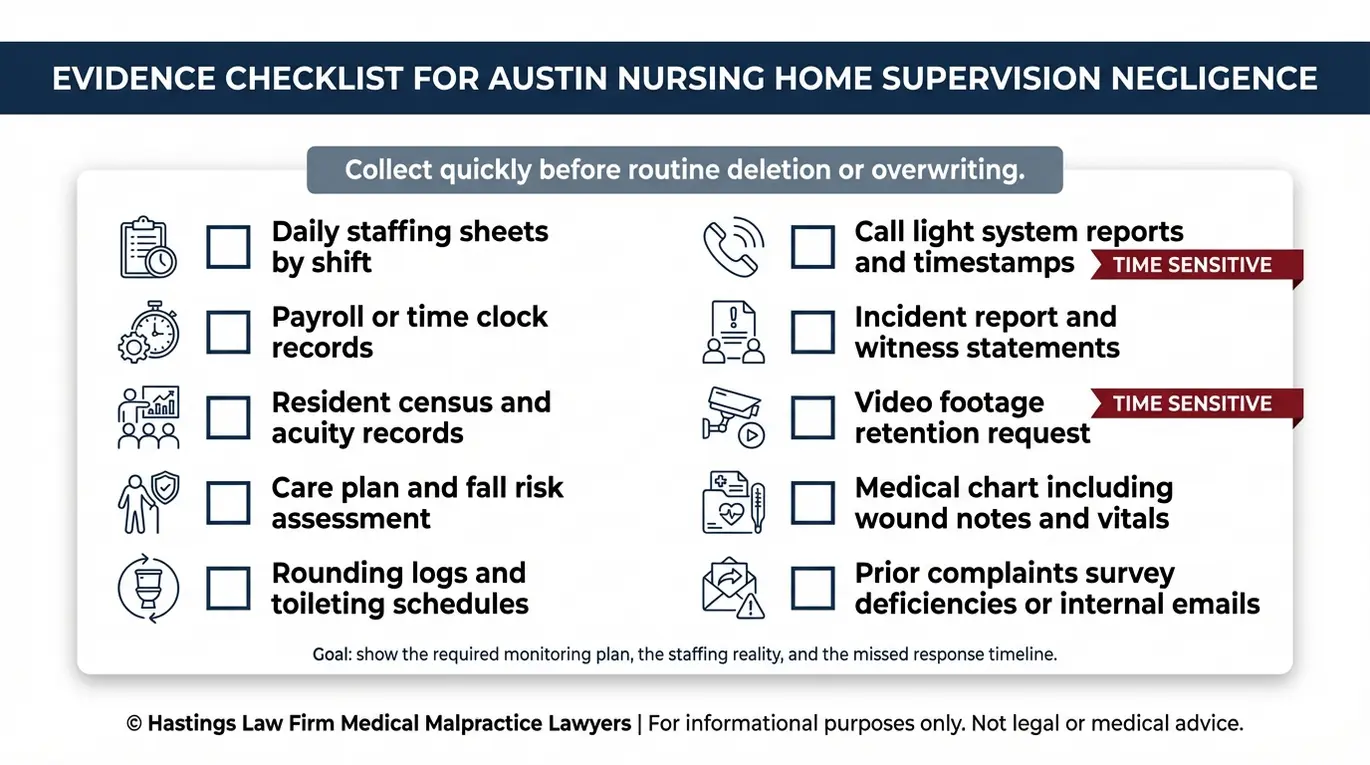
Our team uses the following evidence gathering checklist when investigating supervision cases:
- Daily staffing sheets and payroll records
- Resident census and acuity reports
- Individualized care plans and fall risk assessments
- Call light system response-time data, the electronic records showing how long it takes staff to respond after a resident activates their call bell
- Staffing logs, the facility’s records of which employees were on duty during each shift
- Incident and accident reports
- Surveillance camera footage
- State inspection and deficiency reports
- Witness statements from other residents, families, or staff
Our in-house medical staff, including nurse practitioners and board-certified patient advocates, review these records and provide expert testimony alongside our attorneys. This collaboration between legal and clinical professionals allows us to identify charting inconsistencies and care plan violations that might otherwise go unnoticed.
Damages Recoverable for Supervision Negligence
Families may recover compensation for medical expenses, physical pain, emotional suffering, and in cases of gross negligence, punitive damages to punish the facility for reckless conduct. The specific damages available depend on the severity of the injury and the circumstances of the negligence.
An Austin nursing home supervision lawyer will help your family identify and document every category of loss, including:
- Economic damages: Hospital bills, corrective surgeries, rehabilitation costs, the expense of transferring to a safer facility, and other out-of-pocket financial losses tied to the injury
- Non-economic damages: Physical pain, emotional distress, loss of dignity, and diminished quality of life experienced by the resident
- Wrongful death damages: If a loved one died as a result of supervision negligence, surviving family members may pursue compensation for funeral expenses, loss of companionship, and the suffering endured before death
- Punitive damages: In cases where the facility’s conduct was especially reckless or egregious, Texas law allows punitive damages intended to deter similar behavior in the future
Under Texas Civil Practice and Remedies Code § 41.003, punitive damages are available when clear and convincing evidence shows that the harm resulted from fraud, malice, or gross negligence. Nursing home supervision attorneys at Hastings Law Firm evaluate whether the facts of each case support this higher standard of proof.
Statute of Limitations for Texas Supervision Claims
In Texas, the statute of limitations for filing a nursing home negligence claim is generally two years from the date of the injury or the date the injury was discovered. Missing this deadline typically means losing the right to pursue a claim entirely, regardless of how strong the evidence may be.
This two-year window is established under Texas Civil Practice and Remedies Code Chapter 16 and Texas Civil Practice and Remedies Code §16.003. There are limited exceptions, known as tolling, that may pause the clock when the negligence was not immediately apparent, such as cases involving hidden abuse or injuries that were concealed or mischaracterized in facility records. In those situations, the clock may start when the family knew or reasonably should have known about the harm.
Acting quickly matters for practical reasons. Staffing logs, surveillance footage, and electronic records can be overwritten, lost, or destroyed over time. The sooner an Austin nursing home supervision lawyer begins the investigation, the more evidence is available to build a strong case.
If you believe your loved one was harmed by inadequate supervision, explore your legal options early. Prompt action preserves both your rights and the evidence needed to support your claim. Contact Hastings Law Firm to discuss Texas nursing home supervision laws and how they apply to your family’s situation.
Contact the Austin Nursing Home Attorneys at Hastings Law Firm Today for Help
If your loved one suffered an injury because staff were not present when they should have been, your family deserves answers. An Austin nursing home supervision lawyer at Hastings Law Firm is ready to investigate staffing records, uncover what went wrong, and pursue the accountability your loved one is owed.
Our team includes former defense attorneys who understand how facilities and their insurers respond to these claims, along with in-house medical professionals who can analyze care records and identify exactly where supervision broke down. We prepare every case as if it will go to trial, which allows us to negotiate from a position of strength.
There are no upfront fees. We work on a contingency basis, meaning you pay nothing unless we recover compensation for your family. Contact us today for a free, confidential consultation to discuss what happened and learn about your legal options.
Frequently Asked Questions About Nursing Home Supervision in Austin


This content was researched and written by the Hastings Law Firm editorial team, which includes attorneys, medical professionals, and experienced researchers. Our writing is informed by internal knowledge and practical experience, and we cross-check critical details against authoritative sources cited throughout. Every piece undergoes human-led fact-checking and legal review. Because legal and medical information can change, if you spot an error, please contact us. Learn more about our content standards and review process on our editorial policy page.

Gabe Sassin has focused exclusively on medical malpractice law since 2007. After spending more than a decade as a malpractice defense attorney, he knows exactly how the other side works. He has seen firsthand how healthcare providers, insurers, corporate defendants, and their legal teams think, prepare, and build their defense against claims. That knowledge works for the people who need it most today, injured patients and their families. His unique experience shapes everything he writes, giving readers a look at how these cases actually work from someone who has handled them from both sides.
