


Fort Worth Nursing Home Sexual Abuse Lawyer
Written by: Hastings Law Firm | Reviewed by: Gabe Sassin | Updated: July 27, 2026
Sexual abuse in a nursing home or assisted living setting is a profound violation that can leave a resident traumatized and a family overwhelmed. Abuse can involve nonconsensual contact or exploitation, and it can be hidden during routine intimate care when supervision is weak. Residents with cognitive impairment may be unable to consent or report what happened, which can allow misconduct to continue. Accountability can involve both the individual abuser and facility failures such as poor screening and oversight. If you or a loved one were harmed or worse due to nursing home sexual abuse in Fort Worth, Texas, contact Hastings Law Firm for a free, confidential case review.
Compassionate Legal Advocacy for Victims of Elder Sexual Abuse in Fort Worth
What You Should Know About Elderly Sexual Assault Claims in Fort Worth:
- Safety and dignity can be severely compromised when sexual abuse occurs in nursing homes or assisted living environments.
- Accountability can extend beyond the individual abuser when a facility failed in screening, supervision, or security.
- Options for financial recovery can include costs tied to medical care and counseling plus compensation for emotional harm and loss of dignity.
- Reporting and civil accountability can still be pursued even when a resident cannot clearly describe what happened.
- Disputes often turn on whether the resident had the cognitive capacity to give effective consent.
- Ongoing abuse can be harder to detect when misconduct is disguised as routine intimate care such as bathing or toileting.
- Severe harm can be overlooked when warning signs are missed, including unexplained bleeding or sudden fear of specific caregivers.
- Civil recovery can remain possible even without a criminal conviction because the civil proof standard is different.
- Recovery options can be limited if time sensitive filing requirements are missed, especially for claims involving government run facilities.
- Facility practices can be central to liability when understaffing or failure to report incidents allowed abuse to persist.

A Healthcare Focused Law Firm
When a loved one in a nursing home has been sexually abused, the shock and anger can feel paralyzing. You trusted a care facility to protect someone who could not fully protect themselves, and that trust was broken in the most devastating way possible. You may be unsure of what to do next, who to call, or whether the legal system can actually hold anyone accountable.
At Hastings Law Firm, we focus exclusively on cases where caregivers and institutions fail the people in their care. Our founder, Tommy Hastings, is a board-certified trial lawyer who understands both the clinical evidence and the legal strategy these cases demand. Our team, which includes in-house medical professionals and former defense attorneys, is prepared to investigate what happened and pursue full accountability on your family’s behalf.
If you suspect abuse, we can review the situation in a free, confidential consultation and explain your legal options.
Understanding Sexual Abuse in Assisted Living Environments
Sexual abuse in nursing homes encompasses any non-consensual sexual contact with a resident, including situations where the resident lacks the cognitive capacity to consent. This goes well beyond physical assault. It includes exploitation, coerced nudity, inappropriate sexual comments, and any sexual act performed on a person who cannot understand or agree to what is happening.
Under Texas law, as outlined in Texas Penal Code Chapter 22, sexual contact without effective consent is a criminal offense. For nursing home residents living with Alzheimer’s, dementia, or other cognitive impairments, the law recognizes that they lack the capacity to consent. This means they cannot legally agree to sexual activity regardless of the circumstances. Any sexual contact with these residents is abuse.
One reason elder sexual abuse persists in care facilities is what is sometimes called the “White Coat Effect,” the ingrained tendency to defer to authority figures in medical or caregiving roles. Perpetrators, whether staff members, other residents, or outside visitors, often exploit this power dynamic to silence vulnerable seniors. Residents may feel too afraid, confused, or dependent on their caregivers to speak up. A nursing home sexual abuse attorney can help uncover what happened even when the resident is unable to report it themselves.
Types of Sexual Exploitation in Elder Care
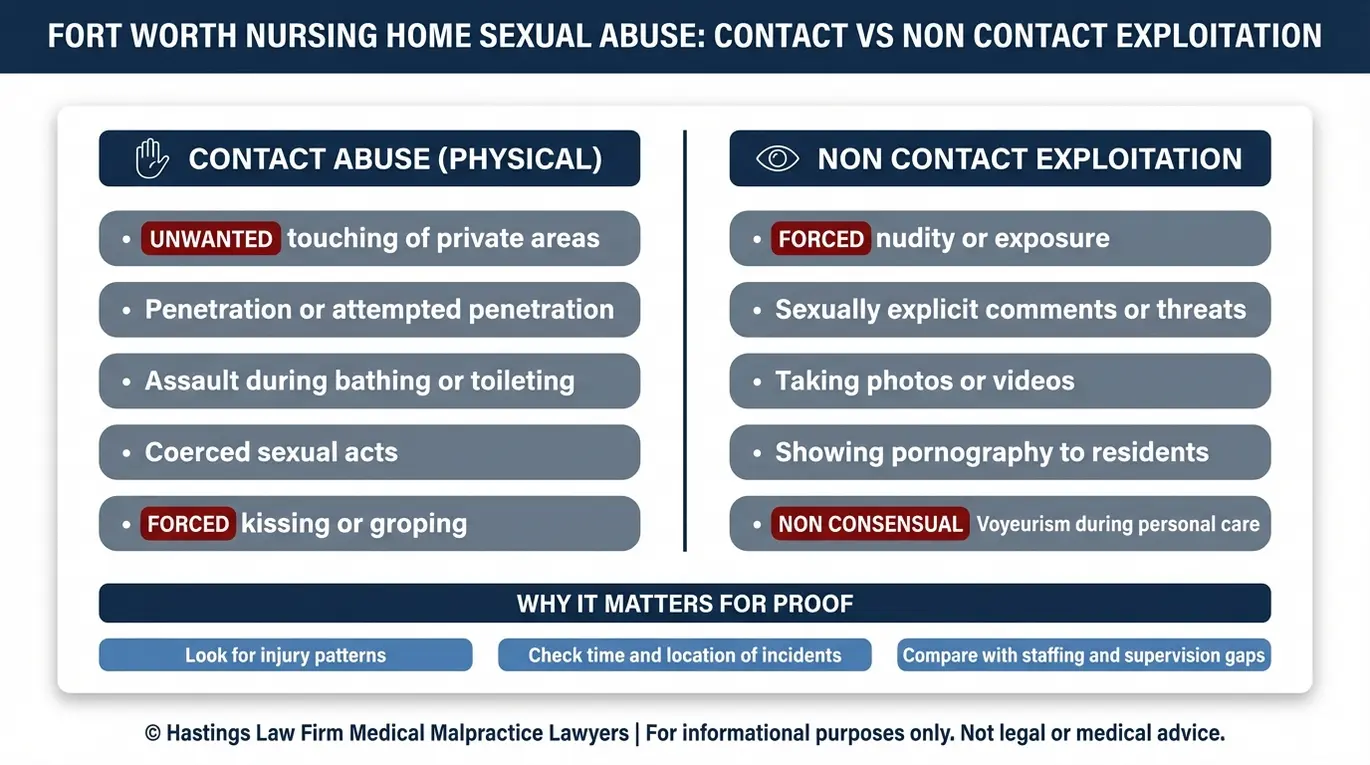
Abuse ranges from non-consensual sexual contact like rape and unwanted touching to non-contact exploitation such as forced nudity, taking compromising photos, or verbal sexual harassment. Families often associate sexual abuse only with physical violence, but the legal definition is broader than many people realize.
Non-contact sexual exploitation refers to abusive acts that do not involve physical touching but are still violations of a resident’s dignity and autonomy. This includes forcing a resident to watch pornography, exposing oneself to a resident, or photographing or recording them without consent.
Some of the hardest cases to detect involve abuse during activities of daily living (ADLs), which are routine intimate-care tasks like bathing and toileting. Because these tasks inherently involve undressing and physical proximity, sexual assault in nursing homes during these moments can be disguised as normal caregiving.
| Contact Abuse | Non-Contact Abuse |
|---|---|
| Rape or sodomy | Forcing a resident to watch pornography |
| Unwanted touching of private areas | Exhibitionism or indecent exposure |
| Sexual contact during bathing or toileting | Taking photos or videos in compromising positions |
| Any penetration without consent | Verbal sexual harassment or sexually degrading comments |
| Coerced sexual acts | Forcing a resident to undress unnecessarily |
The Hastings Law Firm Difference
Results matter, but what truly sets us apart is how we achieve them. Every verdict, every settlement, and every Fort Worth courtroom victory comes from one guiding promise: To treat each client’s fight for justice as if it were our own.
This balance of skill, experience, and empathy reflects our core philosophy that justice should not only compensate the injured, but also make healthcare safer nationwide.

Identifying the Warning Signs of Sexual Assault
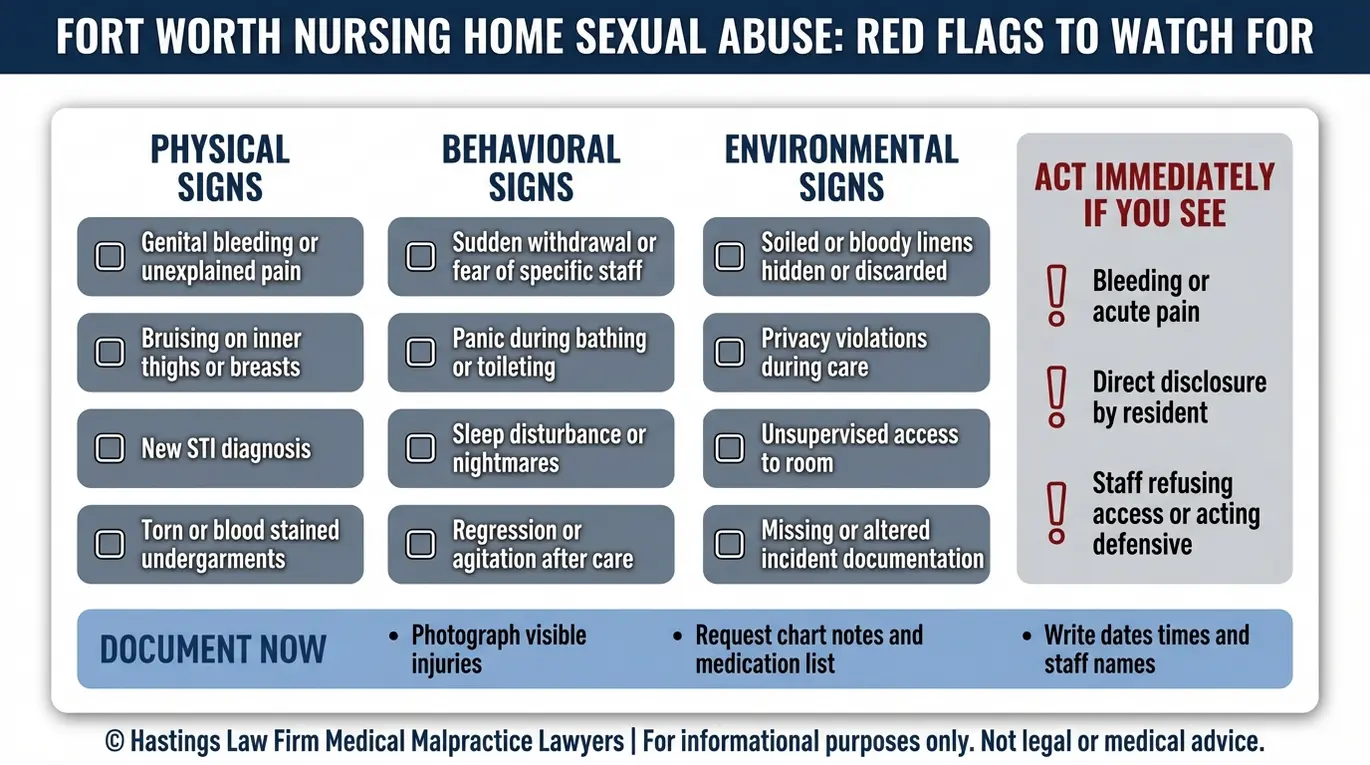
Warning signs include unexplained genital infections or bleeding, torn undergarments, sudden withdrawal or fear of specific staff members, and regression to infantile behaviors. Because many nursing home residents cannot verbalize what has happened to them, families need to recognize both the physical and behavioral indicators of abuse.
Research published through the National Library of Medicine, including “Too Grey To Be True: Sexual Violence in Older Adults”, confirms that sexual abuse in older adults results in emotional trauma and psychological injuries, yet is significantly underreported. Knowing what to look for can help families stop ongoing abuse.
Physical indicators to watch for:
- Anogenital trauma, which refers to unexplained bruising, tearing, or bleeding in the genital area
- Sexually transmitted infections (STIs) or STDs in older adults who are not sexually active
- Bruising on inner thighs, breasts, or around the genitals
- Difficulty walking or sitting without explanation
- Torn, stained, or bloody undergarments
Behavioral and environmental indicators:
- Sudden withdrawal, anxiety, or depression
- Panic attacks or visible distress during bathing or dressing
- Refusal to be left alone with specific caregivers
- PTSD symptoms such as nightmares, flinching, or emotional outbursts
- Regression to infantile behaviors like rocking or thumb-sucking
- Bloody sheets or clothing found hidden or discarded by staff
If you notice any combination of these signs of nursing home abuse, document what you observe and seek both medical attention and legal guidance immediately.
Proving Liability: Facility Negligence vs. Individual Acts
While the perpetrator faces criminal charges, the facility can also face civil liability or vicarious liability for negligence if it failed to perform background checks, provide adequate security, or address poor supervision. In many cases, the abuse would not have occurred if the nursing home had met its basic obligations to protect residents.
Negligent hiring is a common ground for a claim. Facilities are expected to conduct sex-offender screening and thorough background checks for all direct-care staff before allowing them access to residents. When a facility skips or shortcuts this process and a resident is harmed, the facility bears responsibility for that failure.
Understaffing also creates conditions where abuse can go undetected. When residents are left alone for extended periods, predators have the opportunity to act without witnesses. We investigate staffing records to determine whether the facility’s own practices contributed to the harm.
Facilities may also fail to report known incidents of abuse to avoid regulatory citations. These systemic failures can form the basis of a claim for liability for nursing home abuse. Suing a nursing home is about holding the institution accountable for the environment it created or allowed to persist.
Civil Lawsuits vs. Criminal Charges
It helps to understand the difference between criminal prosecution and a civil lawsuit in nursing home sexual abuse cases. A criminal case is brought by the state against the individual abuser, and the goal is incarceration. A civil lawsuit is brought by the family against the facility and the abuser to seek financial compensation for the harm caused.
These two paths are separate. A criminal conviction is not required to win a civil case. The burden of proof in a civil lawsuit is lower, requiring a preponderance of the evidence rather than proof “beyond a reasonable doubt.” This means families can pursue accountability through civil litigation even if criminal charges are not filed or do not result in a conviction.

Recoverable Damages for Sexual Abuse Victims
Residents who have been sexually abused may recover compensation for medical treatment, psychological counseling, pain and suffering, and in cases of gross negligence, punitive damages designed to punish the facility. Texas law allows families to seek both economic recovery and non-economic recovery, and in the most egregious cases, exemplary damages as well.
Compensation for elder abuse may include:
- Economic damages: Medical bills, costs of ongoing therapy and psychological treatment, and relocation expenses to move the resident to a safe facility
- Non-economic damages: Mental anguish, loss of dignity, physical pain and suffering, and the emotional trauma inflicted on both the resident and their family
- Exemplary (punitive) damages: Under the Texas Civil Practice and Remedies Code § 41.001, Texas allows exemplary damages when the defendant acted with gross negligence or malice. These damages go beyond compensation and are intended to deter similar conduct in the future.
Every case is different, and the specific damages available depend on the facts and the evidence. Our team works with medical and psychological experts to document the full scope of harm so that nothing is overlooked during settlement negotiation or at trial.
Contact the Fort Worth Nursing Home Attorneys at Hastings Law Firm Today for Help
Sexual abuse in a nursing home is a profound violation of trust, and your loved one deserves a legal team that will treat their case with the seriousness and sensitivity it demands. At Hastings Law Firm, our attorneys, nurse consultants, and patient advocates work together to investigate these claims thoroughly and hold negligent facilities accountable. Every case we accept is prepared from day one as if it will go to trial to ensure we negotiate from a position of strength.
We operate on a contingency fee basis, which means you pay no attorney fees or costs unless we recover compensation for your family. As a Fort Worth nursing home sexual abuse lawyer with over 20 years of experience, Tommy Hastings and his team are prepared to step in, protect your loved one, and pursue every available legal remedy.
Call us today for a free, confidential case evaluation. Let us help you understand what happened and what you can do about it.
Frequently Asked Questions About Nursing Home Sexual Abuse in Fort Worth


This content was researched and written by the Hastings Law Firm editorial team, which includes attorneys, medical professionals, and experienced researchers. Our writing is informed by internal knowledge and practical experience, and we cross-check critical details against authoritative sources cited throughout. Every piece undergoes human-led fact-checking and legal review. Because legal and medical information can change, if you spot an error, please contact us. Learn more about our content standards and review process on our editorial policy page.

Gabe Sassin has focused exclusively on medical malpractice law since 2007. After spending more than a decade as a malpractice defense attorney, he knows exactly how the other side works. He has seen firsthand how healthcare providers, insurers, corporate defendants, and their legal teams think, prepare, and build their defense against claims. That knowledge works for the people who need it most today, injured patients and their families. His unique experience shapes everything he writes, giving readers a look at how these cases actually work from someone who has handled them from both sides.
