


Austin Nursing Home Sexual Abuse Lawyer
Sexual abuse in a nursing home can leave an older adult with lasting physical injuries, profound emotional trauma, and a deep loss of dignity. These situations often involve more than one wrongdoer, since facility hiring, supervision, and reporting failures can create the conditions that allow abuse to occur and then be hidden. Recognizing warning signs and preserving evidence can affect safety and accountability, especially when records or surveillance may be controlled by the facility. If your loved one was harmed or worse due to nursing home sexual abuse in Austin, Texas, contact Hastings Law Firm for a free, confidential case review.
Last Updated: July 27, 2026
Compassionate Legal Advocacy for Victims of Elder Sexual Abuse in Austin
Learning that a loved one may have been sexually abused in a nursing home is devastating. The shock, anger, and grief that follow can feel overwhelming, especially when the very people entrusted with your family member’s care may have allowed the harm to occur. Elder sexual abuse, any non-consensual sexual contact involving an older adult in a care facility, is a serious violation of trust and law. You deserve answers, and your loved one deserves protection.
Founded by board-certified trial attorney Tommy Hastings in 2005, Hastings Law Firm represents families across Austin who are facing exactly this kind of crisis. Our team of attorneys, nurse consultants, and patient advocates focuses exclusively on medical negligence and facility accountability cases. If you suspect abuse, we can review what happened, explain your legal options, and help you take the right next steps in a free, confidential consultation.

Why Families Need a Specialized Austin Nursing Home Sexual Abuse Lawyer
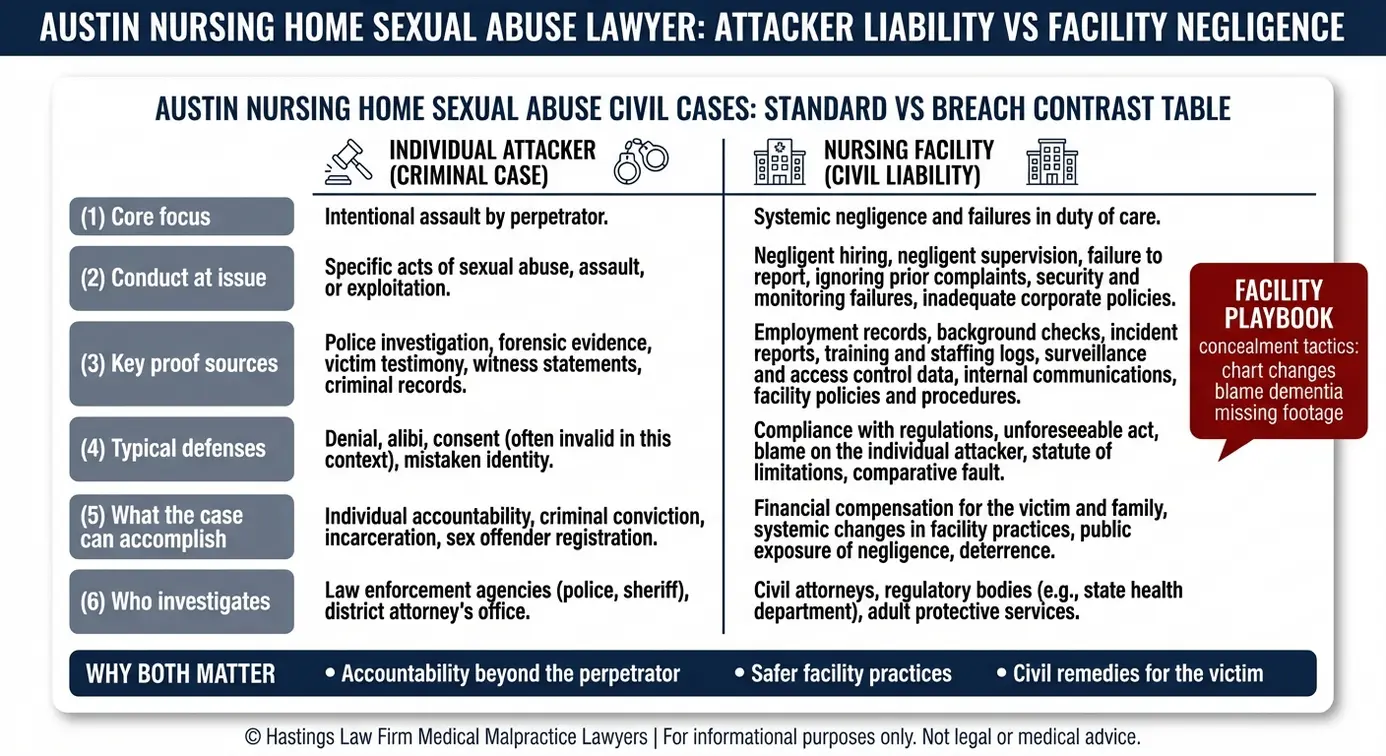
An experienced nursing home sexual abuse attorney investigates the facility’s hiring practices, supervision failures, and internal reporting gaps to establish liability that extends well beyond the individual perpetrator, holding the nursing home itself accountable for systemic negligence. This distinction matters because nursing home abuse cases often involve layers of liability that are difficult to understand without legal expertise.
Two separate legal tracks often run in parallel. Law enforcement handles the criminal charges against the person who committed the assault. But a civil lawsuit targets the facility that created the conditions for the abuse to happen. Criminal prosecution focuses on punishment. Civil remedies focus on accountability, institutional reform, and financial recovery for the harm your family member endured.
Many families feel intimidated at the thought of challenging a care facility. This psychological barrier, often described as the white coat effect, leads people to trust medical and caregiving institutions without question. That hesitation is understandable, but it should not prevent you from protecting your loved one. The facility holds the employment records, incident reports, internal complaints, and surveillance footage. Without legal authority, families simply cannot access this information on their own.
Non-consensual sexual contact, which includes any unwanted touching or sexual interaction, is a violation of basic human rights. Our legal team includes former defense attorneys who previously represented healthcare institutions. That background gives us direct insight into how facilities respond to allegations of elder sexual abuse and how they attempt to minimize exposure.
We also have in-house nursing staff who can interpret clinical records and identify inconsistencies that might otherwise go unnoticed. We scrutinize staffing logs to see if the facility was understaffed, review background checks for missed red flags, and analyze training protocols. When we take a case, we subpoena the documents that matter and build a timeline that reveals what the facility knew, and when they knew it.
Recognizing the Warning Signs of Sexual Abuse in Elderly Care Facilities
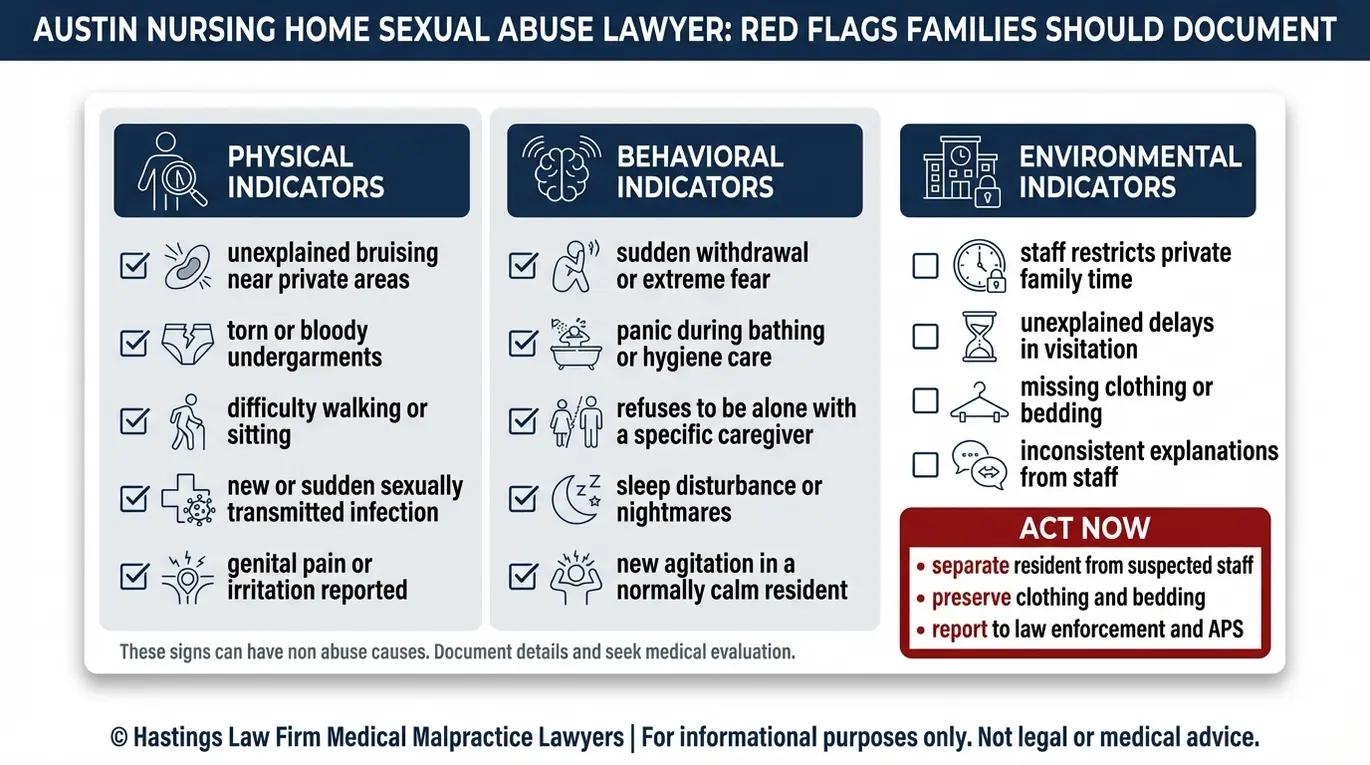
Common indicators of sexual abuse in a nursing home resident include unexplained bruising around private areas, torn or bloody undergarments, sudden contraction of sexually transmitted infections, and extreme withdrawal or fear of specific staff members. Because many residents have limited ability to communicate what happened, families must know what to look for.
Identifying these warning signs of non-consensual sexual contact in a nursing home or assisted living facility generally involves watching for three categories of changes:
Physical indicators:
- Anogenital trauma, meaning genital or anal bruising, tearing, or bleeding, with no documented medical explanation
- New sexually transmitted infections
- Difficulty walking or sitting that develops suddenly
- Unexplained bruising on the inner thighs, chest, or neck
Behavioral indicators:
- Sudden emotional regression, increased agitation, or panic attacks, particularly during bathing or hygiene care
- Refusal to be left alone with a specific caregiver or nursing home staff member
- Withdrawal from social interaction or activities the resident previously enjoyed
- Sleep disturbances, nightmares, or new onset of anxiety
Environmental indicators:
- Staff members who insist on being present during family visits or resist leaving the room
- Unexplained restrictions on visitation hours or access to your loved one
- Missing or incomplete documentation in care logs
Families should also be aware that sexual abuse does not always involve a staff member. Resident-on-resident sexual abuse, where one resident assaults another, occurs when facilities fail to properly assess and separate residents with known aggressive or predatory behaviors. Whether the perpetrator is a nursing home employee or another resident, the facility can be held responsible for failing to keep your family member safe.
If you notice any combination of these signs, trust your instincts. An Austin nursing home sexual abuse lawyer can help you determine whether the evidence supports a formal investigation.
The Hastings Law Firm Difference
Results matter, but what truly sets us apart is how we achieve them. Every verdict, every settlement, and every Austin courtroom victory comes from one guiding promise: To treat each client’s fight for justice as if it were our own.
This balance of skill, experience, and empathy reflects our core philosophy that justice should not only compensate the injured, but also make health care safer nationwide.

Holding Austin Nursing Facilities Accountable for Systemic Negligence
Facilities are liable when they fail to protect residents through negligent hiring, inadequate background checks, poor supervision, or failure to respond to prior complaints of misconduct. Accountability in these cases extends beyond the individual who committed the abuse to the institution that allowed it to happen.
Negligent hiring occurs when a facility brings on nursing home staff without conducting a proper criminal background check, a screening process required to verify whether an applicant has prior convictions or a documented history of abuse. If a facility hires someone with a known record of sexual offenses or violent behavior, that hiring decision itself becomes a basis for liability.
Negligent supervision involves the facility’s failure to adequately monitor interactions between staff and residents or between residents themselves. This can include leaving vulnerable residents unsupervised for extended periods, ignoring complaints about a specific employee, or failing to install and maintain functioning security cameras.
Failure to report is another common issue. When early warning signs are raised by other residents, family members, or even other staff, and the facility takes no action, that pattern of inaction becomes powerful evidence in a civil case.
Facilities often attempt to distance themselves from the abuse by characterizing the perpetrator as a “rogue employee” acting outside the scope of employment. This defense strategy aims to shift all blame to the individual attacker.
However, an experienced nursing home sexual abuse lawyer knows that if the facility hired someone with a dangerous history or failed to monitor them, the institution is responsible. Claims against a negligent facility focus on these systemic failures rather than just the isolated act.
| Liability Type | Individual Attacker | Nursing Home Facility |
|---|---|---|
| Legal Track | Criminal charges (assault, abuse) | Civil lawsuit (negligence, liability) |
| Basis of Claim | Direct act of sexual assault | Systemic failures enabling the abuse |
| Key Evidence | Forensic evidence, witness testimony | Hiring records, supervision logs, prior complaints |
| Potential Damages | Criminal penalties (incarceration) | Financial compensation, punitive damages |
Ways Nursing Homes Conceal Sexual Abuse Evidence
In nursing home negligence cases, facilities sometimes take active steps to conceal sexual abuse evidence to shield themselves from liability. Chart alteration, the deliberate tampering with or rewriting of medical documentation, can obscure injuries or change the recorded timeline of events. Nursing home staff may attribute a resident’s injuries to falls or “behavioral episodes” rather than documenting them accurately.
In cases involving residents with cognitive impairment, meaning a reduced ability to report abuse or provide reliable history, facilities may attempt to discredit the resident entirely. Claims that a resident is “confused” or “prone to fabrication” are sometimes used to dismiss legitimate reports of sexual assault.
Surveillance footage may also disappear. Cameras may be conveniently “out of service,” or recordings may be overwritten before anyone can request them. Texas mandatory reporting law requires facilities to report suspected abuse to the authorities, but not every facility complies. These are the patterns our team looks for when building a case.
Immediate Steps to Take If You Suspect Sexual Abuse in a Nursing Home
Immediate actions include removing the resident to a safe location, preserving all physical evidence, photographing injuries, reporting the incident to law enforcement, and filing complaints with state agencies. If you suspect your loved one has been sexually abused, taking these immediate, deliberate steps can protect both their safety and the integrity of critical evidence.
- Ensure immediate safety. If your family member is in danger right now, call 911. Remove the resident from the facility or request that the suspected abuser be separated from your loved one immediately.
- Preserve all physical evidence. Do not wash, discard, or disturb any clothing, bedding, or personal items that may contain DNA or other forensic material. Place items in a clean paper bag if they must be moved.
- Photograph visible injuries. Use your phone to take clear, well-lit photos of any bruising, marks, or wounds. Include close-ups and wider shots that show the location of the injuries on the body.
- Request a forensic medical exam. Ask for a Sexual Assault Nurse Examiner (SANE), a specially trained nurse who conducts sexual assault forensic examinations. This forensic medical exam, sometimes called a SAFE exam, involves a systematic evidence collection kit used to document injuries and gather biological evidence. Protocols for these examinations are outlined in the National Protocol for Sexual Assault Medical Forensic Examinations published by the U.S. Department of Justice.
- Report to law enforcement and state agencies. File a report with local police. Then contact Texas Adult Protective Services and the Texas Health and Human Services Commission (HHSC) to file formal complaints. Compliance with Texas law and mandatory reporting law is essential to trigger an official investigation.
- Contact an Austin nursing home sexual abuse lawyer. An attorney can move quickly to preserve surveillance footage, subpoena records, and prevent the facility from destroying important evidence.

Compensation Available for Victims of Nursing Home Sexual Abuse in Texas
Victims of nursing home sexual abuse in Texas may recover economic damages for financial losses, non-economic damages for pain and suffering, and potentially punitive damages for gross negligence. Families who bring a civil claim can pursue several categories of financial compensation, depending on the circumstances and severity of the abuse.
Economic damages cover measurable financial losses. These include medical bills for treatment of physical injuries, the cost of ongoing psychiatric care and therapy, and expenses related to relocating your loved one to a safer facility. If additional in-home care or specialized treatment becomes necessary, those costs may also be included.
Non-economic damages address the harm that does not come with a receipt. This includes compensation for pain and suffering, mental anguish, loss of dignity, and loss of enjoyment of life. For an elderly person who trusted their caregivers and was violated by them, the emotional impact can be profound and lasting.
Punitive damages may be available when the evidence shows the facility acted with gross negligence or malice. Under Texas law, punitive damages are designed to punish particularly egregious conduct and to deter similar behavior. If a facility knowingly concealed abuse, ignored repeated complaints, or hired staff with disqualifying criminal histories, these damages can significantly increase the total recovery. An Austin nursing home sexual abuse lawyer can evaluate the full scope of your family’s losses and identify every available category of compensation.
Statute of Limitations for Texas Nursing Home Abuse Claims
In Texas, the general statute of limitations for personal injury claims is two years from the date of the injury or discovery, but specific factors in sexual abuse cases can complicate these deadlines.
Under Texas Civil Practice and Remedies Code § 16.003, the two-year clock typically begins on the date the abuse occurred. However, the discovery rule may extend this deadline for filing a civil lawsuit if the abuse was concealed or if the resident was unable to report it due to cognitive limitations. In those situations, the clock may start when the family knew, or reasonably should have known, about the abuse.
Even with potential extensions, waiting carries real risk. Surveillance footage is often overwritten within days or weeks. Staff members leave or are terminated, and as research published in PubMed Central on nursing staff turnover has documented, high turnover rates in nursing homes mean that key witnesses may become difficult to locate. Acting quickly gives your legal team the best opportunity to secure evidence before it disappears.
Contact the Austin Nursing Home Attorneys at Hastings Law Firm Today for Help
No family should have to face this alone. If you suspect that your loved one has been sexually abused in a nursing home or assisted living facility, Hastings Law Firm is here to listen, investigate, and act on your behalf.
Our firm was built on a single mission: to restore trust for families who have been betrayed by the systems meant to protect them. Every consultation is free, confidential, and handled with care by a team that includes attorneys, nurse consultants, and patient advocates who specialize in facility negligence cases.
Tommy Hastings is a board-certified trial lawyer with a national reputation for securing accountability in medical negligence cases. His induction into the American Board of Trial Advocates reflects the firm’s focus on high-stakes litigation and deep personal empathy for clients. You pay no attorney fees or costs unless we secure a recovery for your family. Reaching out is a low-risk first step to a free, confidential consultation.
Contact our Austin office to speak with an Austin nursing home sexual abuse lawyer who will treat your family’s situation with the seriousness and compassion it deserves.
Frequently Asked Questions About Nursing Home Sexual Abuse in Austin


This content was researched and written by the Hastings Law Firm editorial team, which includes attorneys, medical professionals, and experienced researchers. Our writing is informed by internal knowledge and practical experience, and we cross-check critical details against authoritative sources cited throughout. Every piece undergoes human-led fact-checking and legal review. Because legal and medical information can change, if you spot an error, please contact us. Learn more about our content standards and review process on our editorial policy page.

Gabe Sassin has focused exclusively on medical malpractice law since 2007. After spending more than a decade as a malpractice defense attorney, he knows exactly how the other side works. He has seen firsthand how healthcare providers, insurers, corporate defendants, and their legal teams think, prepare, and build their defense against claims. That knowledge works for the people who need it most today, injured patients and their families. His unique experience shapes everything he writes, giving readers a look at how these cases actually work from someone who has handled them from both sides.
