


Houston Brachial Plexus Injury Lawyer
Written by: Hastings Law Firm | Reviewed by: Tommy Hastings | Updated: May 6, 2026
A brachial plexus birth injury can leave a child with lasting loss of arm and hand function and can place heavy emotional and financial strain on a family. These injuries are often linked to delivery complications such as shoulder dystocia and can be worsened by excessive traction or improper use of delivery tools. Understanding how nerve damage severity affects prognosis and long term care needs can help families make informed decisions about next steps. If you or a loved one were harmed or worse due to brachial plexus malpractice in Houston, Texas, contact Hastings Law Firm for a free, confidential case review.

Trusted Legal Representation for Preventable Birth Injuries
What You Should Know About Infant Shoulder & Arm Nerve Injury Claims in Houston:
- Long term disability and major care costs can follow a brachial plexus birth injury when nerve damage causes lasting loss of function.
- Preventability disputes often focus on whether shoulder dystocia was managed with appropriate techniques rather than excessive traction.
- Liability can turn on whether delivery decisions accounted for known risk factors and whether a surgical alternative was appropriately considered.
- Recovery options in Texas can be lost if legal time limits are missed, even when the injured child is a minor.
- Compensation can cover both financial losses and human harms, including medical care needs and pain and suffering.
- Case value can vary widely based on whether the injury resolves with therapy or results in permanent limitations.
- Proof challenges can increase over time as records become harder to obtain and witnesses become unavailable.
- Medical records and qualified expert support can be central to showing that provider actions fell below the accepted standard of care.

A Healthcare Focused Law Firm
Learning that your child suffered a brachial plexus injury can leave your family searching for answers. This condition involves damage to the network of nerves that connects the spinal cord to the shoulder, arm, and hand. If you or a loved one is in this situation, you may be wondering whether the injury was preventable and what options exist to secure the care your child needs going forward.
As your Houston brachial plexus injury lawyer, we focus exclusively on medical malpractice cases, including birth injuries caused by provider negligence. Our team includes former defense attorneys and hospital nurses who provide an inside look at how medical facilities handle errors. Founded by board-certified trial attorney Tommy Hastings, our firm has spent decades investigating delivery room trauma. This team of attorneys, nurse consultants, and medical experts works to determine if a healthcare provider’s actions fell below the accepted standard of care.
If your child was injured during birth, we can review the circumstances and explain your legal options at no cost and with no obligation.
Understanding the Severity of Brachial Plexus Injuries
A brachial plexus injury involves damage to the network of nerves sending signals from the spinal cord to the shoulder, arm, and hand, often resulting in paralysis or loss of function. When these nerves are stretched, compressed, or torn during delivery, the physical consequences can range from temporary weakness to permanent paralysis of the affected limb.
According to the National Center for Biotechnology Information (NCBI), the brachial plexus is formed by nerve roots branching from the cervical and upper thoracic spine. Because this nerve network controls nearly all movement and sensation in the upper extremity, even partial damage can significantly affect a child’s ability to use their arm and hand. Our attorneys know that the location and severity of the tear dictate the prognosis.
The severity of the injury depends on how the nerves were damaged. Neurapraxia, a mild stretching of the nerve without tearing, often resolves on its own within weeks or months as the inflammation subsides. At the opposite end of the spectrum, an avulsion, where the nerve root is completely torn away from the spinal cord, typically causes permanent loss of function and may not be surgically repairable. This distinction is critical because while some infants recover full mobility, others face lifelong disabilities requiring extensive intervention.
| Injury Type | What Happens | Severity |
|---|---|---|
| Neurapraxia | The nerve is stretched but not torn | Mildest; often heals on its own |
| Neuroma | Scar tissue forms on a partially healed nerve, pressing on healthy tissue | Moderate; may require treatment |
| Rupture | The nerve is torn but not at the spinal cord | Serious; often requires surgical repair |
| Avulsion | The nerve root is torn completely from the spinal cord | Most severe; may cause permanent paralysis |
Understanding the type and extent of nerve damage is essential for both medical treatment planning and evaluating the long-term impact on your child’s life. In severe cases, the financial and emotional costs can extend across a lifetime, necessitating resources for adaptive technologies, specialized therapy, and long-term assistance.
Types of Conditions Associated with Brachial Plexus Trauma
Two specific diagnoses, Erb’s palsy and Klumpke’s palsy, are commonly linked to brachial plexus birth injuries. These conditions involve damage to the nerve network during the delivery process. Erb’s palsy typically causes weakness or limited mobility in the shoulder and upper arm. A child with this condition may hold the affected arm against their body and have difficulty lifting or rotating it.
Klumpke’s palsy, which involves the lower nerves of the brachial plexus, primarily affects the forearm, wrist, and hand. This condition is less common but can result in a loss of grip strength and fine motor control. In some cases, a child may experience both conditions simultaneously, depending on the extent of the nerve damage sustained during delivery.

Common Causes of Preventable Birth Injuries in Texas
Most preventable brachial plexus injuries occur when medical staff fail to manage complications like shoulder dystocia or large fetal size, leading to excessive traction on the infant’s head during delivery.
Shoulder dystocia, a complication where the baby’s shoulder becomes lodged behind the mother’s pelvic bone after the head has been delivered, is the most common precursor to brachial plexus injuries. This is a recognized obstetric emergency. When it occurs, the delivering physician must act quickly and use specific techniques to free the infant without applying dangerous force.
The problem arises when a provider resorts to excessive lateral traction, meaning they pull too hard or at an improper angle on the baby’s head to deliver the shoulder. This force can stretch or tear the delicate nerves of the brachial plexus. In many cases we review, the injury could have been avoided with proper technique or earlier intervention. Our birth injury lawyers can identify when these actions cross the line into medical malpractice.
Improper use of extraction tools like forceps or vacuum extractors can also contribute to nerve damage. These instruments, when applied with too much force or at the wrong angle, place additional strain on the infant’s head and neck during an already difficult delivery.
Another common factor involves the failure to recommend or perform a Cesarean section (C-section) when risk factors were present before labor began. If prenatal evaluations indicated a large baby, gestational diabetes, or a breech birth, the delivering team has a responsibility to weigh the risks of vaginal delivery against the safety of a surgical alternative. Ignoring these warning signs can suggest negligence if the child suffers harm as a result.
Red flags that our brachial plexus injury attorneys examine in delivery room cases include:
- Documented evidence of a large-for-gestational-age fetus without a revised delivery plan
- Shoulder dystocia lasting longer than 60 seconds without recognized maneuvers being attempted
- Use of forceps or vacuum extraction during a complicated delivery
- Failure to call for additional help or escalate care when dystocia occurred
- No documented discussion of C-section despite known risk factors
- Excessive traction noted or implied in delivery records
As your Houston brachial plexus injury lawyer, our role is to reconstruct what happened in the delivery room and identify where the standard of care may have been violated. Our team, which includes experienced nurses and former defense attorneys, knows how to read between the lines of medical charting and identify gaps that point to preventable errors.
The Hastings Law Firm Difference
Results matter, but what truly sets us apart is how we achieve them. Every verdict, every settlement, and every Houston courtroom victory comes from one guiding promise: To treat each client’s fight for justice as if it were our own.
This balance of skill, experience, and empathy reflects our core philosophy that justice should not only compensate the injured, but also make healthcare safer nationwide.

Proving Medical Negligence in Brachial Plexus Cases
To prove negligence, a plaintiff must demonstrate that the healthcare provider deviated from the accepted standard of care, directly causing the infant’s injury, often through expert testimony and medical record analysis. This process establishes liability and confirms that the harm was not an unavoidable consequence of childbirth.
The standard of care refers to the level of treatment a reasonably competent medical professional would have provided under similar circumstances. In a delivery room setting, this means the attending physician should have recognized risk factors, responded appropriately to complications like shoulder dystocia, and used accepted techniques to safely deliver the baby. When a doctor fails to meet this benchmark, questions of preventability arise.
Proving a deviation from this standard is not something families are expected to do on their own. Texas law under Texas Civil Practice and Remedies Code Chapter 74 requires that medical malpractice claims be supported by a qualified expert who can speak to what the standard of care required and how the provider failed to meet it.
Here is a general overview of how our medical malpractice attorneys build these cases:
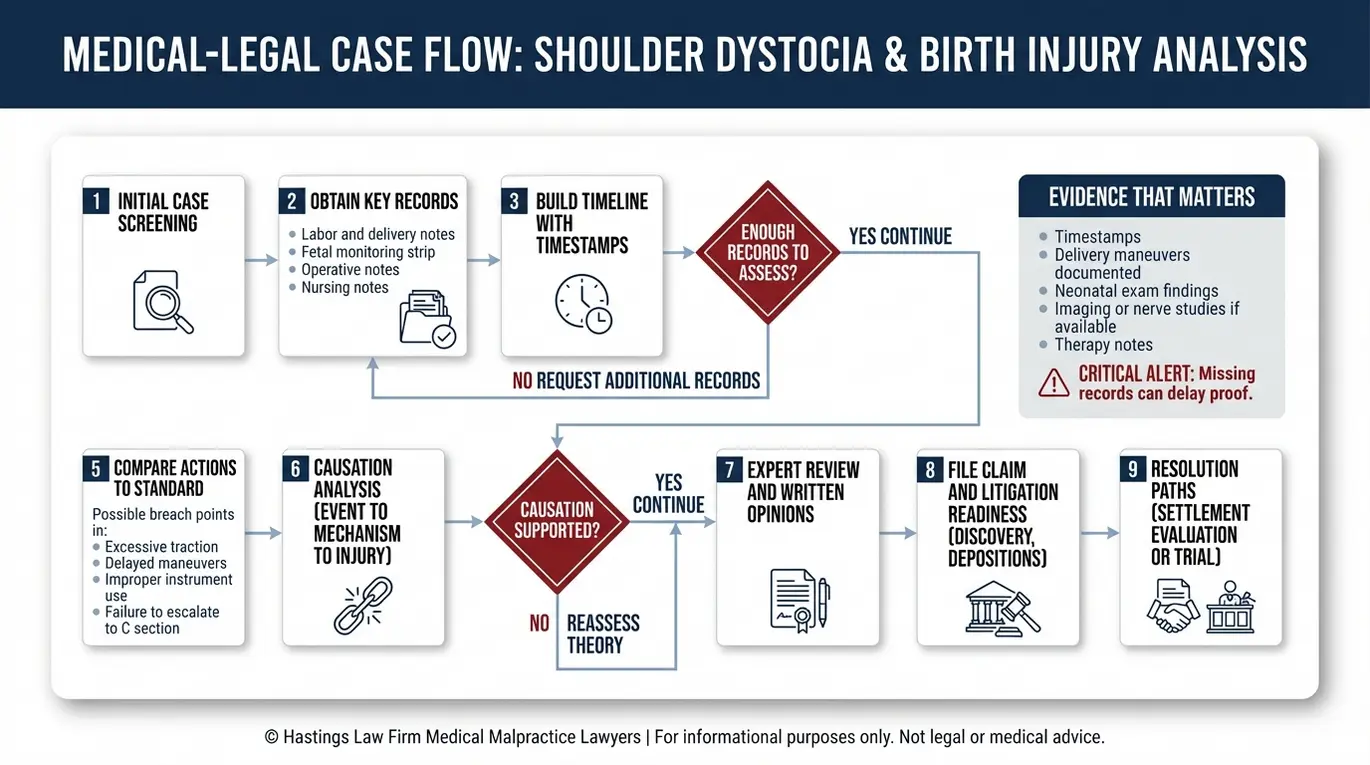
- Obtain and review all medical records. We collect prenatal records, labor and delivery notes, fetal monitoring strips, nursing charts, and neonatal documentation. Texas patients have the right to access their records, as outlined by the Texas Medical Board.
- Identify the breach. Our in-house medical staff analyzes the records to pinpoint where clinical decisions deviated from accepted protocols.
- Retain qualified expert witnesses. We work with board-certified obstetricians and specialists who can testify about what a competent provider should have done. Their testimony is critical for connecting the provider’s conduct to the injury.
- Establish causation. The expert must connect the provider’s specific actions or omissions to the child’s nerve injury, ruling out alternative causes. This step is vital to survive legal challenges from defense counsel.
- Document the full impact. We build a complete picture of how the injury affects the child’s daily life, future development, and the family’s financial reality.
Because we prepare every case as if it will go to trial, the evidence package we assemble sends a clear message to defense counsel and insurers that we are ready to present the case to a jury if a fair resolution cannot be reached. Our founder, Tommy Hastings, is an ABOTA inductee who uses this trial-ready mindset to handle complex birth trauma litigation. We prepare every case to stand up in court, ensuring no detail is overlooked during the investigation.
Unique Considerations for Shoulder Dystocia Claims
Shoulder dystocia cases, which occur when a baby’s shoulder becomes stuck during delivery, involve specific clinical protocols that are well-documented in obstetric training. Medical providers must follow specific protocols when a baby’s shoulder becomes stuck during birth. The McRoberts maneuver, which involves flexing the mother’s legs sharply toward her abdomen to widen the pelvic opening, is typically the first-line response.
If the McRoberts maneuver does not work, providers are trained to attempt additional delivery protocols such as suprapubic pressure, delivery of the posterior arm, or repositioning the mother. What we evaluate is whether these maneuvers were attempted, in what order, how much time passed, and whether excessive force was used instead of following established protocols. The absence of documented maneuvers, or evidence that a provider relied on brute traction rather than technique, can be strong evidence of a breach in the standard of care.
Recoverable Damages for Families of Injured Infants
Families may recover compensation for past and future medical expenses, physical therapy, surgical costs, lost earning capacity for the child, and non-economic damages like pain and suffering.
When a child sustains a brachial plexus injury due to medical negligence, the financial consequences often extend far beyond the initial hospitalization. Severe cases involving a rupture, where the nerve is torn but not at the spinal cord, or a neuroma, where scar tissue compresses healthy nerve fibers, may require nerve surgery, reconstructive procedures, and years of follow-up care.
The goal of compensation for birth injuries is to ensure your child has access to every resource they need, both now and throughout their life. Our team works with life care planning professionals whose qualifications align with the certification standards recognized by rehabilitation medicine research (PubMed) to project the full scope of future needs. A complete life care plan accounts for every aspect of living with a disability, from daily therapies to home modifications.
Economic Damages:
- Past and future medical expenses, including hospitalizations, surgeries, and specialist visits
- Physical therapy and occupational therapy costs over the child’s lifetime
- Nerve surgery and reconstructive procedures
- Adaptive equipment and assistive devices
- Lost wages for parents who must reduce work hours to provide care
- Lost future earning capacity if the child’s disability limits their ability to work as an adult
Non-Economic Damages:
- The child’s physical pain and suffering
- Mental anguish experienced by both the child and parents
- Loss of enjoyment of life and diminished quality of life
- Disfigurement or physical impairment
In brachial plexus settlements and verdicts, the value of a case depends heavily on the severity of the nerve damage and whether the child faces a lifetime of limited mobility. Permanent injuries that require ongoing care and restrict the child’s independence typically carry significantly higher valuations than injuries that resolve with therapy alone.
Texas Statute of Limitations for Birth Injury Claims
In Texas, medical malpractice claims typically have a two-year statute of limitations, but cases involving minors under 12 may allow tolling until the child reaches age 14, though strict statutes of repose still apply.
Under Texas law, the time limit for birth injury lawsuits generally requires that a claim be filed within two years of the date the injury occurred or was reasonably discovered. For adult patients, missing this window typically bars the claim entirely.
Because a minor cannot file a lawsuit on their own behalf, Texas law “tolls,” or pauses, the statute of limitations for children injured before age 12. This generally gives the child’s parents or legal guardians until the child’s 14th birthday to file a claim. This tolling provision recognizes that children should not be penalized for their parents’ failure to act immediately.
A strict hard limit exists that many families may not know about. Texas has a 10-year statute of repose, which acts as an absolute cutoff. Regardless of when the injury is discovered or whether the child is still a minor, no medical malpractice claim can be filed more than 10 years after the date the negligent act occurred.
Waiting too long can also harm your case in practical ways. Medical records may be harder to obtain, key witnesses may become unavailable, and memories fade. Even if your child’s deadline appears to be years away, consulting with an attorney early helps preserve critical evidence and gives your legal team the time needed to build the strongest possible case.
If you are unsure whether your child’s claim is still within the filing window, we encourage you to reach out for a free evaluation as soon as possible.

Contact the Houston Birth Injury Attorneys at Hastings Law Firm Today for Help
Your child’s future care depends on securing the right resources, and your family deserves to know what happened during delivery. Our team is here to help you understand your legal rights after a birth injury. At Hastings Law Firm, our entire team is dedicated to one area of law: medical malpractice. We exist to restore trust for families who have been let down by the healthcare system and to hold negligent providers accountable so the same mistakes are not repeated.
As your Houston brachial plexus injury lawyer, we handle every aspect of the legal process while you focus on your child. Our founder, Tommy Hastings, is Board Certified in Personal Injury Trial Law by the Texas Board of Legal Specialization, a credential held by fewer than 2% of attorneys in Texas.
Our consultations are free, and we provide a confidential evaluation of your child’s medical records. You pay no attorney fees or costs unless we recover compensation on your behalf. If you believe your child’s brachial plexus injury was preventable, contact Hastings Law Firm today for the answers your family deserves.
Frequently Asked Questions About Brachial Plexus Malpractice in Houston

Key Brachial Plexus Malpractice Terms:
- Brachial plexus
- A network of nerves that runs from the spinal cord in the neck down through the shoulder and into the arm, hand, and fingers. These nerves control movement and sensation in the upper limb. During difficult deliveries, the brachial plexus can be stretched, compressed, or torn, leading to temporary or permanent loss of arm function in the newborn.
- Neurapraxia
- The mildest type of nerve injury, where the nerve is stretched but not torn. In brachial plexus birth injuries, neurapraxia typically causes temporary weakness or numbness that usually heals on its own within a few weeks to months without surgical intervention. This is the least severe form of injury on the spectrum of nerve damage.
- Avulsion
- The most severe type of brachial plexus injury, where the nerve root is completely torn away from the spinal cord. Avulsion injuries are usually permanent and cannot heal on their own, often requiring complex surgical reconstruction with limited chances of full recovery. This represents the most catastrophic end of the injury spectrum and typically results in lifelong disability.
- Erb’s palsy
- A condition resulting from damage to the upper nerves of the brachial plexus, typically affecting the shoulder and elbow. Infants with Erb’s palsy may have a weakened or paralyzed arm that hangs limply at the side with the hand turned inward. This is one of the most common types of brachial plexus birth injuries and can range from temporary to permanent depending on the severity of nerve damage.
- Klumpke’s palsy
- A less common condition caused by injury to the lower nerves of the brachial plexus, primarily affecting the forearm, wrist, and hand. Infants with Klumpke’s palsy may have a claw-like hand with little or no ability to grip, and may also experience drooping of the eyelid on the affected side if certain nerves are damaged. This condition is often associated with breech deliveries.
- Shoulder dystocia
- A delivery complication that occurs when a baby’s shoulder becomes stuck behind the mother’s pelvic bone after the head has already emerged. This is the primary cause of brachial plexus injuries during birth, as the trapped shoulder creates pressure on the nerves and may lead healthcare providers to apply excessive force during extraction attempts. Shoulder dystocia requires immediate and skilled maneuvers to safely deliver the baby.
- Excessive lateral traction
- The improper application of too much sideways or pulling force on a baby’s head and neck during delivery. When a doctor or nurse pulls too hard on the baby’s head to free a stuck shoulder, this excessive force can stretch or tear the delicate nerves of the brachial plexus. In medical malpractice cases, proving that excessive traction was used is often key to establishing negligence.
- McRoberts maneuver
- A standard obstetric technique used to resolve shoulder dystocia, where the mother’s legs are sharply flexed back toward her abdomen to widen the pelvis and help free the stuck shoulder. This is typically the first and safest maneuver attempted when shoulder dystocia occurs. Failure to promptly perform this or other appropriate maneuvers, or performing them incorrectly, may constitute negligence in a birth injury claim.
- Rupture
- A type of brachial plexus injury where the nerve is torn but not at the spinal cord attachment point. Unlike avulsion, where the nerve tears away from the spine, a rupture occurs somewhere along the length of the nerve itself. Ruptures are serious injuries that typically require surgical repair and may result in permanent impairment, though they generally have a better prognosis than avulsions.
- Neuroma
- Scar tissue that forms at the site of a nerve injury when the nerve attempts to heal itself. In brachial plexus cases, neuromas can form after a rupture or severe stretch injury and may block proper nerve regeneration, causing ongoing pain, weakness, or numbness. The presence of neuroma formation often signals the need for surgical intervention and impacts the calculation of long-term medical costs and damages.
- Anatomy Head and Neck Brachial Plexus | NCBI Bookshelf
- 306. How do I obtain a copy of my medical records? | Texas Medical Board
- Certification standards of professionals coordinating life care plans for individuals who have acquired brain injury | PubMed
- Texas Civil Practice and Remedies Code Chapter 74 | Texas Legislature Online
- Windrum v. Kareh | Supreme Court of Texas
Get Answers Today
If you think that medical negligence, a dangerous drug, or a failed medical product caused harm to you or someone you love, our team is standing by to offer guidance. We’ll explain your options under current laws and help you move forward with clarity and understanding. Case reviews are free and 100% confidential.