


Fort Worth Nurse Malpractice Lawyer
Written by: Hastings Law Firm | Reviewed by: Brady D. Williams | Updated: July 27, 2026
Nursing negligence can cause serious injury and leave families feeling overwhelmed, uncertain, and distrustful of care that should have been safe. In Texas, nurse malpractice claims focus on whether a nursing professional met the accepted standard of care for their training and role and whether a specific lapse caused measurable harm. These cases often turn on what the records show about monitoring, medication administration, communication, and charting accuracy, including whether documentation was changed after an adverse event. If you or a loved one were harmed or worse due to nurse malpractice in Fort Worth, Texas, contact Hastings Law Firm for a free, confidential case review.

Trusted Medical Attorneys for Nursing Negligence Claims in Fort Worth
What You Should Know About Nursing Negligence Claims in Fort Worth:
- Recovery can depend on showing that a nurse fell below the accepted standard of care for that specific license level and training.
- Options can be limited when harm is not measurable, even if an error occurred.
- Liability can expand beyond the individual nurse when a hospital is responsible for employee conduct or when unsafe staffing or credentialing practices are involved.
- Disputes can arise when hospitals classify agency or travel nurses as independent contractors to contest responsibility.
- Severe outcomes can occur when communication failures delay escalation of a worsening condition during triage or shift changes.
- Harm can result from common nursing errors such as medication administration mistakes or failures to monitor.
- Case viability can end permanently if Texas timing requirements for medical injury claims are missed.
- Compensation for pain and suffering and emotional distress can be limited under Texas damage cap rules even when injuries are severe.
- Credibility can hinge on whether nursing flow sheets and medication records match the clinical course documented elsewhere in the chart.
- Record tampering concerns can be central when electronic audit trails show late entries or post event modifications after a serious injury or death.

A Healthcare Focused Law Firm
When a nurse’s error causes serious harm, the experience can shake your trust in the entire healthcare system. You may feel confused about what went wrong, uncertain whether what happened was preventable, and unsure what to do next. Those feelings are valid, and you do not have to sort through this alone.
Hastings Law Firm focuses exclusively on medical malpractice. Tommy Hastings, a board-certified trial lawyer who has been recognized as a Texas Super Lawyer since 2013, leads our dedicated team. Our legal team, which includes former defense attorneys and in-house nurse consultants, understands how nursing negligence cases are built and what it takes to prove them. If you or a loved one was injured by a nursing error in a Fort Worth healthcare facility, a Fort Worth Nurse Malpractice Lawyer at our firm can review what happened and explain your options in a free, confidential consultation.
Understanding Nurse Malpractice Claims in Texas
Nurse malpractice occurs when a nursing professional fails to provide the accepted standard of care required by their specific level of training, directly resulting in patient injury or death. It falls under the broader category of medical negligence, but these claims carry distinct legal considerations because nurses operate under different licensing requirements and clinical responsibilities than physicians.
The standard of care for nurses is defined by what a reasonably competent nurse with the same credentials and training would have done in a similar situation. This standard is not a subjective matter of opinion. It is shaped by established nursing protocols, specific training requirements, and authoritative guidelines set by regulatory bodies like the Texas Board of Nursing. This applies to every professional, from a specialized Registered Nurse to a Certified Nursing Assistant (CNA), a caregiver trained to assist with basic patient needs. Our Fort Worth nurse malpractice lawyers work with qualified nursing experts to establish exactly what that standard required in your specific scenario and how the nurse’s conduct violated it.
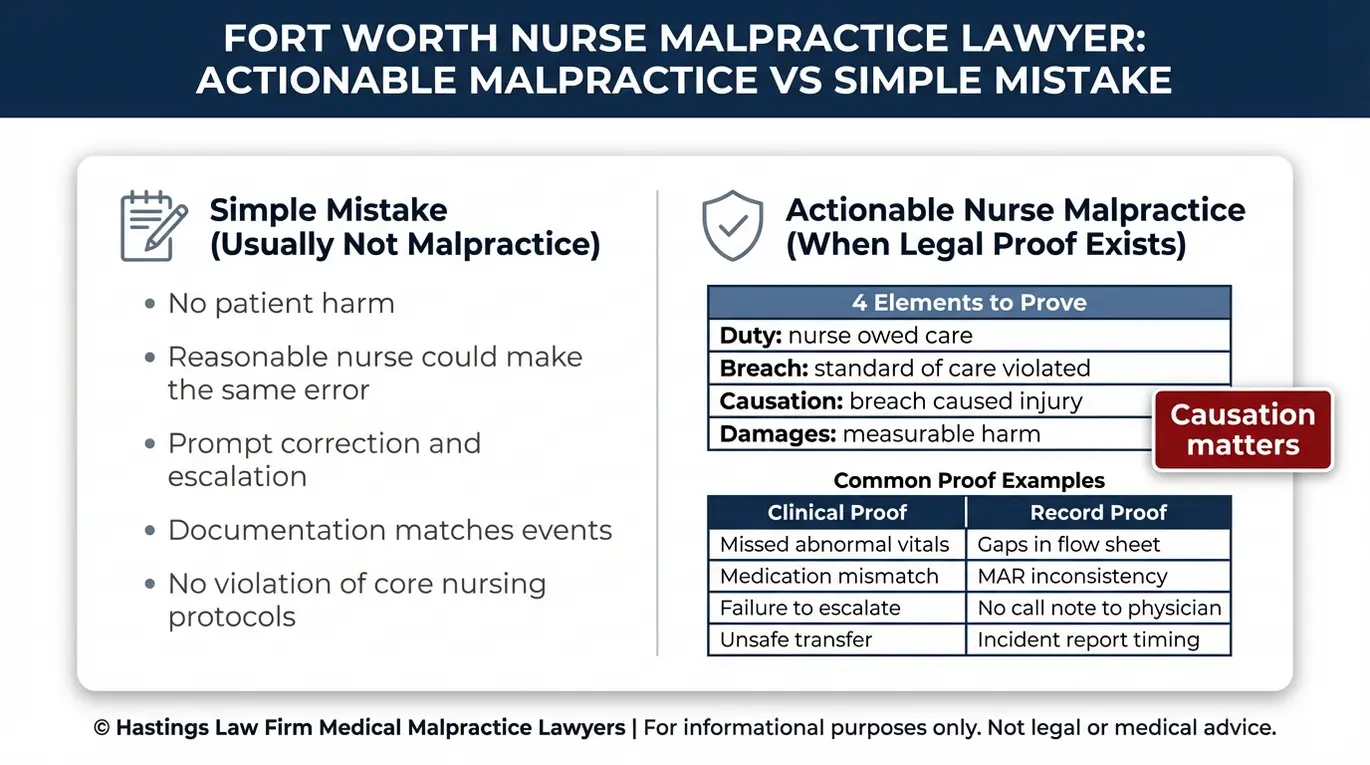
To succeed on a nurse malpractice claim, we must prove four legal elements under Texas Civil Practice and Remedies Code Chapter 74:
- Duty: The nurse owed a professional duty of care to the patient to provide safe and competent treatment.
- Breach: The nurse failed to meet the applicable standard of care through an action or omission.
- Causation: That specific failure directly caused or contributed to the patient’s injury, rather than the underlying illness.
- Damages: The patient suffered measurable harm, whether physical, financial, or emotional, as a result of the error.
Not every poor outcome qualifies as malpractice. The distinction matters, and it is one of the first things we evaluate during a case review. Here is a general framework for understanding the difference:
- Unavoidable Complications: A bad outcome despite proper care is not malpractice. Medicine carries inherent risks, and some complications occur even when everyone does everything right.
- Harmless Errors: A mistake that causes no measurable harm may not support a legal claim, even if the error was real. Without damages, there is no case.
- Actionable Malpractice: Actionable malpractice exists when a nurse’s deviation from accepted protocols directly caused a specific, documentable injury that otherwise would not have occurred.
Liability Distinctions Among Nursing Levels
The standard of care is not the same for every nursing professional. Texas law recognizes that different nursing roles carry different levels of legal responsibility, and liability varies based on the individual’s license, scope of practice, and level of training.
A Registered Nurse (RN), a nurse who has completed a degree program and passed the NCLEX-RN exam, is expected to exercise independent clinical judgment, interpret diagnostic data, and recognize early warning signs of patient deterioration. A Licensed Vocational Nurse (LVN), sometimes called a Licensed Practical Nurse in other states, works under the supervision of an RN or physician and has a narrower scope of duties. A Certified Nursing Assistant (CNA) is held to a standard that reflects their more limited training compared to licensed nurses.
This distinction is important in building a claim. The legal question is always whether the specific nurse met the standard expected of someone with their credentials, not whether they performed like a more highly trained professional.
Common Types of Nurse Negligence Cases We Handle
The most frequent grounds for nursing negligence claims include medication administration errors, failure to monitor vital signs, inadequate fall prevention, and neglecting to communicate patient distress to physicians. In Fort Worth hospitals, medication administration errors are a common form of negligence. These errors involve mistakes like administering the wrong drug, the wrong dosage, or giving medication to the wrong patient. As a nurse malpractice attorney in Fort Worth, our team sees these patterns repeatedly across hospitals, surgical centers, and long-term care facilities.
Here are the categories of nursing errors we handle most often:
- Medication errors: Administering the wrong drug, the wrong dosage, or giving medication to the wrong patient. These cases also include ignoring documented allergies or known contraindications listed in the patient’s chart. Nurses must verify the “five rights” of medication administration; failure to do so is negligence.
- Failure to monitor: Missing or ignoring changes in a patient’s condition, including signs of respiratory distress, cardiac changes, post-surgical complications, or fetal distress during labor and delivery. Failure to monitor, the failure to observe and respond to a patient’s changing clinical status, is one of the most common and preventable forms of nursing negligence.
- Communication breakdowns: Failing to escalate a patient’s worsening condition to the attending physician or incoming shift team. Delayed communication during triage or shift changes can allow treatable conditions to become life-threatening.
- Fall prevention failures: Not following fall risk protocols for patients identified as high-risk, including failure to use bed alarms, assist with transfers, or maintain proper supervision.
- Pressure injuries: Development of serious bedsores, particularly Stage 3 or Stage 4 pressure ulcers. According to the Revised National Pressure Ulcer Advisory Panel Pressure Injury Staging System, Stage 3 injuries, which involve full-thickness skin loss exposing fat tissue, and Stage 4 injuries, which extend to muscle or bone, are largely preventable with proper repositioning and skin assessments.
- Surgical and anesthesia-related errors: Incorrect pre-operative preparation, improper patient positioning, or failure to monitor sedation levels during and after procedures.
Each of these case types requires a detailed review of the medical records to determine whether the nurse’s actions fell below the standard of care. As a Fort Worth nurse malpractice lawyer, our team pairs attorneys with in-house nurse consultants who know exactly where to look in the clinical documentation.
The Hastings Law Firm Difference
Results matter, but what truly sets us apart is how we achieve them. Every verdict, every settlement, and every Fort Worth courtroom victory comes from one guiding promise: To treat each client’s fight for justice as if it were our own.
This balance of skill, experience, and empathy reflects our core philosophy that justice should not only compensate the injured, but also make healthcare safer nationwide.

Determining Liability Between the Nurse and the Hospital
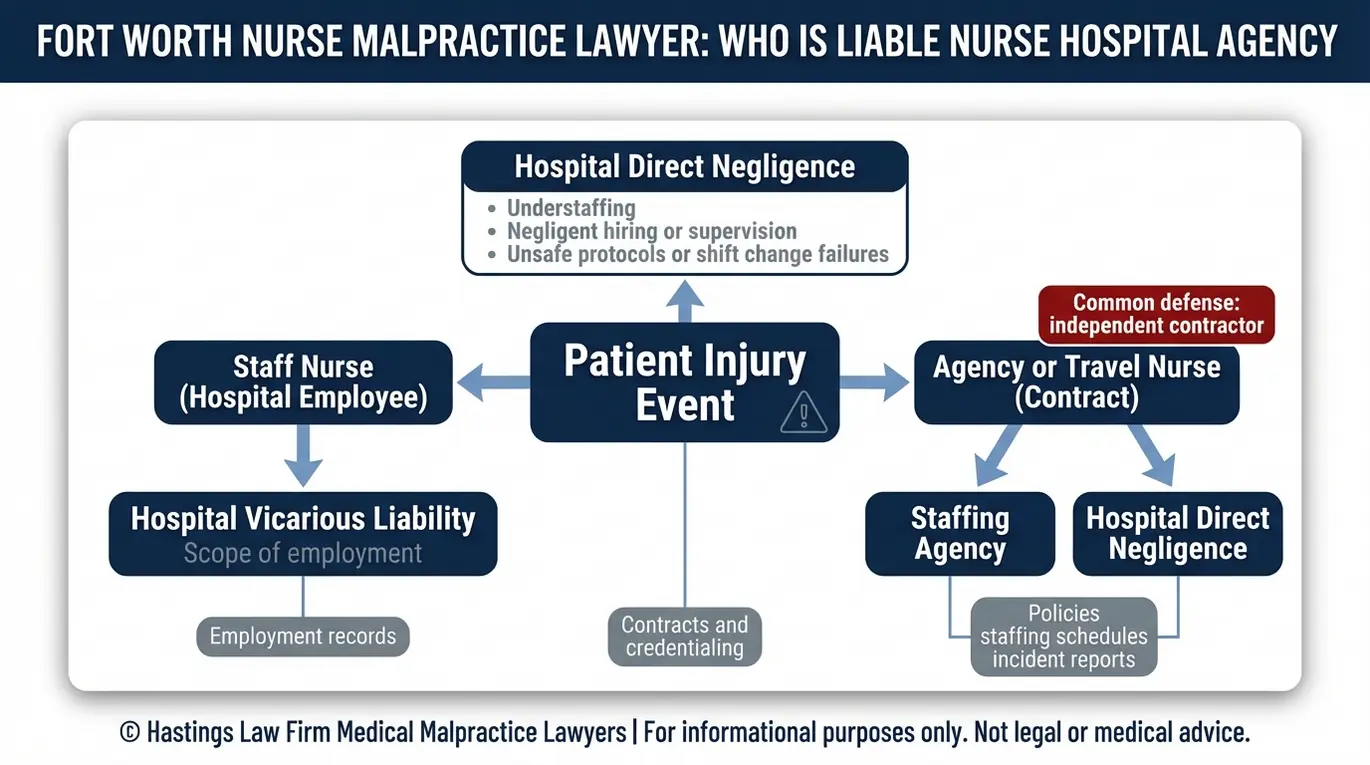
In most cases, the hospital is liable for a nurse’s negligence under the doctrine of vicarious liability, provided the nurse was a direct employee acting within the scope of their employment. This legal principle, known as respondeat superior, holds employers responsible for the actions of their employees performed during the course of their job duties.
Hospitals increasingly rely on agency nurses and travel nurses supplied by third-party staffing companies. When an error occurs, hospitals may argue that the nurse was an independent contractor, not an employee, and therefore the hospital is not responsible for the error.
The distinction between employee and independent contractor is not always clear-cut. Factors like who controls the nurse’s schedule, including shift change assignments, who provides clinical supervision, and who dictates the protocols the nurse must follow all affect the legal analysis. The Texas Workforce Commission’s Independent Contractor Test outlines the criteria used to evaluate this relationship.
| Factor | Staff Nurse (Hospital Employee) | Agency/Travel Nurse (Potential Independent Contractor) |
|---|---|---|
| Hired by | Hospital directly | Staffing agency |
| Supervised by | Hospital charge nurse/management | May argue limited hospital oversight |
| Hospital liability | Vicarious liability generally applies | Hospital may dispute responsibility |
| Other liable parties | Hospital is primary defendant | Staffing agency may share or hold liability |
Beyond vicarious liability, hospitals can also face direct claims for their own negligence. If a facility knowingly maintained unsafe staffing levels, failed to follow its own nursing protocols, or hired a nurse without proper credential verification, the hospital itself may be liable. These are sometimes classified as sentinel events, unexpected incidents that result in death or serious harm and signal a systemic failure.
A Fort Worth nurse malpractice lawyer at our firm investigates every layer of potential liability, from the individual nurse to the staffing agency to the hospital’s own institutional practices.
The Critical Role of Medical Records and Charting
Nursing flow sheets and shift logs are often the primary evidence in a malpractice claim, as they document the timeline of care, medication administration, and the nurse’s response to changing vital signs. We rely on the nursing flow sheet, a detailed log of patient assessments, to build the timeline of what actually occurred versus what was claimed. Alongside the Medication Administration Record (MAR), which tracks every drug given to a patient including time and dosage, these records create a timeline that either supports or contradicts the care team’s account of what happened.
Securing these records quickly is essential. Under the HHS guidance on Individuals’ Right under HIPAA to Access their Health Information, patients have a legal right to obtain their complete medical records. A Fort Worth nurse malpractice lawyer can help clients request their records as early as possible, before any alterations can occur. Proper chart documentation is essential for continuity of care; vague or inaccurate entries can lead to misdiagnosis or delayed treatment, especially during high-pressure situations like triage.
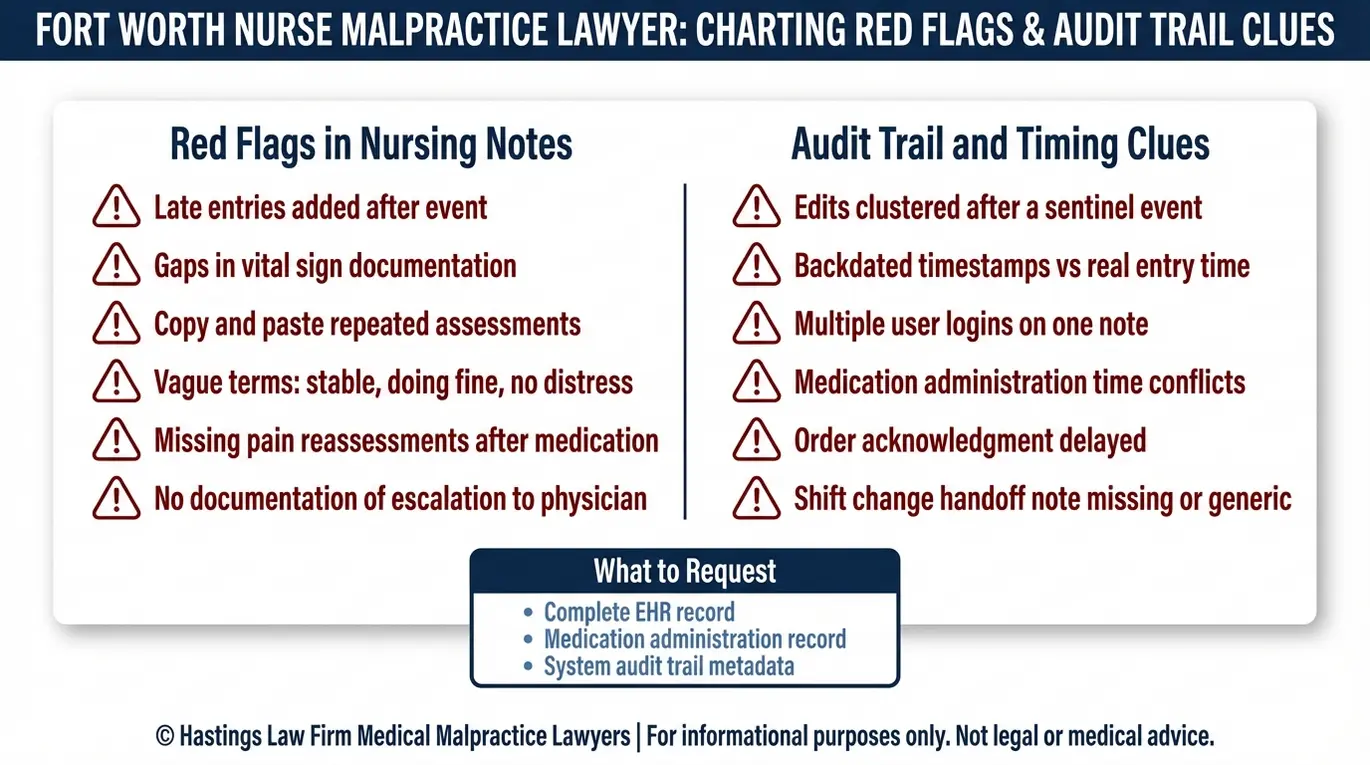
One of the most important steps our team takes is obtaining the electronic health record (EHR) audit trail. This metadata can reveal whether documentation was added or changed after an adverse event. We view this forensic analysis as a core part of patient advocacy, ensuring the truth is not buried in digital files.
Red flags our nurse consultants look for include:
- Late entries added hours or days after the event they describe
- Gaps in monitoring logs during important periods
- Vague or unusually generic descriptions of the patient’s condition
- Charting that does not match other records, such as lab results or physician notes
- Identical or near-identical language copied across multiple time entries
Falsification of Medical Records
When a patient suffers a serious injury or dies, there is sometimes evidence that chart entries were altered after the fact. A late entry, documentation added to the record well after the time of the event it describes, is not automatically evidence of fraud. But when the audit trail shows entries created or modified in the hours or days following an adverse outcome, it raises serious questions.
Our legal team uses in-house nurse consultants and outside expert witnesses to compare the documented care against the patient’s actual clinical trajectory. We investigate whether alterations in the record may have been used to obscure evidence of nurse impairment or a wrongful death. We examine the Electronic Health Record (EHR) audit trail, a digital log of all user activity, to find proof of tampering.
Texas Laws Impacting Your Nurse Malpractice Claim
Texas law requires plaintiffs to serve an expert report detailing the nurse’s negligence within 120 days after the date each defendant’s original answer is filed and strictly enforces a two-year statute of limitations on most medical injury claims. These rules are strict, and missing either deadline can end your case permanently.
Chapter 74 Expert Report Requirement
Under Texas Civil Practice and Remedies Code Section 74.351 and related provisions of Chapter 74, every medical malpractice plaintiff must serve a written expert report on each defendant within 120 days after the date each defendant’s original answer is filed. This report must identify the applicable standard of care, explain how the healthcare provider breached it, and describe how that breach caused the patient’s injury. This report acts as a gatekeeper; without it, even a valid claim cannot proceed. If the report is not timely served, or if it fails to meet the statutory requirements, the court can dismiss the case and order the plaintiff to pay the defendant’s legal fees.
Early consultation with a Fort Worth nurse malpractice lawyer helps ensure these requirements are met. Our firm works with qualified medical experts from the start to make sure the expert report is thorough, accurate, and filed on time.
Statute of Limitations
Texas generally gives injured patients two years from the date of the injury to file a medical malpractice lawsuit. There are limited exceptions, including cases involving minors and situations where the injury was not immediately discoverable. But the two-year window applies in most circumstances. If you miss this deadline, you lose the right to sue, no matter how severe the negligence was.
Caps on Non-Economic Damages
Texas also places a cap on non-economic damages in medical liability cases. Non-economic damages, compensation for pain and suffering, loss of companionship, and emotional distress, are limited by statute regardless of the severity of the injury. Economic damages, such as medical bills, lost income, and future care costs, are not subject to this cap.
Contact the Fort Worth Nurse Malpractice Attorneys at Hastings Law Firm Today for Help
Nursing negligence cases demand a legal team that understands both the medicine and the law. Hastings Law Firm brings that combination to every case, with in-house nurse consultants, former defense attorneys, and a network of nationally respected medical experts.
If you believe a nurse’s error caused harm to you or someone in your family, we are here to help you find answers. Our consultations are free and confidential, and we handle every case on a contingency fee basis, meaning you pay no attorney fees or costs unless we recover compensation for you.
Contact a Fort Worth Nurse Malpractice Lawyer at Hastings Law Firm today to protect your rights and take the first step toward understanding what happened.
Frequently Asked Questions About Nurse Malpractice in Fort Worth


This content was researched and written by the Hastings Law Firm editorial team, which includes attorneys, medical professionals, and experienced researchers. Our writing is informed by internal knowledge and practical experience, and we cross-check critical details against authoritative sources cited throughout. Every piece undergoes human-led fact-checking and legal review. Because legal and medical information can change, if you spot an error, please contact us. Learn more about our content standards and review process on our editorial policy page.

Brady D. Williams is a nationally recognized medical malpractice attorney who has spent his career handling high-stakes litigation for injured patients and families across the country. Licensed in both Texas and California, Brady draws on experience from hundreds of resolved medical cases to break down complex legal and medical topics for the people who need that information most. His writing reflects the same attention to detail and commitment to clarity that he brings to every case he handles.
