


Houston Nursing Home Supervision Lawyer
Negligent supervision in a nursing home can leave a senior exposed to preventable harm when staffing, monitoring, or safety protocols break down. Families often notice unexplained injuries, repeated falls, unsafe wandering, or long waits for help, yet the facility cannot give clear answers. These situations are frequently tied to systemic problems such as understaffing, poor training, or failures to follow individualized care plans. Clear documentation and electronic logs can help show what oversight was missing and why it mattered. If a loved one was harmed or worse due to nursing home negligent supervision in Houston, Texas, contact Hastings Law Firm for a free, confidential case review.

Last Updated: July 27, 2026
Protecting Houston Seniors from Negligent Oversight
When a loved one is injured in a nursing home because no one was watching, the feelings of anger and guilt can be overwhelming. You trusted a facility to keep your family member safe, and that trust was broken. You may not know exactly what went wrong, but you know your loved one deserved better.
A Houston Nursing Home Supervision Lawyer can help you understand what happened and determine whether the facility failed in its duty to protect your family member. At Hastings Law Firm, our team includes hospital nurses and former defense attorneys who previously worked for the systems they now challenge. We review staffing records, care plans, and facility protocols to identify where supervision broke down.
If you suspect neglect, we invite you to contact us for a free, confidential case evaluation. There are no fees unless we recover compensation for your family.

Understanding Negligent Supervision in Texas Nursing Homes
Negligent supervision occurs when a facility fails to provide adequate monitoring or staffing levels required to keep a resident safe from foreseeable harm, such as falls or wandering. It is one of the most common and preventable forms of nursing home neglect in Texas.
Every nursing home owes its residents a duty of care, the legal obligation to ensure resident safety through adequate oversight based on each resident’s individual needs. This duty includes patient supervision at appropriate intervals and minimizing call light response time. This is the duration it takes for staff to answer a resident’s signal and prevent risks like resident-on-resident aggression, which are physical confrontations that staff should anticipate.
It helps to understand the difference between a supervision failure and a clinical medical error. A medical error involves a mistake in treatment, like administering the wrong medication or misreading a lab result. A supervision failure involves an absence of adequate oversight: no one answered a call light, no one checked on a high-risk resident, or no one intervened when two residents were in conflict. Both can cause serious harm, but they arise from different breakdowns in the system.
Texas law sets clear expectations for nursing home operations. Under Texas Health and Safety Code, Chapter 242, licensed facilities must maintain sufficient staff, implement safety protocols, and ensure residents receive the level of supervision outlined in their individual care plans. These standards, formerly enforced by the Texas Department of Aging and Disability Services and now by Health and Human Services, are strictly regulated. When a facility falls short of these standards, a nursing home supervision attorney in Houston can help families hold the facility accountable.
At Hastings Law Firm, our in-house medical staff reviews clinical records alongside our legal team to determine whether a facility met or violated these requirements. That combination of medical and legal analysis is central to how we build these cases.

Identifying Common Signs of Supervision Failure
The most common indicators of supervision failure are unexplained falls, residents wandering off the premises (elopement), and injuries resulting from resident-on-resident aggression. Families should watch for patterns, because a single incident may reflect a much larger systemic problem, such as a failure to monitor vulnerable residents.
Falls are the leading cause of injury in nursing homes. Many occur during transfers, such as moving from a bed to a wheelchair, or while a resident attempts to use the restroom without assistance. Fall precautions, the specific safety measures outlined in a resident’s care plan to reduce fall risk, may include bed alarms, non-slip footwear, or staff-assisted mobility. When those precautions are ignored or never implemented, the result is often a preventable injury.
Elopement, a resident leaving the facility without staff knowledge, is sometimes called unsafe wandering. This is especially dangerous for residents with dementia or cognitive impairment. Elopement incidents often point to failures in security monitoring, such as broken door alarms or inattentive staff.
Resident-on-resident aggression happens when staff fail to separate or adequately supervise residents known to exhibit aggressive behavior. Facilities have a responsibility to identify these risks and intervene before harm occurs.
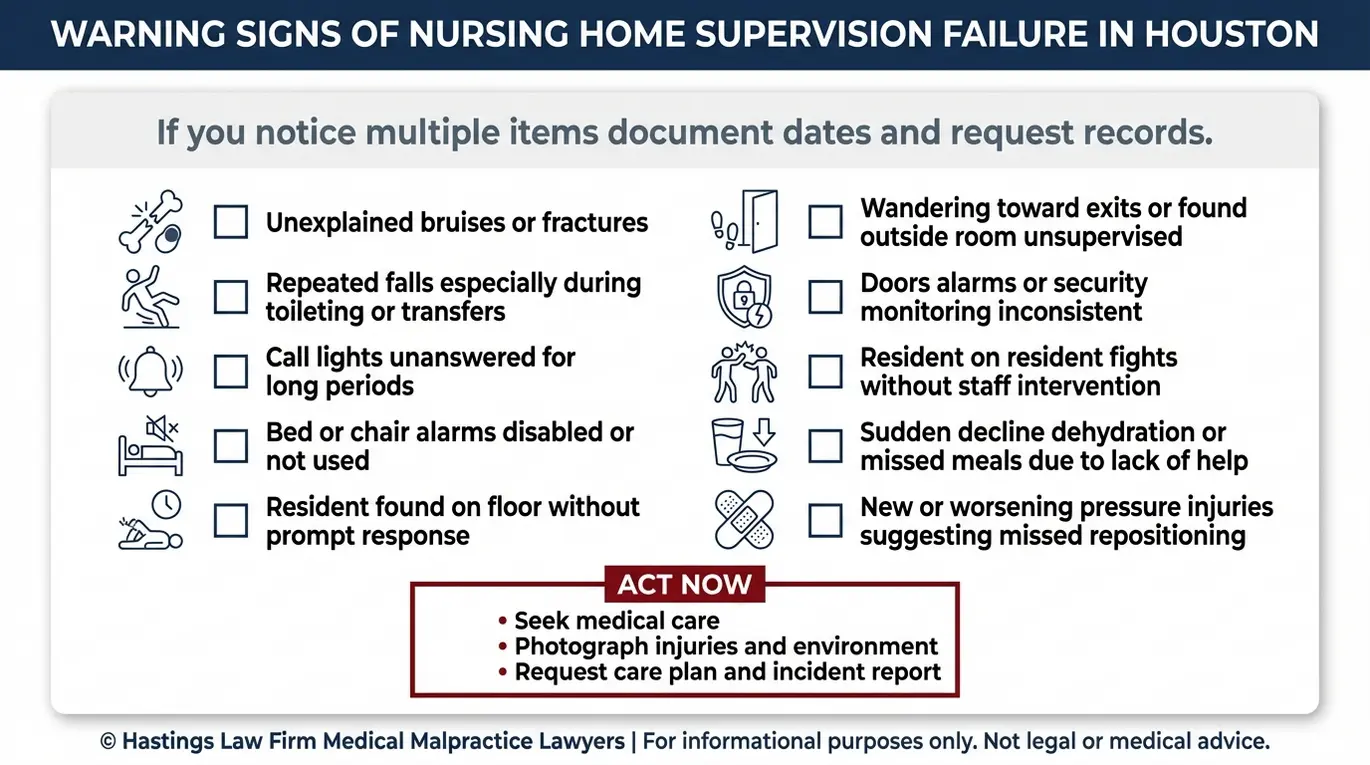
Warning signs families should watch for include:
- Unexplained bruises, fractures, or head injuries
- Reports of a loved one being found outside the facility
- Repeated falls documented in medical records
- Complaints from your loved one about long waits for help
- Staff unable to explain how an injury occurred
- New or worsening bedsores, which can indicate prolonged periods without repositioning
CMS Never Events and Preventable Falls
Certain types of falls fall under the CMS “Never Event” classification, meaning they are errors that should never occur when proper supervision and fall precautions are in place. A Never Event designation signals that the injury was preventable and that the facility’s protocols failed. When a supervision failure lawyer investigates a fall case, the presence of a Never Event classification can be powerful evidence that the standard of care was not met.
The Hastings Law Firm Difference
Results matter, but what truly sets us apart is how we achieve them. Every verdict, every settlement, and every Houston courtroom victory comes from one guiding promise: To treat each client’s fight for justice as if it were our own.
This balance of skill, experience, and empathy reflects our core philosophy that justice should not only compensate the injured, but also make health care safer nationwide.

The Root Cause Is Often Systemic Understaffing
Inadequate supervision is frequently a direct result of corporate decisions to prioritize profits over people by maintaining dangerous staffing ratios that make proper monitoring impossible. When a facility does not employ enough qualified staff to meet the needs of its residents, even well-intentioned caregivers cannot keep up.
Staffing ratios, the number of care staff assigned per resident, directly affect how quickly call lights are answered, how often high-risk residents are checked, and whether care plans are followed. When ratios drop too low, residents sit longer without assistance, fall precautions go unimplemented, and dangerous situations escalate without intervention. This lack of adequate resources leaves vulnerable seniors at risk.
This is often not a case of individual staff negligence. Administrative decisions often dictate these conditions. Some facilities reduce staffing levels to manage operational costs, relying on fewer workers to cover more residents than they can safely monitor.
Others bring in temporary or agency staff who lack familiarity with the residents, the facility layout, or specific care plan requirements. Inadequate training compounds the problem, leaving workers unprepared to identify and respond to warning signs, often resulting in care plan violations.
The Centers for Medicare and Medicaid Services Five Star Quality Rating System publicly rates nursing homes on staffing levels, quality measures, and health inspections. Families can use this resource to check whether a facility has a history of staffing deficiencies.
As a Houston nursing home understaffing lawyer, our team at Hastings Law Firm examines how a facility’s staffing decisions contributed to the harm. We look at the connection between administrative choices and the breakdown in resident safety.
| Staffing Problem | Effect on Residents |
|---|---|
| Too few aides per shift | Call lights unanswered; residents attempt unsafe transfers alone |
| Untrained temporary staff | Care plan requirements overlooked; warning signs missed |
| High staff turnover | Loss of familiarity with individual resident needs and risks |
| Inadequate overnight coverage | Extended periods without monitoring; increased fall and elopement risk |
Liability for Negligent Hiring and Retention
Nursing homes are liable for negligent hiring if they employ staff with histories of abuse or fail to conduct mandatory background checks required by Texas law. Negligent hiring involves a failure to adequately vet staff before they are allowed to care for residents.
This liability extends beyond the initial hiring decision. A facility that retains an employee despite documented complaints, performance failures, or signs of resident mistreatment may face additional legal exposure. The responsibility falls on facility management to screen, supervise, and, when necessary, remove employees who pose a risk.
A negligent hiring attorney investigates whether a facility followed proper vetting procedures. Key areas we examine include hiring practices, such as verifying professional licenses and certifications, and security monitoring protocols. We also verify whether employee background checks, criminal history screenings that Texas law requires, were completed before the employee began working with residents.
When facilities rely on outside agencies for staff or security, third-party liability may also become a factor. We investigate whether these contractors adhered to the same rigorous standards required of the facility itself, ensuring that no gap in safety protocols allowed a dangerous individual access to vulnerable residents.
Key areas we examine include:
- Whether criminal background checks were completed before the employee began working with residents
- Whether the facility verified professional licenses and certifications
- Whether prior complaints or disciplinary actions were documented and acted upon
- Whether the facility retained employees with known histories of abuse or neglect
- Whether third-party staffing agencies used by the facility conducted their own screening
At Hastings Law Firm, our attorneys who previously defended hospitals use their insider knowledge to anticipate defense tactics. We know what records to request and where gaps in hiring and retention practices are most likely to appear.
Proving Failure to Monitor Using Evidence
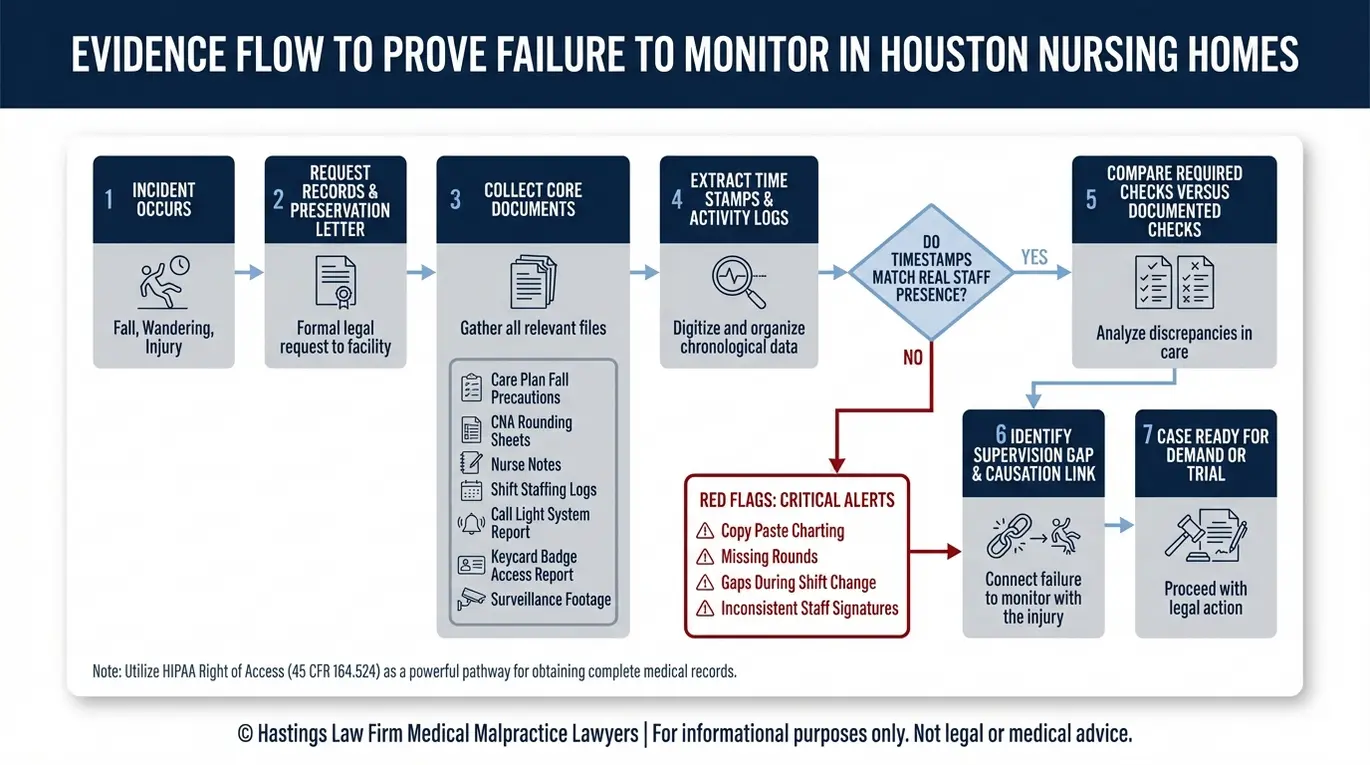
Proving a failure to monitor requires a forensic analysis of shift logs, care plans, and surveillance footage to demonstrate gaps in required resident observation. These documents reveal the gap between what should have happened and what actually did.
Our approach as a lawyer for nursing home supervision cases starts with a thorough investigation of the records themselves. We compare scheduled care plan checks against documentation of actual rounds. If a resident’s plan required repositioning every two hours to prevent bedsores, we look for evidence that it was done. We analyze shift logs against actual staffing to determine whether enough workers were present to carry out required tasks. This forensic approach exposes nursing home neglect hidden in the paperwork.
Electronic data adds another layer of accountability. Keycard swipe records show when staff entered specific rooms. Call light logs reveal how long a resident waited for help. When this data conflicts with the charting, it can indicate that records were falsified or that required care was never delivered, leading to clear care plan violations.
Under Individuals’ Right under HIPAA to Access their Health Information 45 CFR § 164.524, patients and their authorized representatives have the right to access health records. This is an important first step in gathering the evidence needed for a claim.
Key evidence sources we examine include:
- Shift logs, staffing records documenting who was on duty and when
- Resident care plans, the individualized documents outlining required monitoring and interventions
- Call light response time records
- Keycard and electronic access logs
- Incident and accident reports
- Surveillance or security camera footage
Using Granny Cams to Establish Negligence
In some cases, families install authorized room cameras, commonly called “Granny Cams,” used to monitor the care their loved one receives. Texas law permits these recordings under certain conditions. Footage from Granny Cams can serve as powerful video evidence, showing extended periods where no staff member entered a resident’s room or documenting care that contradicts what was recorded in the chart. When available, this type of video evidence can significantly strengthen a negligent supervision claim.
Compensation for Injuries Caused by Lack of Supervision
Patients and their families affected by negligent supervision may recover compensation for medical bills, pain and suffering, physical impairment, and in tragic cases, wrongful death damages. Compensation provides financial support for those who have suffered due to sub-standard care.
Economic damages cover measurable financial losses, including hospital and medical expenses, rehabilitation costs, and the expense of any future care the resident will need as a result of the injury.
Non-economic damages address the human cost: physical pain, emotional suffering, loss of dignity, and diminished quality of life. For elderly patients who were already vulnerable, these injuries can be devastating.
Punitive damages may apply when the evidence shows that a facility acted with gross negligence or conscious disregard for resident safety. These damages are designed to deter the same conduct in the future.
Wrongful death claims may be pursued if the supervision failure resulted in the loss of life. Houston nursing home injury compensation cases require a clear connection between the supervision failure and the resulting harm. At Hastings Law Firm, our medical and legal teams work together to establish that link, building the evidence needed to pursue full and fair recovery for your family.
Contact the Houston Nursing Home Attorneys at Hastings Law Firm Today for Help
If someone you love was harmed because a nursing home failed to provide proper supervision, you deserve answers. You also deserve a legal team that understands both the medicine and the law behind these cases.
Hastings Law Firm was built to handle exactly this kind of case. Our team of attorneys, nurse consultants, and patient advocates investigates every detail, from staffing records to care plan compliance, to determine what went wrong and who is responsible. As a Houston Nursing Home Supervision Lawyer team, we prepare every case as though it will go to trial, because that preparation is what drives fair outcomes.
We handle these cases on a contingency fee basis, which means you pay no attorney fees or costs unless we secure a recovery for your family. Call us today or request a risk-free case evaluation online. Let us help you find the answers your family deserves.
Frequently Asked Questions About Nursing Home Supervision in Houston


This content was researched and written by the Hastings Law Firm editorial team, which includes attorneys, medical professionals, and experienced researchers. Our writing is informed by internal knowledge and practical experience, and we cross-check critical details against authoritative sources cited throughout. Every piece undergoes human-led fact-checking and legal review. Because legal and medical information can change, if you spot an error, please contact us. Learn more about our content standards and review process on our editorial policy page.

Tommy Hastings, founder of Hastings Law Firm, is a board-certified personal injury trial lawyer dedicated exclusively to healthcare injury cases. Since 2001, he has represented injured patients and families in litigation against major hospital systems, pharmaceutical companies, and negligent healthcare providers nationwide. He has handled numerous high-profile cases that have drawn national media attention and resulted in multi-million dollar recoveries. He draws on that experience in his writing, helping readers understand how these cases work and what options may be available to them.
