


Texas Necrotizing Fasciitis Malpractice Lawyer
Written by: Hastings Law Firm | Reviewed by: Brady D. Williams | Updated: July 27, 2026
Necrotizing fasciitis is a fast moving infection that can destroy tissue quickly and become life threatening. When warning signs are missed or symptoms are dismissed, delays in treatment can lead to severe and lasting harm, including emergency surgery, amputation, intensive care, or fatal outcomes. Understanding how delayed diagnosis happens and what the standard of care requires can clarify whether preventable mistakes played a role. If you or a loved one were harmed or worse due to a delayed or missed necrotizing fasciitis diagnosis in Texas, contact Hastings Law Firm for a free, confidential case review.

Compassionate Texas Medical Attorneys for Necrotizing Fasciitis Claims
What You Should Know About Delayed Necrotizing Fasciitis Diagnosis Claims in Texas:
- Outcomes can become catastrophic when necrotizing fasciitis is not recognized quickly because the infection can spread rapidly and become life threatening.
- Recovery can be shaped by whether severe pain out of proportion to visible findings was documented and acted on as a warning sign.
- Permanent injury can result when treatment is delayed after suspicion, since prompt antibiotics and emergency surgical debridement are described as critical.
- Wrongful death can occur when delayed care allows sepsis, organ failure, or septic shock to develop.
- Liability can extend beyond an individual clinician when poor hygiene, unsterile equipment, or infection control failures allow bacteria to enter and spread.
- Options can be lost if Texas medical negligence deadlines are missed because the article describes strict time limits for these claims.
- Compensation can be limited for non economic losses in Texas because the article states that caps apply to pain and suffering type damages.
- Early litigation requirements can affect whether a claim can proceed because Texas law requires a medical expert report.
- Disputes often focus on whether clinicians anchored on a less serious diagnosis and failed to consider necrotizing fasciitis despite red flag symptoms.
- Proof can depend on whether timely diagnostic workup and surgical consultation were pursued when clinical suspicion was high.

A Healthcare Focused Law Firm
Necrotizing fasciitis (NF), a rapidly spreading bacterial infection that destroys skin, fat, and the tissue surrounding muscles, can become life-threatening in a matter of hours. When doctors fail to recognize the warning signs or dismiss symptoms as something less serious, the consequences can be devastating: emergency amputations, prolonged ICU stays, or the loss of a loved one.
If you or a family member suffered serious harm because a medical provider missed or delayed a diagnosis, you deserve answers. Founded by board-certified trial lawyer Tommy Hastings, Hastings Law Firm focuses exclusively on medical malpractice and uses our in-house medical knowledge to determine whether the care you received fell below the accepted standard.
A conversation with our team costs you nothing and carries no obligation. Contact us for a free, confidential case evaluation so we can review what happened and explain your options.
How a Texas Necrotizing Fasciitis Malpractice Lawyer Can Help
A Texas necrotizing fasciitis malpractice lawyer investigates medical records, constructs detailed timelines, and works with qualified medical experts to determine whether a provider breached the standard of care by failing to recognize early signs of infection, leading to preventable harm such as amputation, septic shock, or wrongful death.
These cases are medically complex. Necrotizing fasciitis is a fast-moving soft tissue infection, and proving that earlier intervention would have changed the outcome requires a deep understanding of both the clinical science and the legal framework. Our team includes in-house nurse consultants and former defense attorneys who know how hospitals document care and how defense lawyers build their arguments. That insider knowledge allows us to identify gaps in the medical record that others might overlook.
Every case we accept is prepared from day one as though it will go to a jury. This trial-ready approach allows us to negotiate from a position of strength with defense attorneys and insurance carriers. Insurance carriers often attempt to minimize payouts in these high-stakes claims. We counter these tactics by presenting complete evidence of your economic and non-economic losses, ensuring your financial future is protected. Our founder, Tommy Hastings, is board-certified in Personal Injury Trial Law by the Texas Board of Legal Specialization, a qualification held by fewer than 2% of lawyers in the state.
Types of necrotizing fasciitis cases we handle include:
- Emergency room negligence, where symptoms were dismissed or misdiagnosed
- Post-surgical infections that were not identified or treated in time
- Hospital-acquired infections linked to contaminated equipment or poor hygiene
- Nursing home neglect, such as infected pressure ulcers left untreated
- Wrongful death claims when delayed care led to fatal sepsis or organ failure
- Cases involving preventable amputation due to late surgical intervention
If you suspect that a medical provider’s failure contributed to a necrotizing fasciitis diagnosis, a necrotizing fasciitis attorney in Texas can evaluate the records and help determine whether you have a viable medical malpractice claim.
Why Delayed Diagnosis of Necrotizing Fasciitis is Medical Malpractice
A delayed diagnosis becomes malpractice when a reasonably competent doctor would have recognized the symptoms and started treatment sooner, preventing permanent injury or death. In necrotizing fasciitis cases, time is the single most important factor. The bacteria responsible can destroy tissue at a rate of up to two to three centimeters per hour. This means even a few hours of delay can be the difference between a treatable infection and catastrophic outcomes like sepsis, organ failure, or the need for amputation.
A study published in the *World Journal of Emergency Surgery* found that the impact of operative time on outcomes of necrotizing soft tissue infections was significant, with earlier surgical intervention linked to improved survival rates. When physicians dismiss severe pain as a minor skin issue or wait for test results instead of acting on clinical signs, the infection spreads deeper through tissue layers. This delay releases toxins that can trigger septic shock, which is a dangerous drop in blood pressure that starves organs of oxygen and can lead to death.
Under Texas Civil Practice and Remedies Code, Chapter 74, a patient must show that the provider failed to meet the accepted standard of care and that this failure directly caused harm. This state law outlines the specific legal requirements and strict deadlines for all medical negligence claims in Texas. As a Texas necrotizing fasciitis malpractice lawyer, we build that connection by mapping what the medical team did against what they should have done.
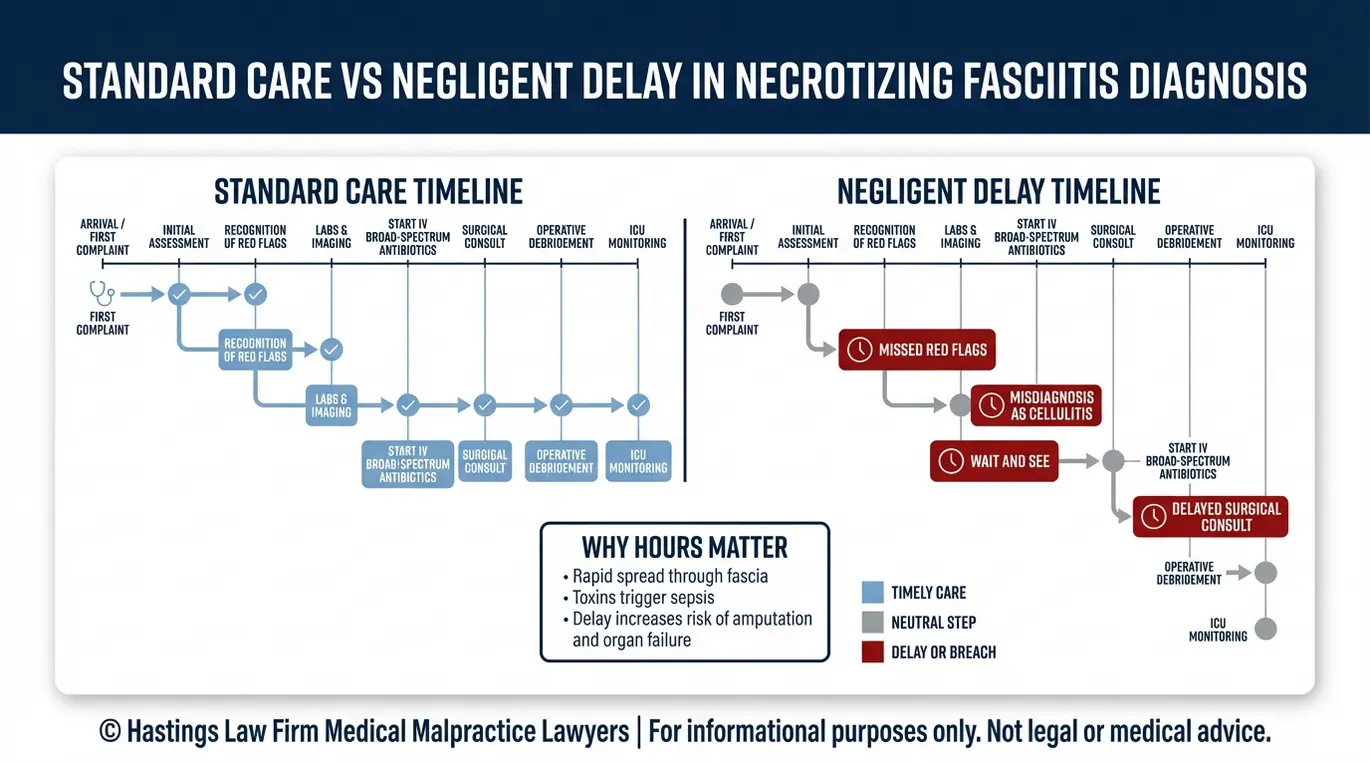
| Stage | Standard Care Timeline | Negligent Delay |
|---|---|---|
| Initial presentation with severe pain and spreading redness | Immediate suspicion of necrotizing fasciitis; labs and imaging ordered | Symptoms attributed to cellulitis or minor injury; patient sent home or observed |
| Diagnostic workup | Blood work, CT or MRI, and surgical consult within hours | Testing delayed or not ordered; no surgical consult |
| Treatment initiation | Emergency surgical debridement and IV antibiotics within hours of suspicion | Surgery delayed by 12 or more hours while infection spreads |
| Ongoing monitoring | ICU-level care with repeat surgical evaluations | Inadequate monitoring; worsening signs missed |
A delayed diagnosis of necrotizing fasciitis can turn a survivable condition into a fatal one. That delay is exactly what our legal and medical team is trained to identify and prove.
The Hastings Law Firm Difference
Results matter, but what truly sets us apart is how we achieve them. Every verdict, every settlement, and every Texas courtroom victory comes from one guiding promise: To treat each client’s fight for justice as if it were our own.
This balance of skill, experience, and empathy reflects our core philosophy that justice should not only compensate the injured, but also make healthcare safer nationwide.

The Standard of Care for Diagnosing Flesh Eating Bacteria
The standard of care requires physicians to include necrotizing fasciitis in their differential diagnosis when a patient presents with severe pain that seems out of proportion to how the skin looks, along with rapidly spreading redness or swelling. A differential diagnosis is the clinical process of identifying a condition by comparing and contrasting it against other similar symptoms. When an emergency room doctor fails to consider this diagnosis and instead treats the symptoms as a routine skin infection, that gap can form the basis of a medical malpractice claim.
Once necrotizing fasciitis is suspected, the standard of care calls for immediate action: broad-spectrum IV antibiotics to slow the bacterial spread and emergency surgical debridement, the removal of infected and dead tissue to prevent further destruction. Delays in either step can allow the infection to reach deeper layers of tissue, leading to irreversible damage.
A Texas necrotizing fasciitis malpractice lawyer evaluates whether the medical team ordered the appropriate diagnostic workup in a timely manner. The following tests and assessments should generally be considered:
- Complete blood panel, including white blood cell count and inflammatory markers
- CT scan or MRI to detect gas or fluid in the deep tissue
- The Laboratory Risk Indicator for Necrotizing Fasciitis (LRINEC) score, a scoring system that uses lab values to assess the likelihood of necrotizing fasciitis versus a less serious infection
- The finger test, a bedside procedure where a small incision is made to check for gray tissue, lack of bleeding, or foul-smelling discharge, all signs of tissue death
- Urgent surgical consultation, regardless of imaging results, when clinical suspicion is high
Cognitive Errors in ER Diagnosis
One of the most common reasons necrotizing fasciitis goes undiagnosed in the emergency room is anchoring bias. This happens when a doctor locks onto an initial impression, often cellulitis or a pulled muscle, and interprets all new information through that lens. Because early necrotizing fasciitis can resemble cellulitis on the surface, this type of misdiagnosis is well-documented but no less dangerous. Emergency room negligence tied to cognitive errors is a pattern our team specifically looks for when reviewing records.

Recognizing Signs of Infection and Proper Treatment Protocols
Early signs of necrotizing fasciitis include severe pain that exceeds what is visible on the skin, red or purple discoloration, fever, and fluid-filled blisters. Once identified, treatment requires aggressive surgical debridement, the removal of dead tissue, and broad-spectrum antibiotics started without delay.
Red flag symptoms requiring immediate evaluation:
- Pain that is significantly worse than the wound or skin appearance would suggest
- Skin that appears red, swollen, or warm and is spreading quickly
- Purple or dark patches of skin, which may indicate tissue death beneath the surface
- Crepitus, a crackling or popping sensation under the skin caused by gas produced by bacteria
- Fever, chills, or confusion
- Blisters or fluid-filled sacs near the affected area
Necrotizing fasciitis is commonly caused by Group A Streptococcus (Strep A) and MRSA, though bacteria often act together. These organisms release toxins that destroy tissue and can trigger septic shock if they enter the bloodstream. Research published in the *Journal of Ultrasound* confirms that point-of-care ultrasonography in diagnosing necrotizing fasciitis can help identify subcutaneous changes physical exams miss.
Pain Out of Proportion to Visible Injury
Pain out of proportion to visible injury, which is intense pain that does not match what the doctor can see, is the hallmark warning sign of necrotizing fasciitis. This happens because the infection attacks the fascia, the connective tissue layer surrounding muscles, nerves, and blood vessels beneath the skin. As the fascia is destroyed, nerve damage causes extreme pain even before the skin shows obvious damage. A Texas necrotizing fasciitis malpractice lawyer will examine whether this symptom was documented, recognized, and acted upon.
Treatment for confirmed necrotizing fasciitis typically involves multiple rounds of surgical debridement, intensive care monitoring, skin grafts to repair damaged areas, and in some cases, hyperbaric oxygen therapy.

Common Causes and Liability in Texas Infection Cases
Liability often falls on hospitals, nursing homes, or individual providers when poor hygiene, unsterile equipment, or clinical neglect allows bacteria to enter the body and spread unchecked. Group A Streptococcus (Strep A), a common bacteria responsible for strep throat that can cause severe invasive infections, and Methicillin-resistant Staphylococcus aureus (MRSA), a staph bacteria resistant to many standard antibiotics, are among the most frequent culprits.
According to the Centers for Disease Control and Prevention’s HAI Progress Report, healthcare-associated infections (HAIs) remain a persistent risk in American hospitals and long-term care facilities.
Common entry points for infection include:
- Surgical site infections from procedures where sterile technique was not maintained
- Catheter-associated infections from improperly placed or monitored urinary or IV catheters
- Infected pressure ulcers in nursing home residents who were not regularly repositioned
- Minor cuts, abrasions, or injection sites that were not properly cleaned or monitored
- Ventilator-associated pneumonia that weakens the immune system, allowing secondary infections to take hold
Potentially liable parties may include the treating surgeon, ER physicians, nursing staff, hospital administration responsible for infection control protocols, or nursing home operators whose neglect allowed a preventable wound to become a gateway for flesh-eating bacteria.
Contact the Texas Healthcare Malpractice Attorneys at Hastings Law Firm Today for Help
If you or someone in your family suffered severe injury or loss because of a delayed or missed necrotizing fasciitis diagnosis, the medical-legal team at Hastings Law Firm is ready to review your case. We understand how overwhelming this experience can be, and we believe you deserve honest answers about what happened and whether negligence played a role.
Our firm handles these cases on a contingency fee basis, which means you pay no attorney fees or costs unless we secure a recovery on your behalf. Every consultation is free and confidential.
You can reach us by phone or through our online contact form. Let us help you understand your options and take the first step toward accountability.
Frequently Asked Questions About Necrotizing Fasciitis Malpractice in Texas


This content was researched and written by the Hastings Law Firm editorial team, which includes attorneys, medical professionals, and experienced researchers. Our writing is informed by internal knowledge and practical experience, and we cross-check critical details against authoritative sources cited throughout. Every piece undergoes human-led fact-checking and legal review. Because legal and medical information can change, if you spot an error, please contact us. Learn more about our content standards and review process on our editorial policy page.

Brady D. Williams is a nationally recognized medical malpractice attorney who has spent his career handling high-stakes litigation for injured patients and families across the country. Licensed in both Texas and California, Brady draws on experience from hundreds of resolved medical cases to break down complex legal and medical topics for the people who need that information most. His writing reflects the same attention to detail and commitment to clarity that he brings to every case he handles.
