


Texas Vasa Previa Diagnosis Failure Lawyer
Written by: Hastings Law Firm | Reviewed by: Tommy Hastings | Updated: July 27, 2026
Vasa previa is a rare but dangerous pregnancy complication that can be identified through appropriate prenatal screening when risk factors are present. When it is missed, exposed fetal blood vessels can rupture during labor or when the membranes break, leading to rapid blood loss, oxygen deprivation, and life altering injury or worse. The standard of care discussed focuses on targeted imaging and timely planning to prevent a preventable emergency. If you or a loved one were harmed or worse due to vasa previa diagnosis failure in Texas, contact Hastings Law Firm for a free, confidential case review.

Top Rated Medical Malpractice Attorneys for Birth Injuries in Texas
What You Should Know About Undiagnosed Placental Vessel Risk Claims in Texas:
- The risk of catastrophic fetal harm can rise sharply when vasa previa is not diagnosed before labor because exposed fetal vessels can rupture and cause rapid blood loss.
- The chance of survival can be dramatically different when vasa previa is identified prenatally because planned delivery management is described as well established.
- Liability disputes can turn on whether prenatal risk factors were recognized and acted on because the standard of care calls for targeted screening when risk factors are documented.
- Options for recovery can be limited if Texas malpractice requirements are not met because missing required filings can lead to dismissal.
- Financial recovery can differ by damage type in Texas because economic damages are described as uncapped while non economic damages are capped.
- Hospital responsibility can be a central issue because training, equipment maintenance, and escalation protocols are described as potential contributors to missed diagnosis or delayed response.
- Severe brain injury outcomes can follow an undiagnosed rupture because sustained oxygen deprivation is linked to hypoxic ischemic encephalopathy.
- The strength of causation arguments can depend on whether timely delivery would have prevented the outcome because the article ties harm to missed diagnosis and delayed cesarean delivery.
- Key records can shape what happened during prenatal care because ultrasound reports, imaging studies, and office notes are used to reconstruct the timeline.
- Emergency response failures can be disputed because fetal heart rate monitor findings are described as warning signs that require immediate action.

A Healthcare Focused Law Firm
When a pregnancy complication like vasa previa goes undiagnosed, the consequences can be devastating. If a child is harmed or lost because a medical provider fails to identify this condition during routine prenatal care, a family deserves answers about what went wrong.
At Hastings Law Firm, our team of medical malpractice attorneys focuses exclusively on medical negligence litigation rather than dividing our attention among unrelated areas of law. Founded by Tommy Hastings, a board-certified trial lawyer, our firm uses medical and legal expertise to investigate whether care fell below the accepted standard. If you are looking for a Texas vasa previa diagnosis failure lawyer, we offer a free, confidential case evaluation led by a patient advocate. Reach out so we can review what happened and explain your options.
Understanding Vasa Previa and the Obstetric Standard of Care
Vasa previa is a critical obstetric condition where unprotected fetal blood vessels run through the amniotic membranes across the cervix, lacking the protection of Wharton’s jelly. Wharton’s jelly is the thick, insulating tissue that normally surrounds and cushions vessels within the umbilical cord, preventing compression or tearing. Because these vessels sit directly in the path of delivery, they are extremely vulnerable to rupture during labor or when the membranes break.
Under normal circumstances, blood travels safely between the placenta and the baby through vessels shielded inside the umbilical cord. In vasa previa, that protection is absent. The exposed vessels can tear open with very little force, causing the baby to lose blood rapidly.
This condition is rare, but it is well-documented in obstetric literature. Research published by PubMed Central on the incidence of vasa praevia confirms that while the overall prevalence is low, the mortality rate when it goes undiagnosed is high. The mortality risk often exceeds 60% compared to a nearly 97% survival rate when diagnosed prenatally. Because the condition is identifiable through prenatal screening, the standard of care requires doctors to look for it, especially when known risk factors are present.
Several maternal and placental characteristics are associated with a higher likelihood of vasa previa. A vasa previa malpractice attorney will evaluate whether your medical team recognized any of the following:
- In vitro fertilization (IVF) pregnancy: IVF significantly increases the risk of abnormal placental development, as the implantation process can affect where and how the placenta forms.
- Velamentous cord insertion: The umbilical cord attaches to the membranes rather than the center of the placenta, a condition where vessels must travel unprotected to reach placental tissue.
- Bilobed or succenturiate placenta: An accessory lobe of placental tissue connected by vessels running through the membranes, creating a bridge of unprotected veins and arteries.
- Low-lying placenta or placenta previa: A placenta positioned near or over the cervix during earlier ultrasounds increases the chance that vessels will cross the internal os.
- Multiple gestations (twins or more): Pregnancies with more than one fetus carry a higher incidence of abnormal cord and placental placement due to the crowded uterine environment.
When any of these risk factors are present, OB/GYNs are expected to perform targeted screening to identify potential vasa previa. The Texas Supreme Court has recognized that physicians can be held accountable for failing to meet established diagnostic standards, as seen in cases like *Columbia Valley Healthcare System LP v. Zamarripa*. A lawyer for undiagnosed placental vessel risk can help determine whether your provider missed warning signs that should have prompted closer evaluation.
The Danger of Type III Vasa Previa
Type III vasa previa is a specific variation of the condition where blood vessels branch away from the umbilical cord and cross the cervix unprotected. These aberrant vessels travel independently through the membranes before connecting to an accessory lobe of placental tissue, known as a succenturiate placenta. This smaller, separate piece of placenta is linked to the main placenta by these vulnerable veins and arteries.
Type III cases can be more difficult to detect because the vessels may not follow the expected path between the cord insertion site and the placental edge. They can branch in unexpected directions, making them easier to overlook during a standard scan. Yet the danger is identical: if these vessels cross the cervix and rupture, the baby can suffer rapid fetal hemorrhage and fetal demise within minutes.
The difficulty of detection does not excuse a failure to look. When risk factors are documented in a patient’s chart, the standard of care still calls for careful screening with the appropriate imaging tools.
Failure to Diagnose Through Ultrasound and Doppler Imaging
The standard of care requires the use of transvaginal ultrasound combined with color Doppler imaging during the 20-week anatomy scan to rule out vasa previa in patients who have known risk factors. Thorough prenatal testing is the first line of defense against birth injuries. Transvaginal ultrasound is a type of internal imaging that provides a much clearer view of the cervix than a standard abdominal scan. Color Doppler imaging is a technology that overlays color onto the ultrasound picture to show blood flow, making it possible to identify fetal vessels crossing over the cervical opening.
Together, these two tools are considered the gold standard for detecting vasa previa. When properly performed, this combination has a high rate of accuracy. The Icahn School of Medicine at Mount Sinai’s international expert consensus on vasa previa diagnosis and clinical management recommends this screening approach for all patients with recognized risk factors. When these protocols are ignored, the result is often a claim for medical malpractice.
A diagnosis failure attorney in Texas will look closely at where the screening process broke down. Points where negligence commonly occurs include:
- Failure to map the cord insertion site: During the anatomy scan, the sonographer should document where the umbilical cord attaches to the placenta. If the insertion site is not identified, a velamentous insertion can go unnoticed.
- Skipping transvaginal imaging: Some facilities rely only on transabdominal ultrasound, which does not provide adequate resolution of the lower uterine segment and cervix to rule out vessels crossing the os.
- Not activating color Doppler: Even when transvaginal imaging is performed, failing to apply color Doppler means blood flow through exposed vessels may not be visualized.
- Inadequate sonographer training: If the technician has not been trained to recognize vasa previa, the condition can be present on the screen and still go unreported.
- Outdated or poorly maintained equipment: Older ultrasound machines may lack the sensitivity needed to detect subtle blood flow patterns near the cervix, leading to false negatives.
When vasa previa is diagnosed before labor, the clinical management pathway is well established. Patients are typically admitted to the hospital between 30 and 32 weeks of gestation for close monitoring and immediate access to surgical teams. A planned cesarean section (C-section) is then scheduled between 35 and 37 weeks, before labor begins and before the membranes rupture. This approach dramatically reduces the risk of vessel rupture and gives the baby the best possible chance of a safe delivery.
Every one of these steps represents an opportunity for a care team to protect a baby’s life. A missed vasa previa lawsuit often centers on which of these steps were performed inadequately, and whether following the standard of care would have prevented the tragedy.

The Hastings Law Firm Difference
Results matter, but what truly sets us apart is how we achieve them. Every verdict, every settlement, and every Texas courtroom victory comes from one guiding promise: To treat each client’s fight for justice as if it were our own.
This balance of skill, experience, and empathy reflects our core philosophy that justice should not only compensate the injured, but also make healthcare safer nationwide.

Catastrophic Injuries Caused by Vessel Rupture and Hemorrhage
When vasa previa is undiagnosed, the fetal vessels often rupture upon membrane rupture (when the water breaks), leading to rapid fetal exsanguination and oxygen deprivation. Exsanguination means the baby bleeds out through the torn vessels. Because a fetus has a very small total blood volume, even a modest amount of blood loss can be fatal within minutes.
The speed of this process is what makes undiagnosed vasa previa so dangerous. A baby’s entire blood volume may be as little as 80 to 100 milliliters per kilogram of body weight. The loss of even a fraction of that volume can trigger a sudden drop in blood pressure and rapidly progress to severe oxygen deprivation, or hypoxia.
When a vasa previa rupture causes the brain to be deprived of oxygen for a sustained period, the result can be hypoxic-ischemic encephalopathy (HIE). HIE is a form of brain damage caused by the combination of reduced blood flow and insufficient oxygen. It can lead to cerebral palsy, seizure disorders, developmental delays, and in the most severe cases, stillbirth.
One of the clinical indicators that can appear on fetal heart rate monitors during this emergency is what is known as a sinusoidal pattern, a smooth, wave-like tracing that signals severe fetal anemia. A case report published in PubMed on ruptured vasa praevia indicated by a sinusoidal fetal heart rate pattern documented this association. When labor and delivery staff observe this pattern and fail to act immediately, the window for an emergency C-section may close before the baby can be safely delivered.
The contrast between diagnosed and undiagnosed outcomes illustrates why prenatal detection matters so much:
| Factor | Diagnosed Before Labor | Undiagnosed at Delivery |
|---|---|---|
| Delivery method | Planned C-section at 35–37 weeks | Emergency response after vessel rupture |
| Fetal survival rate | Approximately 97% or higher | Significantly reduced; high mortality risk |
| Risk of brain injury | Minimal with controlled delivery | Severe, due to rapid blood loss and hypoxia |
| Hospital preparedness | NICU team on standby, blood products ready | Scramble to identify source of hemorrhage |
| Maternal awareness | Mother is informed and monitored | Mother may present with unexplained vaginal bleeding |
This comparison reflects what a Texas birth injury lawyer evaluates when building a case: whether prenatal diagnosis and a planned delivery would have prevented the harm that occurred. Legal help for fetal hemorrhage cases focuses on establishing whether the gap between what happened and what should have happened is what caused the injury or death.

Proving Liability and Hospital Negligence in Texas Courts
Establishing liability requires proving that the OB/GYN or radiologist deviated from the accepted standard of care, directly causing the injury or death that a timely C-section would have prevented. This is the foundation of every medical malpractice claim involving missed vasa previa, and it requires both medical expertise and a detailed reconstruction of the prenatal care timeline.
In cases of diagnostic failure, the physician’s responsibility begins with recognizing risk factors during pregnancy. When a patient has a history of IVF, velamentous cord insertion (where the umbilical cord attaches to the fetal membranes rather than the placenta), a low-lying placenta, or other conditions associated with vasa previa, the treating OB/GYN is expected to order targeted imaging. If the physician fails to order these studies, or fails to act on abnormal findings, that omission can form the basis of a negligence claim.
Our team includes former defense attorneys who understand how hospitals defend these claims. If a sonographer was not properly trained to identify vasa previa, or if a labor and delivery nurse failed to recognize signs of fetal distress, the hospital that employed them may share in the liability. We examine staffing records, training protocols, and equipment maintenance logs to determine whether institutional failures contributed to the outcome.
Hospitals are responsible for ensuring their staff is competent and that their protocols for escalation are clear. If a nurse fails to notify a physician of a non-reassuring heart tracing, the hospital itself may be liable for that communication breakdown.
Causation is often a critical and contested element. We must demonstrate, by a preponderance of the evidence, that the missed diagnosis directly caused the harm. Research published in PubMed on perinatal mortality despite prenatal diagnosis of vasa previa provides important data on survival rates when the condition is identified in advance. The evidence consistently shows that a planned C-section between 35 and 37 weeks results in survival rates above 97%.
As a Texas vasa previa diagnosis failure lawyer, our team builds this proof through a structured process. We analyze the complete prenatal record, including ultrasound reports, imaging studies, office visit notes, and laboratory results. We work with qualified maternal-fetal medicine specialists from our national expert network to evaluate whether the care provided met the accepted standard. This analysis often serves as the basis for expert testimony, which is necessary to explain challenging obstetrical concepts to a jury.
If you are considering suing a hospital for vasa previa, the strength of the case depends on connecting these elements: what the doctor knew or should have known, what they failed to do, and how that failure led to a preventable tragedy.
Recoverable Damages for Families of Injured Infants
Texas law allows families to recover economic damages for medical bills and lifetime care, as well as non-economic damages for pain, suffering, and physical impairment. The specific categories of compensation available depend on whether the child survived with injuries or whether the family suffered a loss.
Economic damages cover the measurable financial costs caused by the negligence. These are not subject to caps under Texas law, and in birth injury cases involving conditions like HIE or cerebral palsy, they often represent the largest portion of a recovery. Economic damages may include:
- Past and future medical expenses, including surgeries, hospital stays, and medications
- Rehabilitation and specialized therapy costs, such as physical, occupational, and speech therapy
- In-home nursing care and personal attendant services
- Assistive devices, home modifications, and adaptive equipment
- Lost earning capacity if the child’s injuries prevent future employment
A life care plan, prepared by a qualified specialist, is often used to calculate the projected cost of caring for the child over their lifetime. This document provides a detailed, evidence-based estimate that accounts for the child’s specific medical needs. An experienced attorney pursuing compensation for vasa previa death or injury will retain the right experts to build this plan.
Non-economic damages address the human cost of the injury. These include:
- Physical pain and suffering endured by the child
- Mental anguish experienced by the child and the parents
- Physical impairment and loss of function
- Disfigurement
In cases where the baby did not survive, Texas allows parents to bring a wrongful death claim. These claims seek compensation for the parents’ mental anguish, loss of companionship, and funeral expenses. While no amount of money can replace a child, a settlement for birth injury in Texas can provide financial stability and a measure of accountability.
Every family’s situation is different, and the damages available will depend on the facts of the case. Our team works to identify and document every category of loss so that nothing is overlooked.
The Texas Medical Malpractice Process and Chapter 74
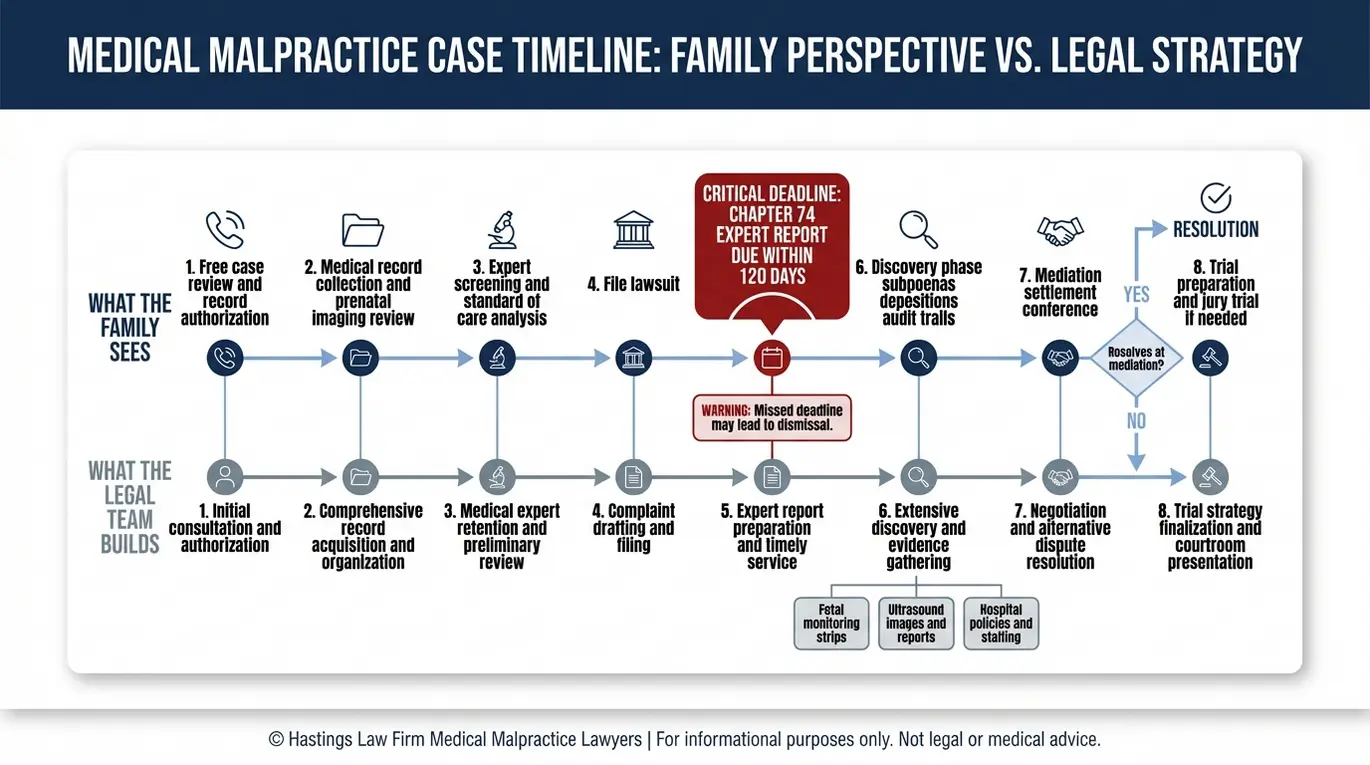
Texas claims are governed by Chapter 74 of the Texas Civil Practice and Remedies Code, which imposes strict deadlines and requires an expert medical report to be served within 120 days of filing the lawsuit. This framework applies to all medical malpractice cases filed in Texas, including those involving missed vasa previa diagnoses.
Here is how the process generally unfolds:
Step 1: Case Evaluation and Filing. The process begins with a thorough review of the medical records by our legal and medical team. If we determine that the evidence supports a claim, we file a lawsuit on behalf of the family. From the date of filing, a critical clock starts.
Step 2: The 120-Day Expert Report. Within 120 days of filing, the claimant must serve a written report from a qualified medical expert. This report must identify the standard of care, explain how the provider breached that standard, and describe the causal connection to the injury. If this expert medical report is not served on time, the court can dismiss the case entirely. This is why families should work with a Texas medical malpractice attorney who understands the process from day one.
Step 3: Discovery. After the expert report is accepted, both sides exchange evidence. During discovery, we obtain internal hospital records, email communications, audit trails, imaging studies, and deposition testimony from the staff involved. This phase often reveals details that were not apparent from the medical chart alone.
Step 4: Mediation. Texas courts typically require mediation before a case goes to trial. Mediation is a structured settlement conference helped by a neutral third party. We approach mediation with the same preparation we bring to trial to ensure a firm negotiation posture.
Step 5: Trial. If mediation does not result in an acceptable resolution, the case proceeds to a jury trial. Our firm prepares every case with this possibility in mind from the beginning, building the evidence and retaining experts. We develop a clear narrative that explains the medicine in terms a jury can understand.
Contact the Texas Birth Injury Attorneys at Hastings Law Firm Today for Help
Losing a child or watching your baby suffer from a preventable injury is something no family should have to endure. If you believe your doctor failed to screen for or diagnose vasa previa during your pregnancy, our team is here to help you find answers.
At Hastings Law Firm, our mission is to restore trust for families who feel betrayed by the healthcare system. Our attorneys, nurse consultants, and patient advocates work together to investigate what happened and determine whether the care you received fell short of what you and your baby deserved.
Time matters. Texas law places strict limits on when a claim can be filed, so the sooner you reach out, the more effectively we can protect your rights. To contact a Texas vasa previa lawyer, call our office or request a free, confidential case evaluation. You pay no fees or costs unless we secure a recovery on your behalf.
Frequently Asked Questions About Vasa Previa Diagnosis Failure in Texas


This content was researched and written by the Hastings Law Firm editorial team, which includes attorneys, medical professionals, and experienced researchers. Our writing is informed by internal knowledge and practical experience, and we cross-check critical details against authoritative sources cited throughout. Every piece undergoes human-led fact-checking and legal review. Because legal and medical information can change, if you spot an error, please contact us. Learn more about our content standards and review process on our editorial policy page.

Tommy Hastings, founder of Hastings Law Firm, is a board-certified personal injury trial lawyer dedicated exclusively to healthcare injury cases. Since 2001, he has represented injured patients and families in litigation against major hospital systems, pharmaceutical companies, and negligent healthcare providers nationwide. He has handled numerous high-profile cases that have drawn national media attention and resulted in multi-million dollar recoveries. He draws on that experience in his writing, helping readers understand how these cases work and what options may be available to them.
